Is Options Selling Right for You? A Complete Self-Assessment Guide
Options selling isn't right for everyone. This guide evaluates personality traits, capital requirements, time commitment, and risk tolerance to help you decide whether you're built for the long game as an options seller.
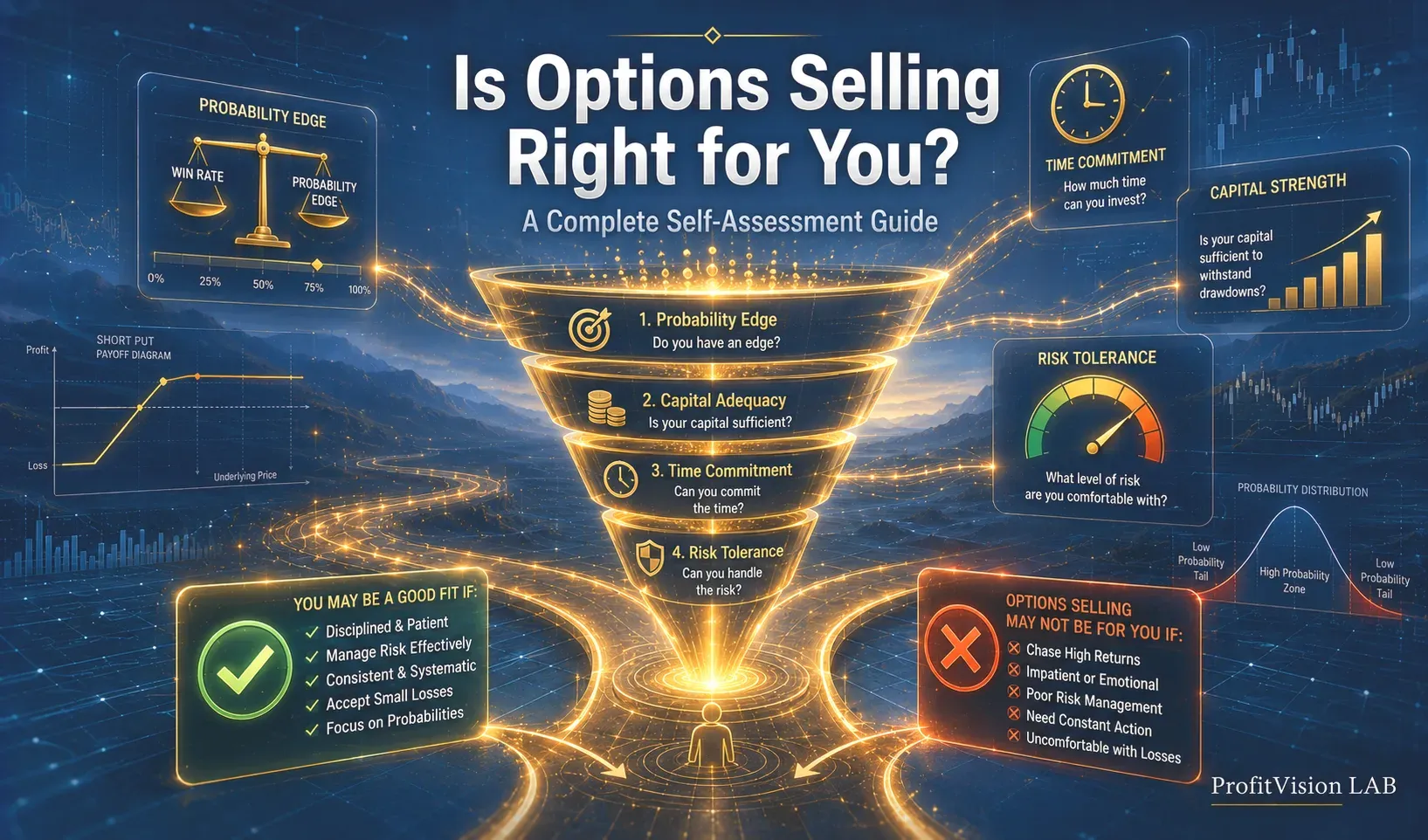
Options selling isn't the right strategy for everyone. This guide evaluates four dimensions — personality traits, capital requirements, time commitment, and risk tolerance — to help you determine whether you're built for the long game as an options seller.
1. The Core Structural Advantages of Options Selling
The options seller's business model is essentially that of an insurance company — you collect premiums, absorb bounded risk, and profit as time decay (Theta) erodes the contract to zero. Compared to options buyers, sellers enjoy three structural advantages that compound over time:
① Probability Edge: A sold option with Delta 0.2 means the buyer has an 80% chance of expiring worthless — the seller wins. Time value (Theta) works for you every single day, even when the underlying sits still. You don't need to be right about direction; you need to avoid being catastrophically wrong.
② Implied Volatility Premium (IV Premium): The market's pricing of future uncertainty (implied volatility) is systematically higher than the volatility that actually materializes (historical volatility). This persistent gap is the structural source of long-term excess returns for options sellers — not luck, but a well-documented market inefficiency.
③ Quantifiable Maximum Loss: Through spread structures (Bull Put Spread, Bear Call Spread), options sellers can calculate maximum possible loss to the penny before entering any trade. Risk management becomes fully executable — no estimation, no surprises.
2. Who Is — and Isn't — Cut Out for Options Selling
✅ Traits That Suit Options Sellers
- Prefers "winning often in small amounts" over "winning big once"
- Can tolerate open paper losses without panicking
- Values capital preservation over chasing maximum return
- Willing to research fundamentals and select high-quality underlying stocks
- Can execute a rules-based SOP mechanically, without emotional override
- Motivated by passive income / cash flow more than capital appreciation
- Accepts stop-losses as normal system operation, not personal failure
❌ Traits That Work Against Options Sellers
- Needs a clear directional conviction before feeling comfortable in a trade
- Cannot tolerate seeing unrealized losses after entry
- Expects options to quickly double or triple account size
- Unwilling to do deep fundamental research on individual stocks
- Prone to letting fear or greed override systematic decision-making
- Has no defined stop-loss discipline; defaults to "waiting for recovery"
- Available risk capital is below $5,000 USD
3. Options Seller vs. Buyer: An 8-Dimension Comparison
| Dimension | Options Seller | Options Buyer |
|---|---|---|
| How time affects your position | ✅ Theta decay works for you every day | ❌ Theta decay erodes your position daily |
| Long-term win rate | 60–80% (depends on Delta selection) | 20–40% (direction + timing + magnitude must all be correct) |
| Maximum gain per trade | Capped (the premium collected) | Theoretically unlimited |
| Maximum loss per trade | Bounded (defined with spread structures) | Limited to the premium paid |
| Ideal market conditions | Sideways / slow grind up or down | Sharp moves / ahead of major catalysts |
| Prediction required | "It probably won't drop too much" — probability judgment | "It will reach X by date Y" — precise directional prediction |
| Capital requirements | Higher (margin required) | Lower (risk limited to premium paid) |
| Suited for systematic long-term operation | ✅ Highly suitable | Difficult (requires consistently accurate forecasting) |
4. Before You Start: Four Non-Negotiable Prerequisites
Prerequisite 1: Account Size ≥ $10,000 USD
While technically possible to start with $5,000, you need $10,000+ to run 3–5 concurrent positions and let PVL's 5% Risk Unit (RU) position sizing actually deliver diversification. Under-capitalized accounts mean each trade represents too large a fraction — one bad week can inflict serious damage before the system's statistical edge has time to work.
Prerequisite 2: Options Trading Authorization at Level 2 or Higher
Brokers like Interactive Brokers (IBKR) require a separate application for options trading access. Level 2 covers buying and selling covered options (Covered Call, Cash-Secured Put). Level 3 unlocks spreads (Bull Put Spread, Bear Call Spread). The spread-based defined-risk approach central to PVL's system requires Level 3. See the Options Seller Philosophy article for a full walkthrough of the account setup process.
Prerequisite 3: 3–5 Hours Per Week for Research
Options selling is not a fully passive strategy. Weekly commitments include: reviewing open positions (Roll decisions, stop-loss checks), screening new candidates through the Four-Layer Defensive Screen, and monitoring market conditions (Distribution Day count). Think of it as running a small, systematic business — not "set it and forget it."
Prerequisite 4: Defined Stop-Loss Rules — Before You Place Your First Trade
You must decide your exit rules before opening any position. ProfitVision LAB's standard: exit when the position loses 2× the premium received (set a price alert immediately after entry). Having this rule in writing removes the emotional decision-making in the moment it matters most. See: Roll or Cut? The Complete Stop-Loss Decision Framework.
- Three structural advantages of options selling: probability edge, Theta decay, and IV Premium
- Seven traits that favor sellers vs. seven traits that work against them
- Eight-dimension buyer vs. seller comparison — find where you fit
- Four prerequisites before placing your first trade — all non-negotiable
📚 Further Reading
- Why I Chose the Options Sell Side: Not a Technique, But a Lifelong Path
- The Options Seller's Four-Filter System: A Systematic Approach from Stock Screening to Entry
- Roll or Cut? The Options Seller's Complete Stop-Loss Decision Framework
- Options Market Reality Check: What the Statistics Actually Tell You