Your First Bull Put Spread on IBKR: From Level 3 Permissions to Position Exit
Bull Put Spread is the ideal first strategy for options sellers: maximum loss is locked in before entry, margin requirements are low, and the logic is clean. This guide walks through every step on IBKR — from applying for Level 3 permissions to placing a Combo order and setting your 50% profit exit.
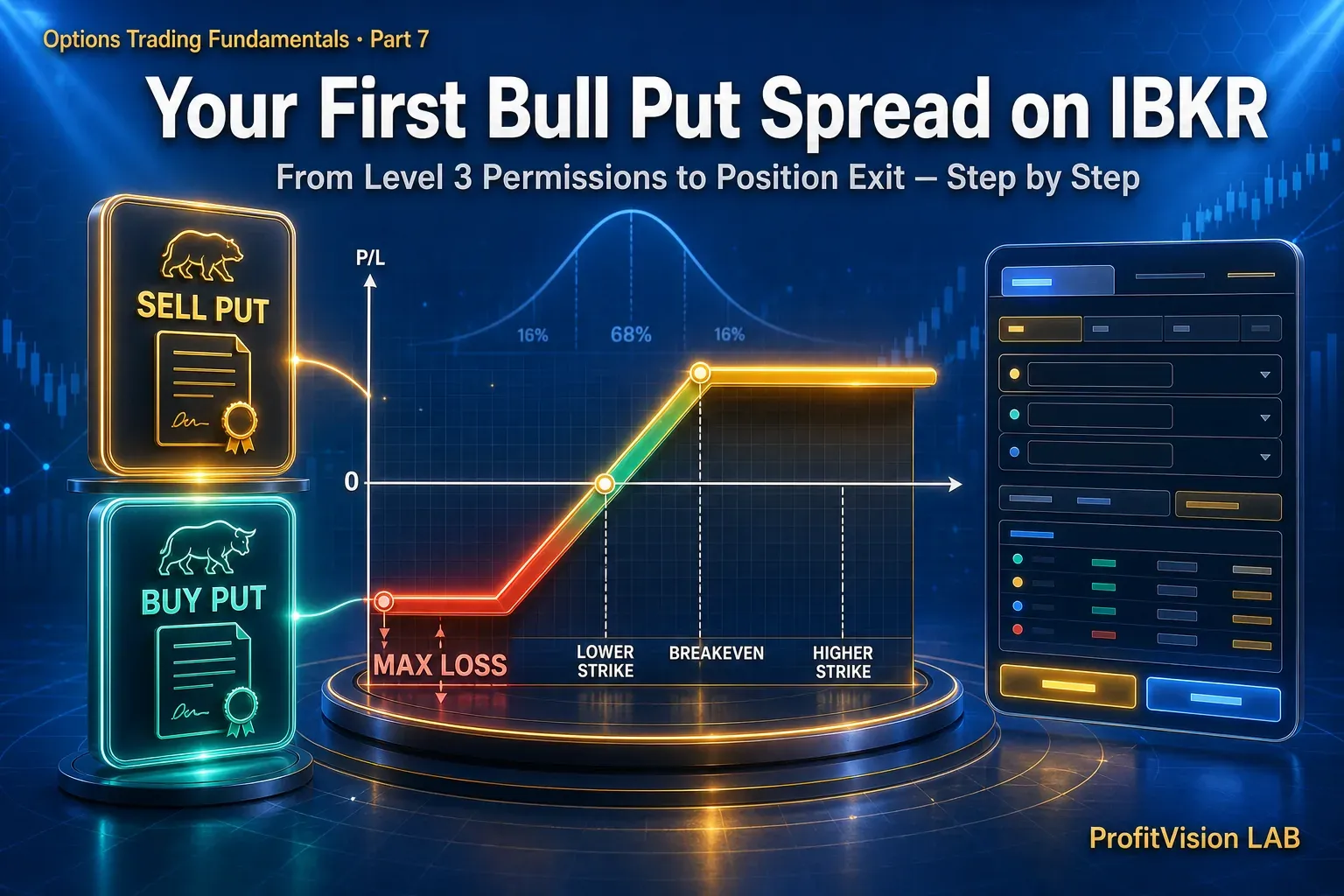
- The Bull Put Spread is the most beginner-friendly options-seller strategy: maximum loss is fully defined before entry, margin requirements are modest, and the logic is straightforward.
- Executing a Bull Put Spread on IBKR requires Options Level 3 permissions (spread trading requires this tier).
- New traders must first practice on a paper trading account for 2–3 months — confirm you understand both the strategy logic and your own emotional responses before committing real capital.
- This article walks through every step: what a Bull Put Spread is → how to apply for IBKR permissions → how to select contracts → how to place the order → and how to manage the position to exit.
Why Choose a Bull Put Spread Instead of Selling a Naked Put?
In earlier articles we covered the logic behind selling puts, but selling a naked put carries one critical problem for beginners: your maximum loss can exceed expectations.
If you sell one AAPL $180 Naked Put, the margin requirement may reach $4,000–$6,000 (the broker requires you to hold enough capital to take assignment), and in theory your losses grow the further the stock falls — with no floor.
The Bull Put Spread solves this problem:
Two simultaneous actions: sell a higher-strike Put (collect premium) + buy a lower-strike Put (pay premium for protection). The net result is a credit — your maximum profit — while the difference between the two strike prices minus that net credit becomes your maximum loss.
Sell the higher-strike Put
Collect premium
This is your primary strategy leg
Buy the lower-strike Put
Pay a smaller premium
This is your protection leg (caps maximum loss)
The key point: your maximum loss is $360, and you know that figure exactly before you enter — it cannot grow beyond it. A $5 spread width is the ideal starting point for beginners: the tuition is controlled, yet the trade is real enough to teach you how the strategy behaves. This is the defining advantage of a Bull Put Spread — downside risk is defined, so you learn within a known boundary.
Phase 1: IBKR Account Setup and Options Permissions
Go to interactivebrokers.com and select "Individual Account." Taiwan residents should choose IBKR LLC (the U.S. entity). Documents required:
- Passport or national ID
- Proof of residential address (utility bill or bank statement within the past three months)
- Tax identification number (Taiwan residents use their national ID number)
In the IBKR web portal, navigate to: Account Management → Trading Permissions → Options, and apply for Level 3 (which enables spread trading). IBKR will ask about your options trading experience — answer honestly:
- Level 1: Buy calls and buy puts only
- Level 2: Sell covered calls and cash-secured puts
- Level 3: Execute spread strategies (Bull Put Spread requires this level) ⭐
IBKR offers a free paper trading account that runs in sync with live markets. To activate it: IBKR Portal → Paper Trader Account → Enable.
Recommended: practice for 2–3 months and complete at least 5–10 simulated trades. Focus on observing:
- Your psychological response when the position shows an unrealized loss
- Whether you can mechanically execute the 50% profit-taking / 2× stop-loss rules
- Whether you can resist the impulse to "just wait a little longer"
- Essential for single-stock options: let at least one position run through an earnings event — observe the full cycle of IV expanding into earnings and then collapsing afterward (IV Crush). This experience cannot be learned from a textbook.
Phase 2: Selecting the Underlying and the Contracts
For Bull Put Spread underlying selection, use PVL's Four-Filter System:
- Filter 1 — Sponsorship: PVL A/D Rating ≥ C (institutional buying continues; not distribution)
- Filter 2 — Moat: ROE ≥ 17%, EPS YoY growth > 25% (financially sound fundamentals)
- Filter 3 — Volatility: IV Rank in the 30–80% sweet zone (premium is rich but risk is reasonable)
- Filter 4 — Technicals: Stock price holding above its 50-day moving average (intermediate uptrend intact; never sell puts into a downtrend)
Options on SPY (S&P 500) and QQQ (Nasdaq 100) offer the following advantages:
- No single-stock black-swan risk — naturally diversified
- No earnings events — no IV Crush risk; the volatility curve is more predictable
- Best liquidity in the entire market; extremely tight Bid/Ask spreads and minimal slippage
- Weekly expiration options (Weekly Options) available — maximum DTE flexibility
- IV closely tracks VIX — learn to use VIX as an entry timing tool
- Ideal for building the muscle memory of "pure system execution" without stock-selection noise
Open the underlying's Options Chain in IBKR TWS:
- Expiration date: Select the expiration tab at 30–45 DTE
- Short Put strike price: Find an OTM Put near Delta -0.25 (approximately 8–12% below the current stock price)
- Long Put strike price: Choose one strike below the short put leg (typically $5 or $10 lower)
- Confirm liquidity: Both strikes should have OI ≥ 500 and a reasonable Bid/Ask spread
Phase 3: Placing the Order in IBKR TWS
A Bull Put Spread is entered in IBKR as a Combo Order — both legs execute simultaneously, eliminating the risk of one leg filling while the other does not:
- Search for the underlying in TWS and open the Options Chain
- Locate the short put strike price, right-click → "Sell"
- In the same expiration, locate the long put strike price, right-click → "Buy"
- TWS will automatically recognize this as a spread combination and display the combined Net Credit
- Set the order type to Limit Order — price it near the midpoint of the Bid/Ask
- Confirm the Net Credit is positive (you are collecting premium, not paying it)
Phase 4: Managing the Position to Exit
Immediately after entry, set two exit conditions in TWS (using Conditional Orders or Alerts):
| Exit Condition | Trigger | Action |
|---|---|---|
| Profit Target | Spread value decays to 50%–55% of the original premium (e.g., collected $1.40; buy back at $0.63–$0.77) | Buy to close — do not wait for expiration |
| Stop Loss | Spread value exceeds 2× the original premium (e.g., collected $1.40; cost to buy back is now $2.80 or more) | Buy to close immediately — take the loss |
This is not a "set it and forget it" strategy. Spend at least 30 minutes each week reviewing:
- Is the stock still trading above its 50 MA? (If it breaks below, evaluate whether to exit early)
- How many days until the next earnings report? (If earnings fall within the holding period, consider closing early)
- Has the unrealized P&L reached the stop-loss threshold?
- If the 50% profit target has been reached — close the position immediately, without hesitation
You Have Completed the Entire Beginner Learning Path
From "what are options," through the four roles, core terminology, reading an Options Chain, the Greeks, and why to stand on the seller's side — all the way to this article on your first Bull Put Spread. You have now built the complete knowledge foundation required to operate as a systematic options seller.
The next step is a deeper dive into the Four-Filter screening system, rolling strategies, and stop-loss logic — the progression from "knowing how to trade" to "trading with a system."
Core philosophy: "I teach you how to think, not just what to do."
Disclaimer: All content in this article is for research and educational purposes only and does not constitute investment advice. Any stocks, ETFs, or operational procedures mentioned are used solely to illustrate the concepts discussed and do not represent buy or sell recommendations. Options trading involves substantial risk. Selling strategies can result in significant losses exceeding premiums received under certain market conditions. Investors should assess their own risk tolerance and make independent investment decisions accordingly.