Delta, Theta, IV & Gamma: The Options Greeks Every Seller Needs to Know
Four Greek letters determine the behavior of every options position: Delta selects your strike, Theta earns you daily income, IV Rank times your entry, and Gamma signals when to exit. This guide explains each one through the lens of the options seller — concise, precise, and immediately actionable.
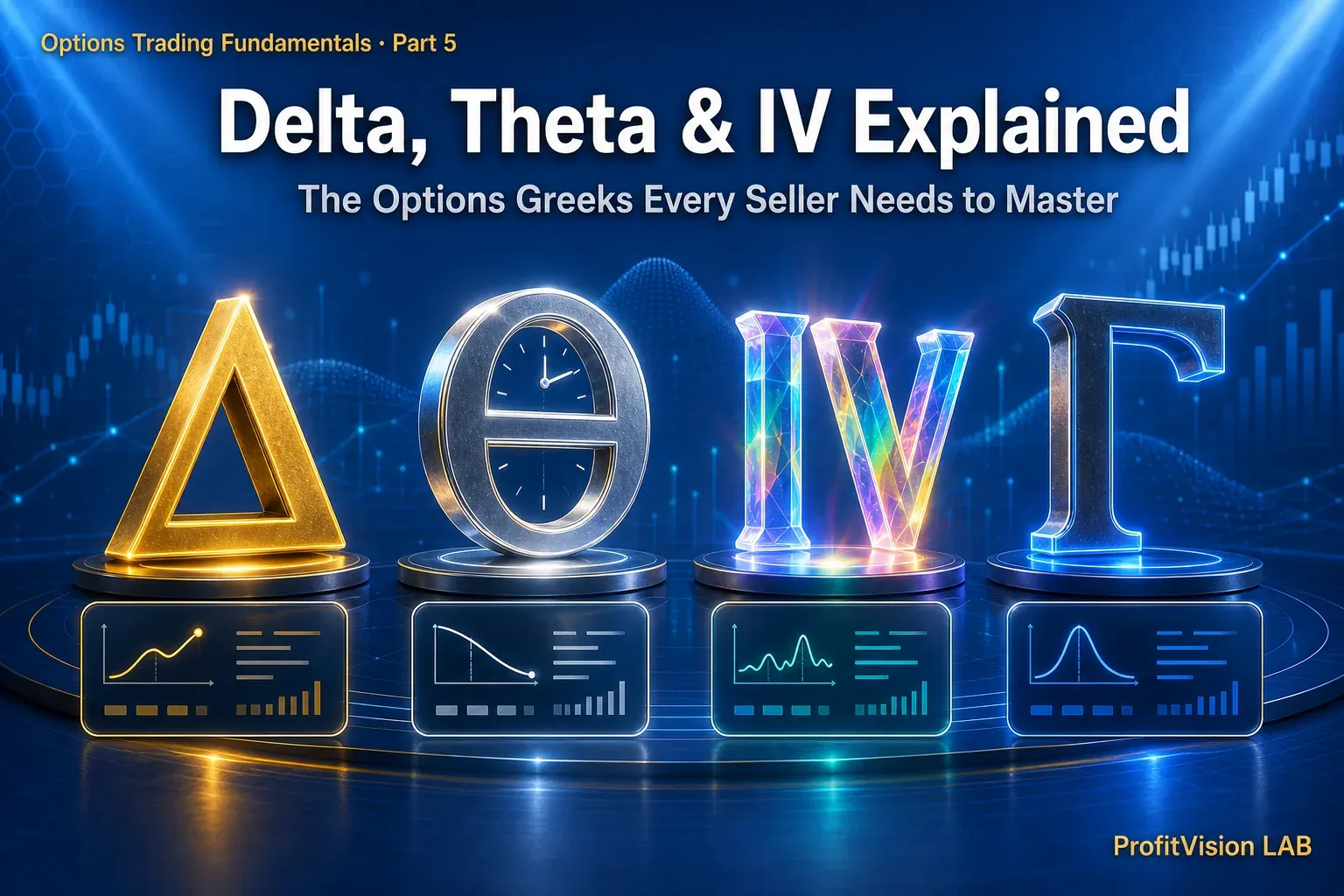
- Options Greeks are metrics that quantify how an option's price responds to various market forces. As a beginner, focus on just three: Delta, Theta, and IV
- Delta serves a dual purpose — ① how much the option moves for every $1 move in the stock, and ② an approximate probability that the option will be in the money at expiration (sellers use it to select strike prices)
- Theta is the daily time value decay — the options seller's "passive daily income." Every calendar day, the contract automatically loses Theta in value, regardless of what the stock does
- IV (Implied Volatility) reflects the market's expectation of future price swings and determines whether premium is expensive or cheap — high IV means richer premium when you sell, but always confirm it isn't driven by a genuine fundamental threat
🤔 Why Do Beginners Need to Understand the Greeks?
Options pricing is far less intuitive than stocks. If a stock rises $5, your position gains $5. But an option's price is simultaneously driven by at least four factors: stock price movement, the passage of time, shifts in expected volatility, and distance to expiration.
The Greeks are a set of metrics designed to quantify each of these influences individually. You don't need to understand the underlying math — but you do need to understand what each Greek means for your position.
For options sellers, the three that matter most are: Delta (strike selection), Theta (time works for you), and IV (entry timing). Gamma is also covered here, but for now the one critical thing to know is that it accelerates sharply near expiration — making it the primary risk sellers must watch.
① Δ Delta — Directional Sensitivity × Probability Proxy
Delta carries two practical meanings you need to internalize:
- Meaning 1 (Sensitivity): A Put with Delta -0.25 gains $0.25 per share (or $25 per contract) when the stock falls $1. Conversely, if the stock rises $1, the Put loses $0.25.
- Meaning 2 (Probability Proxy): The absolute value of Delta approximates the probability that the option will be in the money at expiration. A Delta -0.25 Put has roughly a 25% chance of being breached at expiry — meaning the seller holds a ~75% win rate.
Highly dangerous
Highest premium
Seller entry zone
PVL sweet spot
② Θ Theta — The Seller's "Daily Passive Income"
Theta is the options seller's most reliable ally. Every day that passes — regardless of what the stock does — the contract's time value erodes by the Theta amount. That money effectively transfers from the buyer's pocket to the seller's.
Theta decay is not linear: it accelerates as expiration approaches. This means the final few weeks before expiry are when time erosion is fastest, working hardest in the seller's favor — but it also means Gamma risk is spiking simultaneously (see next section).
③ 📊 IV (Implied Volatility) — The Premium Pricing Engine
IV does not measure past volatility — it measures the market's forward-looking expectation of volatility. When the market is nervous about something (earnings, litigation, macro risk), IV expands and premium rises — because everyone is competing to buy protection.
IV Rank is the more actionable metric: it measures where current IV sits relative to its own range over the past year. IV Rank of 80% means current IV is higher than it has been 80% of the past year — indicating premium is expensive and conditions are favorable for selling (provided the elevated IV isn't driven by a genuine crisis).
PVL core operating zone
④ Γ Gamma — The Seller's Risk Accelerator
Beginners don't need to go deep on Gamma math, but there is one thing you must remember: Gamma surges exponentially as expiration approaches. An ATM option with 5 days to expiry can have 5–10x the Gamma impact on your P&L compared to the same option with 40 days left.
This is precisely why PVL uses the "50% profit close" rule rather than holding to expiry. In the final days before expiration, Gamma is so elevated that any stock movement causes violent swings in your P&L — while the remaining premium is minimal. Continuing to hold is accepting disproportionate risk for a shrinking reward.
📋 The Four Greeks at a Glance
| Greek | What It Measures | How Sellers Use It |
|---|---|---|
| Δ Delta | P&L sensitivity per $1 stock move ÷ probability of strike being breached | Select OTM Puts with Delta -0.20 to -0.30 (70–80% win rate) |
| Θ Theta | Daily automatic time value erosion | Collect daily decay; close at 50% profit to maximize capital efficiency |
| IV | Market's expectation of future volatility; determines whether premium is expensive or cheap | Enter when IV Rank is 30–80%; elevated IV = richer premium collected |
| Γ Gamma | Rate of change in Delta; explodes near expiration | Never hold to the last few days; exit at 20 DTE or 50% profit to avoid Gamma exposure |
Core philosophy: "I teach you how to think, not just what to do."
Disclaimer: All content in this article is intended solely for research and educational purposes and does not constitute investment advice. Options trading involves substantial risk. Investors should assess their own risk tolerance and make independent decisions accordingly.
© 2026 ProfitVision LAB · Shiba the Disciplined · I teach you how to think, not just what to do