Why I Sell Options Instead of Buying Them: Probability, Theta & IV Premium
Over 70% of options expire worthless — the market structurally favors sellers via three edges: probability, daily Theta decay, and the IV premium in every contract. This article explains why selling beats buying on a statistical level, and what that means for your trading system.
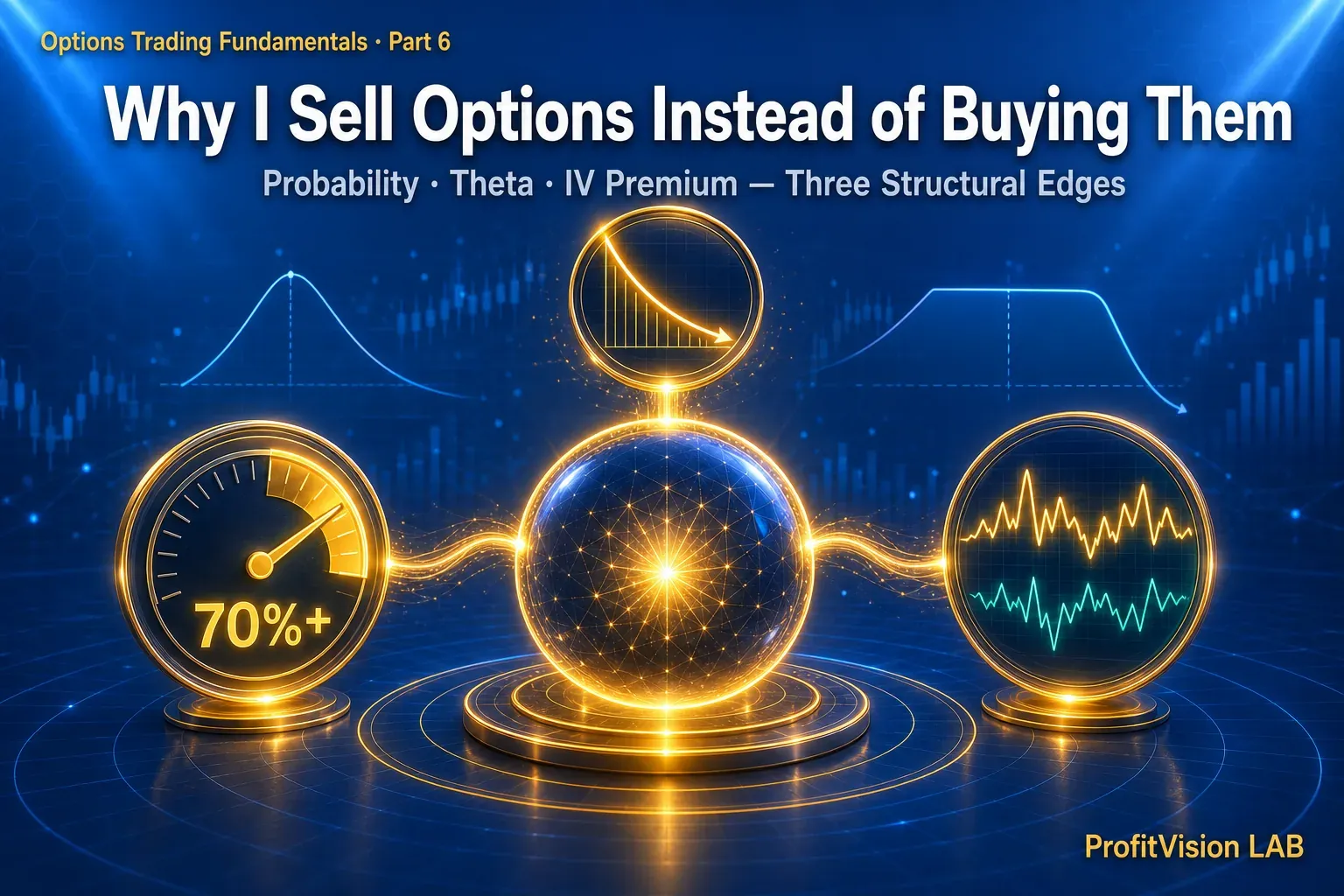
- The options seller has three structural edges built into the market: probability advantage (most contracts expire worthless), Theta advantage (time works for you every day), and IV premium (premiums systematically overestimate actual volatility)
- According to CBOE historical data, over 70% of U.S. equity options expire worthless — the seller is the "insurance company" the majority of the time
- The seller's edge does not come from predictive ability — it comes from a system that lets probability and time work in your favor. This is fundamentally different from the buyer, who must correctly predict direction, timing, and magnitude all at once
- Selling options is not "easy money" — it is "trading discipline for structural advantage." Black swan events still exist, and a robust risk management system is non-negotiable
A Counterintuitive Question: Why Sell Instead of Buy?
Most people's first instinct when they discover options is to "buy a Call" or "buy a Put" — get the direction right and score big. That reaction is completely understandable. Humans are hardwired to love bets that pay off massively when you're right.
But let me ask you something: If you knew that the casino wins in the long run, would you choose to be the gambler, or the house?
This isn't just a metaphor. The options market has a structural feature that tilts the playing field toward the seller — much like the house edge in a casino. Not because sellers are smarter, but because the market's design puts time and probability on the seller's side.
Edge #1: Probability Structure — Most Contracts Expire Worthless
worthless at expiration
(CBOE historical data)
expires OTM (untouched)
(the seller's win rate)
When you sell a Delta -0.20 OTM Put, the market's pricing is telling you this: there is an 80% probability that this contract will be worthless at expiration, and the seller keeps the entire premium. Only in 20% of cases does the buyer's directional bet pay off.
For the buyer to win, three conditions must be met simultaneously: correct direction + correct timing + sufficient magnitude. For the seller to win, only one condition needs to hold: the stock doesn't drop that far. Statistically, the latter is far more likely than the former.
Edge #2: Theta — Time Automatically Works for You Every Day
Every single day — regardless of whether the stock goes up or down — the time value embedded in an option erodes. For the buyer, this is a cost that must be absorbed daily. For the seller, it is passive income that accrues automatically.
- Time is the enemy
- Premium "burns" every day
- Needs the stock to move fast enough and far enough before expiration
- The longer it takes, the lower the odds
- Time is a friend
- Time value "deposits" every day
- Only needs the stock to avoid extreme moves
- The longer it holds, the more accumulates
The real significance of this edge: the seller does not need to predict direction with precision. All that's needed is for the stock to avoid an extreme move within a reasonable timeframe — which is statistically far easier than guessing the right direction at the right moment.
Edge #3: IV Premium — Premiums Systematically Overestimate Actual Volatility
Options premium (IV) measures the market's expectation of future volatility — not the volatility that will actually occur. A phenomenon repeatedly confirmed by academic research is this:
Implied Volatility (IV) is systematically and persistently higher than the Realized Volatility (RV) that actually materializes.
In other words, the market habitually overestimates future volatility. During uncertain periods, investors tend to overbuy protection, driving premiums above fair value. Options sellers are continuously harvesting this structural mispricing.
The structural excess return formed by IV persistently > RV
One of the primary sources of long-term alpha for options sellers
This doesn't mean premiums are always rich enough. When IV is depressed (IV Rank < 30%), premiums no longer adequately compensate for the risk, and entering a short volatility trade is not worthwhile. This is precisely why PVL requires an IV Rank between 30–80% — the "sweet spot" — before initiating a position.
Being Honest About the Seller's Limitations
Black swan events are real: Market crashes of 20–30% do happen — March 2020 and the entire year of 2022 are living proof. During these periods, sellers can suffer losses that far exceed the premium collected. This is not theoretical risk; it has actually occurred.
Consecutive headwinds test your discipline: When the market grinds lower and IV keeps spiking, every new position faces heightened uncertainty. During these stretches, the right move is to shrink position size — or pause entirely — and wait for trend confirmation before re-engaging.
The seller's edge only activates through a system: The probability advantage manifests over a sufficiently large sample of trades. A single trade can go against you; after 20–30 trades, the statistical law of large numbers begins to speak on your behalf. This requires both discipline and sustained capital durability.
Core philosophy: "I teach you how to think, not just what to do."
Disclaimer: All content in this article is intended for research and educational purposes only and does not constitute investment advice. Options trading involves substantial risk. Selling options strategies can result in losses that significantly exceed the premium collected under certain market conditions. Investors should assess their own risk tolerance and make independent decisions accordingly.
© 2026 ProfitVision LAB · Shiba the Disciplined · I teach you how to think, not just what to do