Why I Chose the Options Sell Side: A Lifetime Framework, Not a Technique
The options seller doesn't predict markets — they price and manage uncertainty. A guide to the sell-side philosophy: probability edge, Theta psychology, mark-to-market vs. margin discipline, black swan protocol, and the pre-trade checklist. A lifetime framework, not a technique.
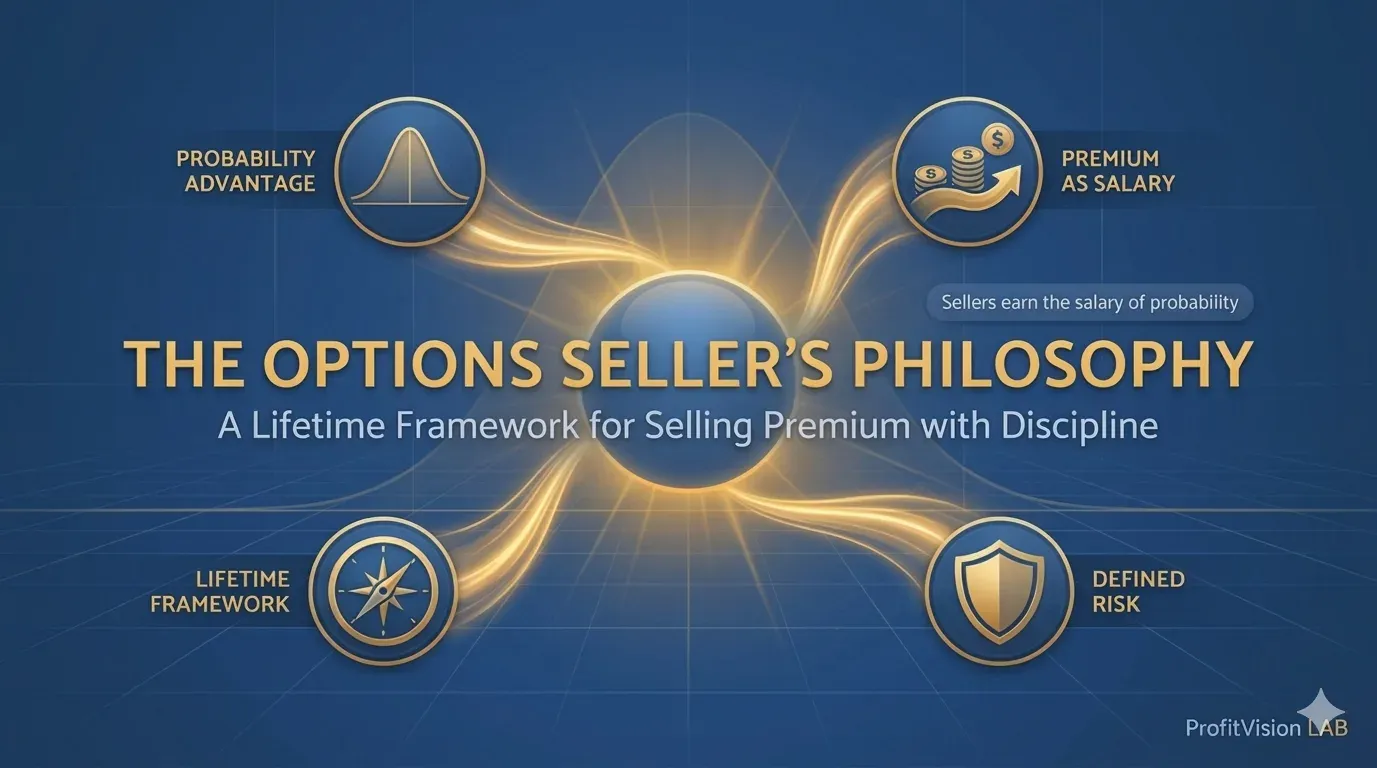
The options sell side doesn't predict markets — it prices and manages uncertainty. This isn't a technique. It's a philosophy you can sustain for a lifetime.
The Options Seller's Philosophy is a trading worldview centered on probability management rather than direction prediction. The options seller writes contracts and collects premium, assuming the risk the buyer refuses to hold — functioning as the market's insurance company. The seller's edge doesn't come from predicting moves; it comes from three structural forces: the daily erosion of time value (Theta), the long-run tendency of implied volatility (IV) to overstate realized volatility, and the systematic discipline of executing stops before emotion intervenes. This is not a technique to master and discard — it is a durable framework for operating in markets for decades.
- Options sellers earn the "salary of probability" — the edge comes from Theta decay and IV's statistical tendency to overprice actual realized volatility, not from predicting direction.
- Buyers predict direction. Sellers manage the worst case. A seller's position is defined before entry: "If I'm wrong, here is exactly how much I will lose and when I will close."
- Mark-to-market P&L is noise for sellers. The real signal is margin health and liquidity — a seller's only job is to survive long enough for probability to play out.
- When a black swan arrives, the mature seller executes four actions only: stop adding, execute the stop, exit the position, wait for order to return. No heroics. No averaging down.
- This is a framework for life because its core skill — managing risk under uncertainty rather than predicting an unknowable future — retains value across every market regime.
I. I Didn't Start Out Wanting to Be on the Sell Side
If you've ever explored options, you know how it looks from the outside: high win rates, monthly premium income, more "stable" than stock trading. It seems like a smarter position — stand on the probability side, collect time decay.
But after actually doing it, I discovered something that changed my entire framework:
Sellers aren't smarter. They're people who chose to confront uncertainty earlier than everyone else.
Buyers hurt when they're wrong about direction. Sellers hurt differently: you know the loss could be large, you stand there anyway — because you trust your ability to manage risk more than your ability to predict direction. That's a fundamentally different mindset.
II. Buyers Predict Direction. Sellers Manage Risk.
Every day, a serious seller asks three questions that have almost nothing to do with technical indicators:
- If the market moves against me, will I survive?
- If a black swan hits, can I stay solvent?
- Can I reach expiration without a margin call forcing me out?
These three questions determine whether you'll still be in the market in ten years. They have nothing to do with whether you can predict next week's price action.
III. Premium Is Not Rent — It's Risk Insurance
This took me the longest to truly understand, and it's the single most important cognitive divide between mature sellers and beginners.
If you think of premium as "rent," you'll naturally start optimizing for higher rental income: raise your delta, sell shorter expirations, ignore tail risk, tell yourself it "probably won't happen." The market is not your tenant — it's your counterparty.
Premium is the market paying you to absorb the uncertainty it doesn't want to carry. How much it pays reflects exactly how large that uncertainty is.
The most accurate mental model for the options seller is not a landlord — it's an insurance company.
| Dimension | Insurance Company | Options Seller |
|---|---|---|
| Revenue source | Premiums | Option premium collected |
| Core assumption | Claims will happen; question is frequency and scale | Losses will occur; question is magnitude and survivability |
| Biggest fear | Single catastrophic payout (earthquake, hurricane) | Single black swan causing unlimited loss |
| Competitive edge | Actuarial accuracy, diversified risk pool, capital reserves | Risk precision, position diversification, margin buffer |
| Definition of success | Long-run: premiums collected > total claims paid | Long-run: premiums collected > total losses absorbed |
No insurance company aims to never have a claim. They assume claims will happen — the question is whether the frequency is manageable and whether any single payout is fatal.
The same applies to the mature options seller. Assignment, being called away, even an individual loss — all of these are pre-built into the risk assumption before the trade is placed. What matters isn't "will I lose?" but "can I afford it, sustain it, and reach expiration?"
When market fear spikes and IV surges, that's not a threat to a prepared seller. It's a richer "insurance market." But the prerequisite never changes: survival first.
IV. Mark-to-Market P&L Is Noise. Margin Is Signal.
This is deeply counterintuitive, but it's the core of the seller's psychology.
Buyers obsessively track daily P&L — green or red, up or down. For sellers, intraday mark-to-market is almost entirely emotional noise.
Mark-to-market P&L = emotional test
Margin balance = survival test
As long as margin remains healthy, time is working for you. Every day that passes, time value bleeds from buyer to seller. The trade doesn't need to be right — it needs to survive to expiration.
The three things a seller should monitor every day:
- Margin utilization — Is there adequate buffer for further moves?
- Maximum possible loss — If the worst-case scenario hits, can I hold?
- Days to expiration — How much theta is still working in my favor?
V. Puts and Calls: You Pre-Choose the Outcome
Once you're genuinely standing on the sell side, the entire framework simplifies. Every position is a pre-selected outcome you've agreed to accept.
| Strategy | Expiration Scenario | Result | Is this a failure? |
|---|---|---|---|
| Short Put | Stock stays above strike | Keep 100% of premium; contract expires | ✅ Perfect outcome |
| Short Put | Stock drops below strike; assigned | Buy shares at a net cost below market (strike minus premium) | ✅ Still a good outcome |
| Covered Call | Stock stays below strike | Keep 100% of premium; continue holding shares | ✅ Perfect outcome |
| Covered Call | Stock rises above strike; shares called away | Profit on shares from cost basis to strike, plus all premium collected | ✅ Still a good outcome |
Sellers don't gamble on outcomes. They select, in advance, which outcomes they're willing to accept — then get paid to wait for one of them to happen.
VI. Why Getting Called Away Is Actually the Perfect Ending
The psychological sticking point for most sellers is having shares called away. "The stock kept going up and I missed it." This thought lives inside a buyer's mental framework — and it's the wrong lens.
When you sold the covered call, you made three explicit, pre-committed choices:
- I accept a capped upside at the strike price
- In exchange for certain, immediate cash today (premium)
- I've sold the market the uncertainty above that strike
Being called away means the stock appreciated. You earned the full spread from your cost basis to the strike, plus every premium payment collected along the way. That's not missing out — that's your pre-defined complete exit.
Capital returns to cash. You run the cycle again. Clean, repeatable, scalable.
VII. What Actually Kills Options Sellers
Many traders assume sellers fear large drops. That's only the surface. The real existential threat is three things happening simultaneously:
All three simultaneously: that's a black swan. When it arrives, the mature seller's priority is not profit — it's survival.
VIII. The Black Swan Protocol: Four Actions Only
- Stop adding risk immediately — No new positions regardless of how compelling the thesis looks during the crisis
- Margin safety first — Reduce to below 50% margin utilization; proactively trim if necessary
- Cut the highest-risk positions — Not the largest losers, but the ones with the highest delta and greatest blowup potential
- Accept "ugly but alive" — Record the loss, preserve capital, earn it back in the next cycle
Survival is Alpha. In a market where others are being margin-called, standing intact is a structural advantage that compounds over time.
IX. The Mature Seller's Pre-Trade Checklist
The most dangerous seller isn't someone who doesn't understand strategy. It's someone who starts thinking: "I'm being conservative enough, right?" or "This probably won't happen to me."
Here are the questions I run before opening any new position:
- ✓ Is this stock's long-term trend intact? (MA50 / MA200 aligned correctly)
- ✓ If the stock drops another 20%, does my margin remain in safe territory?
- ✓ Can I psychologically and financially absorb the maximum loss on this position?
- ! What is the earnings date? (Avoid opening new seller positions within 2 weeks of earnings)
- ! Is IV Rank at a rational level? (Above 70 typically signals a major event — outside the Wheel's framework)
- ✕ If I feel "highly confident" about this trade — that's a warning sign. Mature sellers maintain permanent doubt as a feature, not a bug.
X. Why This Is a Framework for Life
I've asked many traders: "Will you still be trading the same way in ten years?" Short-term traders rarely have a satisfying answer. Short-term strategies demand acute reflexes, constant high attention, immediate reaction to real-time data — capabilities that decline with age.
The options seller framework demands fundamentally different things:
| Dimension | Short-Term Trading | Options Selling |
|---|---|---|
| Screen time required | High — hours daily | Low — weekly review sufficient |
| Core competency | Speed, prediction accuracy | Discipline, risk management, humility |
| Performance with age | Reaction speed declines → edge erodes | Judgment matures → risk management improves |
| Psychological load | High — daily wins and losses | Low — time is structurally on your side |
| Sustainability | Requires sustained peak focus | Can integrate with normal life rhythm |
A framework you can sustain for a lifetime must fit the life you're willing to live for a lifetime.
XI. I'm Not Trading. I'm Managing the Risk of Living.
The most important thing the options sell side gave me: I no longer need to prove myself every day.
Buyers must win daily — predict correctly, be smarter than the market, outperform moment to moment. Sellers only need to stay alive — let time do its work, let risk management do its work, let discipline do its work.
I chose the options sell side not because it's the most profitable path, but because it makes me quieter as I walk further into the market.
If there comes a day when I no longer want to prove myself, when I just want to walk steadily and live steadily — I'll still choose this side. This isn't a trading strategy. It's a philosophy for living alongside risk.
Not suited for: traders who need frequent large wins to stay motivated; anyone who interprets a stop-loss as a personal failure rather than a system execution; those prone to revenge trading after a losing position.
I teach you how to think, not just what to do.
Options Seller Philosophy × Deep Stock Research × Disciplined Trading Systems
profitvisionlab.com