10 Mistakes Every Options Seller Makes (And How to Fix Them)

Options sellers have a mathematical edge — but only for systematic, disciplined practitioners. These are the 10 most common mistakes that neutralize that edge, each with real scenarios and concrete fixes.
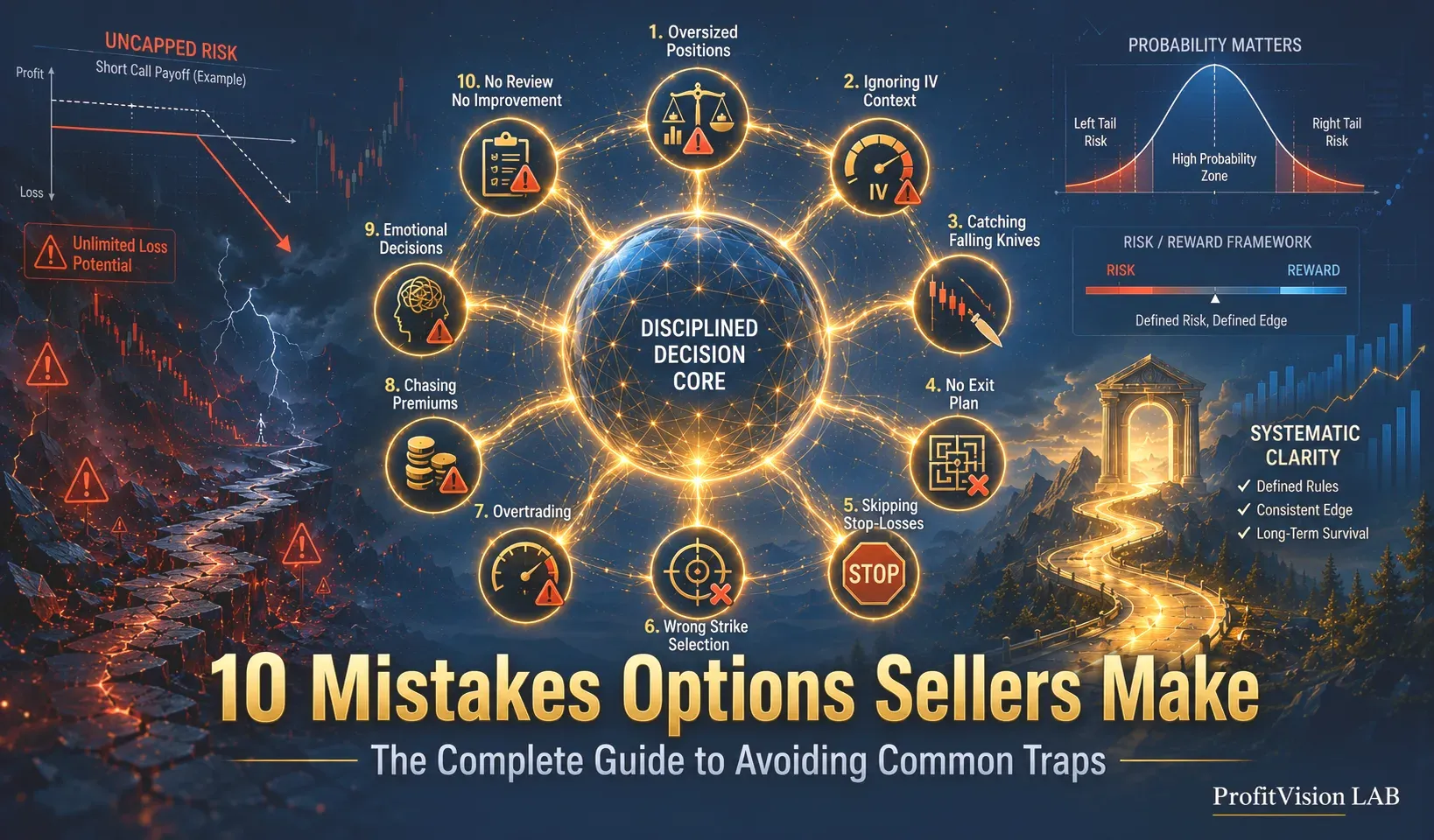
10 Mistakes Every Options Seller Makes (And How to Fix Them)

ProfitVision LAB · Options Selling Strategy · Beginner's Guide

📌 Core Conclusions
  • Options sellers have a mathematical edge — time value erodes daily, probability favors the seller. But this edge only works for systematic, disciplined practitioners. The mistakes beginners make are precisely the ones that neutralize this structural advantage.
  • The most dangerous mistake is #1 — believing options selling is a "sure thing." That cognitive error is the root cause of every other mistake on this list.
  • Every mistake below comes with a real-world scenario and the correct approach — so you can immediately check your habits against what you read here.
  • If you haven't started options selling yet, this is the best preventive medicine. If you've started but keep bleeding small losses, this article probably names your problem.

Why Do Options Selling Beginners Start Strong, Then Watch It Fall Apart?

Options selling has an addictive quality for newcomers: the first few trades almost always work. Premium collected, contract expires worthless, repeat. The "beginner's halo" can last months — then one outsized loss erases everything you earned, and then some.

This isn't a flaw in the strategy. It's because beginners spend those months doing one thing: repeating actions that feel effective, without first building the risk framework that makes those actions sustainable.

The 10 mistakes below aren't hypothetical. They are real loss patterns that recur again and again in real accounts. If you recognize yourself in this list, congratulations — you still have the chance to fix the system before it collapses.

The seller's edge is not automatic. It needs to be activated by the right system. A seller without a system is just gambling with worse odds.
MISTAKE 01
Believing Options Selling Is a "Sure Thing" — Underestimating Maximum Loss
The most dangerous cognitive error a seller can carry into their first trade
Fatal
Real Scenario "I sold a Put at the $100 strike, collected $2 in premium. As long as the stock stays above $100, I profit — feels solid." But if the stock drops to $70, your loss is $28 per share ($2,800 per contract) — 14× the premium collected.

The deepest psychological trap for sellers is that premium looks like "guaranteed income" while the loss looks like "something that probably won't happen." But options are structurally asymmetric: the buyer's maximum loss is the premium paid (finite), while a naked seller's maximum loss — in theory — is the stock going to zero.

This doesn't make selling a bad strategy. In the majority of outcomes, it works. But you must first genuinely internalize this: a single black swan event can wipe out six months of premium income and go beyond. Accepting that reality is the prerequisite for designing the right risk system.

The Correct Approach Before every entry, calculate: "What is the maximum loss on this trade? What percentage of my account does that represent?" If max loss exceeds 5% of the account, reduce position size or switch to a defined-risk spread structure (Bull Put Spread). Never press confirm without first knowing your worst-case number.
Principle: The seller wins on probability — but you must first ensure you can still play the game after the worst case happens.
MISTAKE 02
Oversizing Positions — Committing Too Much Capital to a Single Trade
Sellers most often blow up when they're right on direction but can't survive the drawdown
Fatal
Real Scenario Account is $10,000. Trader sells 3 contracts of Sell Put, each requiring $2,500 in margin — $7,500 total. During a temporary pullback, the position shows a $3,000 paper loss. Psychological pressure becomes unbearable; trader closes at the bottom and locks in the loss.

Oversizing is one of the most common beginner errors. When a single trade consumes a large portion of your account, any temporary adverse move creates massive psychological pressure — pushing you toward emotional decisions at exactly the wrong moment.

The deeper problem: even if your direction is ultimately correct, the volatility in between may force a premature exit at the worst possible price. You were right about the stock; you just couldn't survive long enough to collect.

The Correct Approach Set a hard limit: maximum risk per trade = 5% of account (called 1 RU = 1 Risk Unit). For a $10,000 account, 1 RU = $500. Every time you open a position, confirm the maximum loss on that trade doesn't exceed $500. Also cap total open seller exposure at 20% of the account at any given time.
Principle: Max risk per trade ≤ 5% of account. Survive first, profit second.
MISTAKE 03
Chasing IV Without Asking Why It's High or Low
Too-low IV means underpaid; too-high IV is a market warning — both ends are traps
Fatal
Real Scenario A: IV Too Low A stock has been calm for months, IV Rank at only 12%. Beginner thinks "stock is stable, great for selling Puts to collect rent" and enters. Then an unexpected sector headline drops the stock 15% overnight. The premium collected doesn't come close to covering the loss.

Options selling is fundamentally the business of selling volatility insurance. When IV is very low, the market expects little future movement — your premium is correspondingly small. But low IV doesn't mean the stock won't move. It just means you're accepting huge downside for tiny compensation.

Real Scenario B: IV Too High — The Falling Knife Trap A tech stock's IV Rank spikes to 85%, the premium looks amazing, and the beginner opens a short Put immediately. But they didn't ask: why is IV this high? The company had just issued a profit warning; the stock had already fallen three weeks straight below the 50MA, with institutions exiting. High IV here isn't opportunity — it's the market telling you the stock is in free fall.

When IV Rank breaks above 80%, the market is almost always pricing in a real, known bad event. Selling Puts in that environment — attracted by the fat premium — is catching a falling knife. Every level you think is a bottom has another floor below it.

The Correct Approach Hold two IV lines: 30% floor (premium must pay enough) and 80% ceiling (above this, ask why first). The sweet zone is IV Rank 30%–80%. If IV Rank exceeds 80%, answer three questions before entering: Is the stock still above the 50MA? Is institutional flow still positive (PVL A/D ≥ C)? Is an earnings report or major event inflating IV? If any answer is wrong, the premium — no matter how attractive — gets passed.
Principle: IV is a thermometer, not a verdict. High fever is a warning, not an invitation. Low temperature means wait, not comfort. Sweet zone: 30%–80%. Don't enter at either extreme.
MISTAKE 04
Selling Puts on Fundamentally Weak Companies
Time decay can't protect you when the underlying business is deteriorating
High Risk
Real Scenario High IV makes the premium look attractive. Beginner sells a Put, collects $3. Later discovers the company has been losing money for years — negative ROE, institutions systematically exiting. Stock falls from $50 to $25. Loss: $22 minus $3 premium = $19 per share net loss.

High IV is usually there for a reason — the market sees elevated risk in this stock and is willing to pay high premiums for protection. For a buyer, this is a directional bet. For a seller, it should be a warning signal, not a yield opportunity.

Companies with poor fundamentals (chronically negative ROE, declining EPS, institutional distribution) don't deserve a seller's capital regardless of how elevated their IV is. "High IV plus bad fundamentals" almost always means the market has already identified the problem — and you are providing liquidity for that judgment at your own expense.

The Correct Approach Hold the second filter strictly: ROE ≥ 17%, EPS growth > 25% year-over-year. Only sell options on companies with strong financial foundations. Quality businesses — even when temporarily pressured by market sentiment — tend to have institutional support and fundamental backing that limits downside.
Principle: High IV ≠ good opportunity. First ask: "Is this a company I want my capital exposed to?"
MISTAKE 05
Selling Puts in a Downtrend — Repeatedly Trying to Call the Bottom
Trend is your greatest ally — and your fastest executioner when you fight it
High Risk
Real Scenario A stock falls from $150 to $120. Beginner thinks "it's dropped enough, must be close to the bottom" and starts selling Puts. Stock continues to $90, then $70. Every down leg, the beginner sells another Put thinking it's finally the bottom. Account is destroyed.

Trying to call the bottom is a natural human instinct — and in markets, it's a near-certain losing strategy. A stock in a confirmed downtrend typically falls further and longer than you expect. The 50-day moving average exists precisely to solve this problem — it provides an objective measure of "is the trend intact?" rather than relying on gut feeling.

Price below the 50MA signals a medium-term downtrend. Selling Puts in that environment is fighting the trend. Even a fundamentally excellent business should be left alone until the trend confirms a reversal — patience here prevents far larger losses.

The Correct Approach Enforce the fourth filter without exception: the stock's price must be above the 50-day moving average before considering a short Put. If you already hold a position and the stock breaks below the 50MA, evaluate whether to reduce or exit early. "Waiting for price to reclaim the 50MA and confirm trend" means missing some of the bottom — but it avoids far more damage.
Principle: Trend is the most critical backdrop for options sellers. Selling Puts against the trend is rowing upstream — maximum effort, minimum return, and there's always another leg down. Don't catch falling knives.
MISTAKE 06
Set It and Forget It — No Profit Target, No Stop-Loss
"Hold to expiration" is not a management approach. It's handing the result to chance.
High Risk
Real Scenario Sold a 45-DTE Put, collected $3. Twenty days later the position is up 50% (premium now $1.50). Beginner decides "I'll wait for full expiration, squeeze out a bit more." On day 30, unexpected news drops the stock — position swings from profit to a $5 loss in the same session.

Professional options sellers widely use a rule: close the position when you've captured 50% of the premium. The logic is clear: after collecting 50%, the remaining 50% doesn't justify continued holding through to expiration. As expiration approaches, Gamma risk accelerates — each $1 move in the stock creates an increasingly large impact on your option's value. Your risk exposure actually increases as DTE decreases, not the other way around.

The Correct Approach Set two exit points before you enter — not after:
Profit target: Close when the option's value falls to 50% of the original premium received (you've captured 50%). Don't be greedy waiting for full expiration.
Stop-loss: Close when the position's paper loss reaches 2–3× the original premium received (e.g., collected $3 premium → exit when loss reaches $6–$9). Small losses must not be allowed to become large ones.
Principle: 50% profit exit. 2× stop-loss. Set these before entry — never decide by emotion in the moment.
MISTAKE 07
Ignoring the Earnings Date — Opening a Position Before the Report
Earnings are a minefield for options sellers. Confirming the date is non-negotiable.
High Risk
Real Scenario A stock passes all four filters, IV Rank is 60%, premium looks excellent. Trader opens a short Put. Five days later, the company reports earnings with weaker-than-expected forward guidance. Stock gaps down 18% at the open, blowing straight through the strike — and the position crystallizes a large realized loss.

Before earnings, uncertainty about the future is at its peak — IV inflates artificially. That's exactly why the IV Rank looks attractive. The problem is that earnings are a binary event (beat/miss), and even with a correct view, there's roughly a 50% chance of a gap move that exceeds your Delta cushion and collected premium. Earnings gaps don't care about your strike level.

After earnings, IV typically collapses sharply — this phenomenon is called "IV Crush." That post-earnings environment is the correct time to enter: lower premium than pre-earnings, but the biggest single risk catalyst is gone.

The Correct Approach Before every entry, look up the next earnings date. If the report falls within your holding window (typically 30–45 DTE), choose one of two paths:
① Skip the trade entirely — wait for earnings to pass, then re-evaluate;
② Only open positions after the earnings print, harvesting normalized IV in the post-Crush environment.
Principle: Earnings Date is a mandatory check before entry — not optional, not "probably fine."
MISTAKE 08
Using the Wrong DTE Window — Defaulting to Short-Term (Weekly) Expirations
The optimal expiration window for sellers is 30–45 DTE, not 7 days
High Risk
Real Scenario A trader is drawn to weekly options because the premium seems to compound quickly. They habitually sell 5–7 DTE Puts on individual stocks, expecting to "roll every week for income." A single 3-day adverse move wipes out three weeks of accumulated premium — because near-expiration Gamma is explosively amplified.

The 30–45 DTE window is optimal for options sellers for a specific structural reason: this range sits in the "sweet spot" of Theta decay. Time decay accelerates as options approach expiration, but so does Gamma — the rate at which your delta (and therefore P&L) changes with each dollar of stock movement. Very short DTE positions give up this tradeoff, concentrating Gamma risk into a small window while offering disproportionately thin premium as compensation.

By contrast, 30–45 DTE positions have had enough time for Theta to meaningfully erode the option while keeping Gamma at a manageable level. If the stock makes a short-term adverse move, you have time and buffer to manage the position rather than immediately being forced to cut.

The Correct Approach Target the 30–45 DTE window for all short Put or Bull Put Spread entries. Strike selection: Delta 0.20–0.30 (roughly 70–80% probability of expiring worthless OTM). Close at 50% profit (typically around the 20–25 DTE mark) rather than holding to expiration. Use your broker's margin calculator to confirm margin requirements before entering any naked short position.
Principle: The optimal window for options selling is 30–45 DTE — not 7 days. Chasing higher annualized yield with short DTE amplifies Gamma risk beyond what premium justifies.
MISTAKE 09
Only Knowing How to Sell Puts — Not Knowing When to Switch Strategies
The seller's toolkit is a family of strategies — using the wrong instrument is worse than doing nothing
Moderate Risk
Real Scenario Trader learned to sell Puts, found it effective, and now applies it indiscriminately across all market conditions and all account sizes. With a smaller account, the margin requirements on Naked Puts force oversized concentration in each trade — actually increasing portfolio risk rather than managing it.

Options selling is a family of strategies, not a single technique. Each member of the family has a specific applicable context:

  • Naked Short Put: Bullish, sufficient margin, willing to be assigned stock at the strike
  • Bull Put Spread: Bullish-to-neutral, smaller account, defined maximum loss preferred
  • Covered Call: Already holding 100 shares, want to reduce cost basis
  • PMCC (Poor Man's Covered Call): Bullish but don't want to buy 100 shares — use a LEAP as a synthetic substitute

For accounts under $10,000, the Bull Put Spread is the ideal starting strategy — maximum risk is precisely defined before entry, no large margin commitment required, strategy logic is clean and executable.

The Correct Approach Learn every tool in the seller's family and understand when each one applies. Prioritize Bull Put Spreads when starting out or when account size is limited. Graduate to Naked Puts as the account grows and you have demonstrated consistent execution. Don't let "I only know one strategy" become the ceiling on your capabilities.
Principle: Know all seller instruments — select the right one for your account size and current market conditions.
MISTAKE 10
Emotional Execution — Quitting After a Loss, Oversizing After a Win
The seller's long-run edge requires dozens of trades to manifest — not three
Moderate Risk
Real Scenario Three months of smooth sailing — consistent premium collection each week. Trader starts increasing position sizes. In month four, a market correction hits; one week of losses erases three months of gains. Trader concludes "the strategy stopped working" and closes everything — exiting right at the bottom. Three weeks later the market recovers.

The mathematical edge of options selling comes from the law of large numbers — over a sufficient number of trades, the probability advantage begins to express itself and compound in the account. But this requires time, and throughout that time, it requires emotional consistency.

Two most common emotional traps for beginners:

  • Tailwind overconfidence: After a run of winners, believing you've "found the secret" and doubling down — then suffering amplified losses when the inevitable adverse cycle arrives
  • Headwind capitulation: After a significant loss, concluding the strategy is broken and abandoning the system entirely — often at the moment when IV is highest (market most fearful), which is historically the best environment for options sellers
The Correct Approach Lock each trade at 1 RU (5% of account) — no significant size adjustments whether the recent run has been good or bad. Build a trade journal and record every trade's thesis, entry/exit, and result. Evaluate strategy effectiveness from the data, not from emotion. Commit to tracking at least 20–30 trades before drawing conclusions about whether the system needs adjustment.
Principle: Delegate strategy validation to the law of large numbers. Delegate individual trade results to discipline — not emotions.

Summary: The 10-Mistake Quick Reference

MISTAKE 01
Believing selling is a "sure thing" — underestimating maximum loss
MISTAKE 02
Oversizing — exceeding the 5% per-trade risk limit
MISTAKE 03
Entering when IV Rank is too low — premium can't cover the downside
MISTAKE 04
Selling Puts on fundamentally weak companies
MISTAKE 05
Selling Puts in a downtrend — repeatedly calling the bottom
MISTAKE 06
No 50% profit exit rule, no 2× stop-loss defined before entry
MISTAKE 07
Ignoring earnings dates — holding through binary events
MISTAKE 08
Using weekly expirations (7 DTE) instead of the optimal 30–45 DTE window
MISTAKE 09
Only knowing Sell Put — not knowing when to switch to spreads or other structures
MISTAKE 10
Emotional execution — oversizing on wins, quitting on losses
All 10 mistakes share one root cause: no system. The seller's edge doesn't flow automatically into your account. It requires activation: the right stock selection system (Four-Layer Defensive Screen) + the right risk framework (1 RU = 5%) + the right exit rules (50% profit / 2× stop). Remove any one of the three and the advantage inverts.
📌 Strategic Reminder

Trend Is the Most Critical Backdrop for Options Sellers — This Is the M in CANSLIM

The 10 mistakes above are all tactical — wrong stock, too large, too slow to exit. But above all tactical problems sits a more fundamental strategic question: are you operating with the wind at your back, or into it?

The last letter of the CANSLIM stock selection system stands for M — Market Direction. William O'Neil's research across more than a century of US market history confirmed one conclusion that holds across every market cycle: even if you select the best individual stock available, three out of four stocks will still follow the broad market's direction. Individual company quality does not override macro trend — at least not in the short to medium term.

For options sellers, this lesson is even more unforgiving. Selling Puts is fundamentally a long-biased trade: the premium is capped, but if the broad market rolls into a sustained decline and drags individual stocks down with it, the maximum loss far exceeds anything the collected premium can absorb. The more dangerous trap: during market selloffs, IV spikes sharply, making the premium look especially attractive — "look how much I can collect right now." But elevated IV in a declining market isn't extra yield. It is the market pricing the directional risk you are taking. Selling Puts into a downtrend is rowing upstream: maximum effort, minimum result — and there is always another leg down. Don't catch falling knives.

O'Neil's operating philosophy was direct: even when you've found the best stock, wait for the market to give you the right launch point. Sellers should hold this standard even more strictly. In an environment without trend confirmation, stocks that passed all four filters are a "watchlist of candidates to wait for" — not a "reason to enter today."

Three-State Market Trend Framework
🟢 Bull Environment
SPY / QQQ holding above the 50MA, and the 50MA is above the 200MA (golden cross confirmed)
→ Normal operation through the Four-Filter Screen — full size, no hesitation
🟡 Transitional / Choppy
SPY / QQQ oscillating between the 50MA and 200MA — direction not yet confirmed
→ Reduce position size; shift to Bull Put Spreads to cap downside exposure
🔴 Bear Environment
SPY / QQQ has broken below the 200MA — bear market signal confirmed, trend is down
→ Pause all Sell Put positions; move to cash or short-term bonds; preserve capital for the next tailwind
Fix all ten tactical mistakes — then confirm one final thing: is the wind at your back? The Four-Filter Screen is tactics; trend is strategy. In a bull market, the Four Filters find you the best battleground. In a bear market, the smartest move is often to do nothing — preserve capital, hold powder dry, and wait for the tailwind to return.

Disclaimer: All content in this article is for research and educational purposes only and does not constitute investment advice. Stocks, ETFs, and strategies mentioned are used to illustrate concepts, not to suggest any buy or sell action. Options trading involves substantial risk. Selling options strategies can result in losses significantly exceeding the premium collected. Investors should assess their own risk tolerance and make independent decisions accordingly.