Why the Options Selling System Works Better in US Markets Than Taiwan
Options selling success depends on market structure, not strategy. US equity options offer institutional depth and real Defined Risk. Taiwan individual stock options lack liquidity; TXO faces overnight gap risk that can destroy an account in one session. Two markets, two survival equations.
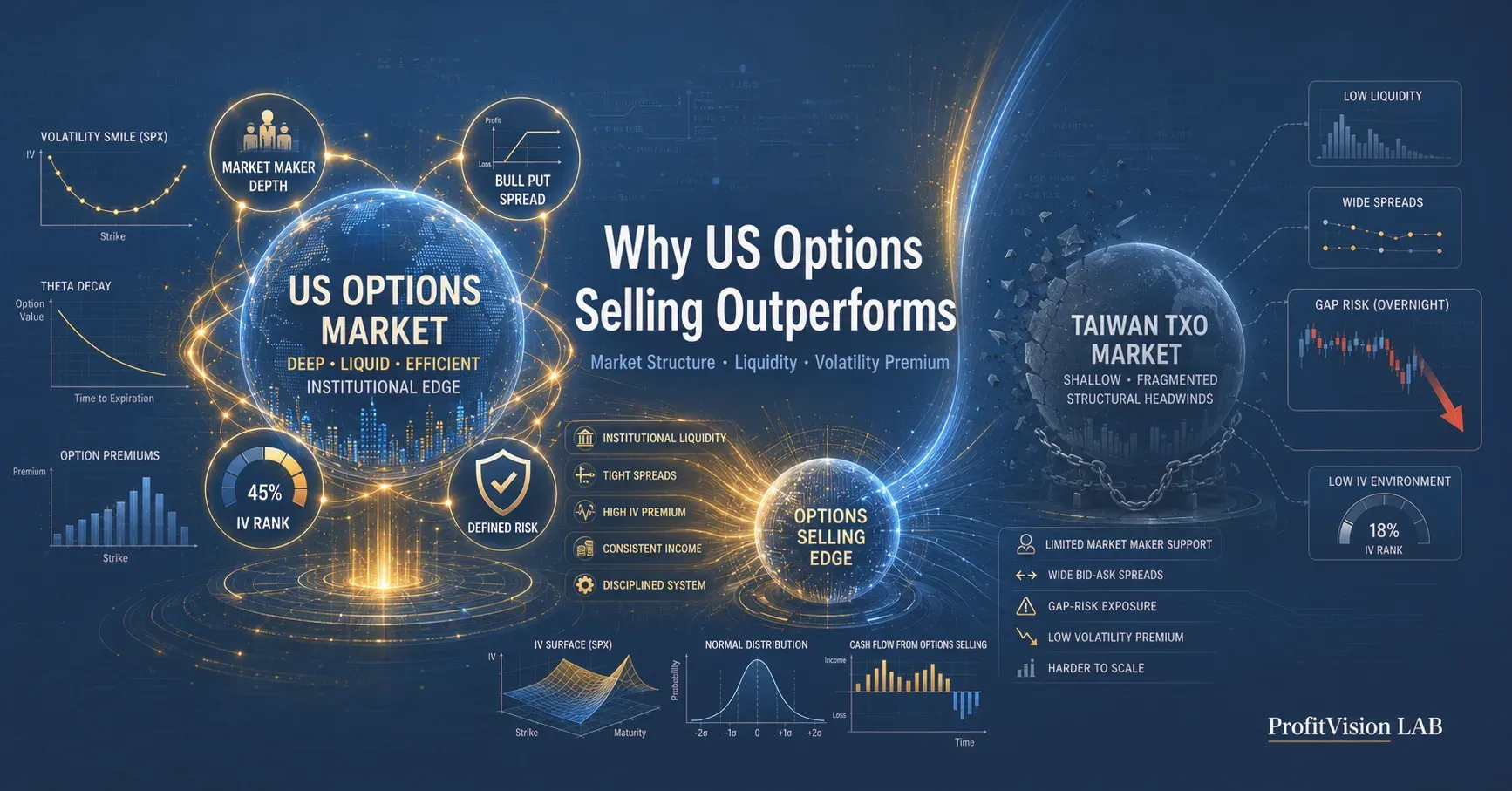
Market Structure · Institutional Liquidity · IV Premium — A Complete Framework
2026.05.22 | Shiba the Disciplined | ProfitVision LAB | Last updated: 2026.05.22
After learning strategies like Bull Put Spread, Covered Call, or Iron Condor, most options traders ask the same question:
"Can I apply this same system to Taiwan's market?"
The answer is: yes — but not by copying it directly.
Without understanding the structural differences between the two markets, applying US options-selling logic to Taiwan is a reliable path to a single catastrophic drawdown that resets your entire equity curve.
Because what truly determines whether an options seller operates with a Positive Expected Value has never been just technical analysis. It's:
An options seller, at its core, is selling market liquidity.
US and Taiwan markets represent two entirely different tiers of that liquidity world.
I. The US Market: Natural Habitat for Options Sellers
The Four-Layer Defensive Screen (4LDS) developed by Shiba the Disciplined at ProfitVision LAB is built on one foundational premise:
"A mature market with deep institutional participation."
The most mature options market in the world is US equities. This is precisely why Bull Put Spread and Covered Call strategies can generate repeatable, systematic cash flow in the US — but not everywhere else.
The US market's advantage isn't just scale. It's:
A complete institutional liquidity ecosystem.
This means the market is continuously populated by Market Makers, Volatility Arbitrage Funds, Delta Neutral Desks, Gamma Scalpers, High-Frequency Trading firms, and passive ETF hedging flows — all of which provide persistent market depth. That depth is the real foundation on which options sellers survive.
II. Three Core Structural Advantages of US Options Markets
Most traders assume US options work for sellers simply because volume is high. The real reason runs much deeper.
1. Individual Stock Options Liquidity Is Exceptionally Mature
The options markets on Apple, Microsoft, Nvidia, Amazon, and Tesla function as near-independent financial ecosystems. Institutional investors, market makers, high-frequency liquidity providers, and volatility arbitrage funds participate continuously.
As a result, even Far OTM options on these names typically have adequate Volume, reasonable Bid-Ask Spread, and deep Open Interest.
This matters enormously — because the greatest risk to an options seller is never being wrong on direction. It's:
"Being unable to exit."
When liquidity dries up, theoretical risk management becomes meaningless. The US institutional ecosystem keeps high-liquidity names tradable even during panic — allowing sellers to actually execute stop-losses, roll positions, adjust Delta exposure, and manage Gamma risk in real time.
This is the most underappreciated structural advantage of US options markets.
2. Defined Risk Actually Holds in the US
The core value proposition of a Bull Put Spread is Defined Risk.
In a Bull Put Spread — sell the 100 Put, buy the 95 Put — your maximum loss is locked at "5-point spread width minus net premium received." No matter how far the stock falls, your loss cannot exceed this ceiling. This is the critical risk management mechanism that separates spread strategies from naked Put selling.
But whether Defined Risk "actually holds" depends entirely on market liquidity — if you can't buy the protective leg (Long Put) at a reasonable price, the structure exists only on paper.
The US market's settlement mechanisms and liquidity ensure this defined risk holds in most scenarios. Even during earnings blowouts and overnight Gap Downs, the combination of the Long Put leg, continuous liquidity, market maker flow, and institutional hedging activity typically keeps the loss capped.
A mature options seller is running a risk distribution system — not placing directional bets.
3. US IV Structure Provides Rich Premium Soil
The real edge for options sellers isn't Theta alone. It's:
"The market's systematic overpricing of fear."
US markets are driven by Earnings Season, AI narrative cycles, FOMC meetings, CPI prints, product launches, and institutional rebalancing — catalysts that repeatedly spike Implied Volatility (IV) in short bursts. The market prices fear into options premiums, then that fear dissipates.
Options sellers harvest the spread between that inflated fear price and realized volatility. This is why ProfitVision LAB enforces the rule: IV Rank > 35 before entering any position. The real edge is Volatility Mean Reversion — not direction.
What a disciplined seller actually trades is not the stock price. It's:
"The market's mispricing of emotion."
III. Why This System Breaks Down in Taiwan
After mastering the US options-selling framework, many Taiwan-based investors naturally ask:
"Can I apply this to TSMC options?"
The problem is that Taiwan's options market infrastructure is not remotely comparable to the US.
Individual Stock Options in Taiwan: A Liquidity Vacuum
Outside of TSMC (2330), virtually all individual stock options in Taiwan trade in near-complete illiquidity: thin order books, insufficient volume, low Open Interest, enormous Bid-Ask Spreads, and Far OTM Puts with essentially no market.
This directly destroys the most critical component of a Bull Put Spread — the protective leg.
In many cases, you cannot buy the Long Put at any reasonable price. Or the slippage on the protective leg eats your entire premium received. In practice: what appears to be a "Defined Risk" strategy in Taiwan's individual stock options market is, for most names, only theoretical Defined Risk — not executable Defined Risk.
Taiwan Index Options (TXO): No Longer an Individual Stock System
This drives most Taiwan-based sellers to TXO. But at that point, the game has fundamentally changed.
You are no longer trading a company. You are trading macro risk sentiment.
In a US individual stock selling system, you can build an "economic moat" using earnings data, free cash flow, ROE, institutional flow, and Relative Strength. TXO's drivers are US overnight futures, currency moves, foreign institutional futures positioning, macroeconomics, geopolitics, and systemic risk.
ProfitVision LAB's Four-Layer Defensive Screen (4LDS) must be substantially reworked for TXO. Because:
An index has no economic moat.
Taiwan's Real Black Swan Risk: Overnight Gap
Many traders assume Taiwan's 10% daily limit rule makes it "safer" than US markets. The reality is the opposite.
Taiwan's market is deeply dependent on US overnight sessions. When Nasdaq crashes after hours, the US 10-year yield spikes, or geopolitical risk explodes, Taiwan's cash market routinely opens with a gap of 300–500+ points the next morning — even with spread positions on, you may hit maximum loss at the open bell, face margin calls, and get force-liquidated before you can react.
TXO sellers don't die slowly. They die instantly — from a single overnight gap.
The options sellers who genuinely survive long-term in TXO share one set of characteristics: extremely low leverage, high cash buffers, no directional concentration, no positions over long holidays, strict limits on margin utilization. Because TXO is not a slow-paced market:
It is a high-Gamma, high-Gap-risk market.
US vs. Taiwan Options Selling Environment — Side by Side
| Dimension | US Individual Stock Options | Taiwan Individual Stock Options | Taiwan Index Options (TXO) |
|---|---|---|---|
| Liquidity Depth | ✅ Extremely deep | ❌ Near-zero (except TSMC) | ⚠️ Moderate |
| Defined Risk: Actually Executable | ✅ Truly holds | ❌ Theoretical only | ⚠️ Impaired by gap risk |
| IV Premium Edge | ✅ Rich catalyst cycle | ⚠️ Limited | ⚠️ US-session dependent |
| Moat Analysis Applicable | ✅ Company fundamentals usable | ⚠️ Limited | ❌ Index has no moat |
| Black Swan Risk Type | ✅ Liquidity usually maintained | ❌ Slippage kills premium | ❌ Overnight gap destroys curve |
IV. Conclusion: Market Structure Determines Whether a Strategy Survives
Most beginners believe the core of options selling is "getting direction right." Every experienced seller knows the truth:
What options sellers actually earn is: liquidity, volatility premium, fear mispricing, time decay, capital discipline, and institutional risk mismatch — and all of these edges require a foundation of mature, deep market structure to function.
That's why Bull Put Spread can become a reliable, repeatable cash flow engine in US markets — while in Taiwan, it more easily becomes a survival game played against overnight gap risk.
The real difference was never the strategy itself.
Market structure determines whether a strategy can survive.
Frequently Asked Questions
The core reason is market structure, not strategy quality. US equity options have a complete institutional liquidity ecosystem — market makers, volatility arbitrage funds, Delta Neutral desks, and HFT firms provide continuous two-sided depth. This ensures the protective leg of a Bull Put Spread (Long Put) can be executed at fair value at any time, making Defined Risk genuinely enforceable. In contrast, most Taiwan individual stock options (outside TSMC) have near-zero liquidity, making it impossible to build or exit spreads at reasonable prices — transforming "Defined Risk" into theoretical risk management only.
IV Rank measures where current Implied Volatility sits relative to its own 52-week range. When IV Rank exceeds 35, it means the market is pricing fear above its historical average — options premiums are inflated relative to what volatility will likely realize. The options seller's structural edge comes from Volatility Mean Reversion: elevated IV eventually contracts back toward its mean, and sellers who entered at premium prices profit from that compression. Entering when IV Rank is too low means premiums have already been fully priced in, and the risk-reward ratio deteriorates sharply. This is the core logic of the volatility filter inside ProfitVision LAB's Four-Layer Defensive Screen.
TXO's defining structural risk is overnight gap. Taiwan's market is deeply tied to US overnight sessions — a post-market Nasdaq crash, a spike in 10-year Treasury yields, or a geopolitical event can result in a 300–500+ point gap open in Taiwan's cash market the next morning. Even with a spread position, a seller may hit maximum loss at the opening bell, face margin expansion, and be force-liquidated before any adjustment is possible. This is fundamentally different from US individual stock options, where institutional market makers typically maintain tradeable depth even during stress — giving sellers time to stop-loss or roll. TXO sellers don't lose gradually; they can lose everything in a single session open.
Not at all — but it requires clarity about market selection. For Taiwan-based investors, executing options selling strategies on high-liquidity US individual stocks (Apple, Microsoft, Nvidia, and similar) provides far superior structural conditions compared to Taiwan's individual stock options market. Taiwan individual stock options are not recommended for replicating US seller systems due to their liquidity constraints. TXO provides some liquidity but changes the fundamental game — the driver shifts from company fundamentals to macro risk sentiment, requiring a completely different analytical framework. The Four-Layer Defensive Screen's company-specific moat analysis does not directly apply in that environment.
15+ years in U.S. equities and options strategy. Applies the Four-Layer Defensive Screen (4LDS) to systematically evaluate individual stocks for options-selling suitability. Long-term researcher on structural differences between US and Taiwan options markets. All analysis is based on public market data and long-term practitioner observation. Not investment advice.
Investing involves risk; please assess your own financial situation carefully before acting.
All options strategies carry risk of loss. Past performance does not guarantee future results.
Data sources: Public market data, CME Group, CBOE Options Statistics (as of May 2026)