
NVIDIA (NVDA) Q1 FY2027 Earnings Deep Dive: $91B Guidance Despite China Zero — Ecosystem Expansion Phase III
China revenue at zero, $8B H20 headwind absorbed — yet NVIDIA guides $91B for Q2. Data center doubled YoY to $75.2B. Vera CPU opens a $200B TAM. Three of four filters pass; waiting on IV Rank above 30% before executing Bull Put Spread 200/190.
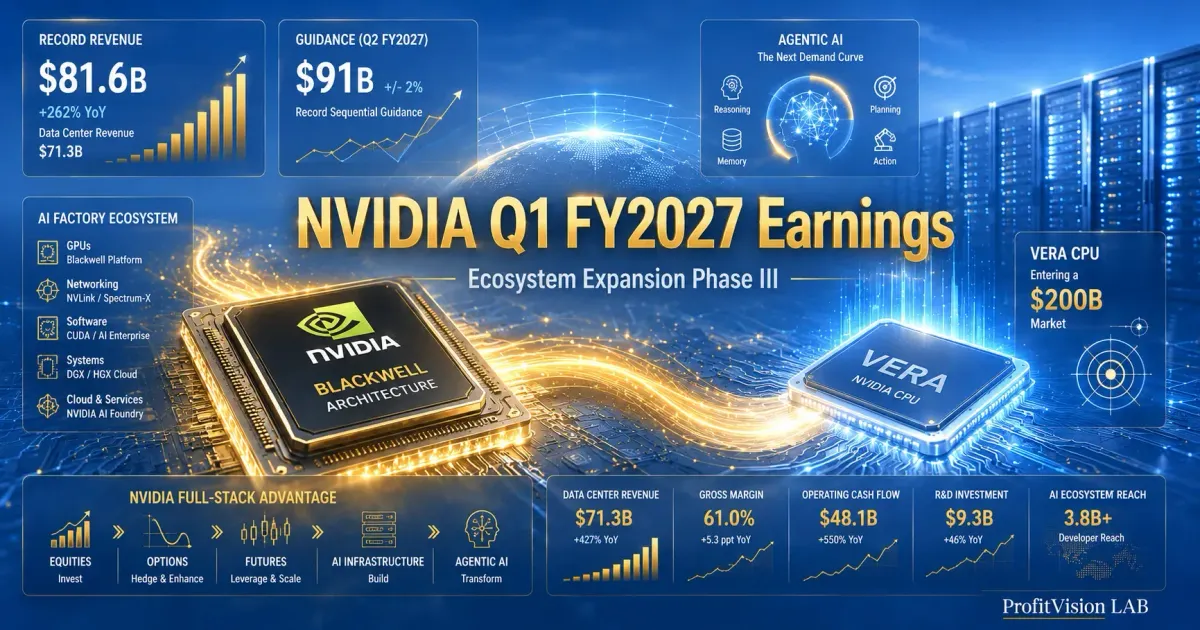
$81.6B revenue, data center doubled, Vera CPU opens $200B market — the Agentic AI dividend has just begun
2026.05.23 | Shiba the Disciplined | ProfitVision LAB | Data as of May 20, 2026 earnings call
🔍 Four-Filter Defense Screen (Updated 2026.05.23)
| Filter | Metric | Data | Result |
|---|---|---|---|
| Filter 1: Institutional Flow | PV Institutional Accumulation / A/D | Sustained institutional buying, PV score ~88 | ✅ Pass |
| Filter 2: Economic Moat | ROE / EPS Growth / SMR | ROE >100% / EPS YoY +101% / SMR A | ✅ Pass |
| Filter 3: Volatility | IV Rank | 24% (threshold: 30%) | ❌ Fail |
| Filter 4: Technicals | Price vs 50MA / Pattern | $215–225 vs 50MA $197; +10% above MA, 3-week consolidation | ✅ Pass |
Chapter 1: Earnings Results — Structure Over Headlines
NVIDIA reported Q1 FY2027 results after the close on May 20, 2026. The headline beat was expected; what matters more is the structural composition of that beat and the altitude of the guidance.
The Hyperscale / ACIE Split: The Most Important Structural Signal
NVIDIA restructured its reporting framework this quarter into two segments: Data Center (Hyperscale + ACIE) and Edge Computing. The near-50/50 split between Hyperscale (~$38B) and ACIE (~$37B, +31% QoQ) is the single most important structural development. Six months ago, hyperscalers accounted for well over 50% of data center revenue. That concentration risk has now materially diminished — no single hyperscaler pulling back on capex can crash NVIDIA's revenue the way it once could.
Chapter 2: Earnings Call — Five Strategic Declarations
"Demand has gone parabolic. The reason is simple: Agentic AI has arrived. In this era, compute capacity is profits." — Jensen Huang, Q1 FY27 closing remarks
Declaration 1: Five Ecosystem Pillars
| # | Pillar | Core Claim |
|---|---|---|
| 1 | Hyperscale Cloud | Core ML workloads, internal AI services, and public cloud GPU demand |
| 2 | Full-Stack AI Factory | New AI-native clouds, sovereign AI clouds, enterprise/industrial on-prem |
| 3 | CUDA to the Edge | Robotics, autonomous vehicles, AI-RAN, embedded medical — Physical AI is next |
| 4 | Vera CPU | World's first CPU purpose-built for Agentic AI; opens $200B TAM |
| 5 | Universal Platform | Only platform running every frontier AI model: Anthropic, OpenAI, SpaceXAI, Meta, Gemini |
Declaration 2: Vera CPU — Entering a $200B Market
CFO Colette Kress stated NVIDIA's ambition to become "the world's leading CPU supplier." Vera CPU "opens a brand new $200B addressable market," with "every major hyperscaler and system maker partnering with us to deploy it." Kress anticipated $20B in CPU revenue this year alone. This is not incremental — it is NVIDIA entering Intel and AMD's core territory with a purpose-built Agentic AI CPU that deepens ecosystem lock-in for existing customers.
Declaration 3: China at Zero — Optionality Preserved
CFO Kress confirmed no China Data Center revenue in Q1. Huang separately stated: "The Chinese government has to decide how much of their local market they want to protect. My sense is that, over time, the market will open." NVIDIA estimates the Chinese AI chip market at approximately $50 billion — currently valued at zero in every guidance figure. Any political unlock is pure upside, entirely excluded from the $91B Q2 guide.
Chapter 3: The ASIC Threat — Market's Biggest False Dichotomy
The "ASIC replaces GPU" narrative has been the central bear thesis for two years. The data tells a more nuanced story.
| Dimension | NVIDIA GPU (Full-Stack) | ASIC / XPU (Custom) |
|---|---|---|
| Flexibility | High (supports new architectures rapidly) | Low (optimized for narrow tasks) |
| Inference TCO | Higher (generality premium) | Low (mature, stable workloads) |
| Deployment complexity | Mature CUDA ecosystem | Requires building custom software stack |
| Resilience to architecture shifts | Strong (fast design iteration) | Weak (stranded when paradigm shifts) |
Huang's strongest moat argument is the pace of AI model architecture evolution — Transformer → MoE → multimodal → Agentic transitions are happening faster than ASIC design cycles. When your ASIC tapes out, the training paradigm may already have changed.
The real medium-term risk: as specific inference workloads mature and stabilize, ASIC TCO advantages will systematically erode NVIDIA's pricing power. Vera Rubin's 10x inference cost reduction is NVIDIA preemptively compressing its own margins to prevent ASIC cost advantages from becoming customer switching triggers — a strategically brilliant but revealing move.
Chapter 4: Financial Resilience — The Cash Flow Machine
| Metric | Q1 FY27 | Q4 FY26 | Q1 FY26 | YoY |
|---|---|---|---|---|
| Total Revenue | $81.6B | $68.1B | $44.1B | +85% |
| Data Center Revenue | $75.2B | $62.3B | $37.3B | +101% |
| Non-GAAP Gross Margin | ~75% | ~75% | ~78% | -300bps |
| Non-GAAP EPS | $1.87 | $1.62 | $0.93 | +101% |
| Free Cash Flow | $48.6B | ~$40B | $26.2B | +85% |
| Networking Revenue | $14.8B | $10.98B | $3.0B | +393% |
Shareholder Returns: The Strongest Confidence Signal
- Quarterly dividend: Raised from $0.01 to $0.25 (25x increase), payable June 26, 2026
- New buyback authorization: $80B (no expiration) + $38.5B remaining = $118B+ total capacity
- Q1 actual returns: ~$20B in buybacks and dividends combined
A 25x dividend increase is not an accounting adjustment. It is management declaring extraordinary confidence in the sustainability of future free cash flow. For a company whose demand durability is still debated, this signal carries disproportionate weight.
Chapter 5: Valuation & Scenario Analysis
This analysis does not predict a price target. The following framework helps assess whether current market pricing reflects reasonable assumptions.
| Scenario | Key Assumptions | NTM P/E | FY28 EPS Est. | Implication |
|---|---|---|---|---|
| 🟢 Bull Case | Partial China market reopening ($20-30B annual) + Vera CPU TAM rapid penetration + Agentic AI drives enterprise GPU demand explosion | 30–35x | $10–12 | Market reprices to premium growth multiple |
| 🟡 Base Case | China stays zero + Hyperscaler capex maintains current levels + Vera Rubin ships on schedule + ACIE continues growing | 22–28x | $8–9 | Current valuation range, moderate upside |
| 🔴 Bear Case | Hyperscalers collectively cut capex + ASICs win systematically in inference + Vera Rubin delayed or margin-compressed | 15–18x | $6–7 | Significant correction, retests prior support |
At current share price ~$215–225, NTM P/E of approximately 23–24x implies base case with no China contribution — the market has priced in a significant China discount. This also means a free call option on China market reopening exists at zero cost in the current price.
Chapter 6: Investment Thesis & Options Setup
Core Thesis: NVIDIA is becoming the full-stack compute infrastructure monopoly of the Agentic AI era. This earnings report is the clearest milestone of that identity shift. With China at zero and ASIC threats persistent, delivering $81.6B and guiding $91B makes the fundamental case stronger than ever.
✅ Bull Case
- Agentic AI demand curve activates: Enterprise-scale agent deployment drives dual GPU + Vera CPU demand; TAM expands from training to every core business process
- Demand base systematically diversified: ACIE ~= Hyperscale; Sovereign AI at $30B+; single-customer capex risk materially reduced
- China is a pure upside option: $50B market at zero; any political unlock is unpriced surprise
- Shareholder returns enter maturity mode: 25x dividend increase + $118B buyback; FCF compounding machine is live
⚠️ Bear Case
- Hyperscaler capex cycle reversal: $725B 2026 commitments could reverse faster than expected if AI ROI disappoints over next 12–18 months
- Vera Rubin transition margin compression: New architecture ramp-up carries typical yield cost headwinds; if gross margin falls below 73%, market reaction will be severe
- Four consecutive post-earnings declines: Expectations ceiling problem — however strong the fundamentals, price action reflects whether results beat the implied pre-earnings pricing
- ASIC long-term inference erosion: Stable, mature inference workloads will systematically favor ASIC TCO over time
Options Setup: Bull Put Spread
Stock consolidating $215–225 for three weeks. 50MA at $197 provides ~10% buffer. IV Rank at 24% is the only missing condition. Execute the following structure when IV Rank exceeds 30%:
| Parameter | Value | Notes |
|---|---|---|
| Strategy | Bull Put Spread | Neutral-to-bullish, defined max loss |
| DTE | 30–45 days | Avoid Q2 FY27 earnings (mid-August) |
| Short Put Strike | $200 (Delta ~20) | ~20% assignment probability; 50MA $197 as final defense |
| Long Put Strike | $190 | $10 spread width, defines max loss |
| Premium Collected | $1.90 ($190) | Confirm with live quote when IV threshold met |
| Max Risk | $8.10 ($810) | $10 spread − $1.90 premium |
| Risk/Reward | 1 : 0.23 | Stop-loss: 2× premium ($380 loss) |
| Profit Target | $95 (50% of premium) | Close at 50%, no holding to expiry |
| Entry Condition | IV Rank >30% AND price holds $213 | Both required simultaneously |
Trigger Conditions
- Upgrade to Execute: IV Rank crosses 30% with price holding above $213
- Watch triggers: Broad market selloff (SPY -1.5%+ single day), China policy news, sector-wide tech pressure — these events typically spike IV Rank simultaneously
- Downgrade to Reject: Price breaks 50MA $197, Non-GAAP gross margin falls below 73%, or export restrictions tighten further
📋 Tracking Log
| Date | Event | Assessment | Outcome |
|---|---|---|---|
| 2026/05/20 | Q1 FY27 Earnings Release | ⏸️ Active Watch | Post-earnings decline, 4th consecutive quarter |
| 2026/05/23 | Initial Publication | ⏸️ Awaiting IV confirmation | — |
Next scheduled update: Post Q2 FY27 earnings (est. mid-August 2026)
Early update triggers: US-China AI chip policy shift, major hyperscaler capex revision, Vera Rubin production timeline update
Frequently Asked Questions
15+ years in U.S. equities and options strategy. Applies the Four-Filter Defense Screen to evaluate individual stocks systematically. All research is based on public SEC filings, Q1 FY2027 earnings call transcripts, and primary industry data. Not investment advice.
Investing involves risk; please assess your own financial situation carefully.
Data sources: NVIDIA Q1 FY2027 Earnings Call Transcript (Motley Fool), CNBC, Kiplinger, NVIDIA Q1 FY27 Investor Presentation, SEC Filings, Public Records (as of May 23, 2026)


Comments ()