
Daimler: Split into Two, Each Wheel Accelerates
In 2021, Daimler split into Mercedes-Benz Group and Daimler Truck. This analysis explains why consumer luxury cars and B2B industrial trucks needed separate owners, and how Daimler converted the pain of the failed DaimlerChrysler merger into disciplined separation.
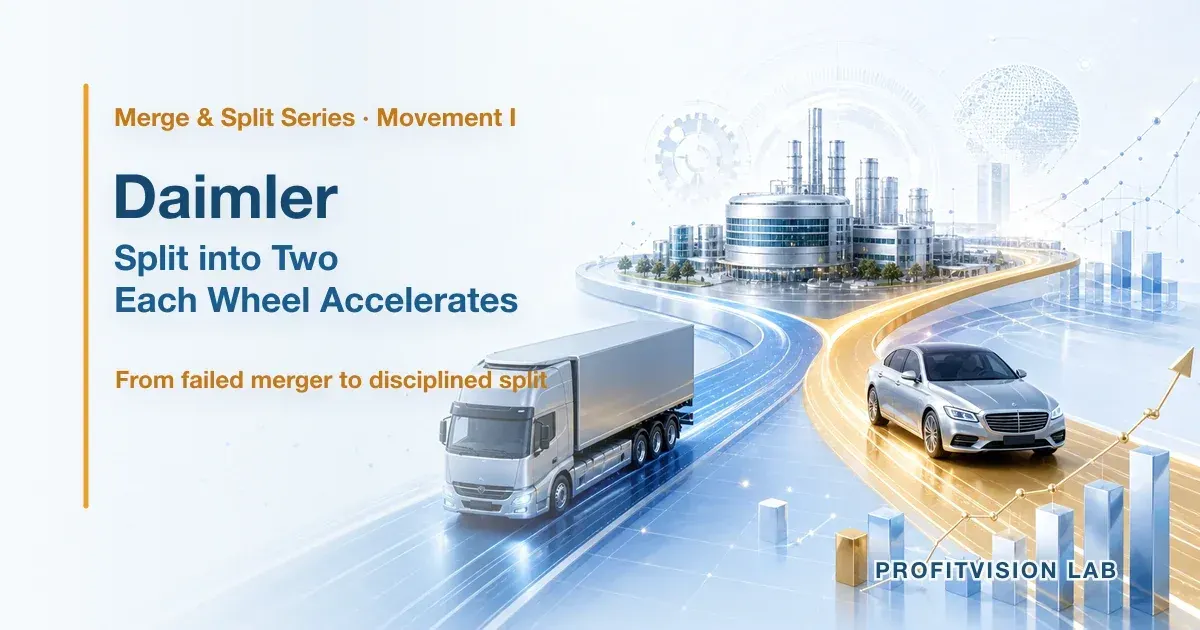
- At the end of 2021, Daimler split into two: Daimler Truck was spun off and listed in Frankfurt, while the remaining parent was renamed Mercedes-Benz Group in February 2022, focused on luxury cars and vans. A century-old industrial name was cleanly divided into two public companies.
- Why did it have to split? Because under the same three-pointed star sat two fundamentally different businesses: Mercedes-Benz passenger cars are a consumer luxury brand; Daimler Truck is a B2B industrial business. They have different customers, cycles, capital needs and valuation logic.
- The truck business was the hidden asset. As the world's largest commercial-vehicle manufacturer, Daimler Truck had durable industrial value, but it was long obscured by Mercedes' luxury halo. The split let this industrial cash machine be priced on its own terms.
- The deeper lesson is historical. Daimler had already lived through the failed DaimlerChrysler "merger of equals" in 1998 and sold Chrysler at a steep loss in 2007. Having paid dearly for undisciplined merger ambition, Daimler better understood the value of disciplined separation.
One Three-Pointed Star, Two Completely Different Businesses
The Mercedes three-pointed star is one of the most valuable brand symbols in the world. But for a long time, that symbol covered two businesses whose customers, rhythms and economics were very different.
On one side was the familiar Mercedes-Benz luxury-car business: consumer-facing, brand-driven, emotional, design-heavy and high-margin. On the other side was the quieter but enormous truck and bus business: sold to logistics companies, fleet operators and public agencies, with buyers focused on fuel efficiency, uptime, service networks and total cost of ownership. It is a deeply rational B2B industrial business.
What happens when an emotional luxury brand and a rational industrial supplier sit inside the same financial story? Both get compromised. In 2021, Daimler finally decided to let them separate.
The Clean Split of 2021
Unlike Siemens, which spent more than two decades spinning off one ship after another, Daimler chose a simpler structure: one clean cut.
(cars + trucks)
Daimler Truck
listed separately
Parent renamed
Mercedes-Benz Group
In December 2021, Daimler Truck Holding was spun out and listed on the Frankfurt Stock Exchange. It was the world's largest commercial-vehicle manufacturer, with brands including Mercedes-Benz Trucks, Freightliner, FUSO and Western Star. In February 2022, the remaining parent formally became Mercedes-Benz Group, concentrating its name, resources and investor story around Mercedes-Benz, AMG, Maybach and the premium passenger-car business.
The Daimler name, used for more than a century, was divided into two: one company called Mercedes-Benz, one called Daimler Truck. Each now had its own management team, stock, shareholder base and strategic destiny.
Why Split? Consumer Luxury vs. B2B Industry
At a superficial level, both businesses "make vehicles." From a capital-allocation perspective, however, Mercedes-Benz passenger cars and Daimler Truck needed different owners, different investors and different valuation frames.
These two businesses attract different shareholders. A Mercedes investor may want exposure to premium consumption and brand economics. A truck investor may want industrial cash flow and cycle discipline. Bundled together, Mercedes' luxury story was diluted by the industrial truck business, while the truck business was hidden under the luxury halo. One company was trying to tell two incompatible stories. That is conglomerate discount in automotive form.
The Undervalued Truck: An Industrial Cash Machine Under a Luxury Halo
The largest beneficiary of the split was arguably the truck business.
Daimler Truck was the world's largest commercial-vehicle manufacturer, a genuine industrial cash machine: large, durable and cash-generative. But before the split, its value was obscured by the glamour of Mercedes-Benz. When investors looked at Daimler, they mostly saw the three-pointed star and the luxury-car story. It was difficult for the market to assign a fair standalone value to a less glamorous but valuable industrial franchise.
| Market-Cap Snapshot | Before the Split | After the Split · 2026 Market Value |
|---|---|---|
| Mercedes-Benz Group (MBG) | Inside one combined Daimler | About US$49.3B (standalone pricing) |
| Daimler Truck (DTG) | Industrial value hidden under the luxury halo | About US$35.4B (visible on its own) |
| Two wheels combined | One Daimler AG | About US$85B, each business with its own frame |
Note: market values are approximate USD figures around June 2026 and will move with share prices and exchange rates. Auto-sector valuations remain volatile because of EV transition risk and industrial cycles.
The Best Owner Test: One Brand, Two Best Owners
The question was not whether Mercedes-Benz was good or whether Daimler Truck was good. Both were world-class businesses. The question was whether the same Daimler could truly be the best owner of both at the same time.
The answer was: probably not. Luxury cars require brand investment, design talent, premium customer experience and a consumer-facing EV transition. Trucks require fleet relationships, global service networks, commercial electrification and hydrogen deployment. These are different capabilities, capital rhythms and management systems.
The split acknowledged that the best owner of Mercedes-Benz was a focused luxury-car company, while the best owner of Daimler Truck was a focused B2B industrial company. Two focused management teams could each become the best owner of their own business.
Daimler's Double Lesson: From the Pain of Merge to the Discipline of Split
This split matters because Daimler had already experienced one of the most famous merger failures in corporate history.
In 1998, Daimler-Benz merged with Chrysler to create DaimlerChrysler. At the time, it was promoted as a "merger made in heaven" and a transatlantic "merger of equals." In practice, the marriage quickly exposed cultural and strategic incompatibility. German precision-engineering culture and American mass-market auto culture did not fit. Synergies failed to appear. In 2007, Daimler sold a majority stake in Chrysler to Cerberus at a steep loss, effectively admitting that the grand merger had failed.
DaimlerChrysler
"merger made in heaven"
Chrysler sold
at a steep loss
clean split
disciplined separation
(approx. USD)
(approx. USD)
of failed "merge"
Note: figures are approximate media-reported values. The 2007 sale was about €5.5B, roughly US$7.4B at the time.
Siemens vs. Daimler: Fleet Method vs. Clean Cut
Both Siemens and Daimler were German industrial giants that chose proactive separation. But they show two different forms of "split."
| Dimension | Siemens | Daimler |
|---|---|---|
| Split form | Fleet method: serial and gradual over 25 years | Clean cut: one decisive split |
| Core tension | Diverse businesses with different cycles and valuation frames | Consumer luxury vs. B2B industry |
| Historical background | Long-term portfolio focus | Lessons from DaimlerChrysler |
| Shared trait | Both were proactive splits: made while the businesses were still healthy, not after collapse | |
Whether through Siemens' continuous pruning or Daimler's clean cut, the shared principle is proactivity. Unlike GE, which waited until the empire nearly collapsed, both companies chose separation before crisis forced their hand. The form differed; the discipline was similar.
Lessons for Taiwan: The Valuation Curse of Mixing Consumer and B2B
1. Consumer brands and B2B industrial businesses follow different valuation logic. When a company combines both, the market often struggles to value either one fairly.
2. An undervalued business may need an independent stage more than more parent-company resources. Independence lets the business explain its own economics to the right shareholder base.
3. A failed merger can become useful tuition only if management learns the right lesson. DaimlerChrysler taught Daimler that scale is not the goal; focus is.
Next Stop: When a Spin-off Creates One of the World's Most Valuable Brands
Daimler separated trucks from cars, allowing an industrial cash machine to become visible. The next case is an even more extreme version: a carmaker spun off its most radiant brand, and that brand eventually approached or exceeded the value of the parent group itself.
That is the story of Fiat and Ferrari: how a prancing horse escaped the traffic and ran toward a luxury multiple.
Post-Spin Health Check: Daimler Split into Two
Using the six questions from the Introduction, here is the overall verdict on the Daimler split:
| Test Item | Score | Comment |
|---|---|---|
| 1. Capital-allocation effect | ✅ | Cars and trucks could each be valued with the right yardstick; the truck business became visible |
| 2. Existing shareholder rights | ✅ | Shareholders received exposure to both Mercedes-Benz and Daimler Truck |
| 3. Clean separation | ✅ | Broadly clean, with the parent later reducing its residual truck stake |
| 4. Synergy trade-off | ✅ | Consumer luxury and B2B industry had limited real operating synergy |
| 5. Exit mechanism | ✅ | The path to reducing the Daimler Truck stake was clear |
| 6. Structure type | — | Clean one-into-two split; contrasted with DaimlerChrysler as a failed "merge" |
Overall verdict: a decisive clean split with most tests passed: a company that converted the pain of failed merger ambition into the discipline of separation.
- Introduction: Merge & Split—the Art of Capital Allocation
- Movement I [Split] · GE: From Empire Collapse to Century Break-up Rebirth
- Movement I [Split] · Abbott → AbbVie: One of the Most Successful Spin-offs Ever
- Movement I [Split] · eBay → PayPal: When the Child Outgrew the Parent
- Movement I [Split] · Siemens: Turning Spin-offs into a Repeatable Art
- Movement I [Split] · Daimler: Split into Two, Each Wheel Accelerating on Its Own
- Movement I [Split] · Fiat → Ferrari: A Prancing Horse Runs Toward a Luxury Multiple
- Coming next: Haleon, GE × Wabtec, Novartis, Philips, Universal Music, Hitachi, Sony
- Movement II [Merge]: Broadcom, LVMH, AB InBev, Schneider, Exor, Fujifilm
Comments ()