Who Benefits From the Enterprise AI Wave? ── Four-Layer AI Investment Map × 20 Representative Companies
Part 1 dissected what enterprises are doing. This flips it: when 90% are stuck and 80% blocked by data, who gets the orders? Four-Layer AI Investment Map covers NVDA, AVGO, TSM, SNOW, PLTR, CRWD, NOW, MSFT and 12 more across Compute, Data, Governance, Apps. 9 link to PVL deep research. Not advice.
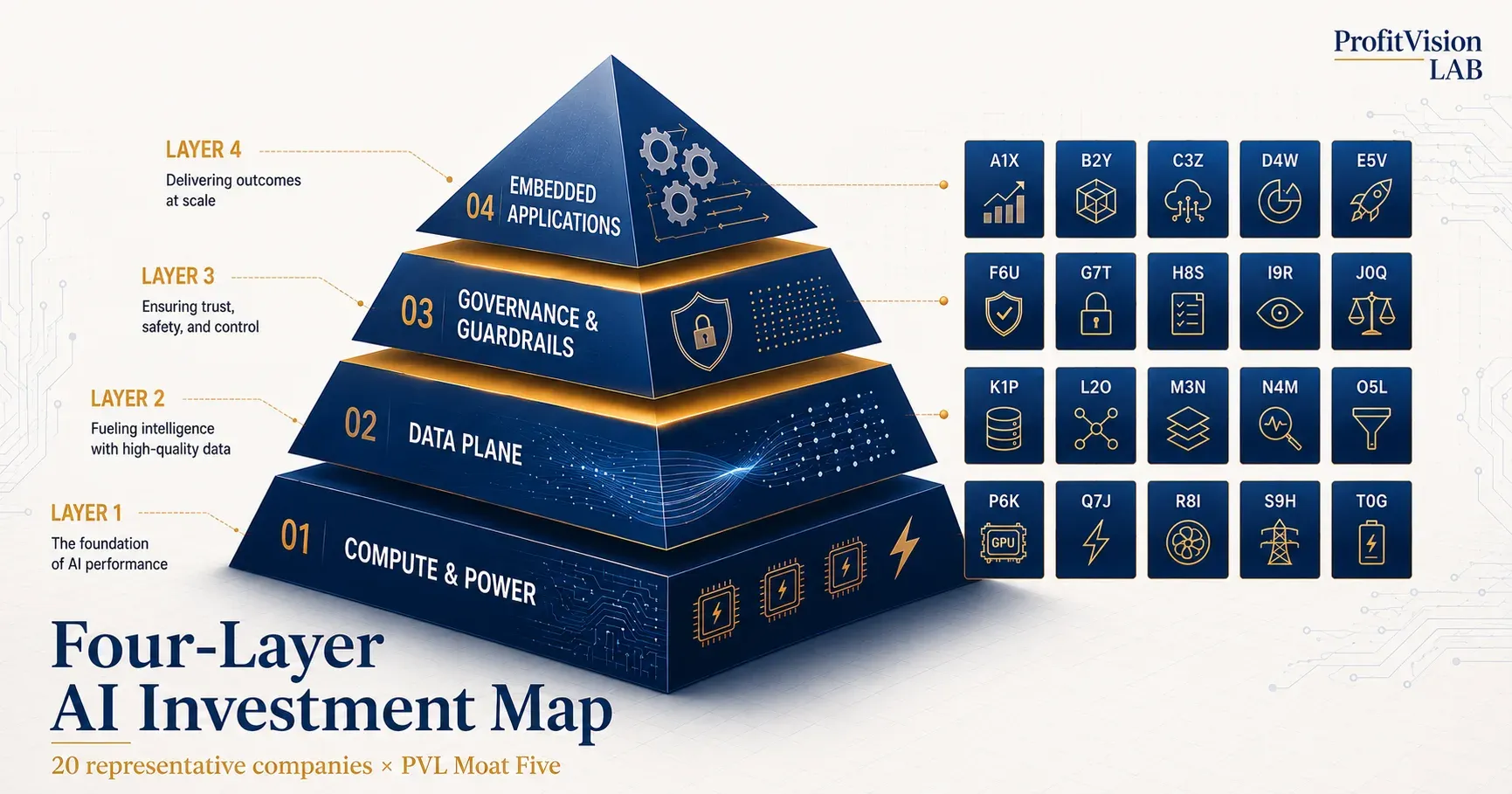
When 90% of enterprises are stuck in pilots and 80% are blocked by data—who picks up the orders? A four-layer AI investment map × 20 representative companies, scored with The Moat Five × The Four-Layer Defensive Screen, with direct links to nine companies already under PVL deep research coverage.
- Layer 1: Compute & Power—GPU, ASIC, hyperscalers, AI data centers, power / thermal / SMR. The most certain "shovels," but valuations partly reflect that.
- Layer 2: Data Plane—data clouds, lakehouses, semantic layers, vector DBs, synthetic data, enterprise search. Relatively underpriced, yet the precise bottleneck blocking 80% of enterprises.
- Layer 3: Governance & Guardrails—agent observability, red-teaming, AI GRC, liability insurance, endpoint security. 21% governance-mature means a 79% expansion gap.
- Layer 4: Embedded Applications—vertical SaaS, embedded copilots, HR / performance platforms, physical AI interfaces. "Installed but unused" makes "embedded into existing workflows" the real adoption dividend.
We score 20 representative companies with the PVL Moat Five (M5) × Four-Layer Defensive Screen (4LDS) and tag each Worthy of Deep Research / Watchlist / Needs Particular Caution. Nine of them (NVDA, TSM, PLTR, CRWD, ZS, PANW, NOW, CRM, INTU) already have published PVL deep research; cards link directly. Research only—not investment advice.
1. Why This Article: Flipping "What Enterprises Are Doing" Into "Who Picks Up the Orders"
Part 1 (Enterprise AI Adoption Trends & Challenges) dismantled the observations of seven major institutions (KPMG, Deloitte, McKinsey, Accenture, Stanford HAI, EY) for 2026. Five numbers to remember:
- 90% stuck: fewer than 10% of enterprises have actually scaled agentic AI with quantifiable value (McKinsey).
- 80% blocked by data: 80% of enterprises cite data limitations as the largest barrier to agentic scaling.
- 79% governance-naked: only 21% have mature agent governance models.
- 77% scrutinize nationality: more than three-quarters factor supplier nationality into procurement decisions.
- 74% budget priority: AI remains the top investment even in a recession.
Translated bluntly: enterprises are spending real money, but they can't make it work. For investors, that's more valuable than knowing "AI matters to enterprises." It tells us where the next three years of order flow will go: companies that "unblock the bottleneck," not those "selling flashy AI applications."
That's the design logic for this four-layer AI investment map. We don't rank by which AI narrative is sexiest. We rank by who sits structurally, durably, unavoidably in front of the four bottlenecks.
2. The Four-Layer AI Investment Map at a Glance
The enterprise AI wave splits cleanly into four layers upstream to downstream. Each serves a different bottleneck, has a different moat source, and obeys a different valuation logic.
| Layer | Bottleneck Served | Player Types | Moat Source |
|---|---|---|---|
| L1 Compute & Power | Agents need compute; compute needs power | GPU/ASIC/foundry/hyperscaler/power/SMR | Process node, scale economics, geographic monopoly |
| L2 Data Plane | 80% stuck on "data unusable by agents" | Data clouds/lakehouses/semantic layers/vector DBs | Switching cost, data gravity |
| L3 Governance & Guardrails | 79% deploying agents without governance | Observability/red-teaming/GRC/endpoint security | Compliance lock-in, integration breadth, trust capital |
| L4 Embedded Applications | "Installed but unused"—subscribed but no habit | Vertical SaaS/embedded copilots/HR platforms | Workflow integration, user habits, data feedback |
Most market lists cut the AI universe into "chips vs software" or "upstream vs downstream." That cut misses the key 2026 bottlenecks: data and governance.
This map follows the principle of "go where the pain is." Part 1's seven reports converge on four structural bottlenecks (compute, data, governance, actual adoption). We map each bottleneck to the companies that can resolve it—not by market cap or sector, but by "where it hurts customers and who can stop the bleeding."
3. The Scoring Framework: Moat Five × Four-Layer Defensive Screen × Three-Tier Tag
Each company is evaluated against two PVL standard frameworks:
The Moat Five (M5)
Five dimensions of structural competitive advantage, each rated ★ (weak) to ★★★★★ (extreme):
- Technology Leadership: objective lead in patents, process node, algorithms, or know-how
- Scale Economics: more customers means lower unit cost
- Switching Cost: extreme cost (time, data migration, contracts) to replace
- Network Effects: each added user / developer / partner makes the service more useful
- Brand Trust: the default option in procurement decisions
The Four-Layer Defensive Screen (4LDS)
A four-stage filter; failure at any stage demotes the company:
- Ownership structure: institutional holding mix, liquidity, concentration risk
- Moat: M5 must score at least three dimensions at ★★★★ or above
- Volatility: historical volatility within risk budget
- Technical / trend: medium-to-long-term trend, relative strength
Three-Tier Tag
| Tier | Criteria | Recommended Action |
|---|---|---|
| Worthy of Deep Research | Clear moat, sound financials, valuation in acceptable range | Move into PVL deep-research coverage |
| Watchlist | Solid business, but valuation rich or execution uncertain | Track; await valuation reset or execution turn |
| Needs Particular Caution | Structural questions in business model or governance | Don't enter coverage absent clear resolution signal |
All ★ ratings reflect PVL's subjective assessment, for research reference only.
4. Layer 1: Compute & Power
Bottleneck served: agents need compute; compute needs power. As agent fleets scale, backend compute demand grows exponentially, pulling power and cooling into the infrastructure conversation.
Common traits: capital-intensive, high process-node barriers, geopolitically sensitive, valuations partly reflect expectations.
PVL research coverage in this layer: NVDA and TSM have published PVL deep research; AVGO, CEG, SMCI are research candidates or caution-watch names.
Business: global AI GPU leader, dual oligopoly in training and inference. From GeForce gaming roots, Data Center exploded into the primary segment in 2023. Hopper (H100) and Blackwell (B100/B200) architectures drive hyperscaler procurement; CUDA + cuDNN + TensorRT software stack creates deep lock-in. NVLink, InfiniBand, and DGX systems package GPU + network + software into an "AI factory" turnkey solution.
AI exposure: the compute floor of all four layers. Public AI capex commitments from MSFT, META, GOOG, AMZN, and ORCL convert directly into NVDA orders; Data Center gross margins have held at historical highs.
Moat: Tech leadership ★★★★★ / Scale ★★★★★ / Switching cost ★★★★ (CUDA lock-in) / Network effects ★★★★ (developer ecosystem) / Brand ★★★★★
Structural risks: (1) hyperscalers' in-house ASIC programs (Google TPU, Amazon Trainium, Microsoft Maia, Meta MTIA) chipping at inference share; (2) China export controls potentially widening to more SKUs; (3) training vs inference market bifurcation, with inference ASIC competition fiercest.
Why this tier: still the industry's widest moat, deepest software ecosystem, and tightest customer lock. Both fundamentals (earnings) and execution (post-entry management) are under continuous PVL tracking.
Business: dual-engine semiconductors + software. Semis cover hyperscaler-custom AI ASICs, networking chips (Tomahawk, Jericho series), and wireless connectivity. Software stack built from CA, Symantec, and VMware acquisitions—an enterprise infrastructure portfolio with deep customer entrenchment. AI-ASIC revenue driven by hyperscaler orders (public references include Google and Meta).
AI exposure: when hyperscalers want to dilute NVDA dependence, AVGO is the first co-design partner they call. VMware Cloud Foundation simultaneously monetizes private-cloud + AI-workload demand at high margins.
Moat: Tech leadership ★★★★★ / Scale ★★★★ / Switching cost ★★★★★ (ASIC design cycle 18–24 months) / Network effects ★★★ / Brand ★★★★
Structural risks: (1) AI-ASIC customer concentration—the top three may account for most segment revenue; (2) long ASIC design cycles—single project slippage materially impacts quarterly results; (3) VMware integration execution risk during subscription transition.
Why this tier: sturdy business base + diversified revenue mix + structural ASIC tailwind. Not yet under PVL deep coverage—a strong candidate for the next round.
Business: global leader in advanced-node foundry; 5nm/3nm/2nm production a generation ahead of Intel and Samsung. Customers include NVDA, AVGO, AMD, AAPL, QCOM. CoWoS advanced packaging is the bottleneck node for AI accelerators—continued capacity expansion still falls short of demand.
AI exposure: whoever wins GPU vs ASIC, orders return to TSM's advanced-node capacity. AI orders simultaneously lift ASP, utilization, and gross margins. 2nm ramp timing and yield are the central valuation variables.
Moat: Tech leadership ★★★★★ (process-node lead) / Scale ★★★★★ / Switching cost ★★★★★ (1–2 year qualification cycle) / Network effects ★★★ (IP ecosystem) / Brand ★★★★★
Structural risks: (1) geographic concentration—maximum exposure to Taiwan Strait dynamics and US-China tech tensions; (2) overseas fab expansion (Arizona, Kumamoto, Dresden) cost and yield learning curves drag short-term gross margin; (3) elevated customer concentration; pricing pressure when large customers push for concessions.
Why this tier: deep moat, sole upstream in the AI compute chain, concentrated but blue-chip customer base. PVL Q1 2026 deep research established the base; long-term tracking focuses on 2nm ramp and overseas expansion progress.
Business: one of the largest U.S. nuclear operators with 21 reactors and ~32 GW total capacity—competitive edge is carbon-free baseload power. The Three Mile Island Unit 1 restart PPA with Microsoft (20-year) is the marquee deal. Also active in natural gas, renewables, and retail electricity.
AI exposure: Stanford HAI flagged "29.6 GW of AI data-center power capacity"; nuclear is among the few options that satisfy 24/7 carbon-free baseload. Hyperscalers, constrained by their own net-zero commitments, sign premium PPAs; CEG's existing reactor fleet + restart / expansion projects make it a structural beneficiary.
Moat: Tech leadership ★★★ / Scale ★★★★ / Switching cost ★★★★ (site + license; new-entrant barrier extreme) / Network effects ★★ / Brand ★★★
Structural risks: (1) power prices and capacity markets sensitive to federal and state policy; (2) nuclear regulatory uncertainty (NRC review, waste handling, insurance); (3) valuation already reflects the hyperscaler-PPA narrative—any policy shift amplifies price reaction.
Why this tier: strong fundamentals but rich valuation; watch how nuclear + AI PPA theme reprices under energy policy moves before upgrading coverage.
Business: AI-server builder, once an important shipment intermediary for NVDA H100 / GB200. Differentiators in liquid cooling and rack-level integration; customers include hyperscalers and large AI startups.
AI exposure: theoretical direct beneficiary of AI-server demand—liquid-cooling and rapid delivery are the technical pitch, evident in the 2023–2024 revenue surge.
Moat: Tech leadership ★★ (liquid cooling differentiated but replicable) / Scale ★★★ / Switching cost ★★ (high substitutability) / Network effects ★★ / Brand ★★ (impaired after governance events)
Structural risks: (1) prior governance events (filing delays, short reports, auditor change) require time to rebuild trust; (2) NVDA allocations to Dell, HPE, Lenovo intensify competition and pressure gross margin; (3) elevated customer concentration risk.
Why this tier: although management has been adjusted and filings restated, brand and institutional-trust repair needs a longer window. Investors should independently verify the latest restatement status, auditor opinion, internal controls, and litigation progress before considering coverage.
Layer 1 is the most certain but most crowded lane. Certainty comes from inelastic demand—no compute, no agents. Crowding shows up in valuations that already price years of growth. The stock-picking question isn't "will it go up?" but "whose orders get cut first when capex corrects?" NVDA / AVGO / TSM sit in structurally solid positions; CEG represents the underrated "AI vs carbon" collision line; SMCI is on caution-watch—not as a denial of the business, but because governance events warrant a longer observation window.
5. Layer 2: Data Plane
Bottleneck served: 80% of enterprises admit data is the largest barrier to agentic scale. The data plane solves "how do we make data readable by agents in real time, with shared semantics, and securely."
Common traits: extreme switching costs (once data is in, it's hard to move out), revenue compounds with enterprise AI adoption, competition from hyperscaler bundling pressures neutral players.
PVL research coverage in this layer: PLTR has published PVL deep research; SNOW, MDB, ORCL, DDOG are research candidates.
Business: cloud data warehouse / lakehouse leader; cloud-neutral across AWS / Azure / GCP. Product line expands from Data Warehouse to Snowpark (data compute), Cortex (built-in LLM), and Native Apps (data app marketplace), with Marketplace fostering a data-exchange ecosystem.
AI exposure: core beneficiary of McKinsey's "Unified Data Infrastructure"—build the data once, reuse everywhere. Customers run analytics, ML, and Gen AI on the same SNOW data, directly capturing the "data plane consolidation" tailwind. Cortex's built-in LLM lets agents run without data movement.
Moat: Tech leadership ★★★★ / Scale ★★★★ / Switching cost ★★★★★ (data hard to migrate out) / Network effects ★★★ (data marketplace) / Brand ★★★★
Structural risks: (1) pricing and integration pressure from hyperscaler-owned warehouses (Redshift / BigQuery / Fabric); (2) usage-based pricing creates short-term revenue volatility; (3) large-customer pricing pressure rising.
Why this tier: structural beneficiary + top-tier switching cost + rare multi-cloud neutrality. Not yet under PVL deep coverage—strong candidate for the next round.
Business: document database (NoSQL) leader; Atlas cloud-managed service is the primary revenue driver. Since 2024, integrated vector search (Atlas Vector Search) brings documents + vectors into a single database. Time Series and Stream Processing modules extend the platform.
AI exposure: RAG (Retrieval-Augmented Generation) is the mainstream architecture for enterprise agentic AI, requiring unstructured data + vector retrieval in the workflow. MDB is among the few platforms offering both natively—a single driver handles it, sharply lowering agent development cost.
Moat: Tech leadership ★★★★ (early vector integration) / Scale ★★★ / Switching cost ★★★★ (schema-less design = deep lock-in) / Network effects ★★★ (developer community + driver ecosystem) / Brand ★★★★
Structural risks: (1) competition from pure-play vector DBs (Pinecone / Weaviate / Chroma); (2) reverse pressure from relational DBs (Postgres pgvector) adding vector features; (3) hyperscaler bundling of native document + vector services.
Why this tier: hard-to-replicate developer community + early vector integration + completed Atlas cloud pivot. A strong candidate for the next research round; watch Atlas revenue mix and margins.
Business: ontology data platform serving enterprises and governments. Core products Foundry (commercial), Gotham (government), and AIP (Artificial Intelligence Platform) form the agent orchestration layer. Customers span U.S. government, military, manufacturing, energy, finance.
AI exposure: McKinsey's "Shared Semantic Foundation" maps almost exactly onto PLTR's ontology framing. AIP layers agent orchestration on top of established ontology—customers upgrade to agentic architecture without changing platform. Boot Camp sales methodology accelerates commercial customer acquisition.
Moat: Tech leadership ★★★★ / Scale ★★★ (still mid-sized) / Switching cost ★★★★★ (deep deployment + custom ontology) / Network effects ★★★ / Brand ★★★★
Structural risks: (1) valuation already reflects AIP + commercial expansion expectations; (2) commercial (non-government) customer growth pace and margin trajectory uncertain; (3) government-budget politicization risk.
Why this tier: business is solid but valuation is the gate. PVL has two coverage pieces (valuation reset, Q1 earnings update); ongoing tracking focuses on revenue mix, commercial customer expansion, and FCF improvement.
Business: enterprise database incumbent (Oracle Database remains the bulk of core enterprise systems) + cloud infrastructure (OCI) + application layer (ERP, HCM, NetSuite). GPU capacity contracts with OpenAI propelled OCI onto the AI infra stage. Exadata and Autonomous Database extend naturally into enterprise data plane.
AI exposure: database incumbent + cloud upstart, converting long-running enterprise DB relationships into AI infra orders. OCI is the "fourth cloud" after AWS/Azure/GCP, using price and flexibility to win large AI customers (OpenAI, xAI, Meta references in public statements). Revenue mix transitioning from license to subscription + usage.
Moat: Tech leadership ★★★★ (database core) / Scale ★★★★ / Switching cost ★★★★★ (DB migration costs are prohibitive) / Network effects ★★★ / Brand ★★★★
Structural risks: (1) cloud capex acceleration compresses near-term FCF and margins; (2) OCI is still chasing scale relative to AWS/Azure/GCP; (3) large GPU contract execution and margin risk.
Why this tier: DB moat + cloud pivot + AI infra entry. A strong candidate for the next coverage round; watch OCI revenue mix and capex / FCF dynamics.
Business: cloud application observability platform spanning infra monitoring, APM, logs, security, CI/CD, and LLM observability—rare to span Layer 2 (data) and Layer 3 (governance).
AI exposure: when agents go live, "how do I know what it's doing" becomes mandatory. DDOG added LLM observability so customers monitor traditional services + AI agents + model behavior on the same platform—no workflow rewrite—capturing the structural tailwind of agent deployment.
Moat: Tech leadership ★★★★ / Scale ★★★★ / Switching cost ★★★★★ (data gravity + dashboards + alert routing) / Network effects ★★★ / Brand ★★★★
Structural risks: (1) free / discounted hyperscaler observability bundles (CloudWatch / Azure Monitor / Cloud Operations); (2) SaaS budget scrutiny in slowdowns; (3) execution risk in multi-module expansion.
Why this tier: rare span across L2 and L3 + top-tier switching cost + early entry into AI observability. A strong candidate for the next research round.
Layer 2 is the most underrated yet unavoidable lane. Part 1 showed 80% of enterprises name data as the biggest blocker—so the next three years of capex will flow disproportionately into data platforms, semantic layers, and observability. Stock picking turns on whether "switching cost" is actually high and whether "hyperscaler bundling pressure" chews into neutral players. SNOW, MDB, ORCL, DDOG all carry ★★★★+ switching costs; PLTR's business is sound, but valuation is the gate (already in PVL coverage with two pieces).
6. Layer 3: Governance & Guardrails
Bottleneck served: Deloitte's 21% maturity + EY's Shadow AI surge. When agents go from "saying wrong things" to "doing wrong things," governance moves from a compliance afterthought to a pre-deployment gate.
Common traits: integration breadth and trust capital are the key levers; once compliance lock-in is established, replacement is hard; hyperscalers and independent vendors coexist.
PVL research coverage in this layer: CRWD, ZS, and PANW are all under PVL deep coverage—reflecting PVL's research weight on this lane; OKTA and S are watchlist / caution-watch names.
Business: cloud-native endpoint defense (EDR / XDR) leader; Falcon platform expanding modularly (identity, cloud, SIEM, Next-Gen SIEM, Charlotte AI). Threat Graph processes trillions of events per day—its core data advantage. Charlotte AI is the in-house generative security assistant accelerating analyst workflows.
AI exposure: Shadow AI and agent-behavior monitoring map directly onto endpoint and identity governance upgrades. Charlotte AI lifts per-SOC-analyst productivity; Falcon Next-Gen SIEM extends governance into the data layer—pushing into Splunk's territory.
Moat: Tech leadership ★★★★★ / Scale ★★★★★ (data graph: more customers = more accurate detection) / Switching cost ★★★★ / Network effects ★★★★ (more customers → more threat intel) / Brand ★★★★★
Structural risks: (1) long-tail brand and retention impact from the July 2024 global outage; (2) MSFT Defender bundling pressure in E5 subscriptions; (3) Next-Gen SIEM expansion needs more time to validate against Splunk (now under CSCO).
Why this tier: still the widest moat in the industry + steady recovery cadence + modular expansion as the long-term growth engine. PVL has a deep-research v2 base; continued tracking on NRR and customer-churn statistics post-outage.
Business: Zero Trust network security cloud service (SSE / SASE) leader; traffic is routed through ZS cloud for inspection and policy enforcement. Expanding into AI-tool protection (AI DLP, Shadow AI Discovery), Risk360, Posture Control.
AI exposure: Shadow AI DLP is a natural extension—enterprises need to prevent employees from pasting customer data or source code into external chatbots, and Zero Trust network routing is the strongest enforcement point. AI Discovery is now a published module.
Moat: Tech leadership ★★★★ / Scale ★★★★ / Switching cost ★★★★★ (network routing architecture deeply embedded; replacement requires full re-deployment) / Network effects ★★★ / Brand ★★★★
Structural risks: (1) Microsoft Entra + Defender + Edge integration pressure in SSE; (2) Cisco SSE integration competition; (3) long sales cycle creates short-term revenue volatility.
Why this tier: Zero Trust architectural lock-in + structural AI DLP tailwind. PVL deep research base established; continued tracking on ARR, NRR, and new-module (Risk360, Posture Control) expansion.
Business: integrated network + endpoint + cloud security platform; three core platforms (NGFW, Prisma Cloud, Cortex) plus Cortex XSIAM unifying AI-driven SecOps. Platformization strategy consolidates customers' point solutions onto PANW, lifting average revenue per customer significantly.
AI exposure: Platformization makes governance for AI a natural module extension; XSIAM redesigns the SOC workflow with AI, deepening platform lock-in.
Moat: Tech leadership ★★★★ / Scale ★★★★ / Switching cost ★★★★★ (post-multi-module integration = extreme migration cost) / Network effects ★★★ / Brand ★★★★★
Structural risks: (1) short-term deferred-revenue noise during platformization (NGS ARR vs Billings gap); (2) point-solution competition from CRWD / ZS; (3) long execution cycle for large integration contracts.
Why this tier: platformization through its validation phase + top-tier switching cost. PVL deep-research v1 base established; continued tracking on NGS ARR and margin trajectory.
Business: identity and access management (IAM) leader spanning workforce identity and customer identity (Auth0, acquired 2021). Strong position in developer-identity through Auth0.
AI exposure: agents going live explode machine-identity volume—who logs into what, with which permissions, and how those are revoked all sit inside OKTA's product boundary. Non-Human Identity (NHI) management becomes a structural demand line as agents scale.
Moat: Tech leadership ★★★★ / Scale ★★★★ / Switching cost ★★★★ (more integrated apps = harder to migrate) / Network effects ★★★ (application-integration list) / Brand ★★★★
Structural risks: (1) brand-trust repair after 2022 and 2023 security incidents; (2) Microsoft Entra (formerly Azure AD) bundling pressure; (3) long IAM replacement cycles among large enterprises slow the rebound.
Why this tier: structurally strong story (machine identity explosion) but near-term execution under brand and competitive pressure. Track NRR and large-enterprise IAM replacement cadence.
Business: autonomous AI-driven endpoint security (EDR / XDR) challenger; Singularity platform emphasizes machine-speed autonomous response and behavior-driven detection. Purple AI is the in-house generative security assistant.
AI exposure: branded as "AI-native" security with autonomous threat response and Purple AI—a flagship narrative in the AI-security category.
Moat: Tech leadership ★★★★ / Scale ★★★ (smaller) / Switching cost ★★★ / Network effects ★★★ / Brand ★★★
Structural risks: (1) GAAP profitability path remains the central watch item; (2) new-business and renewal pressure under triangulated pressure from CRWD / PANW / MSFT; (3) customer concentration in mid-market; large-enterprise expansion is hard.
Why this tier: attractive model and clear differentiation, but profitability path and scaling execution need more conviction signals under the three-way pressure from CRWD / PANW / MSFT.
Layer 3's central logic is governance lock-in—once an enterprise picks a governance / security platform and writes its policy in, replacement is prohibitive. CRWD, ZS, and PANW all sit under PVL coverage (a reflection of the lane's weight in PVL research). OKTA's value will be amplified by the machine-identity surge, but near-term execution depends on brand repair. S has a strong story but faces three large incumbents simultaneously. Layer 3 also embodies "selling shovels to those policing the agents."
7. Layer 4: Embedded Applications
Bottleneck served: Deloitte's "AI-tool penetration jumped to 60%, but fewer than 60% use them daily." The "installed but unused" gap. Solving it isn't another AI subscription—it's embedding AI into the tools already in use.
Common traits: existing customer base + embedded AI = real adoption dividend; hyperscaler-owned products have structural advantages.
PVL research coverage in this layer: NOW (deepest, six pieces from SaaSpocalypse to Analyst Day to position management), CRM, and INTU all have PVL deep coverage; MSFT is a top research candidate; AI (C3.ai) is on caution-watch.
Business: enterprise workflow platform covering IT (ITSM / ITOM), HR, customer service, legal, manufacturing, and CRM verticals. Now Assist embeds AI into existing workflows; Now Platform 9 with RaptorDB folds the data plane into the platform. Pro Plus / Enterprise Plus subscription tiers turn AI into an ARPU multiplier.
AI exposure: enterprise workflows are already NOW territory; the moment a customer turns on an AI module, it lands directly inside the workflow—a textbook reverse of Deloitte's "installed but unused" problem. RaptorDB integrates data, deepening lock-in inside customer estates.
Moat: Tech leadership ★★★★ / Scale ★★★★ / Switching cost ★★★★★ (deeply embedded in enterprise systems of record) / Network effects ★★★ / Brand ★★★★★
Structural risks: (1) valuation already reflects substantial AI-monetization upside; (2) MSFT Copilot + in-house ERP / CRM competition for IT budget; (3) Pro Plus / Enterprise Plus upgrade pacing materially affects near-term results.
Why this tier: best embodies the "real adoption rate" thesis of Layer 4 + PVL's deepest coverage (from SaaSpocalypse to Analyst Day to position management) + top-tier moat. A benchmark name across PVL research + The Discipline of Operations.
Business: the world's largest enterprise software company and one of the few players spanning all four layers—cloud infra (Azure), data platform (Fabric), security (Defender + Entra), and embedded apps (Microsoft 365 Copilot, Dynamics, GitHub Copilot). The OpenAI strategic partnership underpins AI model supply.
AI exposure: spanning four layers means any layer's customer can extend or upgrade into the MSFT stack; Copilot embedded in Office / Teams / Outlook is the textbook "installed = used" case. Azure AI Foundry packages model + tooling + governance for enterprise agentic deployment.
Moat: Tech leadership ★★★★ / Scale ★★★★★ / Switching cost ★★★★★ (dual enterprise IT lock via Office + Azure) / Network effects ★★★★ / Brand ★★★★★
Structural risks: (1) capex acceleration compresses near-term FCF; (2) OpenAI commercial relationship and revenue-share variables; (3) antitrust pressure (EU, UK CMA, US FTC).
Why this tier: four-layer span + top-tier moat + the largest existing customer base = the broadest structural beneficiary. A core candidate for the next research round; track Azure AI revenue mix, Copilot adoption, and capex / FCF dynamics.
Business: CRM and business cloud leader covering Sales Cloud, Service Cloud, Marketing Cloud, Data Cloud, and Slack. Agentforce is its agent-strategy spearhead, with Data Cloud supplying customer data foundations. Industry Cloud packages verticals.
AI exposure: embedded AI into sales / service / marketing workflows. The combination of existing CRM lock-in + Data Cloud customer data gives Agentforce a natural advantage in enterprise customer service. Consumption-based (per-conversation) pricing is a new model under testing.
Moat: Tech leadership ★★★ / Scale ★★★★ / Switching cost ★★★★★ (CRM is the system of record) / Network effects ★★★ (AppExchange) / Brand ★★★★★
Structural risks: (1) Agentforce monetization pace and customer acceptance of consumption pricing; (2) MSFT Dynamics + Copilot competition; (3) Slack and MuleSoft acquisition outcomes.
Why this tier: business is solid but AI monetization cadence and margin improvement still need validation. PVL has "Valuation Floor × AI Governance" coverage; continue tracking Agentforce ARR, consumption-pricing economics, and Data Cloud integration effects.
Business: SMB and consumer tax / finance software leader: QuickBooks (SMB accounting), TurboTax (personal tax), Credit Karma (consumer finance), Mailchimp (marketing). Accountant channels and locked-in data are the core competitive edge.
AI exposure: Intuit Assist embeds generative AI into existing customer routines; tax and accounting workflows are high-value scenarios for AI structured-processing. QuickBooks Online Advanced and the accountant channel are the natural stages for AI-driven value-add.
Moat: Tech leadership ★★★ / Scale ★★★★ / Switching cost ★★★★★ (accounting data + tax history deeply locked-in) / Network effects ★★★ (accountant channel) / Brand ★★★★★
Structural risks: (1) does AI further expand ARPU rather than merely sustain retention; (2) shifts in accountant-channel dynamics; (3) Credit Karma cyclicality.
Why this tier: top-tier moat + deep customer lock-in + AI embedded into existing workflows = complete story. PVL has the Moat Truth deep research base; continue tracking ARPU, accountant NPS, and TurboTax Live adoption.
Business: enterprise AI application platform marketing "low-code/no-code AI" deployment; customers include U.S. defense, energy, manufacturing. The ticker symbol "AI" itself is among the market's most directly thematic securities.
AI exposure: a theoretical direct beneficiary of enterprise AI transformation; the ticker draws thematic flows that can decouple from fundamentals.
Moat: Tech leadership ★★ / Scale ★★ / Switching cost ★★★ / Network effects ★★ / Brand ★★ (strong ticker-name effect)
Structural risks: (1) GAAP profitability has not stabilized; FCF negative; (2) elevated customer concentration (e.g. Baker Hughes) means renewal cadence drives results; (3) revenue-model pacing from subscription to consumption introduces transitional friction.
Why this tier: business model is still being validated, and the ticker symbol attracts thematic capital decoupled from fundamentals. Verify latest filings, customer concentration, and revenue-mix transition independently before considering coverage.
Layer 4's core battleground is real adoption rate. Part 1's "installed but unused" finds its reverse here—players with an existing customer base + workflow embedding (NOW, MSFT, CRM, INTU) have structural advantages because employees are already inside these tools, and AI is one toggle away from being used. PVL's research weight in this lane is heaviest (NOW six pieces, CRM one, INTU one), reflecting the high priority of "embedded value realization." Pure-play "AI concept" stocks bear the burden of convincing customers "why use my AI rather than the AI already inside the tool you use"—that persuasion cost typically swallows all the AI-wave dividend they otherwise would have captured.
8. Cross-Layer View: Relative Weights
With all 20 names on a single board, the geography becomes clear at a glance:
| Layer | Worthy of Deep Research | Watchlist | Particular Caution |
|---|---|---|---|
| L1 Compute & Power | NVDA📚 / TSM📚 / AVGO | CEG | SMCI |
| L2 Data Plane | SNOW / MDB / ORCL / DDOG | PLTR📚 | — |
| L3 Governance & Guardrails | CRWD📚 / ZS📚 / PANW📚 | OKTA | S |
| L4 Embedded Applications | NOW📚 / MSFT | CRM📚 / INTU📚 | AI (C3.ai) |
📚 = PVL site has published deep research (9 companies, 16 pieces total: NVDA 2 + TSM 1 + PLTR 2 + CRWD 1 + ZS 1 + PANW 1 + NOW 6 + CRM 1 + INTU 1).
Weighting Principles Across Layers
"How much to allocate" is a deeply personal question driven by risk budget, existing positioning, and holding horizon. PVL doesn't supply allocation ratios. We supply the structural weighting framework:
- Layer 1: highest certainty, but also the largest valuation swings. At capex peaks, this is typically the deepest drawdown layer.
- Layer 2: relatively cheaper than L1, yet sits in front of the 80% data bottleneck. Long-term certainty and near-term price tempo may diverge.
- Layer 3: counter-cyclical resilience—security and governance demand becomes more rigid in slowdowns because the AI-driven attack surface keeps widening. PVL's research weight is densest here (CRWD, ZS, PANW all covered), reflecting high attention to "governance lock-in" tailwind.
- Layer 4: closely tied to customer ARR and NRR; financial reporting is the primary tracking axis. PVL's heaviest single-layer coverage (NOW 6 pieces) reflects "embedded value realization" as a long-term key question.
Hyperscaler = ultra-large-scale cloud company, typically AWS (Amazon), Azure (Microsoft), Google Cloud, Oracle Cloud, plus selected Chinese clouds (Alibaba, Tencent).
Their distinctive feature: they sit across all four layers—they build the data centers (L1), run data services (L2), run governance tools (L3), and sell AI applications (L4). That puts pressure on the independent players in every layer. MSFT is the clearest example—it has products in all four, which also makes its investment story the most complex.
9. FAQ
Q1. Which layer offers the most certain investment opportunity in the enterprise AI wave?
Certainty and valuation are two different things. Layer 1 (Compute & Power) has the highest certainty because agents must have compute. But certainty is largely priced in, so it's also first to take pressure when capex corrects. Layer 2 (Data Plane) is relatively underpriced yet sits in front of the 80% data bottleneck. Long-term direction is clear; near-term price cadence diverges.
Q2. Why is the Data Plane the most critical bottleneck in 2026?
McKinsey observed in 2026 that "80% of enterprises cite data limitations as the largest barrier to agentic AI scaling." When agents collaborate across departments, they need a Shared Semantic Foundation—otherwise definitions of "customer" or "order" diverge and agents clash. SNOW, PLTR, ORCL, MDB, and similar data-plane companies become structural beneficiaries.
Q3. NVDA, AVGO, TSM—how do you choose?
Three different layers of the AI compute stack: NVDA is the GPU + software ecosystem (CUDA) integrator; AVGO is the hyperscaler custom-ASIC design partner; TSM is the foundry upstream for both. Whichever wins GPU vs ASIC, orders return to TSM. All three are "Worthy of Deep Research"; differences live in risk source (NVDA: ASIC substitution; AVGO: customer concentration; TSM: geopolitical). PVL has published deep research on NVDA and TSM.
Q4. How does AI affect the power supply chain? Are there related opportunities?
Stanford HAI flags "AI data-center power capacity at 29.6 GW" and the collision between "AI power demand" and "carbon targets." That forces structural demand into nuclear (CEG), SMR (small modular reactors), long-duration storage, and renewable PPAs. CEG—the nuclear + hyperscaler-PPA representative—is on Watchlist: fundamentals strong, valuation partly reflects the narrative.
Q5. Why are embedded applications more durable than pure AI subscriptions?
Deloitte observed "AI-tool penetration at 60% but daily-workflow usage below 60%"—the "installed but unused" gap. Pure subscriptions require behavior change; embedded apps (NOW, MSFT Copilot, CRM Agentforce) work because "the customer is already in the tool—AI is one toggle away from being used," so real adoption is dramatically higher. PVL's research weight is heaviest in this layer (NOW six pieces, CRM one, INTU one).
Q6. How does Sovereign AI affect a U.S. stock portfolio?
Deloitte: "77% of companies now factor supplier nationality into procurement decisions." For U.S. portfolios, this means multi-model routing / inference gateway vendors (able to route across multiple LLMs) capture structural tailwind; single-model-dependent application names carry long-term geopolitical risk; regional hyperscalers (Europe, Middle East, India) deserve watchlist inclusion.
Q7. How do you distinguish "real beneficiaries" from "story stocks"?
Three filters: (1) M5 must have at least three ★★★★+ dimensions; (2) financial disclosure—is AI revenue contribution decomposable, are there concrete contracts or customer counts; (3) switching cost—"how expensive is it to leave." Our "Particular Caution" tag isn't a denial of the business; it's a flag that more of these filters remain unresolved and require a longer observation window.
Q8. What is the PVL Moat Five (M5)?
PVL's proprietary single-stock assessment framework. Five dimensions of structural advantage: Technology Leadership (patents / process node / algorithms), Scale Economics (bigger = cheaper), Switching Cost (cost to leave), Network Effects (more users = more useful), Brand Trust (default in procurement). Each company in this article carries ★ scores for research reference only.
Q9. Which companies in this article already have PVL deep research?
Nine companies, 16 pieces: NVDA (earnings + Discipline of Operations framework), TSM (Q1 deep research), PLTR (valuation reckoning + Q1 update), CRWD (deep research v2), ZS (deep dive), PANW (deep research v1), NOW (six pieces, from SaaSpocalypse to Analyst Day to position management), CRM (Valuation Floor × AI Governance), INTU (Moat Truth). The remaining 11 (AVGO, CEG, SMCI, SNOW, MDB, ORCL, DDOG, OKTA, S, MSFT, AI) are candidates or caution-watch names.
10. Closing: Your Investment-Map Playbook
This four-layer AI investment map isn't worth much for telling you "buy X." Its value is giving you a structured way to think. When the next "AI play" lands on your radar, you should be able to ask three questions instantly:
- Which layer is it in? (tells you moat source, competitive shape, valuation logic)
- Which structural bottleneck does it serve? (tells you whether it sits in front of the customer's pain)
- What's the M5 score distribution? (tells you whether the edge is surface or structural)
For 18 months, the market has tagged hundreds of companies "AI beneficiaries." But the durable winners aren't the ones with the slickest AI story—they're the ones solving the enterprise AI bottlenecks. Part 1 dismantled the bottlenecks. This article dismantled the bottleneck-solvers. The next piece will pull a representative name from "Worthy of Deep Research" that isn't yet in PVL coverage (AVGO, SNOW, MDB, ORCL, DDOG, MSFT are leading candidates) and build a full PVL deep-research piece with M5 × 4LDS applied end-to-end.
Until then, may this map make the questions you ask of an "AI theme stock" a little sharper. Think with me, not just trade with me.
⚠️ Important Disclaimer
This article is research commentary and a framework share from ProfitVision LAB. All company analyses, moat scores, and three-tier tags are PVL's subjective research views and do not constitute individual investment advice. Company profiles, business descriptions, and risk assessments are based on publicly available information and may become outdated due to market changes or new earnings. Readers should make their own investment decisions based on personal financial situation, risk tolerance, and goals, and consult qualified financial professionals. Investing involves risk, including potential principal loss. The author and ProfitVision LAB are not liable for outcomes of investment decisions made on the basis of this article.
Sources
Enterprise AI trend data referenced in this article comes from the seven reports synthesized in Part 1, Enterprise AI Adoption Trends & Challenges:
- KPMG — Global AI Pulse Survey (Q1 2026)
- Deloitte — The State of AI in the Enterprise 2026
- McKinsey — State of AI Trust in 2026: Shifting to the Agentic Era
- McKinsey — Building the Foundations for Agentic AI at Scale
- Accenture — The Age of Co-Intelligence (with Wharton School)
- Stanford HAI — AI Index Report 2026
- EY — AI Pulse Survey (Wave 3)
Company business profiles and fundamentals observations are drawn from each company's public filings, annual reports, industry news, and PVL research coverage (the nine PVL-researched names link directly inside their cards). All data as of May 2026.
Written in May 2026. All references are for research only, not investment advice.
Readers should evaluate the suitability of individual investment decisions themselves.
© 2026 ProfitVision LAB · Shiba the Disciplined · I teach you how to think, not just what to do