
Fiat → Ferrari: A Prancing Horse Runs Toward a Luxury Multiple
In 2015, Fiat Chrysler spun off Ferrari. The IPO valued Ferrari at about US.8 billion; by 2026 its market value was roughly US billion. This analysis explains how Ferrari shifted from an auto multiple to a luxury valuation identity.
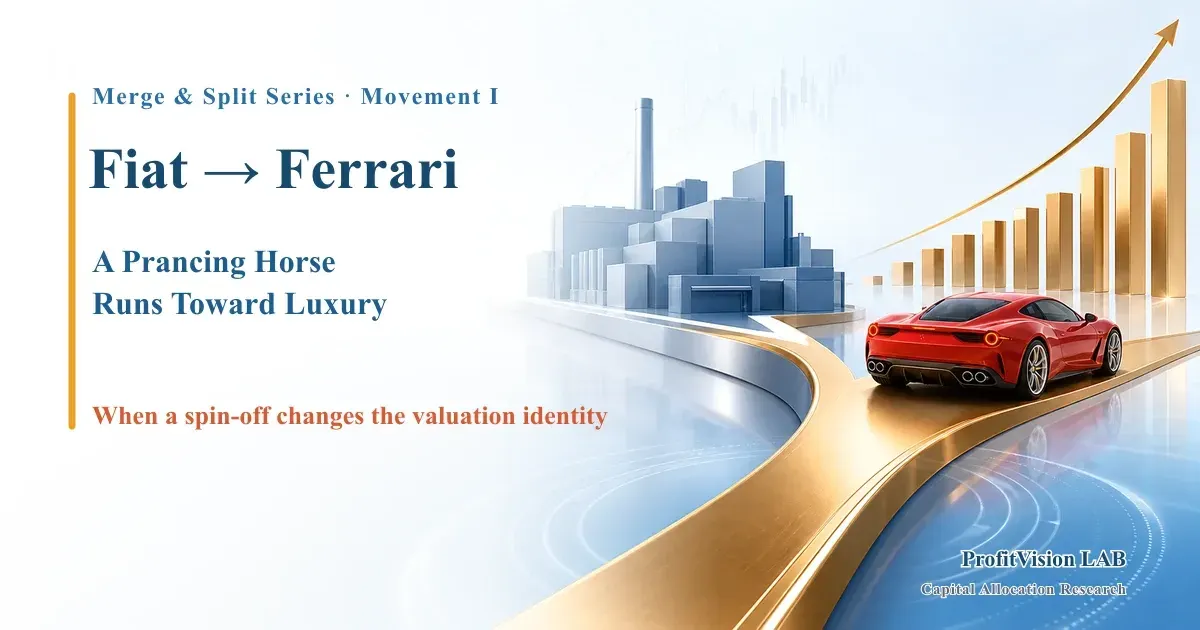
- In 2015, Fiat Chrysler Automobiles spun off Ferrari (RACE). Ferrari priced its IPO at US$52 per share, implying a value of about US$9.8 billion. By 2026, Ferrari's market value was roughly US$62 billion, about six to seven times higher.
- The spin-off did not create a new factory or a new product line. It created a new valuation identity. Inside Fiat, Ferrari was priced as part of an automaker; on its own, the market could value it as a luxury company.
- But "luxury" is not just a higher price tag. A 40x-type valuation requires a real value structure: scarcity, pricing power, brand continuity, customer willingness to wait, residual value, margins and capital efficiency.
- This was Sergio Marchionne's central insight: Ferrari is not a car company. It is a luxury company that happens to make cars. Its deliberate scarcity, with annual deliveries around 14,000 units, is not a constraint. It is the moat.
- The result is one of the purest examples of focus premium. A supercar maker with tiny unit volume can still be worth several times more than mass-market Stellantis. The best owner test was clear: anchoring Ferrari to Fiat's mass-market auto multiple wasted its true value.
How Can 14,000 Cars Be Worth More Than Millions?
Ferrari delivers roughly 14,000 cars a year. Large automakers can produce that number in a few days. Yet Ferrari's market value has been far higher than the value assigned to much larger mass-market automakers.
This is impossible to understand if the only question is "how many cars did it sell?" The right question is different: what does the market believe this company is? The 2015 spin-off changed that answer.
2015–16: Marchionne Lets the Horse Escape Traffic
Ferrari had long been part of Fiat. Sergio Marchionne, while leading Fiat Chrysler Automobiles (FCA), made the decisive move: Ferrari should stand on its own.
(valued as an automaker)
$52/share · ~$9.8B
(RACE)
In October 2015, Ferrari listed on the New York Stock Exchange at US$52 per share, valuing the company at about US$9.8 billion. In January 2016, FCA distributed its remaining Ferrari shares to shareholders, completing the spin-off. Ferrari then traded as RACE.
There is a useful contrast: while Marchionne separated Ferrari, FCA later moved toward "merge" by combining with PSA in 2021 to form Stellantis (STLA). The same capital allocator used both verbs: split what should be separate, and combine what needed scale.
Why Split? The Gap Between Automaker Multiple and Luxury Multiple
This is the core of the case. The auto industry is structurally low-multiple: capital-intensive, cyclical, fiercely competitive and margin-constrained. Luxury is the opposite: high gross margins, deep brand moats, scarcity and pricing power. The market is willing to assign a very different multiple.
When Ferrari was inside Fiat, investors saw it as a premium brand inside an automaker. They could not buy Ferrari without buying the rest of the mass-market auto group. Analysts also tended to measure it with an auto-industry yardstick. A business that deserved a luxury yardstick was trapped under an auto label.
That distinction matters. Luxury is not the same as being expensive. A high price is the result, not the cause. A company deserves luxury valuation only when it can show a durable value structure: controlled supply, demand that exceeds supply, customers willing to wait, steady pricing power, resilient residual values, a brand story that travels across generations, and financial proof in margins, operating profit and free cash flow.
- Durable pricing power created by scarcity: controlled supply reduces the need to protect demand through discounting.
- Demand visibility created by brand and community: customers are willing to wait, collect and return, making demand less purely cyclical than ordinary auto demand.
- Capital efficiency created by a low-volume, high-margin model: the company does not need maximum volume to convert brand equity into margins and free cash flow.
In one sentence: Ferrari belongs in the luxury-valuation discussion not because its cars are expensive, but because it converts scarcity, desire and brand continuity into verifiable financial quality.
Can Luxury Keep Growing Shareholder Value?
Yes, but the growth model is different. A luxury business is not trying to maximize revenue by selling as many units as possible. It is trying to generate high-quality growth that does not destroy scarcity. For Ferrari, value does not come only from more deliveries. It comes from steady price increases, mix upgrades, limited editions and personalization, disciplined brand extension, and reinvestment of high-margin cash flow.
Marchionne's Insight: Ferrari Is Luxury, Not Auto
Marchionne understood the category error. Ferrari should not be compared with General Motors or Toyota. Its closer peers were luxury houses such as Hermès and LVMH.
This was not merely marketing. Ferrari deliberately limits production. Selling fewer cars preserves scarcity, desire and pricing power. For a conventional automaker, failing to sell more cars is a problem. For a true luxury brand, selling too many can be the problem. Ferrari's independence let the market see that its economics were closer to a scarce luxury franchise than a volume car manufacturer.
The Best Owner Test: Fiat Was Not Ferrari's Best Owner
The question was not whether Ferrari was a good business. It was one of the world's elite brands. The question was whether Fiat, a mass-market auto group, was its best owner.
The answer was no. Ferrari did not lack the capital or supply-chain support that Fiat could provide. What Fiat imposed was more damaging: a mass-market auto valuation identity. As long as Ferrari remained inside Fiat, its market value was anchored to auto-sector multiples. Its luxury nature could not be fully priced.
This is a best-owner failure caused by valuation anchoring. The parent was not bad; the parent's industry category was wrong for the asset. Letting Ferrari stand alone allowed the market to classify it where it belonged.
The Numbers: US$9.8B → US$62B
($52/share)
(USD)
(luxury re-rating)
| Ferrari Snapshot | Before / IPO (2015) | Around 2026 |
|---|---|---|
| Valuation identity | Automaker | Luxury brand, closer to Hermès / LVMH logic |
| Market value | About US$9.8B | About US$62B |
| Annual volume | Deliberately scarce, around 14,000 vehicles per year | |
| vs. former mass-market parent | Hidden inside Fiat | Still far above Stellantis, despite Stellantis selling millions of vehicles |
Note: market values are approximate USD figures around June 2026 and will move with share prices and exchange rates. Historical returns do not imply future performance.
The numbers make the point: the same Ferrari, the same craftsmanship and the same scarcity went from about US$9.8 billion at IPO to roughly US$62 billion around 2026. The main change was not volume. It was the valuation yardstick.
Not Just Valuation: The Metabolism of Independence
The spin-off gave Ferrari more than a higher multiple. It gave Ferrari the freedom to define itself.
Inside a mass-market group, Ferrari's decisions had to be weighed against the group's broader needs: production planning, capital allocation, brand architecture and strategic priorities. Once independent, Ferrari could operate with a pure luxury logic: how scarce should it remain, how tightly should it control the brand, how should it approach electrification, and how far should it extend into lifestyle. Independence turned Ferrari from a premium department into the sole owner of its own destiny.
Three Forms of Undervaluation: PayPal, Daimler, Ferrari
Placed next to other cases in Movement I, Ferrari shows that "undervaluation" can have different causes and different remedies.
| Case | Why It Was Undervalued | What the Split Released |
|---|---|---|
| eBay → PayPal (PYPL) | The parent's identity blocked neutrality and market reach | Network effects were unlocked |
| Daimler → Daimler Truck | An industrial cash machine was hidden under a luxury halo | Each business could be seen by the right shareholders |
| Fiat → Ferrari (RACE) | Luxury economics were trapped under an automaker multiple | A full category shift into luxury valuation |
Ferrari is the most extreme version. The value release did not come from entering a new market. It came from letting the market place the same business into the correct category.
Lessons for Taiwan: Where Is Your Jewel Anchored?
1. Valuation depends on category. The same earnings can command very different value depending on whether the market sees them as low-multiple industrial earnings or high-multiple luxury earnings.
2. Scarcity can be the moat. Ferrari shows that deliberately selling less can support pricing power and brand desire when the asset is truly luxury-grade.
3. Sometimes the best gift is letting the jewel leave the mine. Keeping a jewel-class business inside a mass-market parent can look protective but actually impose the wrong valuation yardstick.
Next Stop: Europe's Largest Consumer-Health Spin-off
After Ferrari, the next case moves from supercars to healthcare. GSK spun off its consumer-health business as Haleon, separating pharmaceuticals from everyday health brands so that two businesses with very different rhythms could each find the right home.
Next: GSK × Haleon.
Post-Spin Health Check: Fiat → Ferrari
Using the six questions from the Introduction, here is the overall verdict on the Ferrari spin-off:
| Test Item | Score | Comment |
|---|---|---|
| 1. Capital-allocation effect | ✅ | A full category re-rating from auto to luxury |
| 2. Existing shareholder rights | ✅ | FCA shareholders benefited through IPO and share distribution |
| 3. Clean separation | ✅ | FCA distributed its remaining stake, allowing Ferrari to stand alone |
| 4. Synergy trade-off | ✅ | Mass-market auto and ultra-luxury had little real synergy |
| 5. Exit mechanism | ✅ | Complete spin-off with no residual control |
| 6. Structure type | — | Spin-off; the parent later merged into Stellantis |
Overall verdict: the purest category-shift spin-off in this series: a jewel released from the mine and measured with the correct yardstick.
- Introduction: Merge & Split—the Art of Capital Allocation
- Movement I [Split] · GE: From Empire Collapse to Century Break-up Rebirth
- Movement I [Split] · Abbott → AbbVie: One of the Most Successful Spin-offs Ever
- Movement I [Split] · eBay → PayPal: When the Child Outgrew the Parent
- Movement I [Split] · Siemens: Turning Spin-offs into a Repeatable Art
- Movement I [Split] · Daimler: Split into Two, Each Wheel Accelerates
- Movement I [Split] · Fiat → Ferrari: A Prancing Horse Runs Toward a Luxury Multiple
- Movement I [Split] · GSK → Haleon: Europe's Largest Consumer-Health Spin-off
- Coming next: GE × Wabtec, Novartis, Philips, Universal Music, Hitachi, Sony
- Movement II [Merge]: Broadcom, LVMH, AB InBev, Schneider, Exor, Fujifilm
Comments ()