Enterprise AI Adoption Trends & Challenges ── From Seven 2026 Reports, A View of the Agentic Era
Part 1 of the AI Investment Series. Seven consulting reports converge: 90% of enterprises stuck in pilots, 80% blocked by data, 79% governance-naked. Investment frenzy hits a value gap; agentic AI shifts risk from saying to doing; sovereign AI rewrites supply chains. Research, not advice.
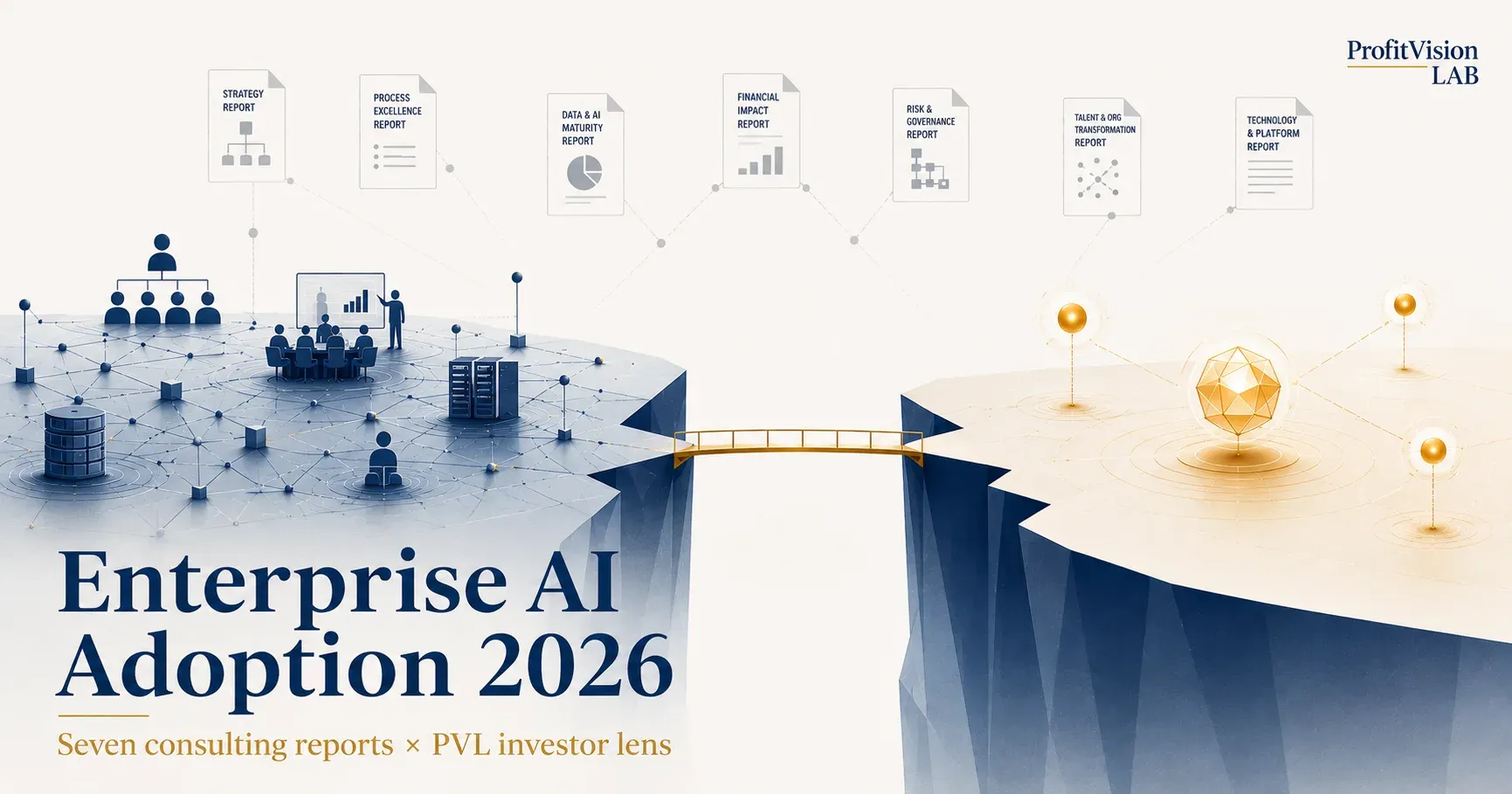
When AI evolves from a tool into a collaborator, the real competitive edge is no longer the model—it's the organization. Seven authoritative reports converge on one verdict: most enterprises aren't ready. And that gap is exactly where investors should look.
1. Foreword: AI Has Been Pulled Into the Boardroom
By 2026, AI is no longer a sandbox experiment tucked away in some corner of the IT department. It has been pulled directly onto the boardroom table, with the CEO watching personally.
Across the early-2026 reports from KPMG, Deloitte, McKinsey, Accenture, Stanford HAI, and EY, you can hear the conversation shifting in real time: from "technology adoption" to "organizational transformation," from "using models" to "governing agents," from "cost savings" to "reshaping work." Capital is breaking new ceilings, CEOs are stepping in personally, and the agentic-scale narrative dominates every consulting cover. But beneath the polish, another reality keeps surfacing—most enterprises simply aren't ready.
Chatbots like ChatGPT operate on a question-answer loop—you ask for something, it gives you text, and you remain the one who acts. Agentic AI adds the missing motor function: give it a goal (say, "book me a flight to Tokyo next week"), and it will open the browser, compare prices, fill the form, charge the card, and email the itinerary.
So agent ≠ chatbot—the difference isn't the mouth, it's the hands. Throughout this article, "agents" simply means AI that can do things on its own.
This article weaves together seven studies—KPMG's Global AI Pulse Survey Q1 2026, Deloitte's State of AI in the Enterprise 2026, McKinsey's State of AI Trust in 2026: Shifting to the Agentic Era, McKinsey's Building the Foundations for Agentic AI at Scale, Accenture's The Age of Co-Intelligence, Stanford HAI's AI Index Report 2026, and EY's AI Pulse Survey Wave 3—to answer the five questions enterprise leaders care about most: How big is the spending? Can it actually scale? Is governance keeping up? Is the infrastructure ready? And when agents take over execution, what is left for humans?
The seven reports share a consensus and a quiet disagreement.
The consensus: agentic AI has moved from concept to deployment; investment speed is far outpacing organizational adjustment; governance and data foundations are the real bottlenecks. The disagreement: how many enterprises have actually scaled? How is ROI measured? What role do humans play in this transition? We'll dismantle each of these in turn—and from the cross-comparison, surface actionable insights for leaders, and more importantly, for investors.
Notice that this article spends very little time on model progress and far more on the "non-technical" topics—organization, governance, data, talent. For CEOs, that's an execution checklist. For investors, that's where stock-picking alpha comes from. When technology is no longer the bottleneck and organizational capability decides who crosses the chasm, our job is to identify (1) who will cross, (2) who is selling the shovels to those crossing, and (3) who will be left behind. That's the core inquiry of this AI investment series.
You'll see that if 2023–2024 was the year of the LLM race and 2025 was the year of pilots, then 2026 is unmistakably the year scale gets tested. Technology is no longer the bottleneck. Organization and governance are.
Before diving in, here's a quick map of the seven reports and what each is best for:
| Report | Lens | Best for understanding… |
|---|---|---|
| KPMG — Global AI Pulse Survey Q1 2026 | Quarterly C-suite survey: investment intent, scaling progress, risk awareness | What the market is doing |
| Deloitte — State of AI in the Enterprise 2026 | The ambition-to-activation gap, sovereign AI, physical AI | Strategic view × execution audit |
| McKinsey — State of AI Trust in 2026 | Responsible AI and governance, ~500 organizations | The global trust gap |
| McKinsey — Foundations for Agentic AI at Scale | Data, infrastructure, platform-layer technical lens | What CIOs and CDOs need |
| Accenture — The Age of Co-Intelligence | With Wharton: hours-reshaping and human role | Quantified economic impact |
| Stanford HAI — AI Index Report 2026 | Technology, industry, policy, education, geopolitics, environment | The macro baseline |
| EY — AI Pulse Survey Wave 3 | Third-wave tracking survey, RAI practices, Shadow AI | Time-series shifts |
Cross-referenced, the seven reports give you six simultaneous layers: market heat (KPMG, EY), execution gap (Deloitte), governance reality (McKinsey Trust), technical foundation (McKinsey Foundations), the human role (Accenture), and the macro baseline (Stanford HAI). Together, they paint a reasonably complete portrait of 2026 enterprise AI.
2. The Investment Frenzy and the Value Gap: Money in fast, value not yet
Enterprise AI investment in 2026 has reached an unprecedented peak.
KPMG's Global AI Pulse Survey Q1 2026 finds that global leaders plan to invest an average of USD 186 million in AI over the next 12 months. More striking still: 74% of leaders say AI will remain their top investment priority even in a recession.
That number breaks an old reflex. In past tech cycles, the first budget to fall when conditions tightened was always IT. This time it's different—AI is being treated as something you accelerate through a downturn rather than a luxury you defer until the next upturn. That's a meaningful inflection in enterprise psychology.
EY's Wave 3 follows up with numbers that look almost too good: "96% of organizations investing in AI saw productivity gains over the past year; 57% saw significant productivity gains", and "97% of executives say their organization is seeing positive ROI from AI investment."
Held against the last decade's ERP, CRM, and cloud migration projects, a 97% positive-ROI rate would have been considered a miracle. AI seems to have pulled it off.
But KPMG, in the same report, immediately pours cold water: "Spending more on AI doesn't equal creating more value." While 64% of organizations report substantial business outcomes, they simultaneously cite difficulty measuring and quantifying value, governance models that can't keep pace, data privacy and security risk, and employee resistance—keeping many globally stuck in the experiment-and-pilot phase.
In other words, there is still an unclosed gap between satisfaction and real value translation.
The Ambition-to-Activation Gap
Deloitte gives this gap an evocative name: "From Ambition to Activation." Deloitte observes: "74% of organizations want AI to drive revenue growth in the future, but only 20% are doing so today." Aspiration is roughly four times reality. Deloitte further segments enterprises into three tiers:
| Tier | Share | Real Meaning |
|---|---|---|
| Deep business transformation | 34% | Truly using AI to reshape the business model |
| Redesigning key processes, keeping the existing business model | 30% | Process optimization |
| Surface-level AI use | 37% | "Adopted AI" but limited substantive benefit |
EY echoes the same gap. "Organizations spending more than 5% of budget on AI are pulling away fast"—on tech upgrades (82% vs. 62%), customer satisfaction (78% vs. 55%), and security (78% vs. 49%), the high-investment cohort has decisively separated from the low-investment one. EY concludes: "The more you invest, the more asymmetric the return becomes." Unlike traditional IT—where marginal returns flatten—AI shows winner-take-all dynamics. For mid-sized companies, that's a difficult two-sided trap: not investing means being left behind, while half-hearted investment may not clear the threshold to positive feedback.
The Attribution Gap: 97% see returns, 65% can't tell you why
EY notes: "Among organizations seeing productivity gains, 65% struggle to attribute those gains directly to AI adoption, and 63% say other executives don't always credit AI for the improvement."
This attribution gap is rarely discussed but quietly becoming pivotal. When productivity rises, who gets the credit? AI? Process improvement? Employee effort? Or just a stronger order book this year? Without a clear measurement framework, the legitimacy story for AI investment keeps facing internal challenges—and the tension between CFO and CEO will keep rising.
Stanford HAI confirms the macro picture: "In early 2026, generative AI tools delivered USD 172 billion in annual value to U.S. consumers; the median per-user value tripled between 2025 and 2026." AI has moved from "worth trying" to "you'll lose if you don't." But how that value gets absorbed by enterprise P&Ls—as auditable revenue or cost savings—still demands more refined tooling and accounting frameworks.
Translated into investment language: the 97% vs. 65% tension is the single biggest valuation fog around AI theme stocks. When CEOs can't cleanly attribute returns, there are only two responses: "let me pause" or "spend more to prove myself right." The first triggers a second wave of capex correction (short-term risk for shovel-sellers); the second drives runaway capex (long-term tailwind for hyperscalers, GPUs, and the power supply chain). Watch which CFOs start demanding "auditable AI ROI"—that's a more useful tell than counting AI mentions in transcripts. It's the real signal of who keeps spending when the tide goes out.
3. The Scale Chasm: 90% Stuck in Pilots
If 2025 was the year of pilots, then the defining question of 2026 is simple: why don't most pilots scale?
McKinsey's April 2026 Building the Foundations for Agentic AI at Scale gives the most direct answer: "Nearly two-thirds of enterprises globally have experimented with agents, yet fewer than 10% have truly scaled them and produced quantifiable value."
That 60-to-10 chasm is 2026's most representative pain point. Imagine: your company spends a year and several million dollars piloting ten agent use cases, and only one makes it to production. That isn't a failure—it's the market average. But it does mean that the overwhelming majority of investment isn't converting to durable business value.
KPMG offers a finer breakdown: "32% of enterprises have deployed and scaled agents; 27% have begun orchestrating multiple agents." Asia-Pacific leads at 49%, the Americas at 46%, EMEA at 42%. The numbers look higher than McKinsey's, but the divergence reflects definitional looseness—KPMG counts "deployed and scaled" and "orchestrating multiple agents," while McKinsey insists on "quantifiable value." Tighten the standard and the share drops sharply.
That definitional split is itself a signal: the industry has no shared yardstick for "scale," and inside the firewall it's easy to comfort yourself with "we've deployed agents, therefore we've scaled."
The Real Bottleneck Isn't the Model—It's Data
McKinsey makes the diagnosis explicit: failure to scale "is not about the AI model itself but the underlying data and infrastructure"—"80% of enterprises cite data limitations as the largest barrier to scaling agentic AI."
That means the 2026 competition has moved off LLM selection and onto the data plane—whoever can make data across departments readable by agents in real time, with shared semantics, wins. For IT and data teams, this is a strategic pivot: resources that used to go into adopting new models must now flow into building the data foundation that lets agents run.
An everyday example: in your company, Department A says "customer" means "anyone who has placed an order"; Department B says it means "anyone who has signed up." An agent working across the two will be hopelessly confused about whom it is supposed to serve.
A semantic layer is essentially an "internal dictionary" that fixes the definition of every business term so machines see the same thing. Without it, the smarter the AI, the more it gets wrong. That's why the industry now says: share meaning, not just data—handing over data without a definition is just handing over confusion.
Deloitte confirms the bottleneck: "Tech infrastructure readiness sits at 43%, data management at 40%, talent readiness has dropped to 20%—and all of these are lower than last year." The drop is not because companies regressed but because AI is accelerating faster than enterprise readiness, so the relative gap widens. Deloitte calls this the "treadmill effect": enterprises are running, but AI is running faster. Even if you finished a foundation-building cycle last year, you may face an even bigger readiness gap this year. That's the new normal.
Accenture frames the upside: "For a $60 billion-revenue company, agentic AI at full maturity could deliver about $6 billion in annual revenue growth and $1.7 billion in annual productivity gains." That's the ceiling scaling can reach—but if 90% of enterprises stay stuck in pilots, most companies can only watch.
What Did the Few Who Scaled Do Differently?
McKinsey's State of AI Trust 2026 offers a clue: "Organizations investing more than $25 million annually in Responsible AI have materially higher maturity and are more likely to capture meaningful AI value—including EBIT impact above 5%."
The implication: scale isn't "buy more models." It's systematic investment across governance, data, talent, and process—sustained and undiscounted. The winners aren't the best AI buyers. They are the best foundation builders.
EY adds the pragmatic note: "34% of executives say their organization has begun deploying agentic AI; early adopters are putting agents into real workflows." But, EY warns, "agentic AI is still a revolution stuck in evolution"—because governance, trust, and behavioral visibility have yet to catch up. Revolution is fast, evolution is slow. The tension between the two is exactly where the scaling battle is being fought.
This section sets up the core AI investment thesis: when 90% of enterprises are stuck in pilots and 80% point to data as the biggest barrier, the durable winners are not the firms selling AI applications (whose customers can't get them working) but the firms laying the foundation—data platforms, semantic layers, vector databases, observability, governance tooling, synthetic data, and enterprise search. This is the classic "selling shovels beats mining gold" logic, but this time the shovel isn't the GPU. It's the layer that feeds data into the GPU. Part 2 will dismantle each of these tickers.
For CEOs the question isn't "should we deploy agents this year?" but "have our data, governance, and talent crossed the minimum threshold that lets agents run?" If not, any agentic deployment will hit a wall in six months and burn out team morale.
4. The Rise of Agentic AI: From "Saying Wrong Things" to "Doing Wrong Things"
The 2026 agentic stack and the 2024–2025 chatbot/copilot stack differ in essence: agents make decisions, call tools, and execute actions on their own. The nature of risk changes with them.
McKinsey's State of AI Trust 2026 lands the line that defines the era: "In the agentic era, organizations cannot only worry about the risk of AI saying the wrong thing—they must confront the risk of AI doing the wrong thing, including taking unintended actions, misusing tools, or operating outside appropriate guardrails."
That sentence marks a paradigm shift: from output risk to action risk. A chatbot saying the wrong thing earns you a furrowed brow; an agent doing the wrong thing might push a wrong price into the order system, wire a wrong amount to a wrong account, or grant the wrong permissions to the wrong person. Both the radius and the speed of risk are amplified by orders of magnitude.
Not because the AI is on drugs. Large language models (LLMs) generate content by predicting the statistically most likely next token. They don't have an "I don't know" option, so when context runs thin, they plausibly fabricate—grammatically smooth, confident in tone, but factually wrong.
Stanford's "22% to 94% hallucination rate" simply quantifies the fabrication frequency across scenarios. For chatbots the consequence is misinformation you read. For agents the consequence is agents acting on that misinformation. The second consequence is, often, irreversible.
The Perception-Action Gap
KPMG finds: "Nearly three-quarters of leaders express some or high concern about data security, privacy, and risk—the highest of all assessed factors." That elevated concern is healthy: enterprises have moved from the excitement phase into the responsibility phase. But concern isn't the same as action.
McKinsey decomposes the risk landscape: "74% of respondents see inaccuracy as a highly relevant risk and 72% see cybersecurity that way. But across nearly all risk categories, respondents report a meaningful gap between the risks they consider relevant and the risks they're actively addressing—particularly on IP infringement and personal privacy."
That perception-action gap is among the most dangerous problems of the agentic era. Enterprises know where the risk lives but governance, process, tooling, and accountability haven't caught up. The most hazardous state isn't ignorance—it's knowing the risk and having no defense for it. Call it conscious vulnerability.
Shadow AI and Hallucination: A Compound Risk
EY observes that "Shadow AI" is accelerating: when governance lags, employees use unauthorized AI tools privately, exposing corporate data to risks no one can trace. EY's Wave 3 notes Responsible AI adoption rising from 49% (Wave 1) to 59% (Wave 3), with another rise to 64% expected next year—meaning 40% of organizations still haven't woven RAI into daily practice.
Stanford HAI surfaces an unsettling trend: "The most capable models are now the least transparent." Across a new accuracy benchmark covering 26 top models, "hallucination rates range from 22% to 94%"—even the flagship models enterprises rely on can fabricate at high rates in certain contexts. For agents, this is uniquely dangerous: a hallucination acted on becomes an action error.
Stanford adds the cognitive dissonance: even a model that wins an International Mathematical Olympiad gold medal reads analog clocks with only 50.1% accuracy. The lesson for enterprises is that model capability is wildly uneven; before deploying any agent, you must stress-test its specific workflow's edge cases.
Accenture frames the accountability angle: "Intelligence may be scalable, but accountability is not." Even when AI removes the upper limit on thinking, humans must still decide what matters, set strategy, and bear consequences.
The shift from "saying wrong things" to "doing wrong things" maps directly onto an entirely new AI guardrail supply chain: agent observability, behavioral audit, permission management, red-team testing platforms, AI liability insurance, synthetic data, model evaluation benchmarks. These were niche tooling in 2024 but by 2026 will be on boardroom checklists. Meanwhile, the existence of Shadow AI means endpoint security, DLP, and SIEM are all riding the same governance upgrade wave. This is the "second layer of shovel-selling": not to agents, but to those policing the agents.
5. Governance Behind the Capability: Trust, Accountability, Security
If the nature of risk has changed, the design of governance must change too. The seven reports speak with one voice: governance is materially behind capability.
Deloitte offers the rawest number: "Agentic AI is expected to have the biggest impact on customer support, supply chain, R&D, knowledge management, and security—but only 21% of companies report having mature governance models for agents." In plain English: four out of five companies pushing agents into production have governance frameworks still in draft. Layered against the 10% who have actually scaled, the picture sharpens: even some of those who scaled aren't governance-mature. Some are simply running first and asking questions later.
It sounds like a slogan, but it's just four things:
(1) Fairness—no discrimination against specific groups.
(2) Transparency—you can explain why the system decided what it did.
(3) Privacy—no leaking of personal data.
(4) Accountability—when things go wrong, there's someone clearly on the hook.
For chatbots, these four are ethical bullet points. For agents, they become the red lines defining permission boundaries—what can the agent do on its own, and what must it escalate. McKinsey's finding that organizations spending $25M+ annually on RAI capture EBIT impact above 5% tells you governance isn't a compliance cost; it's the entry ticket to scale.
McKinsey notes the regional contour: "Asia-Pacific leads on overall RAI maturity, but governance and agentic AI control lag behind data and tech across every region—indicating a globally consistent governance gap." For multinationals, governance is universal weakness, and the group's exposure is shaped by its weakest link.
Governance Has to Move From "After-the-Fact" to "Built-In"
McKinsey's Foundations spells out the two relevant capabilities of four:
1. Build trust into the platform by default: security, access control, privacy, and AI governance should be on by default, not manually patched on later.
2. Make behavior visible and measurable: continuously track data quality, model performance, latency, and cost so problems surface early and improvements compound.
Both upend the conventional governance model. Traditional IT governance is an after-the-fact audit—you check compliance after the system ships. But in the agentic era, "after the fact" is often too late—agents execute irreversible actions in seconds. "Default-on" and "behavior-visible" pull governance from an audit checkpoint into a built-in machine property. For CISOs and CIOs, the buying logic flips: you're no longer purchasing "tools to see what agents did" but tools that prevent agents from doing unauthorized things.
EY ties governance back to value capture: "Responsible AI adoption rose from 49% (Wave 1) to 59% (Wave 3), with another rise to 64% expected next year." Awareness is spreading. But Shadow AI is rising in parallel, and employees keep bypassing governance for speed—"the cost of falling behind is being paid in individual incidents." RAI policies "existing" and "being followed" are two different things—any policy without paired tooling and incentives is just decorative text.
Probabilistic Systems Need a New Governance Frame
Traditional IT governance rests on the assumption of predictable systems: same input, same output. But agentic AI is probabilistic: same input may yield different outputs. McKinsey's observation that "we don't know what the agent will do" isn't really about agent opacity—it's about not yet having designed governance frames for probabilistic systems.
What governance committees need in 2026 is not more audit headcount but redefinition: what counts as reasonable preventive control, what counts as acceptable post-incident traceability, and what counts as tolerable residual risk. Without those answers, no amount of tooling produces real safety—only its appearance.
21% governance-mature, 79% governance-naked—that defines the three-year expansion runway for GRC for AI. Three investable lines: (1) hyperscalers baking "default-on" governance into their platforms; (2) independent vendors of agent observability / red-teaming / evals; (3) legal-tech and insurance-tech firms folding probabilistic systems into existing risk frameworks. Each line has incumbents and challengers; the picking question is the balance between customer switching cost and the risk of being swallowed by hyperscalers. Part 2 lays out the comparison.
6. Data and Infrastructure: The Real Bottleneck Isn't the Model
Synthesizing all seven reports, the most underestimated yet decisive issue of 2026 is data and infrastructure.
McKinsey's Foundations is blunt: "80% of enterprises cite data limitations as the largest barrier to scaling agentic AI. This infrastructure challenge, not the AI model itself, is the core issue blocking successful scaling."
The first two of McKinsey's four foundational capabilities are about data:
| Capability | Core Idea |
|---|---|
| Shared Semantic Foundation | Share meaning, not just data. Attach clear, common definitions so analytics, ML models, and agents all see the same thing. |
| Unified Data Infrastructure | Use one data foundation for analytics and AI. Build the data once and reuse it everywhere—reports, ML, generative AI—instead of separate pipelines and platforms. |
Capability #1 returns to the "internal dictionary" idea: when departments disagree on what "customer," "order," or "active user" mean, agents clash when they collaborate across boundaries. The semantic layer is becoming the new heart of enterprise data architecture. Capability #2 challenges a decade of practice (one pipeline for BI, one for ML, now another for Gen AI) and argues for radical consolidation. The cost is steep—you don't rewrite years of pipeline overnight—but McKinsey's subtext is unmistakable: don't do this and you don't scale. For CIOs, this is a 3-to-5-year strategic decision.
The Treadmill Effect: Readiness Declines Year Over Year
Deloitte's confirmation: "Tech infrastructure readiness at 43%, data management at 40%, talent readiness down to 20%, all lower than last year." Not because enterprises regressed—because AI accelerated faster than they could keep up.
Deloitte also flags a compounding pressure: when agentic AI and physical AI expand together, the infrastructure load multiplies. "58% of companies report at least limited use of physical AI; the proportion using any form of physical AI is expected to reach 80% in two years."
Traditional automation runs on hard-coded flows: a robotic arm executes a fixed program. Change the environment and it stalls.
Physical AI means machines with a brain: a robot "sees" the empty shelf and decides on its own whether to restock and what to restock first. The class includes automated warehouses, autonomous vehicles, humanoid robots, smart cameras, and last-mile delivery bots.
When it errs, the consequence isn't a red flag on a dashboard—it's wrong parcels delivered to wrong addresses, hits against walls, or harm to people. Deloitte's "80% within two years" makes data quality a strategic issue that directly touches customers, partners, and physical safety.
Once agents stop merely running back-office flows and begin controlling robots, autonomous vehicles, and automated warehouses, infrastructure latency tolerance falls dramatically.
The Power-Carbon-Data Cascade
Stanford HAI flags another infrastructure-layer constraint: "AI data-center power capacity has reached 29.6 GW, roughly the peak demand of the entire state of New York. Training Grok 4 is estimated to emit 72,816 metric tons of CO2-equivalent."
That is to say: as enterprises embrace agentic AI, they implicitly absorb a larger environmental and energy bill. For CFOs and Chief Sustainability Officers, AI compute consumption now needs reconciling with carbon commitments—more AI may collide head-on with carbon targets.
From another angle, "data readiness" carries a different weight in the agentic era than in the BI era. In the BI era, poor data quality usually manifested as a wrong report; in the agentic era, low-quality data, once consumed by an agent and acted upon, amplifies, propagates, and even cross-contaminates systems automatically. With "80% physical AI adoption within two years," bad inventory data no longer just makes an analyst redo a spreadsheet—it makes a warehouse robot send the wrong parcel onto the wrong truck.
McKinsey's closing line on infrastructure deserves to be a motto: "Agentic AI scales on strong data." To scale agents, scale the data first.
This section is the single most important stock-picking compass in the whole article: 80% citing data as the biggest barrier and 80% adopting physical AI within two years jointly define capex direction for the next three years. Three thick supply chains: (1) data plane—data clouds, lakehouses, semantic layers, vector databases; (2) compute & power—hyperscalers, GPU, ASIC, AI-ASIC peripherals, power/grid/thermal infrastructure; (3) physical AI interface layer—machine vision, edge inference, sensor fusion, OT/IT integration. Don't miss the "AI vs. carbon" collision—it forces new energy stories like nuclear, SMR, long-duration storage, and renewable PPA. That's the often-overlooked third shovel layer.
7. Workforce and Skills: The Human Position Under Co-Intelligence
When agents take over execution, what is left for humans? The reports answer from different angles.
Accenture's The Age of Co-Intelligence introduces a key idea: the evolution from "tool" to "co-intelligence." Accenture writes: "AI is moving from tool to co-intelligence, with humans leading and AI amplifying judgment, execution, and autonomy. AI has shifted from simple augmentation to interpreting intent, reasoning over options, coordinating steps, and executing bounded work at machine speed across functions."
Think director and editor. The director (the human) decides what the film is and which moment matters most; the editor (the AI) processes raw footage at impossible speed, offers cut variants, and surfaces the strongest shots; the final call still belongs to the director.
Accenture's framing is that future work isn't "humans using Excel" but "humans directing a team of self-driving AI assistants." Your edge isn't whether you can operate the tool. It's whether you can direct it—judge what's good, ask the right questions.
Accenture quantifies the scope: "More than 50% of work hours in the U.S. economy are being reshaped by roughly 60 digital and physical AI agents, affecting more than 120 million workers across 18 industries." Even roles considered "most creative" or "most human"—marketing, design, research, writing—now have agents inside at least one stage of the workflow.
Which Human Capabilities Appreciate?
KPMG's counter-observation: agents proliferating doesn't render humans dispensable—it elevates certain human capabilities. "Leaders increasingly value critical thinking and problem solving (49%), adaptability and continuous learning (52%), and creativity and strategic thinking (41%)—reinforcing the message that even as agents expand, human capability remains indispensable."
The shared trait of those three? They cover what agents cannot. Critical thinking offsets hallucination risk. Adaptability covers edge-case fragility. Creativity supplies what agents lack in defining the problem.
"Installed but Unused": Another Face of the Activation Gap
Deloitte: employees encountering AI tools is outpacing actual use—"AI-tool penetration jumped from below 40% to 60% in a year. But among employees with tools available, fewer than 60% use them in daily workflows." The famous "installed but unused" problem: tools are there; habits aren't.
EY adds a productivity-attribution layer: "Among organizations seeing productivity gains, 88% say it is a key metric leaders are evaluated on. But 65% find it hard to attribute the improvement to AI adoption, and 63% say other executives don't always give AI the credit." When humans and agents jointly produce output, how do you attribute performance? How do you design KPIs? How do you split bonuses? These root HR and performance-management questions still lack mature answers.
Stanford HAI surfaces a generational shift: "Generative AI reached 53% population adoption in three years—faster than the PC or the internet. Organizational adoption hit 88%. Four out of five college students now use generative AI." Tomorrow's new hires already treat "using AI" as a default skill. Training menus built around "can the employee use AI" will be obsolete on day one; the real curriculum should be "how do humans collaborate with agents," "how do we verify agent output," and "how do we work inside agent accountability boundaries."
Cross-referencing "co-intelligence" with "installed but unused" yields the investment thread: pure AI subscriptions sold to users will dull (because too many never adopt them), while AI embedded inside existing workflows (vertical SaaS, embedded copilots) will capture the real adoption-rate dividend. Watch one underrated line as well: when KPIs need redesigning because of AI, enterprise HR / performance / L&D platforms face a structural upgrade—not just training catalogs, but a redefinition of the data structure called "performance". That's the fourth shovel layer: organizational capability upgrades.
8. Global Competition and Sovereign AI: A New Geopolitical Battlefield
Two of the seven reports focus on AI's geopolitical dimension, and the topic's weight is rising fast.
Stanford HAI offers a key data point: "The gap between U.S. and Chinese models has materially narrowed. Since early 2025, U.S. and Chinese models have repeatedly traded the top of the leaderboard; as of March 2026, Anthropic's flagship leads by only 2.7 percentage points." The "U.S. leads by a generation" narrative is over. For enterprises, that means AI supply is no longer monopolar—it is bipolar, sometimes tripolar (Europe, Arab states, and India are stepping up).
Think of it like "domestic auto" policy. When AI becomes utility-grade infrastructure, governments start asking three questions:
(1) Can our data sit on another country's cloud?
(2) If relations sour, can our AI service be cut off?
(3) Does the foreign model embed values or biases we don't want?
So countries spin up their own hyperscalers, their own LLMs, and their own AI regulations. For enterprises, AI procurement is no longer just "cheap and good"—it's also "politically resilient." Deloitte's "77% of companies now factor supplier nationality into procurement decisions" makes the shift concrete.
Deloitte: "77% of companies now factor supplier nationality into procurement decisions, and nearly three-fifths primarily use domestic suppliers to build their AI stack." A paradigm change: over the past decade, enterprises rarely asked "where is this vendor headquartered?" when buying cloud or AI tools. From 2026 on, that becomes a standard question.
Asia-Pacific Leads, With Two-Way Influence
McKinsey on regional contour: "APAC leads overall RAI maturity, but governance and agentic AI control trail data and tech in every region." KPMG's regional cut also useful: "Agent scaling is highest in APAC at 49%, the Americas at 46%, EMEA at 42%." APAC's lead reflects a fact: markets with tighter resources and rising labor costs are more aggressive in pushing agents toward productivity breakthroughs.
For APAC enterprises this is both pressure and opportunity: pressure to keep up with regional peers; opportunity because they sit inside the strongest agent-adoption culture, with local experience that flows back into global frameworks. It overturns the traditional "HQ designs, regions execute" governance flow and calls for a more bidirectional global architecture.
Supply-Chain Resilience Is Also an AI Topic
When AI becomes a critical production input and providers concentrate in a few countries, any geopolitical clash can cut a company's AI supply. Deloitte's "domestic supplier" trend is, in essence, enterprises hedging that risk. For corporate strategy teams, 2026 AI procurement is no longer just "cheapest and best"—it adds a new axis: "who is least likely to be cut off under geopolitical pressure?"
The rise of sovereign AI = a fast-forming geopolitical AI moat. Three investable angles: (1) regional hyperscalers / sovereign clouds—local AI infra plays in Europe, the Middle East, India, and Southeast Asia; (2) geopolitically neutral "middleware"—platforms that bridge NVIDIA, AMD, ASIC, and meet local data-sovereignty rules; (3) the closing 2.7-percentage-point US-China model gap compresses the soft-narrative premium for "U.S. monopoly," while multi-model routing tools (model routers, inference gateways) capture structural tailwind. This line demands sharp reading of geopolitics and regulation.
9. Closing: Five Questions for Investors
Synthesizing the seven reports, five issues should be top of mind for 2026 enterprise leaders. But we flip the "leader checklist" into an "investor question framework"—same five, asked not as "is my company ready?" but as "is the company I'm watching in the right position?"
| # | Original guidance for CEOs | Flipped: the investor question |
|---|---|---|
| 1 | Treat governance and scale as the same thing | Is this company "selling governance tools" or "running without governance"? The first has higher long-term certainty; the second has short-term explosiveness and tail risk. |
| 2 | Invest in the data plane, not just models | Is the AI story "selling applications" or "selling data foundations"? Switching costs are usually an order of magnitude higher in the latter. |
| 3 | Design human-agent collaboration workflows | Does the company "sell subscriptions to use" or "embed AI into existing workflows"? The latter has much higher real adoption. |
| 4 | Institutionalize ROI measurement | Do customers pay via "package ARR" or "usage-based billing"? Usage tracks real value far better. |
| 5 | Prepare for "doing wrong things" | Is this company the one likely to be sued when an agent does something wrong? If so, legal and insurance costs need to be in your valuation. |
The 2026 painted by these seven reports isn't a story of AI's breakthrough—it's a story of whether enterprises can keep up with AI. Agentic AI isn't merely a new generation of tools. It reshapes how work is structured, how decisions are distributed, how risk is managed, and how value is measured. That makes it, fundamentally, a transformation in management and leadership—not just a technology upgrade.
For leaders, the real question isn't "should we push AI harder this year?" but "is our org chart, governance, talent system, data plane, and measurement loop ready to let agents create real value?" Across the seven reports the answer is nearly uniform: most enterprises are not. The good news: those who act early and systematically close the gaps will, in 2026, open a lead that's hard to reclaim—and that lead is the real watershed for the next decade.
Breadth vs. Depth
A second important distinction for 2026: breadth versus depth. Deloitte's three-way segmentation (34% deep transformation / 30% process redesign / 37% surface use) is a useful mirror. Board reports usually emphasize breadth—how many employees have AI tools, how many departments deploy agents. But breadth itself isn't value. Value depends on depth: how many critical processes have been rewritten by agents? How many decisions accelerated by an order of magnitude? How many new revenue models become possible?
The gap between KPMG's "64% report substantial business outcomes" and Stanford HAI's "88% organizational adoption" suggests the breadth story has been over-told. The depth story is just beginning.
One last reflection: the seven reports come from world-class institutions, but they don't fully agree. EY's 97% positive ROI sits in tension with McKinsey's under 10% actually scaling—and that tension is worth pausing on. Among the companies you watch, are they part of the "saw positive ROI" majority, or the "actually scaled" minority? The two are not mutually exclusive, but they mean very different things. The first means "the direction is right." The second means "execution has landed." The 2026 advantage will depend on whether companies can graduate from the first to the second.
Who Will Benefit From the Enterprise AI Wave?
This article dissected what enterprises are doing. Part 2 flips the question: when 90% are stuck in pilots, 80% blocked by data, 79% governance-naked, and 77% asking about supplier nationality—who picks up those orders?
Part 2 lays out the Four-Layer AI Investment Map:
- Layer 1: Compute & Power—GPU, ASIC, hyperscalers, AI data centers, power / thermal infra, SMR & long-duration storage
- Layer 2: Data Plane—data clouds, lakehouses, semantic layers, vector databases, synthetic data, enterprise search
- Layer 3: Governance & Guardrails—agent observability, red-teaming, AI GRC, AI liability insurance, endpoint security upgrade
- Layer 4: Embedded Applications—vertical SaaS, embedded copilots in existing workflows, HR / performance platforms, physical AI interfaces
For each layer we pick 3–5 representative companies and apply The Moat Five (M5) × The Four-Layer Defensive Screen (4LDS), tagging each as "worthy of deep research," "watchlist," or "needs particular caution." Think with me, not just trade with me.
Sources
The seven reports synthesized in this article:
- KPMG — Global AI Pulse Survey (Q1 2026)
kpmg.com/.../ai-pulse - Deloitte — The State of AI in the Enterprise 2026
deloitte.com/.../state-of-ai-in-the-enterprise - McKinsey — State of AI Trust in 2026: Shifting to the Agentic Era
mckinsey.com/.../state-of-ai-trust-in-2026 - McKinsey — Building the Foundations for Agentic AI at Scale
mckinsey.com/.../agentic-ai-at-scale - Accenture — The Age of Co-Intelligence (with Wharton School)
accenture.com/.../age-of-co-intelligence - Stanford HAI — AI Index Report 2026
hai.stanford.edu/ai-index/2026 - EY — AI Pulse Survey (Wave 3)
ey.com/.../pulse-ai-survey
Written in May 2026. All data and views are drawn from the seven publicly released reports above.
This is research commentary, not individual investment advice.
© 2026 ProfitVision LAB · Shiba the Disciplined · I teach you how to think, not just what to do