
ACN Q3 Earnings Update: Crouch or Broken?
Accenture fell 16% after Q3, with P/E near a decade low. The earnings engine remains intact; the leading indicators weakened: bookings turned negative and ownership is now Grade E. Fundamentals are neutral-constructive, but ownership is a single-veto signal.
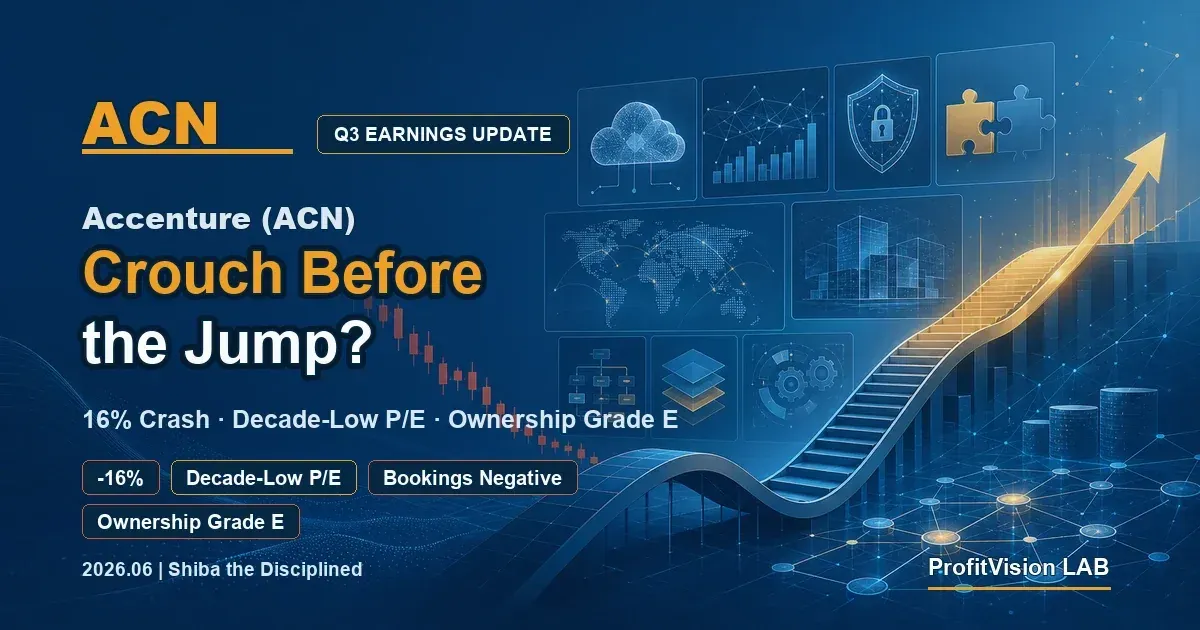
A 16% one-day drop, where the market got the direction of its fear right—but the excuse wrong
This piece continues the April 2026 research, "Accenture: The Biggest Winner of the AI War" (prior rating: ⏸️ Active Watch, near the threshold to clear). At that time the stock was $255–270 at ~19–21x forward earnings, and I positioned ACN as the largest contractor for enterprise AI implementation. After Q3, two things must be updated: first, the stock fell further to ~$130, and new bookings flipped from an H1 record of $43B to −2% YoY in Q3, so the "aggressive growth" characterization must be retracted; second, the ROE of 38–40% I used then was too high, and is corrected here to the official 10-K basis—ACN's reported ROE peaked near 31% (2022) and is now ~24%. The full analytical skeleton of the original research is preserved below, with Q3 fact-corrections embedded chapter by chapter.
Chapter 01Industry Landscape: The Money Didn't Shrink—It Switched Lanes
To understand why ACN was sold off, start with the lane it runs in. Technology spending in 2026 is not a story of retreat—Gartner projects global IT spending to grow 10.8% to $6.15 trillion, with global AI spending approaching $2.5 trillion. The pie is expanding fast.
The issue is where the money flows. Within that $2.5 trillion AI pie, over 80% is absorbed by hardware and cloud—AI infrastructure (accelerator-embedded servers) accounts for roughly 84% of total AI spending, with data-center systems spending up 31.7% to over $650 billion. That money lands with NVIDIA and the hyperscalers, structurally compressing the relative share left for consulting and human-led implementation.
The AI value chain splits roughly into three layers: at the base, the "shovel sellers"—hardware and cloud (NVIDIA, AWS); in the middle, the "tool makers"—software and models (OpenAI, Palantir); at the top, the "teachers"—consulting and implementation (Accenture, Deloitte).
In 2026, money is flooding the base layer, because enterprises must first build the compute and data centers. But construction eventually finishes. As enterprises move from "buying GPUs" to "making GPUs actually generate ROI," that work flows back to end-to-end implementers like ACN. ACN currently sits in a lane that is temporarily out of favor—but where demand should eventually return.
ACN's position in this chain is clear: it does not make hardware or build foundation models. It is the hand that "integrates dispersed technologies into the enterprise and makes them actually run."
Chapter 02Business Model & Economic Moat: Client Relationships Built Over Time
ACN's moat isn't a single technology—it's a composite of scale × client relationships × end-to-end capability. It serves ~9,000 clients, with ~$72B in annual revenue and nearly 800,000 employees across 120 countries. CEO Julie Sweet frames it as the only company that can operate at scale "from the AI and technology core all the way to reinventing nearly every part of the enterprise."
This moat rests on a key market gap—enterprises that know they need AI but can't do it themselves. Sweet's framing is precise: GenAI itself is just a tool, and the work required to use it to create value at scale is substantial.
Why can't they do it? Not because models fall short, but because the foundation isn't ready. Sweet notes clients are still "in the midst of cloud, ERP, and security modernization, with data readiness still nascent." This produces ACN's most valuable pull-through effect: roughly one in every two AI projects carries significant data-integration demand. Clients don't want a single AI tool—they need their data, cloud, and security stack wired together first, which is exactly what a company that operates end-to-end at scale can capture.
How the moat could be breached
The reverse case must be stated honestly: this moat bets that "AI adoption is too complex to do without us." Should AI tools become dramatically easier to use, or should clients begin demanding hard, measurable results relentlessly, the width of that moat will be tested. A Futurum 2026 study found that 71% of enterprise buyers plan to, or may, switch consulting vendors between 2025 and 2028—those who retain clients will be the ones that prove measurable outcomes; those who can't deliver ROI get replaced. That 71% is both ACN's opportunity and its risk.
Update: the growth narrative shifts from "offense" to "low-gear defense"—M&A is the monitoring axis
This is the largest divergence from the April research, and it must be stated explicitly. The original piece used the H1 FY26 record of $43B in bookings to support a picture of "aggressive growth"—correct at the time, but Q3 bookings fell back to $19.3B and turned negative YoY, overturning the "aggressive growth" characterization. The moat itself (client stickiness, switching costs, ecosystem hub) remains, but the growth stage must be re-rated from "offense" to "low-gear defense."
More importantly, the original research already flagged ACN as an "M&A factory" (30–50 acquisitions per year; a $5B FY2026 acquisition budget). After Q3, this line is upgraded to the central monitoring axis of this report: ACN's recent acquisitions (Dragos, runZero, NetRise, Whalar, the AlphaSense investment) are reshaping it from a "high-ROE, asset-light consultancy" into a "goodwill-heavier hybrid that includes software platforms." This is a deliberate strategic choice to "buy growth"—directionally favorable; but its cost shows up directly in ROE (see Chapter 4), and the decisive judgment on the transition is whether that goodwill converts into returns or deteriorates into impairment.
Chapter 03Competitive Dynamics: Symbiosis, Not Zero-Sum
The market's biggest misread is casting ACN as the old guard about to be disrupted by AI startups. But surveying who can actually deliver board-level, measurable results to the Global 2000 reveals a three-way symbiotic circle—not a single winner taking all.
| Tier | Representatives | Outcome delivered | Fatal limitation |
|---|---|---|---|
| Consulting majors | Accenture · Deloitte · McKinsey | End-to-end transformation; natively seated next to the Global 2000 | Slowing growth; labor-intensive |
| Platform layer | Palantir · Glean · Microsoft | Operational decision / knowledge-productivity outcomes | PLTR relies on human implementation; Glean is essentially a search layer |
| Vertical startups | Sierra · Writer · Cohere | Point tools (service / writing / models) | Lack measurable Global 2000 outcomes; stuck in the pilot attrition race |
The key structural fact: Palantir is model-neutral and Glean integrates 15+ LLMs—these "outcome-delivery layers" don't bet on a single model themselves. So whether market attention is on Gemini or Claude, they win either way. And the one that actually inserts these tools into a $100B-revenue, 9,000-client incumbent is still Accenture—the hand.
Even Palantir, the purest "outcome-quantifiable" player, requires armies of forward-deployed engineers for upfront implementation—so much so that an entire cohort of implementation consultancies founded by ex-Palantir engineers has emerged. That precisely proves the point: buying software isn't enough; implementation always needs people.
ACN faces two real threats, neither being AI startups. First is head-on competition for share from same-tier majors like Deloitte, McKinsey, and TCS—a fight over existing market share. Second, and deeper, is the day AI tools become so usable that clients no longer need consultants. But given Palantir still requires heavy human implementation, that day remains distant.
Startups won't replace ACN—they feed it: startups build the tools, consultants make the Global 2000 actually use them.
Chapter 04Financial Resilience: The Engine Is Intact, but the Leading Indicator Flashes Yellow
Lining up three quarters of data is the core evidence for "crouch" versus "fall." First, note the divergence between two trajectories:
| Metric (FY2026) | Q1 (Nov) | Q2 (Feb) | Q3 (May) |
|---|---|---|---|
| New bookings | $20.9B | $22.1B (record) | $19.3B |
| Bookings YoY (USD) | +12% | +6% | −2% |
| Revenue YoY (local FX) | +5% | +4% | +3% |
| EPS YoY | — | +4% | +9% |
| Operating margin (YoY) | — | +30bps | +20bps |
Revenue is gliding down smoothly: 5% → 4% → 3%, a steady 1-point decline each quarter, paired with two straight quarters of YoY margin expansion and a gross margin holding near 32.8%—signs of "mature, decelerating, but healthy."
Bookings are the sharp turn: +12% → +6% → −2%, from a record high to negative in a single quarter. New bookings are a leading indicator of future revenue; when they weaken first, it typically signals further pressure on revenue growth over the next 6–12 months. This is the only genuinely alarming signal in this report.
Book-to-Bill = new bookings ÷ current-period revenue. Above 1 means "more orders coming in than revenue being consumed," so the revenue base won't collapse; below 1 is the real warning.
ACN's was 1.2 in Q2. Even with Q3 bookings down to $19.3B against $18.7B revenue, the ratio is still ~1.03—holding above 1. Add management's note that bookings swing sharply with the timing of a few large managed-services deals, and using a record Q2 as the base naturally makes Q3 look worse. So "negative bookings" is a yellow light, not a red one.
The balance sheet, meanwhile, looks every bit like a "healthy company":
| Resilience metric | Value (as of May 2026) | Read |
|---|---|---|
| Total cash | $10.2B | Ample |
| Net cash position | ~ +$1.0B (net cash) | No net-debt strain |
| TTM free cash flow | ~$12.5B | Cash machine |
| ROIC / ROE | ~27% / ~25% | Top-tier capital efficiency |
| D/E | ~0.25 | Low leverage |
| Q3 shareholder returns | $2.2B (incl. $1.0B dividends) | Consistent returns |
A company being structurally hollowed out by AI does not produce 27% ROIC, $12.5B in free cash flow, and consecutive margin expansion. And the full-year free-cash-flow outlook was actually raised by $1 billion.
Update: ROE data correction, and an honest decomposition of the decline
The April research labeled ROE at 38–40%, "world-class"—that figure was too high, and is corrected here to the official 10-K basis. Per ACN's filings, the true path of reported ROE is: ~31% peak in 2022, ~28% in 2023, ~25% in 2024–25, and ~23.5% in the February 2026 quarter—now below the 10-year median (~33%). The original 38–40% likely came from a goodwill-excluded adjusted basis (which can run above 80%) and shouldn't serve as the headline figure for communication. Candidly, this is where the prior version should have been corrected.
Post-correction, the real question isn't "does it clear the 17% threshold" (24% far exceeds it), but what is driving this five-year, one-directional decline. The DuPont decomposition gives the answer: "three causes, only one tied to the moat":
| Driver of ROE decline | Nature | Moat signal? |
|---|---|---|
| ① M&A injecting goodwill, inflating assets & equity | Capital-allocation choice (buying growth) | No—strategy, not decay |
| ② Earnings accumulation, equity base swelling | Structural; buybacks lag equity growth | No—denominator effect |
| ③ Slight dip in net margin / asset efficiency | AI pricing pressure on human implementation | Yes—but smallest in magnitude |
ROE = net margin × asset turnover × equity multiplier. When a company acquires heavily, goodwill is injected into assets and shareholders' equity swells, so the denominator grows and ROE naturally falls—but this doesn't mean its "earning power" weakened; it means it is actively "spending to buy future growth."
ACN is exactly this script: an "M&A factory" that has bought in cybersecurity software and data capabilities. The main drivers of ROE falling from 31% to 24% are goodwill and equity inflation, not collapsing margins (gross margin still steady at 32.8%, operating margin still expanding YoY). So this is "the moat's shape changing," not "the moat disappearing." What to watch isn't the absolute ROE level—it's whether that goodwill converts into returns, or one day becomes impairment.
Chapter 05Valuation & Scenario Analysis: Which Box Is the Market Pricing?
ACN trades around 12.8x trailing and ~11x forward, with a yield near 4%, after a ~49% drop over the trailing year—valuation now sits in a decade-extreme cheap zone. But cheap doesn't mean buy; what matters is which scenario the market is pricing. This report does not set a price target; it runs scenarios only.
Update: the original research's price-target framework is now void. The April piece, with the stock at $255–270 and ~19–21x forward, offered bull/base/bear valuation ranges (the most bearish scenario mapped to 15–18x). With the stock now ~$130 at 12.8x, it has broken below the lower bound of even that bearish scenario—evidence that the market's entire pricing logic has shifted down post-Q3, and the old framework no longer applies. What follows uses a target-free, three-scenario P/E approach.
| Scenario | Core assumptions | Implied valuation | Investment meaning |
|---|---|---|---|
| Bull | AI infrastructure wave recedes, implementation demand returns; cybersecurity software and mid-market (Accenture Edge) transitions work; bookings YoY turns positive again | P/E re-rates to 16–18x (historical mean zone) | "Crouch before the jump" holds, with a better post-crouch physique |
| Base | Low-gear consolidation: low-single-digit revenue growth, gradual margin expansion; transition works but takes time; bookings oscillate around 0% | P/E consolidates in a 12–14x range | Collect the dividend (~4%) while waiting for the transition to pay off—time for space |
| Bear | Structural de-rating: AI tools become usable enough to erode human implementation; the 71% switching wave materializes; Middle East escalation weighs; federal business keeps shrinking | P/E compresses further to 9–10x | The "crouch" is confirmed a "fall"—a value trap |
The market's 6/18 reaction essentially pushed pricing from "Base" toward "Bear"—selling the combination of "negative leading indicator + consecutive guidance cuts" on a name already carrying an AI-disruption narrative, with emotion amplified. Yet the earnings data (27% ROIC, net cash, $12.5B FCF) still support the "Base" scenario—a tension between valuation and fundamentals.
Chapter 06Risk Factors
Beyond the moat-breach scenario above, five risks deserve to be named explicitly:
1. Institutional distribution (ownership Grade E)—the most immediate risk
PV institutional-demand strength has fallen to Grade E: institutions are actively selling down, not accumulating. Under the 4LDS this is a single-veto, and it is the ownership-side attribution of the 16% crash itself. Until this reverses, "cheap" can get cheaper—entering now is catching a falling knife regardless of how constructive the fundamentals look.
2. Mistaking a structural shift for a cyclical crouch
A structural down-shift and a cyclical crouch look identical in their early phases but end in opposite places. The market's current bet is precisely that ACN's "knee is injured"—that AI fundamentally shrinks the ceiling of the human-implementation business. This is the single hardest risk to disprove in real time.
3. Uniform insider non-buying
Management talks optimistically, but their feet vote the other way. Over the recent period, the CEO and the entire C-suite have been net sellers, with zero open-market purchases—no one at the top is adding at a decade-low valuation. That stands in tension with the "we are unique, the future is bright" narrative.
4. Geopolitics already in the guidance
The Middle East conflict is explicitly embedded in guidance (the region is ~1% of revenue, with ~3,000 employees on the ground); a material escalation would force a further cut. The U.S. federal business (DOGE-related reductions) is a recurring drag, trimming roughly 1 point off full-year growth.
5. The M&A transition may fail, and time has a cost
The transition (cybersecurity software, mid-market) is a multi-year effort and dilutes EPS initially; if the acquired goodwill can't convert into returns and instead becomes impairment, ROE keeps falling and "the moat's shape changing" becomes "the moat loosening." The market extends little patience to names that are "directionally right but require a long wait"—which is exactly why the P/E has been compressed to a decade low.
Chapter 07Investment Thesis & Tactical Outlook: Crouch Before the Jump—but Institutions Are Still Distributing
The core view has two layers. On fundamentals, this looks more like "a quality company shifting into low gear" than "a company starting to break" (neutral-to-constructive, watching the M&A transition). But on ownership, PV institutional-demand strength is Grade E—institutions are actively selling down—which triggers a single-veto right now. The "crouch before the jump" thesis holding does not make this an entry point: this is a "thesis-bullish, timing-not-yet" name.
The Four-Layer Defensive Screen (4LDS): updated verdict (vs. April 2026)
The original research's screen read "moat clear, volatility clear, ownership and technicals on watch"—overall "Active Watch, near the threshold to clear." After Q3, the ownership filter deteriorated straight from "watch" to "single-veto"—the biggest change in the verdict:
| Filter | April 2026 verdict | Updated verdict |
|---|---|---|
| 1. Ownership | Watch (A/D awaiting recovery) | Reject | PV institutional-demand = E (distribution) → single-veto |
| 2. Moat | Clear (ROE 38–40%) | Pass + trend warning (ROE corrected to ~24%, 5-yr decline; goodwill unproven) |
| 3. Volatility | Clear (IV Rank 40–55%) | Pass (IV Rank higher post-crash) |
| 4. Technicals | Wait (below 50MA) | Fail (deeper below 50MA post-crash) |
⚠️ Ownership Grade E = single-veto: this also explains the crash itself
- PV institutional-demand strength has fallen to Grade E, meaning institutions are actively distributing (selling down), not accumulating.
- Under the 4LDS single-veto rule, a Grade E ownership reading triggers an absolute reject—no matter how deep the moat, an options-selling entry is off the table right now.
- This doesn't conflict with the fundamental conclusion—it complements it: the fundamentals say "worth tracking long-term (crouch before jump)," while the ownership picture says "but institutions are still selling, so entering now is catching a falling knife."
- Grade E ownership = institutional distribution = the ownership-side attribution of the 6/18 16% crash. Emotion is just the surface; distribution is the substrate—so the drop is no surprise at all.
Two-layer conclusion: separate the fundamentals from the ownership picture
✅ Bull Case (fundamentals: crouch before jump)
- Demand redirected, not gone: IT spending +10.8%, AI at $2.5T; implementation demand should return once infrastructure build-out completes.
- Moat can't be taken: 9,000 client relationships, a $10B cybersecurity base, $115B cumulative advanced-AI bookings; in the three-way symbiosis, ACN is "the hand" that implements.
- Rehearsing the jump during the crouch: betting on cybersecurity, pushing Accenture Edge into the mid-market, shifting revenue toward higher-margin subscription—if the M&A transition works, it emerges stronger.
⚠️ Bear Case (ownership + execution risk)
- Grade E ownership, institutional distribution: the hardest single-veto right now—entering today is catching a falling knife.
- Crouch and fall indistinguishable early + uniform insider non-buying: the CEO and the whole C-suite are selling only at a decade-low valuation—no one closest to the "knee" is adding.
- The M&A transition may fail: if goodwill can't convert and turns into impairment, ROE keeps falling, and "the moat's shape changing" becomes "the moat loosening."
Tactics by layer: spot vs. options reach different conclusions
Spot, long-term investors: the fundamentals support "crouch before the jump"—a very small starter position and a watchlist entry are reasonable, but the core position should wait for ownership to strengthen (institutions stop selling; PV institutional-demand recovers to C or above) before adding. Cheap (12.8x P/E, ~4% yield) provides a margin of safety, but while institutions are still distributing, cheap can get cheaper.
Options sellers: a freshly crashed name carries a high IV Rank, but Grade E ownership has already triggered a single-veto—an absolute reject. Even if the "crouch before jump" thesis holds, you do not sell puts into institutional distribution and catch the knife. Only when PV institutional-demand recovers to C or above, and the stock reclaims and holds the 50MA, would a Bull Put Spread (Delta < 30, DTE 30–45 days, strike tucked below support) be worth considering.
Upgrade / downgrade triggers
Upgrade to "Clear": PV institutional-demand recovers from E to C or above (institutions stop selling); next quarter (Q4, late August) new bookings YoY turns positive or book-to-bill holds above 1.05 for two straight quarters; the stock reclaims the 50MA; cybersecurity-M&A ARR begins converting meaningfully.
Maintain / downgrade to "Absolute Reject": ownership stays at Grade E; bookings deteriorate further from −2% and book-to-bill breaks below 1; M&A goodwill shows signs of impairment; Middle East escalation forces another guidance cut.
Chapter 08Tracking Log
📋 Tracking Log
| Date | Price | Event | Assessment |
|---|---|---|---|
| 2026/03/30 | $255–270 | Initial coverage (Biggest Winner of the AI War); H1 bookings $43B record | ⏸️ Active Watch, near threshold to clear |
| 2026/06/19 | ~$130 | Q3 16% crash, earnings update; bookings negative, ROE corrected, ownership Grade E | Fundamentals neutral-constructive (crouch before jump) | Ownership Grade E single-veto |
Next scheduled update: after Q4 FY2026 earnings (~September 2026).
Conditions triggering an early update: PV institutional-demand recovers to C or above (institutions stop selling), completion of the cybersecurity-M&A close (expected Aug–Sep), signs of goodwill impairment, material Middle East escalation, or a break below a key prior support level.
FAQ
Investing involves risk; please assess your own financial situation carefully.
Data sources: Accenture Q3 FY2026 SEC Filing & earnings call, StockAnalysis, Gartner, Forrester, public records (as of June 2026).


Comments ()