
Microsoft (MSFT) Deep Research: The Complexity IS the Moat
Microsoft's edge isn't that any single BU leads its market — it's that the complexity itself IS the moat. Azure × M365 × GitHub form a three-layer cross-lock no competitor can simultaneously replicate. DCF breaks down here. Conglomerate Resilience Framework · Case Study #1.
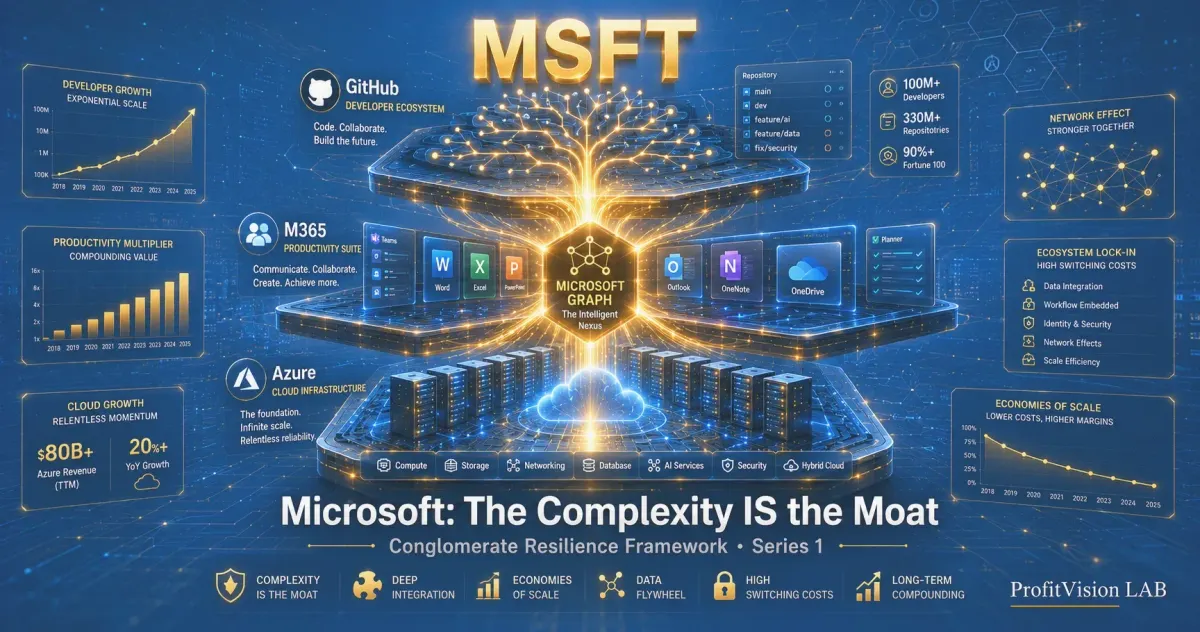
Conglomerate Resilience Framework Case Study #1 — Three-Layer Empire, Glue Diagnostics & the DCF Paradox
🔍 Long-Term Holding Screen (Equity Research Perspective)
| Dimension | Metric | Data (FY2025E) | Verdict |
|---|---|---|---|
| Institutional Conviction | Institutional Ownership / A/D Rating | ~73% institutional, A/D Grade: A | ✅ Strong Accumulation |
| Economic Moat | ROE / 5Y EPS CAGR / FCF | ROE 35%+, EPS CAGR ~18%, FCF ~$85B | ✅ World-Class Moat |
| Growth Visibility | Azure YoY / Copilot Commercialization | Azure +30%+ YoY, Copilot adoption accelerating | ✅ High Visibility |
| Valuation | P/E, P/FCF, EV/EBITDA | P/E ~35x, P/FCF ~40x (significant premium) | ⏸️ Fully Priced |
Chapter 1: Why the Four-Not-Like Framework — When Standard Analytical Tools Break Down
When Satya Nadella took over as Microsoft CEO in 2014, the first question analysts asked was: "What exactly is this company?" It had Windows, but Windows was in decline. It had Office, but Google Docs was eroding the franchise. It had Xbox, but Sony's PlayStation was gaining share. It had Bing, but Google dominated search. Every single business unit, viewed in isolation, was not the market leader.
A decade later, that question still stands — but the answer has changed completely. Microsoft's market capitalization has exceeded $3 trillion, making it one of the most valuable companies on earth. Yet it still defies every standard classification. It's not a pure-play cloud company (AWS is larger). It's not a pure software company (it has Xbox hardware). It's not a pure AI company (OpenAI is). It's not a pure social company (LinkedIn is only ~10% of revenue).
It is, in the most precise sense, a "Four-Not-Like" — a conglomerate that doesn't fit any standard taxonomy.
The Conglomerate Resilience Framework's core diagnostic question: What is the institutional glue? Can it be transplanted? Does it survive without the founder?
Traditional financial analysis tools — Porter's Five Forces, ROIC tree diagrams, DCF models — were designed for companies operating in a single industry. When a company spans cloud computing, productivity software, gaming, professional social networking, developer tools, and AI, any single framework produces distortion. It's like measuring an elephant's height with a vernier caliper.
The Four-Not-Like Framework (formally: Conglomerate Resilience Framework) evaluates such companies across eight dimensions: equity structure, industry breadth, headquarters-vs-BU dynamics, institutional glue, capital allocation discipline, growth DNA, succession resilience, and geopolitical sensitivity. The fundamental question it answers: Is this company's complexity a moat or a time bomb?
⚠️ Framework applies to platform-type and conglomerate-type enterprises. Not designed for single-business companies.
MSFT's Classification: Platform-Type, Not Conglomerate-Type
The framework begins with a binary classification: Platform-Type vs. Conglomerate-Type. Platform-type enterprises have a single unified core capability running through all business units — each BU appears independent but shares the same "technology engine." Conglomerate-type enterprises are diversified investment portfolios held together by management skill and capital allocation discipline alone.
Microsoft is unambiguously Platform-Type — and the cleanest example in existence. Azure cloud infrastructure is the backend for every BU. Microsoft Graph data layer connects user behavior across M365, Teams, and GitHub. Azure OpenAI Service is the unified AI compute layer powering every Copilot product line. This technology stack is not a "convenient shared resource" — it is a compounding multiplier engine where each BU's moat actively reinforces every other BU's moat.
Chapter 2: Business Model & Economic Moat — Eight-Dimension Scoring
Below is Microsoft's systematic scoring across the eight dimensions of the Conglomerate Resilience Framework:
| Dimension | Score | Strength | Key Observation |
|---|---|---|---|
| ① Equity Structure | 9/10 | Ballast-Grade | 73% institutional ownership; Vanguard/BlackRock/State Street jointly hold >20%; no single controlling shareholder; professional management governance; zero family-interference risk |
| ② Industry Breadth | 8/10 | Adjacent Diversification | Cloud → Productivity → Gaming → Social → Developer Tools → AI: each of the six business lines has a logical strategic closure, not opportunistic sprawl. All BUs share the technology platform, driving declining marginal costs |
| ③ HQ vs. BU Dynamics | 9/10 | Culture-Type Control | Nadella abolished Stack Ranking, introduced Growth Mindset. BUs operate with high autonomy but unified culture. Post-2024 reorganization clarified BU boundaries and streamlined reporting chains |
| ④ Institutional Glue | 10/10 | Technical Glue (Maximum) | Three-layer stack: Azure infrastructure + Microsoft Graph data layer + AI compute. Glue is technical capability, not personal charisma — transplantability is extremely high, institutionalization is industry-best |
| ⑤ Capital Allocation Discipline | 9/10 | Exceptional Discipline | LinkedIn ($26B, 2016), GitHub ($7.5B, 2018), Activision ($69B, 2023) — all three mega-acquisitions had clear strategic rationale and closed loops. Sustained buybacks + dividends. Successfully closed Activision despite FTC challenge, demonstrating execution resilience |
| ⑥ Growth DNA | 9/10 | Disciplined M&A × Organic Platform | Every major acquisition reinforces the existing technology stack rather than diversifying away from it. Azure organic growth sustained at 30%+. AI commercialization accelerating |
| ⑦ Succession Resilience | 9/10 | Endogenous Institutional Ballast | The cultural transformation from Ballmer to Nadella is now institutionalized. Growth Mindset is embedded in engineering culture, not personality-dependent. The next CEO does not need to be a Nadella-type figure |
| ⑧ Geopolitical Sensitivity | 7/10 | Moderate Sensitivity | Azure China operates independently via 21Vianet, contributing <5% of revenue. Primary revenue from North America and Europe. Primary geopolitical risk: GitHub as global open-source infrastructure — potential forced partition if U.S.-China tech decoupling deepens |
Chapter 3: Competitive Dynamics — Why No One Can Replicate All Three Layers Simultaneously
Understanding Microsoft's moat requires shifting the lens from "which business unit is strongest" to "how the three-layer cross-lock operates." The three layers are:
Azure is Microsoft's foundation — the compute and data pipeline for the entire three-layer empire. With 60+ global data center regions, Azure's coverage matches AWS, but its competitive differentiation lies in the enterprise hybrid cloud market: Azure Arc enables enterprises to manage on-premises infrastructure through Azure, a capability where AWS and GCP fall demonstrably short.
Azure's annualized revenue in FY2025 has exceeded $110 billion, sustaining 30%+ YoY growth. More critically, Azure OpenAI Service is the only public cloud capable of delivering GPT-4o enterprise-grade SLAs — because Microsoft holds a 49% stake in OpenAI and retains priority API access rights. This is not replicable by competitors on any time horizon.
Moat Mechanism: Data Gravity — once enterprise workloads migrate to Azure, the cost of moving out is astronomical. Every Azure Entra ID account is a lock-in node. The identity layer is the deepest hook.
Microsoft 365 is the operating system of enterprise workflow. With over 400 million paid seats covering Outlook, Word, Excel, PowerPoint, Teams, SharePoint, and OneDrive, the terrifying reality is not scale — it's stickiness. Enterprise employees spend more than 4 hours per day inside M365 tools on average.
Teams became enterprise communication infrastructure post-pandemic, now counting over 320 million monthly active users. Copilot for M365 ($30/user/month) is one of the fastest-commercially-adopted AI products in history — every Copilot seat stacks on top of an existing M365 subscription, delivering near-pure margin expansion.
Moat Mechanism: Workflow stickiness — enterprise approval flows, document formats, meeting records, and communication protocols all live inside M365. Any substitute requires employee retraining × data migration × workflow redesign. Estimated switching cost: over $2,000 per seat (including hidden costs).
The most underestimated layer of Microsoft's moat, and the hardest to replicate. GitHub hosts over 100 million developers and more than 420 million repositories — including Linux Kernel, React, TensorFlow, Kubernetes, and virtually every foundational piece of modern software infrastructure. VS Code commands over 75% IDE usage share globally (Stack Overflow Developer Survey).
GitHub Copilot is the most mature AI code assistant in the market, with 1.5M+ paid developers as of late 2024. The training dataset — 300 billion lines of developer-voluntarily-uploaded code — cannot be purchased on the open market. It is the result of 16 years of developer contributions, making it the "moat of the moat" for AI code generation.
Moat Mechanism: Network effects + data monopoly — once a developer team's workflows (PRs, CI/CD, code reviews, Actions pipelines) are on GitHub, migration means rebuilding the entire engineering infrastructure from scratch. Copilot's personalized code suggestions, trained on a team's own repositories in the Enterprise tier, become increasingly irreplaceable over time.
Founded in 2008 and acquired by Microsoft in 2018, GitHub is the world's largest code hosting platform. The initial reaction from the developer community was largely negative — fears that Microsoft would "ruin it." Six years later, the verdict is unambiguous: this was one of the most value-accretive acquisitions in technology history.
The reasons are structural: GitHub Copilot's AI capability is powered by 300 billion lines of developer-contributed code — a dataset that cannot be reproduced externally. GitHub also brought npm (the world's largest JavaScript package registry, 30B+ weekly downloads) and GitHub Actions (CI/CD automation), completing the developer workflow from "write code" to "deploy to Azure" without leaving Microsoft's ecosystem. VS Code's deep integration with GitHub means Microsoft literally lives inside the tool where developers spend their working hours.
⚠️ Why competitors can't close the gap: GitLab holds under 10% market share and lacks equivalent AI training data. Bitbucket has retreated to a Jira-integration niche. The fundamental problem isn't feature parity — it's that GitHub has 16 years of developer behavioral data and institutional gravity that no newcomer can buy or train away.
The Cross-Lock Effect: Why the Three-Layer Structure Breaks Competitive Logic
Each layer in isolation is already a world-class moat. What makes competitors truly hopeless is the cross-lock between all three layers simultaneously:
A typical enterprise scenario: engineers write code in VS Code with GitHub Copilot assistance, deploy to Azure, end users interact through Teams-embedded applications, and administrators manage identity through Azure Entra ID — the entire workflow never leaves the Microsoft ecosystem. This isn't "convenient." It's structurally inescapable.
Chapter 4: Financial Resilience — The Numbers Behind the Three-Layer Empire
Revenue Structure (FY2025E)
| Segment | Annualized Revenue (Est.) | YoY Growth | Gross Margin (Est.) | Notes |
|---|---|---|---|---|
| Intelligent Cloud (Azure-led) | ~$110B | +30%+ | ~72% | Azure OpenAI accelerating ARR |
| Productivity & Business Processes (M365/LinkedIn/Dynamics) | ~$90B | +13% | ~76% | Copilot seat upgrades driving ARPU expansion |
| More Personal Computing (Xbox/Surface/Bing) | ~$50B | +10% | ~50% | Activision contribution lifting Gaming weight |
| Total | ~$250B | +18% | ~70% | Overall gross margin expanding |
Microsoft's GAAP net income is compressed by substantial stock-based compensation (SBC) — estimated at ~$9B in FY2025. These expenses represent long-term incentive costs for engineering talent, not cash outflows, meaning Non-GAAP operating income is a far more accurate proxy for the company's true cash-generating capacity.
The most important metric is Free Cash Flow (FCF): estimated at ~$85B for FY2025. This is the actual distributable financial energy of the three-layer empire. FCF yield on market cap is approximately 2.7% — modest by traditional standards, but that's the price of owning a compound growth machine with embedded option value across multiple BUs.
Peer Financial Comparison
| Metric | MSFT (FY2025E) | Amazon (AWS) | Alphabet (Google Cloud) | Significance |
|---|---|---|---|---|
| Cloud Revenue Growth | +30%+ (Azure) | +17% (AWS) | +28% (Google Cloud) | Azure accelerating; Google Cloud at parity |
| Overall Gross Margin | ~70% | ~46% (incl. retail) | ~58% | MSFT's software-dominant mix drives superior margins |
| Operating Margin | ~44% | ~10% (consolidated) | ~32% | MSFT among the highest operating margins in large-cap tech |
| ROE | 35%+ | N/A (consolidated) | 30%+ | MSFT's elevated ROE partly reflects buyback-driven equity reduction |
| FCF Yield | ~2.7% | ~3.0% | ~3.5% | MSFT commands the largest valuation premium |
Chapter 5: Valuation & Scenario Analysis — Why DCF Consistently Undervalues MSFT
Microsoft always "looks expensive" — P/E ~35x, P/FCF ~40x, the highest premium among large-cap technology peers. Every quarter, analysts note "valuation fully reflects fundamentals," then Microsoft appreciates another 30%. This isn't market irrationality. It's a structural failure of the DCF framework when applied to platform-type conglomerates.
Three Structural Blind Spots in DCF Modeling
Blind Spot 1: Option Value Across BUs. Every Microsoft BU is a potential "next Azure." GitHub was acquired for $7.5B in 2018; its implied current value exceeds $50B. If M365 Copilot reaches 100 million paid seats, it generates $36B in incremental ARR annually. DCF can only discount known cash flows — it systematically excludes the option value of future BU development that doesn't yet exist as revenue.
Blind Spot 2: Non-Linear Network Effect Acceleration. Microsoft Graph's value grows with the square of users (Metcalfe's Law). DCF's standard linear growth assumption systematically underprices companies during network-effect acceleration phases — which is precisely where Microsoft is with AI adoption.
Blind Spot 3: Competitor Replication Cost. Building an "Azure + M365 + GitHub" three-layer empire from scratch would require capital investment exceeding $2 trillion and 30+ years to accumulate the developer trust and enterprise customer stickiness that Microsoft holds today. DCF does not account for the dimension where "moat maintenance costs make it permanently impossible for competitors to catch up."
Scenario Analysis (Replacing Target Price)
| Scenario | Core Assumptions | EV/FCF Multiple | Investor Implication |
|---|---|---|---|
| 🐂 Bull Case | Azure sustains 30%+ growth; M365 Copilot reaches 100M paid seats; OpenAI partnership deepens; AI monetization accelerates above consensus | 50–55x FCF | Current market pricing reflects partial bull case realization; upside comes from Copilot adoption velocity exceeding expectations |
| ⚖️ Base Case | Azure decelerates to 22–25% growth; Copilot penetration 15–20%; AI competition intensifies but MSFT maintains share | 40–45x FCF | Close to current market pricing — "fair but not cheap" at this scenario |
| 🐻 Bear Case | AI compute competition compresses Azure margins; OpenAI terminates exclusive arrangement; regulation forces GitHub partition | 28–32x FCF | Significant downside, but requires multiple negative events to converge simultaneously — lower probability outcome |
Chapter 6: Risk Factors — The Counterarguments to "Complexity as Moat"
No research that fails to present the bear case is complete research. Here is the honest threat inventory for Microsoft's "Four-Not-Like moat" thesis:
⚠️ Risk 1: Conglomerate Discount Reversal
- GE (General Electric) is the canonical conglomerate discount cautionary tale — once the world's highest market cap company, ultimately forced to break up under the weight of excessive complexity. Microsoft operates at similar complexity but currently commands a "platform premium" instead
- Trigger: If a competitor achieves a decisive advantage in cloud (AWS) or the developer layer (competitive AI coding tools), the market may re-evaluate the synergy value of the three-layer empire and apply a structural discount
⚠️ Risk 2: Antitrust Regulatory Overhang
- The EU Digital Markets Act (DMA) already required Microsoft to decouple Teams from the M365 bundle. If regulation expands to Azure/GitHub market position, forced API opening or structural separation becomes possible
- The U.S. FTC lost on Activision but retains appetite for Big Tech enforcement, and political cycles can shift enforcement intensity rapidly
- Trigger: Simultaneous U.S.-EU investigation into Azure OpenAI market position, or class-action litigation over GitHub's AI training data usage
⚠️ Risk 3: The OpenAI Bet Fails
- Microsoft's $13B+ investment in OpenAI is the foundation of its current AI differentiation. If OpenAI goes public and adopts cloud-neutral API distribution, Azure's AI competitive advantage evaporates rapidly
- Google DeepMind (Gemini series) and Anthropic (Claude) have reached GPT-4 capability parity in enterprise procurement contexts. If either forms a decisive enterprise preference, Copilot's moat faces direct erosion
- Trigger: OpenAI announces "multi-cloud neutral" policy, or Azure OpenAI enterprise contract renewal rates show measurable deterioration
⚠️ Risk 4: AI Arms Race Capital Burn
- Microsoft's FY2025 capex is estimated at $75B+ (primarily AI data center construction), exceeding 88% of FCF. If AI commercialization lags expectations, high capital expenditure will compress FCF materially
- Ongoing GPU performance improvements mean today's data center infrastructure may be relatively obsolete in five years, creating a structural capital reinvestment treadmill that persistently constrains free cash flow
Chapter 7: Investment Thesis & Tactical Outlook — The Four-Not-Like Lesson
Microsoft's most important lesson for investors isn't "cloud is strong" or "AI is hot." It's a more fundamental, framework-level insight:
When a company's complexity itself becomes an asset that competitors cannot replicate, traditional valuation tools break down — because they cannot price "the moat of the moat."
Microsoft is the first company in commercial history to simultaneously reach "impossibly high switching cost" thresholds at the infrastructure layer (Azure), the workflow layer (M365), and the developer layer (GitHub). Each layer in isolation is a mid-cap company. All three locked simultaneously creates a structure where any competitor faces a fundamental dilemma: which layer do I attack first — knowing that success on one layer still leaves the other two intact?
The Conglomerate Resilience Framework tells us: the right questions to ask about this class of company are not "Is the P/E too high?" but rather:
- Is the institutional glue technical or personality-based? (MSFT: technical, transplantable, does not depend on Nadella)
- Are the BU multiplier effects positive or negative? (MSFT: positive — three-layer cross-lock)
- Is the succession ballast stone institutionalized or personalized? (MSFT: institutionalized — Growth Mindset is now embedded in OKR systems and promotion criteria)
- Does the "four-not-like" nature force competitors to give up, or regulators to intervene? (MSFT: currently forces competitors to give up; regulatory risk is rising but not yet structurally threatening)
When the answers to all four questions are positive, the "four-not-like" company's moat exists precisely because of its four-not-like nature.
That is Microsoft. The next case study — Foxconn (Hon Hai) — will present the mirror image: institutional glue failure and externalized succession ballast. The contrast will make the framework's diagnostic power fully visible.
✅ Bull Case — Three Core Thesis Points
- Copilot Monetization Acceleration: If M365 Copilot penetration reaches 20% (currently estimated 5–8%), it generates $25B+ in incremental ARR annually — equivalent to organically creating a new mid-cap software company within an existing customer base
- Three-Layer Cross-Lock Deepening: As AI embedding depth increases, cross-sell efficiency from Azure → M365 → GitHub continues rising; net revenue retention (NRR) is in structural expansion mode
- Succession Resilience Best Practice: Institutionalized glue makes MSFT the only large-cap tech company where a CEO departure would not trigger a 20%+ market cap decline — a structural rarity that deserves a valuation premium
⚠️ Bear Case — Three Core Risk Points
- AI Arms Race Capital Burn: FY2025 capex exceeds 88% of FCF; if AI ROI disappoints, valuation compression risk is significant
- OpenAI Dependency is a Double-Edged Sword: Microsoft's AI differentiation depends heavily on the OpenAI arrangement; any change in terms would cause Azure's AI premium to evaporate
- Regulatory Antitrust Overhang: EU DMA enforcement and U.S. FTC attention constrain M&A strategy; future large acquisitions face increasing execution difficulty
📋 Chapter 8: Tracking Log
| Date | Event | Judgment | Result |
|---|---|---|---|
| 2026/05/24 | Four-Not-Like Framework Series initial publication (MSFT Case Study #001) | ✅ Core long-term position; accumulate on pullbacks | — |
Next scheduled update: Post FY2026 Q1 earnings (October 2026)
Early update triggers: OpenAI IPO announcement; EU DMA enforcement action; Azure growth rate falls below 20% for two consecutive quarters
Frequently Asked Questions
Investing involves risk; please assess your own financial situation carefully before making any investment decisions.
Data sources: Microsoft SEC Filings, FY2025 Earnings Call Transcripts, StockAnalysis, Bloomberg, Public Records (as of May 2026)


Comments ()