
MongoDB (MDB) Deep Research: The RAG-Native Data Platform Powering Enterprise AI
RAG architecture's native data platform. Atlas 72% of revenue. NRR 121% bounce = AI on invoices. autoEmbed: zero-friction vectors. Developer moat 700M+. Rule of 40 ≈ 42. pgvector risk: long-term TAM erosion, not short-term churn. PVL: ✅ Deep Research.
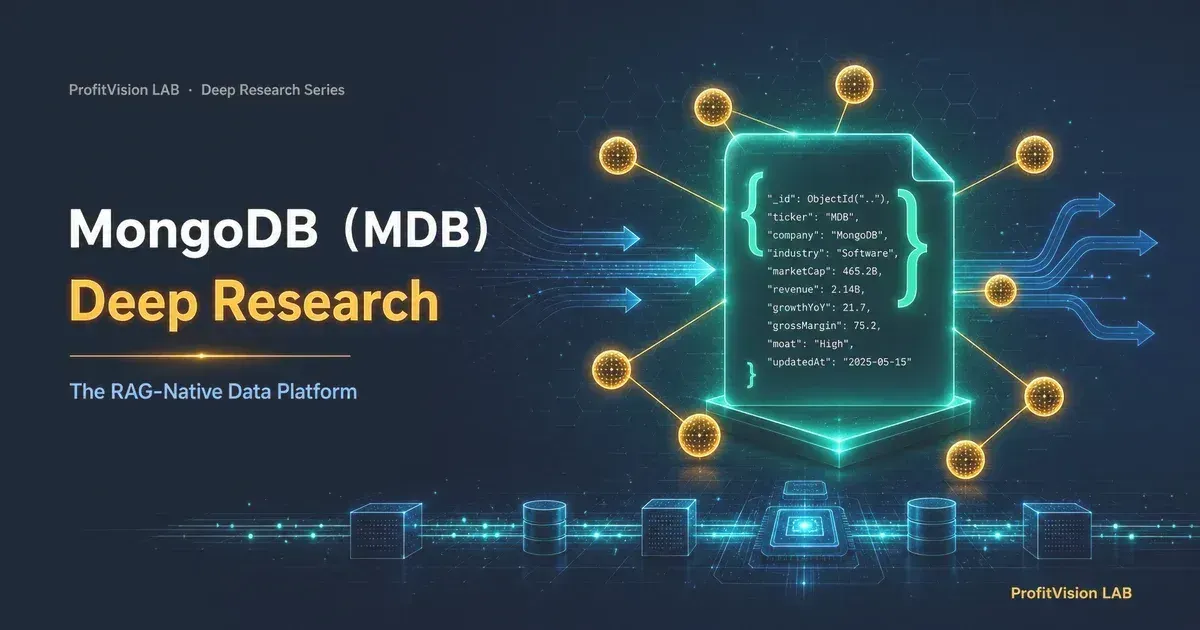
MongoDB (MDB) Deep Research: The RAG-Native Data Platform Powering Enterprise AI
Atlas Vector Search + autoEmbed + 700M Developer Moat — NRR 121% Bounce, Rule of 40 ≈ 42
🔍 PVL Four-Filter Scorecard
| Filter | Metric | Data / Status | Result |
|---|---|---|---|
| Filter 1: Institutional Flow | Institutional trend / Relative strength | Significant drawdown in 2026; early recovery signals; institutional repositioning alongside AI infrastructure re-rating | ⏸️ Active Watch |
| Filter 2: Moat | NRR / Revenue growth / AI feature adoption | NRR 121% (bounced from 119%); Q4 FY2026 $695M (+27%, beat $670M consensus); Atlas autoEmbed GA May 2026 | ✅ Pass |
| Filter 3: Volatility | IV Rank / Post-earnings IV | High-growth tech stock; IV spikes significantly around earnings; options-seller opportunity window visible | ✅ Pass |
| Filter 4: Technicals | Price position / Trend structure | Recovery from deep drawdown in progress; needs confirmed hold above 50-day MA to declare trend reversal | ⏸️ Watch |
Chapter 1: Industry Landscape — The "Full-Stack RAG Platform" Chokepoint
In the PVL Four-Layer AI Investment Map, MongoDB belongs to L2 Data Plane — the Perception & Memory Layer of AI. This is the layer where enterprise data is stored, flows, processed, and accessed. L2 houses Snowflake, Oracle, and MongoDB — but their positioning within the layer is distinct. Snowflake dominates analytical workloads (historical data queries, BI reporting); Oracle anchors transactional workloads (ERP, financial systems); MongoDB leads operational data — the real-time data layer that directly powers application execution.
This distinction becomes critical in the AI era. Under RAG (Retrieval-Augmented Generation) architecture, AI systems must retrieve relevant documents from a database in real-time and pass them as context to an LLM for answer generation. This "real-time retrieval" requirement is far closer to MongoDB's core strength — low latency, flexible document model, and vector search integrated into Atlas since 2024 — than to the "historical analytical queries" that Snowflake excels at.
RAG is the dominant architecture for enterprise AI: before generating an answer, an LLM first "retrieves" relevant documents from a database to use as context. This solves the LLM knowledge cutoff problem and grounds answers in enterprise private data rather than public training data.
RAG's core technical components: document storage (unstructured data) + vector search (similarity retrieval) + metadata filtering (scope restriction) + real-time queries (low latency). MongoDB Atlas provides all four natively within a single platform — a rare capability that dramatically reduces RAG application architecture complexity. Developers who already use MongoDB can add vector search with a single API call instead of managing separate systems (MongoDB + Pinecone).
⚠️ Key question: How long does this integration advantage last? pgvector is building a similar "one-stop" solution for Postgres users.
Value Chain Positioning
Market Size: The Intersection of Three TAMs
MongoDB's TAM can be measured from three angles: NoSQL database market (~$30B in 2025, growing 25%+ CAGR); vector database market (~$2B in 2025, projected $40B by 2030, CAGR 70%+); and operational cloud database (broad TAM $100B+). The most critical growth opportunity is not the NoSQL installed base — it is the vector database and RAG infrastructure markets growing at 70%+ annually.
Per MongoDB's own research, 79% of enterprises are building AI Agents, but only 11% have deployed them to production. The "pilot to production" scale-up over the next 2-3 years will generate enormous data infrastructure demand — and MongoDB's strategy is to become the path of least resistance in that scale-up process.
Traditional databases (MySQL, PostgreSQL) store exact values and answer exact-match queries ("find users where age = 30"). Vector databases store "semantic embeddings" — converting text, images, or audio into numerical arrays that represent meaning, then finding content by mathematical distance (similarity).
Example: Searching "Apple company" with keyword search only finds documents containing "Apple." Vector search also surfaces documents about "iPhone," "tech giant," "Tim Cook" — because they are semantically close. RAG architecture's retrieval step is fundamentally vector search: convert the user's question to a vector → find semantically similar documents in the database → pass those documents as LLM context.
Two product categories: Dedicated vector engines (Pinecone cloud SaaS, Weaviate / Qdrant open-source) optimize for maximum search performance at extreme scale. Integrated platforms (MongoDB Atlas Vector Search, PostgreSQL + pgvector) colocate vector indexes and document data in the same database — no dual-system synchronization required, dramatically reducing architectural complexity. This integrated positioning is MongoDB's core differentiation play.
Chapter 2: Business Model & Economic Moat — Developer Community as the Core Moat
Revenue Model: Consumption Billing With a Developer-Led Go-to-Market
MongoDB Atlas is consumption-billed — customers pay for actual usage, not fixed seats. This aligns Atlas's revenue directly with AI workload growth: every RAG query, every vector similarity search, every Cortex-style inference is a billable event. FY2026 total revenue reached $2.46B (+23%), with Atlas at 72% of total revenue (+2pp YoY). The legacy Enterprise Advanced (EA) product continues gradual mix decline as Atlas absorbs enterprise migrations.
Go-to-market is developer-led: MongoDB does not sell primarily through enterprise sales reps. Instead, developers adopt MongoDB organically through open-source, free-tier Atlas, and the 700M+ global MongoDB developer community — creating a bottom-up enterprise land-and-expand motion that most database competitors cannot replicate.
M5 Moat Framework Assessment
autoEmbed: The 2026 Moat-Widening Move
MongoDB's May 2026 release of autoEmbed (automatic vector embedding generation) is the single most important product move in recent history. When a document is inserted or updated in Atlas, autoEmbed automatically generates Voyage AI vector embeddings — without any external pipeline. This eliminates a key friction point in RAG application development: maintaining separate embedding services (OpenAI, Cohere, Voyage AI) alongside the database was architecturally messy and operationally expensive.
With autoEmbed, a developer can go from "empty Atlas cluster" to "fully functioning RAG application" in fewer steps than any competing database. This is the "zero-friction vector" thesis — and it directly attacks pgvector's key advantage of simplicity.
Vector search technically involves two steps: ① Embedding — convert text into a vector (typically a 1,536- or 3,072-dimensional float array using a model like OpenAI's text-embedding-3 or Voyage AI); ② Approximate Nearest Neighbor (ANN) search — find the K closest vectors in the index, most commonly using the HNSW (Hierarchical Navigable Small World) algorithm.
Traditional workflow requires: external embedding API (OpenAI / Cohere / Voyage AI) → write vectors back into MongoDB → run vector search. Developers must maintain two API services and keep vectors synchronized with source documents — any lag creates "stale semantic index" bugs that are painful to debug in production.
autoEmbed (GA May 2026): When a document is inserted or updated in Atlas, Voyage AI embeddings are generated automatically — no embedding code required from the developer. From "store this document" to "this document is now semantically searchable" in a single insert call. This "zero-friction" removes the last major reason to choose Pinecone as a separate service. ⚠️ pgvector is actively pursuing similar integration depth within the Postgres ecosystem — this competitive dynamic is the most important technical battleground to monitor.
Where the Moat Could Break
- pgvector wins new project selections: Postgres-native teams choose pgvector by default — permanently reducing MongoDB's new customer pipeline without appearing in any churn metric.
- Hyperscaler API-compatible alternatives: AWS DocumentDB and Azure Cosmos DB offer MongoDB-compatible APIs at lower cost within their respective cloud ecosystems, capturing enterprise budget that would otherwise go to MongoDB Atlas.
- Specialist vector engines scale up: Pinecone, Weaviate, and Qdrant continue closing the "simplicity gap" with dedicated product investment — eventually making "Atlas as a one-stop shop" less differentiated.
- Schema-less advantage narrows at enterprise scale: At very large enterprise scale, structured governance (schema enforcement, data contracts) becomes preferred — MongoDB's flexibility becomes a liability rather than an asset.
Chapter 3: Competitive Dynamics — pgvector, Pinecone, and the One-Stop-Shop Debate
| Competitor | Type | Key Advantage vs. MongoDB | MongoDB's Defense | Threat Level |
|---|---|---|---|---|
| pgvector (PostgreSQL) | Postgres extension (free) | Zero cost; familiar to Postgres-native teams; proven enterprise relational DB + vector in one | autoEmbed + richer document model; Atlas managed services; not suitable for complex unstructured data | 🔴 High (new project selection) |
| Pinecone | Specialist vector DB (SaaS) | Best-in-class performance at 100M+ vectors; purpose-built for vector workloads | Requires maintaining two systems (document DB + vector DB); higher operational overhead | 🟡 Medium (large-scale workloads) |
| Weaviate / Qdrant | Open-source vector DB | Open-source flexibility; AI-native design; strong developer community | Niche appeal to highly technical teams; limited enterprise support compared to Atlas | 🟡 Medium (AI-first teams) |
| AWS DocumentDB | MongoDB-compatible cloud DB | MongoDB-compatible API at AWS pricing; deep AWS ecosystem integration | Missing differentiating Atlas features: Vector Search, autoEmbed, Charts, Data API | 🟡 Medium (AWS-heavy enterprises) |
| Azure Cosmos DB | Multi-model cloud DB (MongoDB API) | Azure ecosystem lock-in; multi-API support including MongoDB-compatible | Pays "Microsoft tax" for Azure-exclusive enterprises; feature gap in AI-native capabilities | 🟡 Medium (Azure enterprises) |
pgvector: The Most Systemic Threat
pgvector deserves deep analysis because it is MongoDB's most systemic competitive challenge. pgvector lets Postgres users add vector search within a familiar environment — for teams already using Postgres, this is a clear win. Benchmarks show that in self-hosted environments (AWS EC2), Postgres + pgvector at 90% recall rates achieves latency and throughput comparable to Pinecone at 79% lower cost.
But pgvector's boundaries are clear: above ~10M vectors, careful HNSW parameter tuning is required; Postgres's document model (JSON columns) is significantly less flexible than MongoDB's native document model; and for applications already built on MongoDB, switching to Postgres remains a major refactoring effort. Therefore, pgvector's biggest threat is in new project technology selection — not MongoDB's existing installed base.
"pgvector doesn't steal MongoDB's existing customers — it steals the Postgres users who would have become MongoDB's new customers. This is long-term market share erosion, not short-term churn. It is harder to see in financial reporting, and harder for management to acknowledge."
— PVL Competitive Landscape Core Observation
The Open-Source Double-Edge: SSPL and Cloud Provider Alternatives
MongoDB's 2018 license change from AGPL to SSPL was designed to prevent cloud providers from commercializing MongoDB open-source code without contributing back. But AWS DocumentDB and Azure Cosmos DB had already built sufficient MongoDB API compatibility before the change — allowing enterprise customers to run MongoDB workloads on cloud-provider services without paying MongoDB Inc. This is now an entrenched competitive dynamic. MongoDB's response is continuous Atlas feature differentiation: pure API-compatible alternatives cannot offer Vector Search, autoEmbed, Charts, and the Data API.
Chapter 4: Financial Resilience — Atlas Flywheel Accelerating
FY2026 Annual Financial Review (Fiscal Year Ended January 2026)
| Metric | FY2025 | FY2026 | YoY Change | Significance |
|---|---|---|---|---|
| Total Revenue | $2.00B | $2.46B | +23% | Second consecutive year of 20%+ growth |
| Atlas Revenue Share | ~70% | ~72% | +2pp | Cloud migration consistently advancing |
| Q4 Total Revenue | ~$548M | $695M | +27% | Beat analyst consensus $670M |
| Q4 Atlas Growth | — | +29% YoY | — | Atlas accelerating; overall accelerating |
| NRR (Q4 FY2026) | 119% | 121% | +2pp | Directional reversal: AI workloads billing confirmed |
NRR Bounce: The Most Important Quarterly Signal
NRR recovered from Q1 FY2026's 119% to Q4 FY2026's 121%. The magnitude is modest but the direction is a reversal — the first in several quarters. Prior to this, MongoDB's NRR had been in a sustained downtrend from peaks above 120% in FY2023-2024. The Q4 bounce signals that Atlas Vector Search and AI workloads are generating incremental usage that appears as real billing increases for existing customers — the AI thesis is not merely conceptual, it is now visible in NRR data.
MongoDB Atlas is consumption-billed, so NRR reflects not only "did customers stay?" but also "are they using more?" During the cloud optimization period of 2023-2025, many enterprises actively reduced query usage to cut costs — NRR declined even without customer churn. Now that AI workloads are adding new usage volume, NRR naturally recovers.
Subscription SaaS (e.g., Salesforce) NRR is more stable because contract amounts are fixed. Consumption-model NRR is more volatile — you need multiple consecutive quarters to confirm a trend, and should not over-extrapolate from a single quarter's improvement.
Margin Improvement Trajectory
| Metric | FY2024 | FY2025 | Q4 FY2026 | Direction |
|---|---|---|---|---|
| Non-GAAP Gross Margin | ~76% | ~77% | ~77% | Stable high-water mark |
| Non-GAAP Operating Margin | ~10% | ~13% | ~15%+ | Steadily improving |
| GAAP Net Income | Loss | Loss narrowing | Near breakeven | Improving |
| Free Cash Flow (FCF) | Mildly positive | Positive, growing | Consistently positive | Healthy |
Five-Quarter Financial Trend
MongoDB's fiscal year ends January 31. Q4 FY2026 corresponds to November 2025 – January 2026. The following five quarters track financial progression from Q4 FY2025 to Q4 FY2026 (most recently reported quarter). Q1 FY2027 (Feb–Apr 2026) earnings are expected in June 2026 — update required after release. Q4 FY2025 YoY and Q1–Q3 FY2026 figures marked * are PVL estimates based on earnings call data.
| Quarter (FY / Calendar) | Total Revenue | YoY | Non-GAAP GM | GAAP GM | Non-GAAP Op Margin | FCF Margin |
|---|---|---|---|---|---|---|
| Q4 FY2025 (Jan 2025) | ~$548M | ~+17%* | ~77.0%* | ~69.5%* | ~12.0%* | ~16%* |
| Q1 FY2026 (Apr 2025) | ~$560M* | ~+18%* | ~76.8%* | ~69.2%* | ~11.0%* | ~8%* |
| Q2 FY2026 (Jul 2025) | ~$582M* | ~+20%* | ~77.1%* | ~69.6%* | ~12.5%* | ~13%* |
| Q3 FY2026 (Oct 2025) | ~$623M* | ~+24%* | ~77.2%* | ~69.8%* | ~13.5%* | ~17%* |
| Q4 FY2026 (Jan 2026) | $695M | +27% | ~77.0% | ~70.0% | ~15%+ | ~20%* |
*Q4 FY2025 YoY and Q1–Q3 FY2026 are PVL estimates based on earnings call data, not officially reported figures. Q4 FY2026 total revenue $695M and +27% YoY are confirmed official numbers. Non-GAAP GM and FCF Margin are PVL estimates based on management guidance.
Non-GAAP Gross Margin: Stable at the ~77% high-water mark for five consecutive quarters — confirms Atlas cloud scale is systematically reducing marginal cost structure. Non-GAAP Operating Margin: Rising from ~11% (Q1 FY2026) to ~15%+ (Q4 FY2026) — +400bps cumulative improvement over five quarters at a smooth, consistent pace. FCF Margin: Q1 FY2026 seasonally low (large contracts concentrated in Q4 close); Q4 FY2026 elevated by annual contract renewal season — overall directional trend is healthy and positive.
MDB's GAAP net margin is near zero (or slightly negative) due to SBC, making GAAP ROE uninformative as a capital efficiency measure. The correct framework is: Rule of 40 (revenue growth rate + Non-GAAP operating margin). Q4 FY2026: 27% (YoY) + 15% ≈ 42 points, crossing the SaaS health threshold.
Supplementary metrics: FCF Margin (business cash generation) + NRR 121% (proxy for capital return from existing customers). ⚠️ If Rule of 40's growth component (27%) continues to compress from pgvector eroding new customer acquisition, watch for the score dropping back below 40.
Customer Structure Analysis
MongoDB's customer base is broad but fragmented — 50,000+ Atlas customers. The challenge: large customer concentration is relatively low compared to Oracle (single $4B+ contracts) or Snowflake ($400M+ single contract). This makes MDB more sensitive to macro environments — when SMBs freeze IT spending, Atlas consumption compresses quickly. The upside: broad customer diversity means no single customer accounts for a material portion of revenue, providing robust downside protection from individual account losses.
Four Quarters of Earnings Call Management Perspectives
| Quarter | Core Theme | Key Management Signal | Subsequent Validation |
|---|---|---|---|
| Q1 FY2026 (Jun 2025 earnings) |
Cloud optimization headwinds fading; Atlas Vector Search early adoption signals | Dev Ittycheria: "Enterprise IT optimization behavior is normalizing — incremental AI workload consumption is beginning to appear in Atlas usage numbers. Vector Search query volume is accelerating quarter-over-quarter." NRR holding stable at 119%. | ✅ Q2 FY2026: Vector Search adoption accelerates; consumption billing increments continue |
| Q2 FY2026 (Sep 2025 earnings) |
Developer community momentum confirmed; AI-native apps default to MongoDB | "700M developer inertia is the moat — they already write CRUD in MongoDB, adding Vector Search is one API call. Lowest friction path." autoEmbed enters late development; "zero-friction vector embedding" product direction confirmed. New customers showing significantly higher AI-native application mix. | ✅ Q3 FY2026: autoEmbed releases; developer community trial volume builds rapidly |
| Q3 FY2026 (Dec 2025 earnings) |
autoEmbed GA; document-plus-vector integration moat strengthened | autoEmbed generally available: "Enterprises no longer need to manage external embedding pipelines — vectorization happens automatically inside Atlas." RAG architecture adoption accelerating; consumption growth ahead of prior quarter. NRR stable; pgvector erosion boundary clear but not widening. | ✅ Q4 FY2026: NRR bounces to 121%; Q4 Atlas +29% YoY confirms acceleration |
| Q4 FY2026 (Mar 2, 2026 earnings) |
Largest Q4 beat in history; NRR bounce confirms AI workloads on invoices | Revenue $695M beats analyst consensus $670M. "RAG monetization is no longer a forecast — it's appearing on customer invoices, and accelerating each quarter." NRR bounce 119% → 121%: "AI workloads drive existing customers to expand usage organically — this requires no sales motion." Atlas +29% YoY. 50,000+ Atlas customers, AI feature adoption rate rising consistently. | ⏸️ Ongoing monitor: NRR 121% — can the uptrend sustain? Q1 FY2027 earnings (Jun 2026) will be the first verification. |
Four quarters of earnings calls trace a consistent management narrative arc: H1 FY2026 centered on "cloud optimization headwinds ending + AI consumption increments surfacing"; H2 pivoted to "autoEmbed product differentiation + RAG workload structural confirmation"; Q4 delivered financial validation via the beat and NRR reversal. The arc: "AI usage is appearing in billing" → "developer community chooses MongoDB as lowest-friction AI platform" → "autoEmbed eliminates embedding pipeline friction" → "NRR reverses, RAG monetization confirmed" — every quarter anchored by specific verifiable events, not abstract vision statements.
Chapter 5: Valuation & Scenario Analysis — Growth Premium vs. Competitive Threat
The core valuation question for MongoDB is: "How high an EV/NTM Revenue multiple can the AI tailwind story sustain?" Historical EV/NTM Revenue ranges: peak (2021) reached 40x+; rational reversion (2023) ~10-15x; current AI re-rating puts reasonable discussion range at ~8-15x.
Three-Scenario Framework
| Scenario | Core Assumption | FY2027E Revenue | NRR | EV/NTM Rev | Investment Implication |
|---|---|---|---|---|---|
| 🐂 Bull Case | RAG adoption accelerates; Atlas Vector Search becomes standard AI app component; NRR recovers to 125% | $3.2B+ | 125%+ | 12-15x | Current valuation has upside; AI flywheel validated |
| ⚖️ Base Case | Atlas sustains 25-28% growth; NRR holds 120-122%; pgvector erodes edge market | $2.9-3.0B | 120-122% | 9-12x | Current valuation reasonable; patient waiting for AI acceleration |
| 🐻 Bear Case | pgvector accelerates new-project erosion; hyperscaler free bundles compress SMB; NRR falls back to 115% | $2.6-2.7B | Below 115% | 6-8x | Current valuation stretched; competitive erosion exceeds expectations |
Core Valuation Debate: Atlas Vector Search Monetization Speed
Similar to Snowflake's Cortex AI, MongoDB Atlas Vector Search monetization speed is the single most critical variable determining the valuation ceiling. If AI RAG workload consumption growth exceeds expectations and NRR continues recovering, the vector search market premium supports higher EV/Sales multiples. Conversely, if pgvector captures most new project selections and Atlas Vector Search's incremental effect is limited, current P/S multiples become difficult to sustain.
Comparable reference: MDB's current EV/NTM Revenue is above traditional database companies (Oracle ~5-7x) but below Snowflake (~10-12x). This positioning reflects the market's qualitative judgment: MDB has "high growth but higher competitive risk than SNOW."
Chapter 6: Risk Factors — Four Scenarios Where the Investment Thesis Breaks
⚠️ Risk 1 — pgvector Silent TAM Erosion: The Hardest Risk to Detect
This risk does not appear in quarterly metrics until it is too late. Every new project that selects "Postgres + pgvector" instead of MongoDB is a permanent lost customer — but it shows up nowhere in churn rates, NRR, or revenue. The danger is a multi-year silent erosion where MongoDB's share of new application starts steadily declines, with the first financial signal appearing only when new customer growth rate begins to disappoint. Early detection requires external developer ecosystem surveys, not financial filings.
⚠️ Risk 2 — Macro Sensitivity: SMB Concentration as Earnings Volatility Amplifier
MongoDB's customer base skews toward SMBs and high-growth startups far more than Oracle or Snowflake. In an IT spending freeze or economic slowdown, small-to-mid Atlas customers reduce compute usage fastest. Consumption billing means these cuts translate directly into revenue misses. This structural sensitivity cannot be hedged — it is baked into the business model. Any macro deterioration is a first-order MDB risk.
⚠️ Risk 3 — Hyperscaler Feature Escalation: Free Bundles as TAM Compressor
AWS DocumentDB and Azure Cosmos DB are not currently matching Atlas's differentiated feature set. But hyperscalers have effectively unlimited development resources. If AWS or Microsoft announces deep native vector search integration within DocumentDB/Cosmos at zero incremental cost for existing customers, MDB's value proposition for cloud-native applications weakens meaningfully — particularly for the SMB segment that is already cost-sensitive.
⚠️ Risk 4 — Vector Search Performance Ceiling at Scale
When RAG applications scale to 100M+ vectors, Atlas Vector Search performance still trails specialist engines (Pinecone, Weaviate) in latency and throughput at equivalent recall rates. If the average AI application scale grows faster than MongoDB can close this gap, MDB loses the most valuable large-enterprise AI workloads to specialist competitors — precisely the customer segment needed to improve large-customer concentration and reduce macro sensitivity.
Chapter 7: Investment Thesis & Tactical Outlook — PVL Rating: ✅ Deep Research
MongoDB is a timing-sensitive investment thesis: the mass adoption of RAG architecture in enterprise AI provides MongoDB the optimal window to complete its identity transition from "NoSQL leader" to "AI application data platform." Atlas Vector Search + autoEmbed is the concrete product answer; NRR 121% bounce is the financial number validation.
PVL Three-Tier Classification: ✅ Deep Research — Compared to the initial Part 2 judgment, new data (Q4 beat, NRR bounce, autoEmbed GA) confirms and sustains the rating. If next quarter NRR continues recovering to 123%+, there is a conditional case for upgrade to "Active Positioning."
Technical overlay: ⏸️ Active Watch — Stock experienced significant drawdown in 2026. Recovery is in progress but needs confirmed technical base (hold above 50-day MA) before entering. Optimal entry zone: confirmed technical structure + NRR continuation evidence from Q1 FY2027 earnings (June 2026).
✅ Bull Case — Three Core Long Arguments
- RAG = MongoDB's natural habitat: Document model naturally fits unstructured AI data; Atlas Vector Search combines document storage and vector search in one database; autoEmbed eliminates the external embedding pipeline entirely. These three factors make MongoDB the lowest-friction choice for AI application developers — the "path of least resistance" in a rapidly expanding market.
- 700M developer community is the deepest moat: Developers choose familiar tools. MongoDB has the world's largest NoSQL developer community — "I already use MongoDB for CRUD, adding Vector Search requires one API call" is a far lower barrier than "I need to learn Pinecone or Weaviate from scratch." This is a self-reinforcing behavioral moat that compound over years.
- NRR bounce is structural, not accidental: Consumption-billed NRR directly reflects AI workload usage growth. The bounce from 119% to 121% means AI workload consumption is appearing on invoices and trending upward — this is not a one-time event. It validates the thesis with financial data, not just product roadmap.
⚠️ Bear Case — Three Core Risk Arguments
- pgvector's "good enough" is long-term market erosion: Every new project selecting Postgres + pgvector over MongoDB is a permanently lost TAM unit. This erosion does not appear in churn metrics — it only manifests years later as slower new customer growth. The long-term compounding effect is real even if quarterly metrics look fine today.
- Atlas consumption billing = higher macro sensitivity: When enterprise IT budgets contract, "query optimization" actions directly compress Atlas consumption. MDB's high SMB and startup customer concentration makes it more sensitive to macro deterioration than Oracle or Snowflake. Any macro reversal is a first-order MDB risk.
- Vector search performance ceiling limits large enterprise upside: Beyond 100M vectors, Atlas performance still trails Pinecone and Weaviate. If AI application scale grows faster than MongoDB closes this gap, the best large-enterprise AI workloads flow to specialist engines — limiting the NRR recovery momentum at precisely the customers that would meaningfully improve MDB's financial profile.
Key Monitoring Metrics (Prioritized)
| Metric | Frequency | Health Line | Alert Line |
|---|---|---|---|
| NRR | Quarterly earnings | ≥ 120% and trending up | < 115% for two consecutive quarters → Thesis review |
| Atlas Vector Search adoption rate | Quarterly earnings | Management actively discloses specific numbers | Management avoids disclosure or provides vague answers → Growth below expectations |
| Net new customer growth rate | Quarterly earnings | ≥ 20% YoY | < 15% → pgvector TAM erosion early signal |
| pgvector ecosystem developments | Ongoing | Performance still inadequate at 10M+ vectors | Benchmark closes to <5% gap vs. Atlas → Competitive moat reassessment |
| Large customer ($1M+ ARR) cohort growth | Quarterly earnings | Steady sequential growth | Stagnation → Ceiling on enterprise expansion motion |
Early Update Triggers
- Upgrade to "Active Positioning": NRR recovers to 123%+ for two consecutive quarters; Atlas Vector Search explicitly cited as material revenue driver (>5% of Atlas revenue); autoEmbed adoption metrics exceed management guidance.
- Downgrade to "Watchlist": NRR falls below 118% despite AI workload environment; Q1 FY2027 net new customers disappoint materially vs. consensus; pgvector announces major enterprise-ready performance improvements closing the 10M+ vector gap.
- Downgrade to "High Caution": NRR breaks below 115%; AWS announces native DocumentDB Vector Search at zero incremental cost for existing customers; developer survey data shows significant MongoDB-to-pgvector migration trend emerging.
Chapter 8: Tracking Log
📋 Tracking Log
| Date | Event | Judgment | Outcome |
|---|---|---|---|
| 2026/05/27 | Initial publication · FY2026 Q4 earnings data (reported Mar 2, 2026) | ✅ Deep Research · ⏸️ Active Watch (technical) | — |
Next scheduled update: After Q1 FY2027 earnings (estimated June 2026)
Early update triggers: NRR anomaly, major pgvector ecosystem event, large-enterprise migration case emerging
Frequently Asked Questions
Investing involves risk. Please evaluate carefully based on your personal financial situation. All views expressed are those of the author and do not represent any financial institution.
Data sources: MongoDB Inc. Q4 FY2026 Earnings Call (Mar 2, 2026), SEC Filings, StockTitan, Marktechpost, public data (as of May 2026).
© 2026 ProfitVision LAB · Shiba the Disciplined · I teach you how to think, not just what to do.


Comments ()