From All-You-Can-Eat to Pay-Per-Use: The AI Billing Revolution Reshaping SaaS Profit Margins
Whoever controls the billing controls the moat. How Microsoft and ServiceNow use AI Credits to externalize inference costs — and the budget nightmare awaiting enterprise CIOs and CFOs.
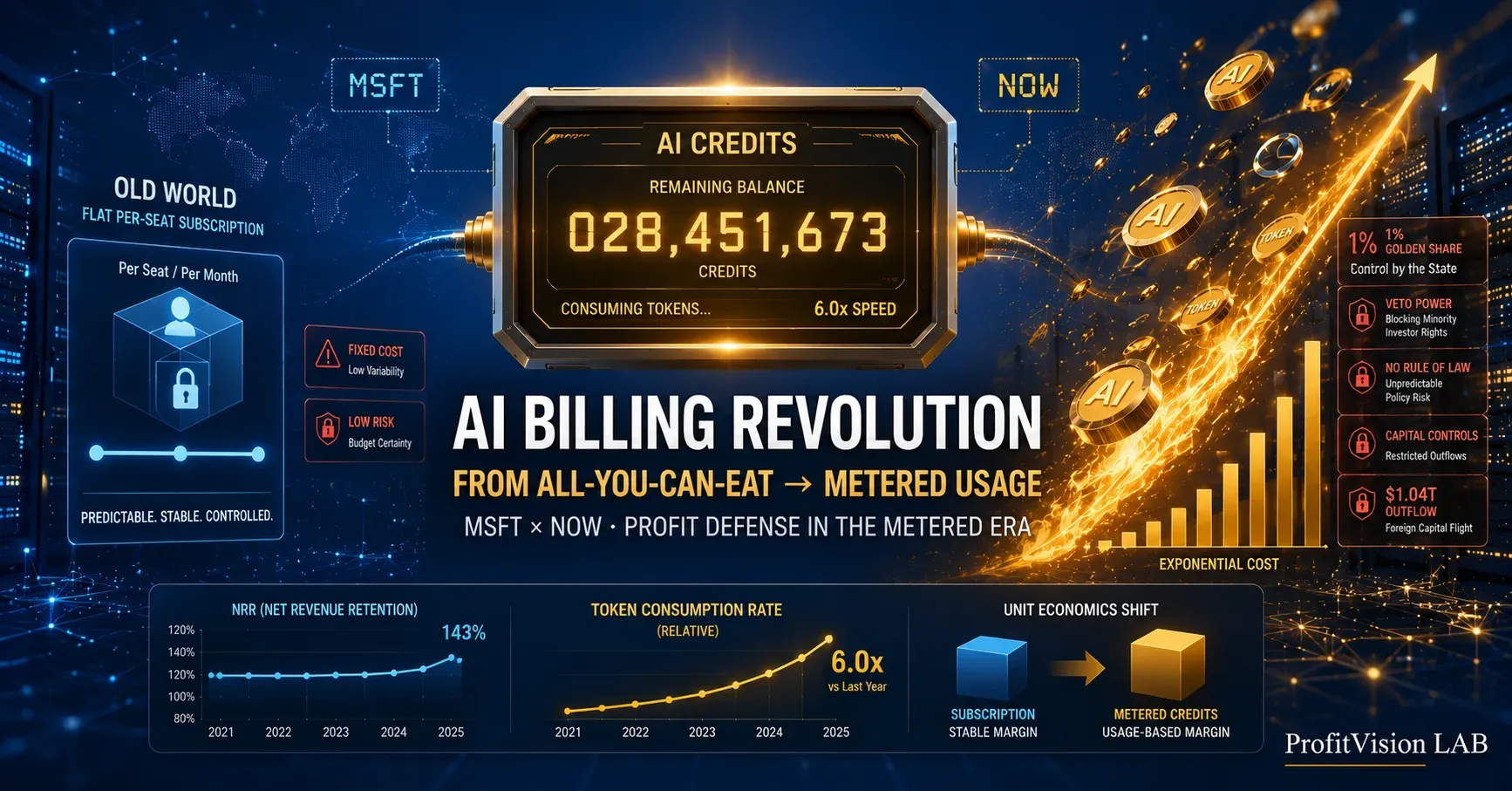
The software industry has one unwritten golden rule: whoever controls the billing controls the moat.
In 2026, AI is forcing that rule to be rewritten.
The shift from per-seat monthly subscriptions to usage-based metering isn't a technology decision — it's a carefully engineered profit structure reorganization. Microsoft (MSFT) and ServiceNow (NOW) aren't "upgrading their products." They're using the cover of the AI cycle to quietly slip a new billing schedule into enterprise contracts.
This article dissects the game from two angles: how vendors are using metered pricing to reclaim gross margin control, and why enterprise CIOs and CFOs are about to face a budget nightmare unlike anything they've experienced before.
- Metered pricing is a gross margin defense, not a product upgrade. Inference costs are dynamic and uncontrollable — vendors must pass overages onto users.
- Microsoft's AI Credits are fundamentally a marginal cost externalization play — fixed subscriptions lock in customers; metering protects margins. Platform-level Prompt Caching converts saved tokens directly into net profit.
- ServiceNow's Assists point pool is an engineered trap: lightweight tasks enter at 25 points; Agentic AI workflows burn 150 points each — a 6× consumption multiplier by design.
- Enterprises have entered the budget-loss era: the cloud bill nightmare is back, this time in AI form. Contracts must lock in Top-up price ceilings and mandatory overage alerts.
- The final judgment metric: not how powerful the model is, but whether every dollar of token spend can be justified with a clear ROI.
Part I — The Vendor Perspective: This Isn't an Upgrade. It's a Margin War.
Microsoft (MSFT): Lock in the Low-Margin with Seats, Capture the High-Margin with Credits
Microsoft's underlying logic is colder than the market appreciates.
Azure is the compute backbone; subscription fees are the customer lock-in mechanism. But AI Agent inference costs are dynamic and uncontrollable — if heavy users are allowed to burn tokens without limit, the traditional SaaS 70–80% gross margin gets crushed, potentially going negative.
Starting June 1, 2026, GitHub officially introduces "AI Credits," separately metering advanced Code Review and autonomous Agent actions. The design's brilliance isn't in "charging more" — it's in shifting uncontrollable marginal inference costs off Microsoft's P&L and making user behavior directly map to the invoice.
The Platform Advantage: Prompt Caching
By caching frequently used code tokens at the infrastructure level, Microsoft reduces its own costs — but under metered pricing, those saved tokens don't get passed to customers; they convert directly into net profit. This is a structural advantage only platform-scale companies can exploit. Independent SaaS vendors can't replicate it.
ServiceNow (NOW): The Point Pool Is a Trap, and the 6× Burn Rate Is by Design
ServiceNow's approach is more aggressive — and more sophisticated.
In April 2026, NOW completed a major restructuring, reorganizing its product line into Foundation, Advanced, and Prime tiers with AI baked throughout. On the surface it looks like "simplification." The underlying architecture is a hybrid billing trap:
This isn't accidental — it's engineered. Lightweight tasks get enterprises in the door. Agentic AI burns through their budget. For a deeper analysis of ServiceNow's full business model, see our NOW Deep Research.
NOW also holds a less visible card: Action Fabric. Via the Model Context Protocol (MCP), external AI systems — including Anthropic's Claude — can directly invoke ServiceNow's internal automation workflows. NOW doesn't need to monopolize the user interface; it turns itself into an "invocation tax" collector sitting inside enterprise processes. Use whatever AI you like — if the workflow runs on NOW, you pay.
Part II — The Enterprise Perspective: The AI Efficiency Dividend Is Over. Welcome to Budget Chaos.
For the past two years, the major software vendors subsidized AI adoption costs — they were willing to bleed to grab market share. That era officially ended in 2026. Enterprises now face a fight nobody taught them how to win.
The CIO/CFO Billing Nightmare: The Cloud Horror Story, AI Edition
Anyone who remembers the early AWS era knows this story: engineers didn't understand billing, ran EC2 instances for a month, and the CFO had a breakdown when the bill arrived.
That story is now playing out in AI. Uber's case has become an industry cautionary tale: four months to burn through an entire year's AI budget. This isn't an outlier — it's a structural inevitability under metered billing. Fixed SaaS fees let CFOs budget in January and reconcile in December. AI Credits are dynamically consumed — one mistakenly triggered Agentic workflow can burn through a month's quota in an afternoon.
Old Era Contracts (Manageable)
- Fixed per-seat monthly fees
- Budget locked in January, reconciled in December
- Overages usually have grace periods
- Procurement negotiates discounts
New Era Contracts (Must Negotiate)
- Base fee + metered Credits
- Budget can blow at any time
- Overages invoiced at full list price
- Must lock in Top-up price ceiling
Contract negotiation difficulty has doubled. In 2026 renewal meetings, enterprise procurement must get two things in writing:
- A hard ceiling on Top-up add-on unit pricing (prevents being invoiced at list price after exhaustion)
- Mandatory overage notification obligations (require the vendor to send alerts when credits reach 20% remaining)
Without these two clauses, signing the contract is handing the vendor a blank check.
IT Architecture Transformation: From "Blind Adoption" to "ROI Review Committees"
Internal enterprise responses must also become systematic. This problem's underlying logic mirrors what we analyzed in our AI Four-Layer Investment Map — the infrastructure vs. application layer question: whether you can control consumption determines whether you're a beneficiary or a victim of this AI wave.
AI Control Tower — Step One
Deploy monitoring tools to precisely track which department, which engineer, and which Agent workflow is consuming how many Credits. This isn't an IT luxury — it's financial control infrastructure.
Tiered Access Control — Step Two
Junior engineers and general customer service get basic Q&A and summarization (low or zero credit cost). Only senior architects and high-value business processes get access to high-burn Agentic AI. The analogy: this is exactly like corporate travel policy — not everyone flies business class, and those who do must justify the ROI.
Conclusion: Unit Economics Is the Only Scorecard That Matters
| Dimension | Old Era (2023–2025) | New Era (2026+) |
|---|---|---|
| Billing logic | Fixed per-seat monthly fee | Base fee + value/usage metering |
| Vendor challenge | More heavy users = lower margins | Optimize caching & grow NRR under metered model |
| Enterprise pain | Measuring AI's impact on employee productivity | Controlling token consumption unit economics to avoid budget blowouts |
| Winner's edge | How powerful and impressive the model is | Token cost control and ROI premium capture for specific tasks |
The underlying logic of this transition mirrors every market cycle maturation: during the euphoria phase, stories prop up valuations; during the maturity phase, numbers determine survival.
There's no shortage of AI compute or AI narratives. What comes next, for software vendors and enterprise AI users alike, comes down to a single question:
Those who can are the winners. Those who can't are the billing casualties.
All content in this article is for research and educational purposes only and does not constitute investment advice or a recommendation to buy or sell any security. References to specific companies (MSFT, NOW) and business model analysis are solely for illustrating market trends and commercial logic, and do not represent any form of investment rating or price target. Investing involves risk. Readers should make their own independent judgments based on their financial situation and risk tolerance, and consult a qualified financial advisor.