The Five Defenders Series Finale: Natural Selection in the SaaSpocalypse — The More AI Is Used, the More Critical Node Holders Grow
SaaSpocalypse is natural selection, not the end of SaaS. Agentic AI converts labor costs into software spend, opening a $100B new market. Companies locked into critical AI nodes grow more as AI is used more. The Five Defenders series final verdict.
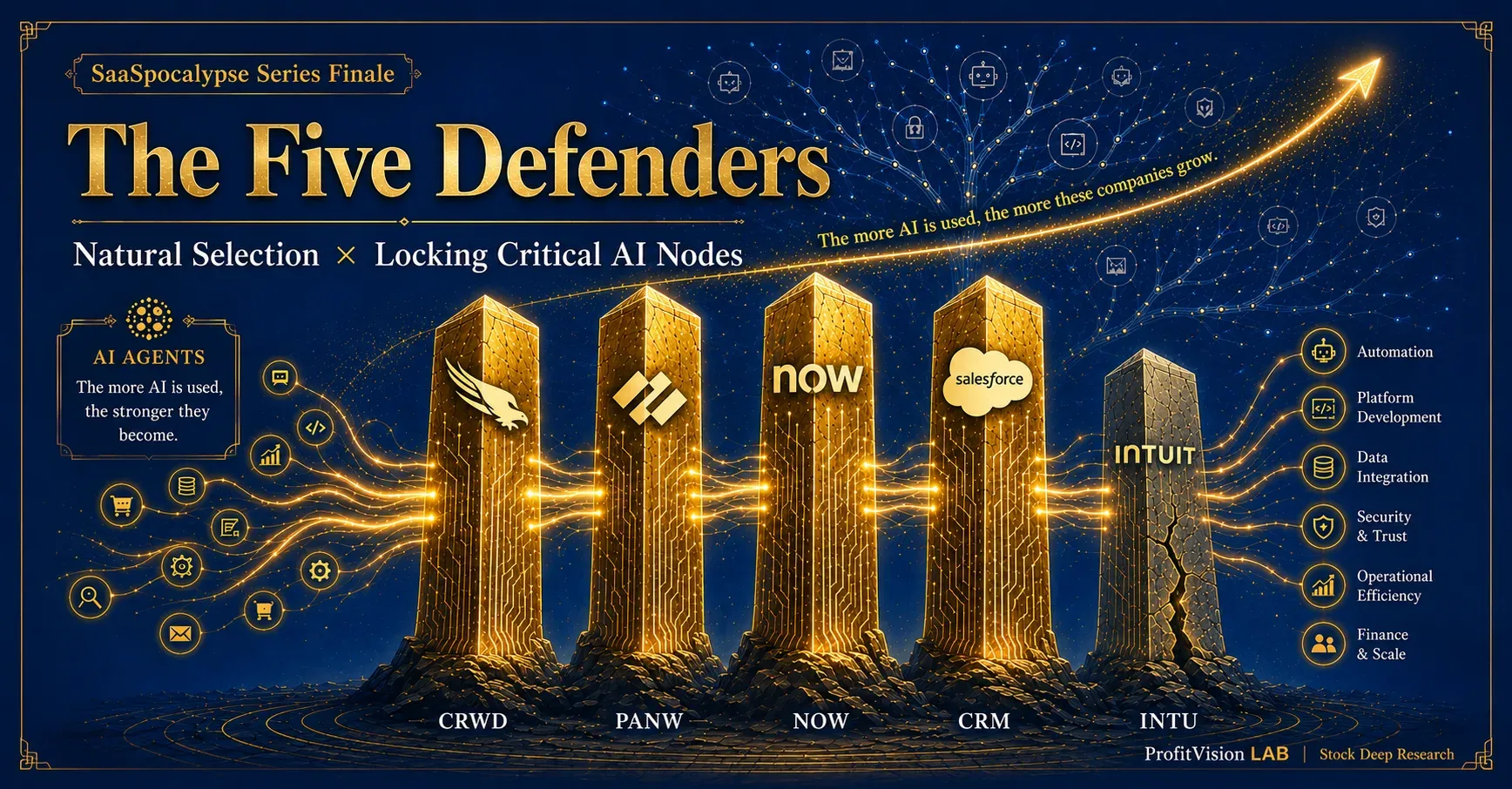
SaaSpocalypse is not the death of SaaS. It is natural selection.
The market's framework: AI agents replace human users → per-seat revenue collapses → SaaS dies. This framework has a fatal blind spot — it assumes AI is a substitute for the existing market, not an amplifier of the existing market plus creator of an entirely new one.
The correct framework: Agentic AI traffic is more than 10x the scale of existing SaaS traffic. Converting labor costs into software spending opens a $100B new market that did not exist before. AI proliferation creates the highest-order new demand for "AI governance infrastructure." Companies locked into critical nodes grow more as AI is used more, not less.
Chapter 1: The Facts — What SaaSpocalypse Is and Is Not
February 3, 2026 — the date the financial press now calls SaaSpocalypse. In 48 hours, $285 billion in software market cap was erased. IGV fell more than 30% from peak. The software sector's weight in the S&P 500 dropped from 12% to 8.4%. The market's verdict: SaaS is dead.
Three triggers converged: Anthropic's enterprise Claude industry plugins going live, a wave of agentic AI product launches from Salesforce, ServiceNow, and Google, and reports warning that "one AI agent can do the work of ten users — per-seat pricing is broken at the foundation." The market used a sledgehammer instead of a scalpel, striking all SaaS indiscriminately.
This was half-right and half-wrong.
What was right: A subset of SaaS was built on the assumption that users must manually operate interfaces. When AI dissolves that assumption, those moats shrink or disappear.
What was wrong: The market failed to separate "SaaS threatened by AI" from "SaaS that becomes more indispensable because of AI." Hitting both was mispricing, not accurate valuation.
• Traditional SaaS growth rate: +8% (decelerating, not collapsing)
• AI-native application spend growth: +94% (large enterprises: +393%)
• Global SaaS market 2026: $465 billion (still growing +14% YoY)
• Software sector short interest: all-time high (a contrarian signal)
Traditional SaaS +8%, AI-native +94%. This is not a market shrinking — it is capital rapidly rotating from the old model to the new model. The beneficiaries of that rotation are the companies that locked into critical nodes.
Chapter 2: Natural Selection — What Does "Fittest" Mean Here
Natural selection does not mean all species die. It means the species that adapted to the changed environment survive and expand explosively, while those that failed to adapt disappear. SaaSpocalypse is a natural selection event in the SaaS ecosystem, not the ecosystem's extinction.
In this context, there is only one condition for survival: Have you locked into a critical node of the AI era?
"Having AI features" is not the test. In 2026, almost every SaaS claims AI features — that is the entry ticket, not the competitive advantage. A critical node means: when an enterprise deploys AI agents, those agents must route through you to complete their tasks. You are not a tool. You are infrastructure.
Three criteria to judge this:
- Are you the system of record? Any AI doing meaningful work must read your data and write back to your database. Without your data, the agent is blind.
- Are you the execution authorization layer? Any AI action must be authorized through your system. You built the authorization architecture — no AI company built it for you.
- Is your switching cost "genuine irreplaceability" or "manufactured stickiness"? The former deepens in the AI era. The latter eventually gets bypassed.
Chapter 3: The Most Important Insight — More AI Usage Means a Bigger Market, Not Smaller
This is the most important chapter in the entire series, and the market's biggest current mispricing.
The market's logic: AI agents replace human users → per-seat revenue collapses → SaaS market shrinks.
This logic has two blind spots.
Blind Spot 1: Labor Costs Converting to Software Spend — a $100B New Market
Bain & Company's May 2026 research provides a clear quantitative framework: Agentic AI's biggest opportunity is not replacing SaaS — it is converting labor costs into software spending by automating cross-system coordination work, creating a large new market. Bain estimates this potential market at $100 billion in the US alone, with more than 90% still uncaptured.
This $100 billion is not taken from existing SaaS subscriptions. It is converted from enterprise payroll costs. A concrete example: a finance department's accountant spends 40 hours a month on cross-system data reconciliation — pulling figures from ERP, comparing against CRM receivables, confirming bank reconciliations, populating reports. Those 40 hours of labor cost appeared in the enterprise P&L as "salary expense" — not a single dollar reached any SaaS vendor. When an AI agent takes over that work, the enterprise recoups the cost as "software expense," paying per action the agent completes. This is a new market created from scratch, not a contest for existing market share.
Blind Spot 2: AI Creates Demand That Literally Did Not Exist Before
Enterprises previously could not achieve many capabilities due to cost — 24/7 real-time customer service, instant cross-system financial anomaly detection, personalized service paths for every customer. The demand always existed; human labor costs made it impractical. AI agents make these capabilities economically viable for the first time.
Intercom's Fin AI agent is the clearest case: $0.99 per resolved support ticket. This revenue was not taken from any existing subscription — it converted "service capacity that never existed because human labor cost too much" into a monetizable new market.
The deeper implication: when enterprises deploy AI agents at scale, they need more "infrastructure that lets AI act safely" — data boundaries, identity governance, security protection, execution authorization layers. The demand for this infrastructure grows as AI deployment scales. It does not shrink as AI replaces humans.
• Bain (May 2026): US cross-system coordination automation new market $100B, currently only $4-6B captured — 90%+ uncaptured
• IDC: Global Agentic AI spend to exceed 26% of worldwide IT spending, reaching $1.3 trillion by 2029
• Gartner: 40% of enterprise apps will integrate task-specific AI agents by end of 2026 (up from 5% today); by 2035 Agentic AI drives 30% of enterprise software revenue — surpassing $450 billion
• Deloitte: Agentic AI market CAGR ~53%, from $8.5B in 2026 to $45B by 2030
• Fortune Business Insights: Agentic AI market $9.1B in 2026, $139B by 2034, CAGR 40.5%
• Zylo ($75B enterprise SaaS spend tracked): AI-native app spend +108% YoY; large enterprises (10,000+ employees) +393%
• Global SaaS market 2026: $465 billion (+14% YoY) — no shrinkage, accelerating transformation
Chapter 4: Natural Selection Results — Each Company's Critical Node Verdict
Applying Chapter 2's three criteria to all five companies yields a clear picture.
The more AI deployment scales, the larger the attack surface, and the more urgent the security protection need — a self-reinforcing positive loop. Charlotte AI upgraded CrowdStrike from "tool collection" to "autonomous defense system." The single-agent architecture gives competitors years of catch-up work.
Natural Selection Verdict: ✅ Grows with AI proliferation, and accelerates
AI Gateway defines "all AI agent traffic entry and exit" — every AI agent action in the enterprise must pass through PANW's inspection. Five-platform integration deepens this boundary with adoption depth, not eroded by frontal competition.
Natural Selection Verdict: ✅ Direct beneficiary of AI traffic growth
AI Control Tower (Armis + Veza + Moveworks) is the governance architecture enterprises cannot deploy AI agents without. The Claude Mythos disclosure elevated this from "optional" to "mandatory" — a board-level question about compliance, liability, and insurance. Enterprises cannot let AI run unconstrained; NOW is the architecture that makes AI trustworthy to deploy.
Natural Selection Verdict: ✅ Post-Mythos demand level sharply upgraded
Customer 360 is the data boundary for all front-office AI agents — AI cannot directly access raw customer data; it executes within Salesforce's data model. Agentforce transitions pricing from per-user to per-action, turning AI usage volume directly into CRM revenue. This is the "labor cost converting to software spend" logic realized in front-office CRM.
Natural Selection Verdict: ✅ More AI agents deployed = more revenue; 14x P/E does not price this
TurboTax's moat is political rent-seeking, not technological irreplaceability — Direct File being killed was a political victory, not a moat victory. QuickBooks switching costs are real but AI is changing the calculation. Credit Karma and Mailchimp's intermediary positions are among the first business models AI bypasses. Management has not answered "what is INTU in the AI era."
Natural Selection Verdict: ⚠️ Short-term survival (regulatory protection), long-term node unclear — underweight
Four passed. One uncertain. This is the Five Defenders' honest scorecard after six articles.
Chapter 5: Why Now — How Deep Is the Market Mispricing
Throughout this series, the investment thesis was never "buy because it's cheap." Cheap is the outcome, not the reason. The reason: the market used the wrong framework to understand SaaSpocalypse, and therefore assigned the wrong price. When the correct framework is re-adopted, current prices will look absurd.
Three conditions that can trigger re-pricing — no overall market recovery required:
- Per-action revenue modules (Agentforce, Now Assist) continuing to accelerate — when the market sees "AI usage growing → SaaS revenue growing" demonstrated directly in quarterly numbers
- Enterprise AI agent deployment count becoming quantified — Gartner's 40% enterprise app integration by year-end (from 5% today) is the most direct catalyst when it begins to be reported
- Bain's $100B "uncaptured market" narrative entering mainstream coverage — when the "90% of a $100B market still uncaptured" framing reaches institutional consensus, the narrative shifts
Chapter 6: Portfolio Framework — Five Defenders in Different Scenarios
| Name | Portfolio Role | Core Thesis | Near-Term Catalyst | Primary Risk |
|---|---|---|---|---|
| CRWD | Cybersecurity growth engine | Every AI agent = new attack surface; structural demand growth | Q1 FY27 ARR acceleration | Consolidation pressure |
| PANW | Platform integration engine | AI Gateway defines enterprise AI traffic security boundary | NGS ARR +30% sustained | Integration execution risk |
| NOW | AI governance infrastructure | Claude Mythos made AI Control Tower a hard requirement | May 7 Knowledge Conference | Three-acquisition integration pace |
| CRM | Valuation floor + data governance | P/E 14x + AI governance layer = double undervaluation | May 28 Q1 FY27 earnings | Agentforce growth deceleration |
| INTU | Short-term defensive FCF | FCF $5B+, YTD most resilient, but long-term node unclear | May 21 Q3 FY26 earnings | Government filing tool re-emergence |
Three Scenario Portfolio Logic
Scenario A: SaaSpocalypse Continues (IGV -15% more)
CRWD + PANW most defensive (security demand immune to cycles). INTU defensive cash flow anchor. NOW + CRM pressured short-term but thesis unchanged; add-on-dip logic strengthens. Let May 21 (INTU) and May 28 (CRM) earnings provide directional guidance before sizing up.
Scenario B: Base Case (Market sideways, earnings-driven individual divergence)
May 21 and May 28 earnings are the critical sorting events. NOW's Knowledge Conference provides a Phase 3-B entry opportunity. Core allocation toward NOW + CRM (clearest thesis, nearest catalysts), with CRWD + PANW as cybersecurity foundation.
Scenario C: Market Re-Pricing (Agentic AI data beats, Fed cuts)
CRM has the most recovery leverage (starting point lowest — P/E 14x to 25x recovery is the widest gap). NOW's AI Control Tower thesis gets fully re-evaluated. Entire Five Defenders portfolio benefits, but CRM + NOW benefit most deeply. INTU participates least — regulatory moat re-rating operates on a different timeline.
Chapter 7: Research Methodology — Making the Process Transparent
After six articles, the research methodology behind this series deserves an explicit statement — because methodology compounds better than any single conclusion.
Method 1: Ask "what is the moat built on" before asking "what is it worth." TurboTax is built on political lobbying. QuickBooks is built on genuine switching costs. NOW is built on genuine irreplaceability in enterprise nervous systems. These three moat types have completely different fates in the AI era. Valuation is the outcome; moat quality is the cause.
Method 2: Present both bull and bear arguments honestly, then adjudicate. In the CRM article, JPMorgan's Overweight $320 and Goldman's strategist "newspaper industry warning" were placed side by side. Not because there is no position — but because an honest analysis must understand the strongest counterargument before claiming its own thesis is more persuasive.
Method 3: Be explicit about your own lens, so readers can evaluate whether it's worth trusting. The personal context in the NOW article (MCSE certification, Taiwan BCM national security unit, telecom frontline) was not credential-signaling — it was transparency about "why I can see the AI Control Tower thesis as a hard requirement, not just ServiceNow marketing." This transparency is the spirit of the Five-Layer Transparency Framework (5LTF).
SaaSpocalypse is natural selection, not the end of SaaS. Companies that locked into critical AI-era nodes — those that make AI agents route through them to complete tasks — grow more as AI is used more, not less. Agentic AI traffic at 10x scale converts labor costs into software spend, opening a $100B market; AI proliferation creates a highest-order demand for governance infrastructure. The Five Defenders series is five concrete cases of this judgment. Think with me, not just trade with me.
Series Review
| Article | Company | Core Thesis | Natural Selection Verdict |
|---|---|---|---|
| 1/6 | CRWD | AI cybersecurity growth engine; Charlotte AI single-agent architecture; every AI agent is an attack surface | ✅ Grows with AI proliferation |
| 2/6 | PANW | Five-platform integration; AI Gateway defines enterprise AI traffic security boundary | ✅ Direct beneficiary of AI traffic growth |
| 3/6 | NOW v3.0 | AI Control Tower hard requirement; Claude Mythos elevated governance from optional to mandatory | ✅ Highest-order demand, most direct beneficiary |
| 4/6 | CRM | Valuation floor P/E 14x × Agentforce per-action × AI data governance layer — double undervaluation | ✅ More AI agents deployed = more revenue |
| 5/6 | INTU | Moat truth: political rent-seeking × short-term defensive × long-term node unclear | ⚠️ Short-term survival, long-term uncertain |
| 6/6 | Series Finale | Natural selection framework: lock into the node, survive; more AI usage, more growth | Complete series adjudication |
This content is for educational and research purposes only and does not constitute investment advice. ProfitVision LAB is not a registered investment advisor. Investing involves risk.
Sources: Bain & Company "The $100-Billion SaaS Opportunity Hiding in Cross-System Labor" (May 2026); Gartner "Agentic AI in Enterprise Applications 2025-2035"; IDC Agentic AI Spending Forecast; Deloitte Tech Value Survey 2025; Zylo 2026 SaaS Management Index ($75B enterprise spend tracked); Fortune Business Insights Agentic AI Market Report; BetterCloud "AI and the SaaS Industry in 2026" (May 2026); Stanford AI Index 2026; The Next Web "AI-native enterprise spending surges 94%" (May 2026); SaaS Mag "How SaaS Companies Are Monetizing AI Agents in 2026"; SaaS Ultra "SaaS Statistics 2026" (May 2026).
Individual stock analysis: refer to each respective deep research article and disclaimer. All scenario analyses are conditional projections. No price targets. Position sizing, entry prices, and stop-loss levels are determined by each investor's own risk management framework.