Buy Call, Buy Put, Sell Call, Sell Put: The Four Options Roles Fully Explained
Options trading has four roles — and most beginners only understand one. This guide decodes all four: Buy Call, Sell Call, Buy Put, Sell Put. Each carries different rights, obligations, and risk profiles. Mastering this asymmetry is the foundation of every options strategy.
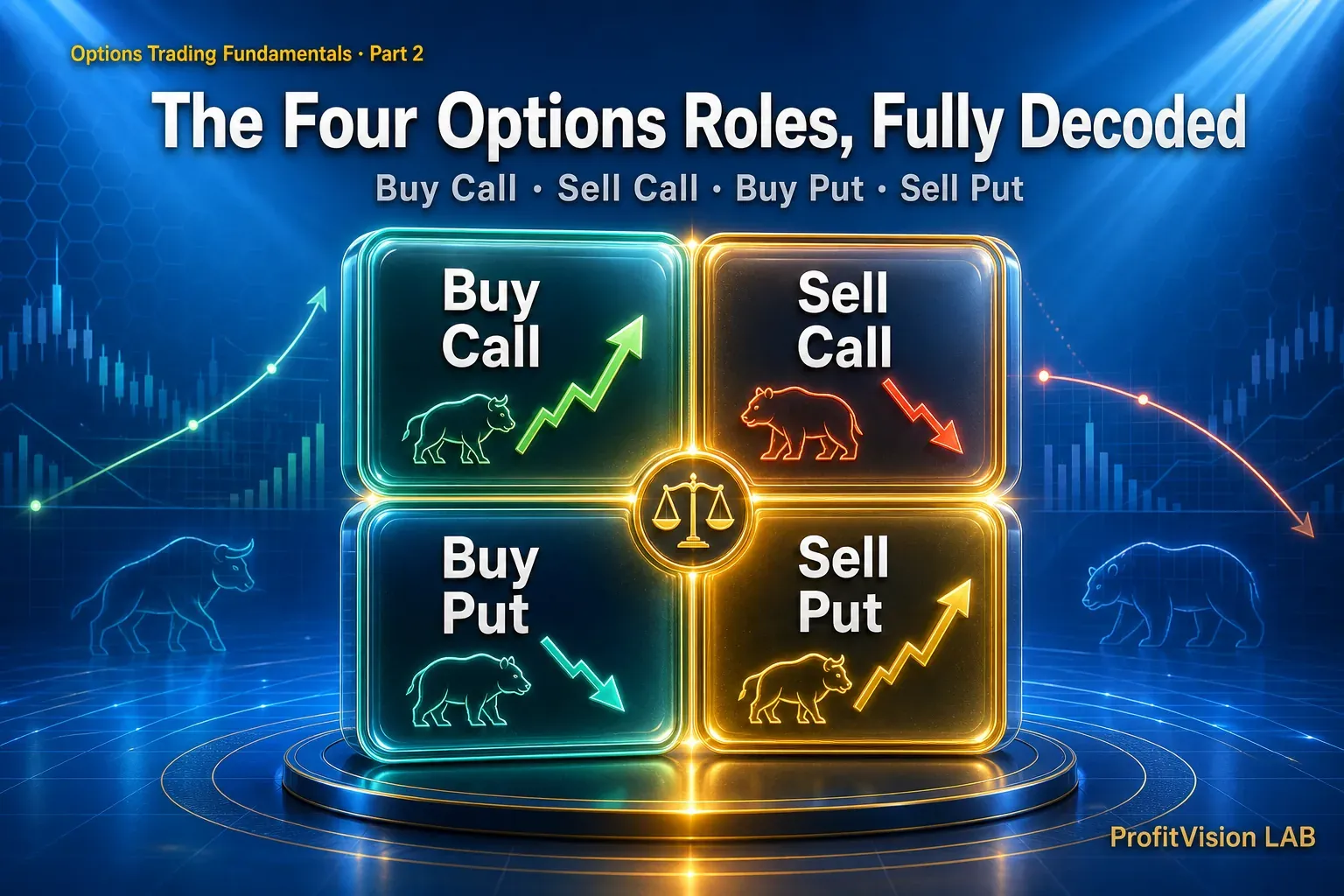
- Options have four fundamental roles: Buy Call, Sell Call, Buy Put, and Sell Put. Each role has a completely different profit condition, maximum loss, and win rate.
- Buyers (Buy Call / Buy Put): Pay a premium to bet on direction. If correct, the upside can be large; if wrong, you lose only the premium — low win rate but high payout ratio.
- Sellers (Sell Call / Sell Put): Collect a premium and let time and probability work in their favor — high win rate but capped profit per trade.
- ProfitVision LAB's core strategy is Sell Put (advanced version: Bull Put Spread): bet that a quality stock won't fall sharply, collect premium, and let Theta work for you every day.
Why Does Understanding All Four Roles Matter?
Every options transaction requires two counterparties: one buyer and one seller. The buyer and seller hold completely opposite expectations about the same underlying asset — and that is precisely what makes the options market function.
If you don't know which role you're playing, you won't know what you're betting on, how much you can make, or how much you can lose. The goal of this article is to lay out the logic of all four roles with complete clarity, so that whenever you look at any options trade, you can immediately identify its profit-and-loss structure.
the seller is offering the assurance that "most of the time you won't be right — and the premium is mine."
Both sides are rational — they're simply betting on different things.
The Core Asymmetry of Options: Rights vs. Obligations
To understand options, the single most important dividing line is not "bullish vs. bearish" — it's whether you are on the buyer's side or the seller's side, because their legal standing within the contract is fundamentally different.
The premium is received the moment the position is opened, in exchange for the obligation to perform upon assignment. This is not optional — this is the contract. That is why a seller's entry discipline (choosing the underlying, selecting the strike price, setting stop-losses) must be ten times more rigorous than a buyer's: your potential loss is not limited to the premium — it is the consequence of being forced to transact at contract terms.
The Four Roles at a Glance
Profit condition: Stock rises substantially above strike + premium
Max loss: Premium paid (100%)
Max gain: Theoretically unlimited
Win rate: Relatively low (requires the move to be large enough and fast enough)
※ If the buyer exercises, you must sell at the strike price — no refusal allowed.
Profit condition: Stock stays below strike; premium is kept
Max loss: Theoretically unlimited if stock rallies sharply
Max gain: Premium received (capped)
Win rate: Relatively high (any non-rally is a win)
Profit condition: Stock falls sharply below strike
Max loss: Premium paid (100%)
Max gain: Maximum when stock falls to zero
Win rate: Relatively low (requires the move to be large enough and fast enough)
※ If the buyer exercises, you must buy at the strike price — no refusal allowed.
Profit condition: Stock stays above strike; premium is kept
Max loss: Substantial if the stock collapses (naked position)
Max gain: Premium received (capped)
Win rate: Relatively high (any non-decline is a win)
Payoff Diagrams: What Profit and Loss Actually Look Like
A payoff diagram visualizes "at expiration, what is the profit or loss at each possible stock price." The horizontal axis represents the stock price at expiration; the vertical axis shows the dollar P&L. Understanding this diagram means understanding the risk and reward ceiling of the strategy.
Reading the chart: Profit begins when the stock expires above $205. Maximum loss is the $5 premium (finite). The higher the stock climbs, the greater the profit — upside is theoretically unlimited.
Reading the chart: If the stock stays above $180 at expiration, the full premium of $3 is kept. Below $177, losses begin and grow with every additional point of decline. The seller's profile: small wins most of the time, large losses occasionally.
Detailed Breakdown of All Four Roles
① Buy Call: Bullish, but don't want to commit too much capital
Suppose you believe AAPL is about to surge, but you only have $1,000 available — at $200 per share, you could buy just 5 shares with limited upside. Instead, you could spend $500 (one Call contract, $5 premium per share, representing 100 shares) and gain the right to buy AAPL at $200 if it rises to $230.
AAPL rallies to $230: Your Call is worth $30 ($230 − $200), netting you $25 ($30 − $5 premium). That's a 500% return.
AAPL doesn't rally: Your Call expires worthless, and you lose the entire $500 premium.
The core logic of buying Calls is leverage amplification: use a small amount of capital to bet on a big directional move. Get it right and you win big — get it wrong and you lose only the premium.
② Sell Call: Neutral to bearish, or earning "rent" on a stock you already own
Selling Calls covers two completely different scenarios with vastly different risk profiles:
- Covered Call (selling a Call against an existing stock position): You already own 100 shares of AAPL and don't expect a big near-term rally, so you sell one Call to collect premium and reduce your cost basis. If the stock rises above the strike, you are obligated to sell at that price (capping your upside), but you've already collected the premium. This is one of the most conservative options strategies.
- Naked Call (selling a Call without owning the stock): If the stock surges, losses are theoretically unlimited. Absolutely not recommended for beginners.
Setup: You hold 100 shares of AAPL at $200. You expect AAPL won't break $215 in the next 30 days, so you decide to sell a Call to generate income.
Trade: Sell one AAPL $215 Call expiring in 30 days, collect $2.50 per share in premium — $250 in your account.
Outcome A: AAPL expires at $210 (below $215) → Call expires worthless; $250 premium fully retained ✅. You continue to hold the shares.
Outcome B: AAPL spikes to $230 → You are assigned and must sell 100 shares at $215. You've forfeited the upside above $215 ($15/share = $1,500 in missed gains), but you received $250 in premium as partial compensation. The cost isn't a loss — it's the cap you chose to place on your upside.
Best use case: You hold stock, expect a flat or modestly rising market in the near term, and want to generate "rental income" to lower your cost basis.
Reading the chart: If the stock stays below $215, the full premium of $2.50 is kept. Above $217.50, losses begin. The naked Call's upside risk is theoretically unlimited — which is precisely why beginners should stick to Covered Calls (hedged with an existing stock position).
③ Buy Put: Bearish, or buying insurance for an existing position
Buying a Put serves two very different purposes — and understanding this distinction matters:
Use case 1: Portfolio insurance (Protective Put) — This is the most rational use of a bought Put. You have a long-term bullish conviction on AAPL but are worried about a potentially large drop over the next quarter and don't want to sell your shares. By paying a premium to buy a Put, you're effectively taking out a "downside insurance policy" on your position — no matter how far the stock falls, you retain the right to sell at the agreed strike price, locking in a maximum loss.
Use case 2: Pure directional short bet — You expect a stock to fall sharply and buy a Put to express that view. The problem: you need to be right, and the move must happen before expiration. A stock that falls too slowly, or not far enough, can still result in a complete premium loss. Time naturally favors the seller — buyers face the dual challenge of getting both direction and timing right.
Setup: You hold 100 shares of AAPL at $200, concerned a weak earnings report could trigger a steep drop over the next 60 days. You don't want to sell, but you want to cap your maximum loss.
Trade: Buy one AAPL $185 Put expiring in 60 days, paying $4 per share in premium — $400 for one contract.
Outcome A: AAPL falls to $160 → You exercise your Put and sell at $185. Your loss is capped at $15/share ($200 − $185), plus $4 premium = a maximum of $19/share. Without the Put, you'd lose $40/share; with it, your max loss is $19/share ✅
Outcome B: AAPL rallies to $220 → The Put expires worthless. You lose the $400 premium ❌. But your shares have gained $2,000 — the premium was simply the "peace-of-mind cost," representing just 20% of that gain.
Core concept: Buying a Put is "paying for certainty," much like auto insurance — if nothing happens, you lose the premium; but when something does go wrong, the protection is real.
Reading the chart: Profit begins when the stock falls below $181; maximum loss is the $4 premium. The deeper the drop, the greater the gain — but the move must arrive before expiration. Time pressure is the buyer's greatest enemy.
④ Sell Put: Neutral to bullish — acting as the "insurance company" ⭐
This is ProfitVision LAB's core strategy and the destination this series has been building toward. When you sell a Put, you collect premium and commit to "buying the stock at the agreed price if it falls below that level."
Most of the time, stocks don't fall that far — your Put expires worthless and the premium is yours to keep. The logic is identical to how insurance companies operate: most cars never get into accidents, and those unclaimed premiums are the insurer's profit.
Setup: MSFT is trading at $420. You believe it's unlikely to fall below $380 (roughly a 10% drop) in the next 45 days.
Trade: Sell one MSFT $380 Put expiring in 45 days, collecting $4 per share in premium — $400 for one contract.
Outcome A (most common): MSFT expires at $385, above $380 → Put expires worthless; you keep the full $400 premium ✅
Outcome B: MSFT falls to $370 → You are assigned and must buy 100 shares at $380 (market price: $370), a paper loss of $10/share ($1,000). Net of the $400 premium received, net loss is $600 ❌
Key insight: By selling Puts only on high-quality companies with strong Economic Moats, even if you're assigned, you end up owning a great business at a price you were already willing to pay.
All Four Roles: Side-by-Side Comparison
| Role | Legal Status | Directional Bias | Max Gain | Max Loss | Win Rate |
|---|---|---|---|---|---|
| Buy Call | ✅ Right | Strongly bullish | Theoretically unlimited | Premium (finite) | Low (needs rally + speed) |
| Sell Call | ⚠️ Obligation | Neutral / bearish | Premium (finite) | Theoretically unlimited (naked) | High (any non-rally wins) |
| Buy Put | ✅ Right | Strongly bearish | Max when stock → $0 | Premium (finite) | Low (needs drop + speed) |
| Sell Put ⭐ | ⚠️ Obligation | Neutral / bullish | Premium (finite) | Stock → $0 (manageable) | High (any non-decline wins) |
How Do You Choose Your Role? A Decision Framework
The four roles aren't chosen at random — each one maps to a specific market thesis and risk preference.
Here is a quick decision framework:
Decision logic and best-fit scenarios for each of the four roles
ProfitVision LAB chooses to stand on the seller's side, letting statistical law work in our favor: in most circumstances, "not falling" is all you need to win — no precise directional call required.
❓ Frequently Asked Questions
Core philosophy: "I teach you how to think, not just what to do."
Disclaimer: All content in this article is for research and educational purposes only and does not constitute investment advice. Options trading involves substantial risk. Seller strategies may result in losses exceeding the premium received under certain market conditions. Investors should make independent judgments based on their own risk tolerance and bear the corresponding risks.
© 2026 ProfitVision LAB · Shiba the Disciplined · I teach you how to think, not just what to do