
Overseas Broker vs. Sub-Brokerage: The Total-Cost Guide for Taiwanese Buying U.S. ETFs
A total-cost guide for Taiwanese buying U.S. ETFs through sub-brokerage or overseas brokers. It compares FX, wires, commissions, SIPC coverage, and tax-reporting responsibility by route.
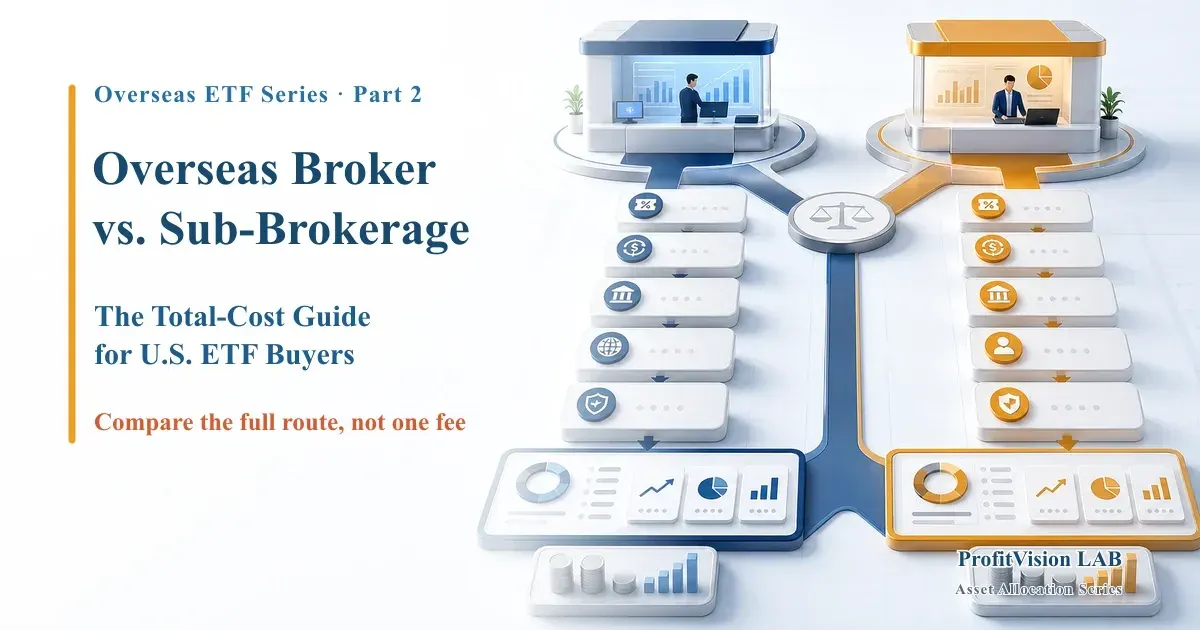
The list is open — but how do you actually get your money in to invest?
The two routes — domestic sub-brokerage and overseas broker — differ in more than commission: FX spread, wire fees, and data-handling effort are all different. This piece runs the "total cost" for you, then tells you which route fits.
- Two routes: domestic "sub-brokerage" and overseas broker (mainly IBKR Pro). The difference isn't just commission — it's FX spread, wire fees, and the hours you spend on admin.
- We run a total-cost analysis (TCA) on "buying 100 shares of VOO": a traditional 0.5% sub-brokerage = $275 (expensive); a low-fee sub-brokerage (e.g. Cathay's flat $3 per ETF, no wire fee) = ~$3; IBKR commission is $0.35–$1, but each funding wire costs $10–$25. For infrequent ETF buying, a low-fee sub-brokerage can be the cheapest.
- It's not "account size" that decides, but "ETF or single stocks × how often you trade × whether you need IBKR's products": buy ETFs infrequently → a low-fee sub-brokerage (e.g. Cathay's flat $3, no wire fee) may be cheapest, even beating IBKR; large single-stock trades / frequent trading / instruments not listed at sub-brokerages → overseas broker, but face the estate-tax exposure.
- Sub-brokerage does not make tax filing less work. Brokers are exempt from issuing an overseas-income statement; on both routes you must compile and file overseas income (gains + dividends) yourself. Overseas income above NT$1 million must be "filed" for AMT (but filing ≠ paying — actual tax usually requires basic income above the NT$7.5 million exemption, which most people never reach).
- ⚠️ Neither route escapes U.S. tax — the channel only affects cost, not the tax landmines (see Part 3).
The two routes — first, the full picture
Many ask "sub-brokerage or overseas broker — how do I choose?" But the real heart of the question is: your total cost is more than the number on the commission label. The gap between the two routes shows up across four dimensions: commission, FX cost, wire fee, and the time and opportunity cost you spend on admin.
| Dimension | Sub-brokerage (domestic broker) | Overseas broker (IBKR Pro) |
|---|---|---|
| Commission | Range is huge — can't call it all expensive: new entrants have cut deep — Cathay, SinoPac etc. at 0.08% on single stocks, ETFs mostly a flat $3 or no minimum (promo); Pocket at 0.12%, $3 minimum; traditional plans still 0.3%–1% plus a minimum charge. (brokers cited as examples, not recommendations; rates per each broker's current notice) | IBKR Pro has two pricing plans: Fixed $0.005/share (min $1), or Tiered $0.0035/share (min $0.35, plus small exchange/regulatory fees) |
| FX cost | Both routes must convert currency (~0.1%–0.3% one-way), with little difference. With sub-brokerage, if you settle in TWD the broker converts for you and the spread is embedded in the rate (a black box); but sub-brokerage also lets you bind a foreign-currency account and convert to USD yourself before settling, just like an overseas broker. To save here, pick a digital bank with a good FX margin — not a particular broker. | |
| Wire fee | None; settlement currency can be TWD or foreign (bind a USD account to convert yourself and bypass the broker's spread) | Each funding wire ~$10–$25 (SWIFT fee); withdrawals extra |
| Language / support | Chinese, local in-branch service | IBKR, Firstrade etc. all offer a Traditional-Chinese interface and Chinese support (no longer an English barrier) |
| Product range | Narrower (limited to what the broker lists) | Almost the whole market, including ETFs Taiwan sub-brokerages can't buy |
| Order execution quality | An extra routing layer; during volatile sessions prone to app lag/crashes, quote delay, wide spreads — market orders often slip to worse prices | Direct market access, real-time quotes; limit orders give precise price control |
| Tax data | Chinese, TWD-denominated trade reports are friendlier, but the broker is exempt from issuing an overseas-income statement — you still compile and file gains/losses yourself | English; export your own Activity Statement from IBKR (itemizes gains/losses & dividends), likewise self-compiled |
| Filing duty | Same for both: overseas income above NT$1 million must be "filed" for AMT (note: filing ≠ paying — actual tax usually requires basic income above the NT$7.5 million exemption) | |
| Account protection | FSC-regulated, "segregated custody" | U.S. SIPC: $500,000 total, cash capped at $250,000 |
| U.S. tax | Same for both routes (channel doesn't matter): ordinary dividends withheld 30% (but long-term capital gain distributions, ROC, etc. are not; BDCs refund the next year), plus U.S. estate-tax exposure. Distribution-type differences and actual tax burden in Part 3 | |
Total-cost analysis (TCA): it's not just commission
"Sub-brokerage is expensive, overseas brokers are cheap" used to be the common line, but new entrants have half-overturned that conclusion. The truth: sub-brokerage fees vary enormously, and picking the right broker (especially for ETFs) can even beat IBKR; while FX cost is similar on both sides, the real difference is commission plan × wire fee × trading frequency.
Below we break the same trade into three scenarios (FX ~0.1%–0.3% exists on both sides and depends on which bank you use — shown as its own line, not hidden):
| Cost item | Traditional sub-brokerage (0.5%) | Low-fee sub-brokerage (e.g. Cathay/SinoPac ETF) | IBKR Pro (overseas broker) |
|---|---|---|---|
| ① Commission | $275 (0.5%) | $3 (flat ETF rate) | $0.35–$1 (100 shares; Tiered ≈ $0.35 + fees / Fixed $1) |
| ② Wire fee (funding) | None | None | $10–$25/time |
| ③ FX (0.2% one-way, illustrative) exists on both sides; depends on which bank | ~$110 | ~$110 | ~$110 |
| Total (①+②+③) | ~$385 | ~$113 | ~$121–$136 |
Key conclusions:
· The real big-ticket item is "FX" (~$110 illustrative), far larger than the commission gap ($3 vs ~$26) — so what deserves the most attention is "picking a digital bank with a good FX margin", not agonizing over which broker
· On commission: for ETFs bought "single, infrequent", a low-fee sub-brokerage (Cathay's flat $3, no wire fee) can beat IBKR on the commission + wire piece — because IBKR's $10–$25 wire fee dominates small-ticket cost
· A traditional 0.5% sub-brokerage only clearly loses on large trades ($55,000 gets charged $275)
· FX cost: ~0.1%–0.3% one-way, 0.2%–0.6% round trip; the table uses 0.2% one-way as illustration
· Rates and promos are mostly time-limited offers — confirm each broker's / bank's current notice
FX spread: the most overlooked hidden cost
For long-hold, low-frequency strategies, the FX spread often matters more than commission. If you buy in small amounts every month, both routes get eroded by this cost repeatedly.
Take sub-brokerage: with TWD settlement, the broker's bid-ask FX spread is usually embedded in your "trade report", not itemized, so it's hard to tell how much you were charged — the round-trip total FX cost (TWD→USD on buy, USD→TWD on sell) is about 0.2%–0.6%, depending on the bank's quote. But you can avoid this: sub-brokerages mostly let you bind a foreign-currency (USD) settlement account — convert TWD to USD at a digital bank with a good FX margin first, then settle in USD, bypassing the broker's FX black box, exactly like picking your own rate at an overseas broker.
Take IBKR Pro: you must first convert TWD to USD at a Taiwan bank, then wire the USD into IBKR (IBKR doesn't accept TWD), so the FX cost happens "before the wire, at the Taiwan-bank step", around 0.1%–0.3%. To lower it, pick a digital bank with good FX terms — e.g. SinoPac DAWHO and Taishin Richart often run USD FX-margin promotions, and the digital-only banks (NEXT Bank, LINE Bank) charge clearly lower international wire fees than traditional banks (the figures are time-limited promo rates that change often — check each bank's current notice). Note: this has nothing to do with "IBKR's internal FX" — the TWD-to-USD step cannot, and won't, happen inside IBKR.
Minimum charge: the small investor's hidden tax
The most underestimated cost of a traditional sub-brokerage is the "minimum charge" clause. If a broker charges a minimum of $15 per order, then buying just $200 of an ETF means your effective rate isn't 0.5% but 7.5% — completely eroding your return.
But in recent years new entrants compete precisely on "no minimum": Cathay, SinoPac etc. at 0.08% on single stocks with ETFs mostly a flat $3; Pocket at 0.12%, $3 minimum (recurring-investment minimum $0.5). So "the minimum charge eats small trades" is no longer a universal sub-brokerage flaw — it's a question of which broker you pick. For small, recurring investors, picking a no-minimum or low-minimum broker makes sub-brokerage a great fit. The point isn't "sub-brokerage vs. overseas broker", it's "which one you picked, ETF or single stock, and how often you buy".
Who fits which route? Look at the situation, not just size
People used to slice this purely by "account size", but after low-fee new entrants appeared, the more practical criteria are three things: ETF or single stocks, how often you trade, and whether you need IBKR's products and features. Use the framework below to place yourself — it's an analytical tool, not investment advice.
Consideration: a low-fee sub-brokerage is very likely the most economical.
Why: Cathay/SinoPac-type ETF trades are a flat $3, no minimum, no wire fee — buying VOO costs just $3 in commission; IBKR's commission is lower ($0.35–$1), but each funding wire of $10–$25 dominates small-ticket cost. For "buy ETFs, rarely trade" people, a low-fee sub-brokerage is cheaper on this piece and skips the cross-border wire effort.
Key: pick a no-minimum / low-minimum new entrant, not a traditional plan still charging 0.3%–1% plus a high minimum.
Consideration: the overseas broker (IBKR) starts to show its edge.
Why: sub-brokerage mostly charges a "percentage of trade value" (even at 0.08%, $50,000 is $40), while IBKR charges per share — often just $0.35–$1 per order — so the gap widens on large or frequent trades. Only after amortizing the wire fee with "one large quarterly funding" does IBKR's commission edge fully show.
Admin note: you'll need to learn the IBKR interface, file W-8BEN, export the annual Activity Statement, and handle AMT filing. The learning curve is real, but once learned the marginal effort is near zero.
Consideration: the overseas broker is almost the only choice — but face the estate tax.
Why: many factor, sector, and international ETFs simply aren't listed at Taiwan sub-brokerages (see Part 1's gap); options, multi-currency, and margin are only at overseas brokers. Here you use IBKR not to save commission, but to "be able to buy and do it at all".
⚠️ Important: a large position makes U.S. estate-tax exposure more pressing. A non-U.S. person holding U.S.-domiciled ETFs (e.g. VOO, QQQ) above $60,000 faces estate tax, graduating to a top rate of 40% on the excess at death. The larger the amount, the more worthwhile advance planning — what actually "removes the exposure" is holding non-U.S. assets (e.g. Ireland-domiciled UCITS ETFs, outside U.S. estate tax). As for the often-recommended joint account (JTWROS), it does NOT auto-split for a non-U.S. person: U.S. tax law presumes the full amount enters the first decedent's estate unless the survivor's actual contribution can be proven — its effectiveness is highly case-specific. Consult a cross-border tax CPA on all of this (see Part 3).
This is an analytical framework, not advice. For tax planning, consult a CPA with cross-border expertise.
Sub-brokerage: easy, possibly even cheapest — but with a few real limits
Sub-brokerage's biggest upside is "dealing with a broker you already know" — a Chinese interface, local service, TWD settlement, and a Chinese-language trade statement from the broker. For people who don't want to handle cross-border wires, with smaller amounts and infrequent trades, "peace of mind" itself has value. (Reminder: sub-brokerage is a "brokerage" business — statements and any forms come from the broker; the bank is only the settlement/FX step.)
But "peace of mind" has a cost, and not just the headline commission rate. First, the minimum charge can make small trades' effective rate far higher than the surface rate. Second is the FX "black box" — sub-brokerage FX is often handled by the broker, and investors can't verify the actual rate or how much spread is baked in.
Product range is another real limit. Taiwan sub-brokerage platforms list a limited set of ETFs; many of the semiconductor, biotech, defense, and thematic ETFs covered later in this series simply can't be found at domestic sub-brokerages. If your plan needs these instruments, the sub-brokerage route hits a ceiling.
Sub-brokerage routes your order through an extra layer to the overseas market, adding routing and system steps. In practice you'll hit: app lag or even crashes, quote delays, and widened bid-ask spreads during the open, earnings, and volatile sessions.
Under delay and a wide spread, a market order easily fills at a noticeably worse price (slippage). By contrast, a direct overseas broker (like IBKR) has a short order path, real-time quotes, and limit orders for precise price control.
But scope it clearly: this drawback mainly affects people who "want to grab a precise price during volatile sessions like the open or earnings". If you're this article's main audience — long-term, recurring, buying large ETFs in batches, not racing the tape — a bit of intraday slippage matters little. The real rule for both routes: always use limit orders for U.S. stocks, never market orders.
Overseas broker: low commission, full range, and quite smooth once you've opened the account
The overseas broker's edge (using IBKR Pro as the main reference) is on three fronts: (1) low commission structure, (2) product breadth covering almost the entire U.S. market, and (3) full advanced features (multi-currency account, options, global markets, margin).
People used to think overseas brokers were "all English and a hassle" — that impression is outdated:
- Chinese support and interface: IBKR, Firstrade and other brokers Taiwanese commonly use offer a Traditional-Chinese interface and Chinese support — no longer an English barrier.
- Withdrawals are actually fast; cashing out isn't hard: after selling, a withdrawal wire is commonly initiated the same day and lands in your Taiwan bank by around noon the next day. In terms of "getting cash back", it isn't necessarily slower than Taiwan stocks (T+2 settlement) — arguably cleaner. The withdrawal "cost" (wire fee) is real, but withdrawal "speed" long ago stopped being a barrier.
The real "hands-on" part is concentrated in the one-time account opening and setup (online onboarding, filing W-8BEN, binding funding accounts); once that's done, placing orders, funding, and exporting reports are all quite smooth, with very low marginal effort.
You'll often see "converting via IBKR's built-in FX market is cheaper". For Taiwanese this is misleading: IBKR doesn't accept TWD deposits; your standard flow is "convert TWD to USD at a Taiwan bank first → then wire the USD into IBKR". So the TWD-to-USD cost happens at the Taiwan-bank step, not inside IBKR. IBKR's IDEALPRO FX market only applies when you already hold a "non-USD foreign currency" in the account to convert — irrelevant to a Taiwan retail investor's funding path. To lower FX cost, the key is picking a digital bank with a good FX margin (see the section above), not IBKR's internal FX.
IBKR (Interactive Brokers): IBKR Lite (zero-commission plan) is not open to Taiwan residents; Taiwanese can only use IBKR Pro. IBKR Pro offers two pricing plans for U.S. stocks: Fixed $0.005/share (min $1/order, max 1% of trade), or Tiered $0.0035/share (min $0.35/order, plus exchange/regulatory pass-through fees, declining with volume). For investors trading few shares, Tiered is usually even cheaper than Fixed; either way, both are an order of magnitude below most sub-brokerage commissions.
Charles Schwab: the site still lists Taiwan as an eligible country, but some Taiwanese investors report needing more documents or being declined (community anecdotes, not an official policy change). Confirm current eligibility with Schwab before opening.
Firstrade: open to Taiwan residents, marketed as zero-commission, but its product range and account tools are more limited than IBKR Pro.
W-8BEN (Certificate of Foreign Status of Beneficial Owner for United States Tax Withholding and Reporting) is the form declaring to the U.S. IRS that you are a "non-U.S. person", usually signed when opening an overseas brokerage account, and re-filed every three years.
Its role is to establish your withholding status. But note: Taiwan and the U.S. have no income-tax treaty, so even after filing W-8BEN, your U.S.-source dividends are still withheld at 30% — the form won't cut your tax, it just prevents you from being mistaken for a U.S. person and taxed more complexly. (Why 30%, and is there a fix? See Part 3.)
Account safety: precisely understanding SIPC vs. sub-brokerage "segregated custody"
Account safety is a major factor in choosing a route. But "is it safe" is often confused or oversimplified. Here's a precise look at both protection mechanisms.
IBKR / U.S. SIPC protection
SIPC (Securities Investor Protection Corporation) is a U.S. non-profit; when a member broker fails, SIPC provides a payout mechanism so investors can recover the securities and cash in their account.
SIPC limits:
- Per-account total cap: $500,000 USD
- Of which cash is capped at: $250,000 USD
SIPC covers the "broker failure" scenario, not investment losses. If your ETF drops 50%, SIPC won't reimburse a cent. Its purpose is: should IBKR as a broker fail and client assets be commingled or go missing, SIPC ensures you can recover the assets your account should hold (within the cap).
Moreover, IBKR's holdings themselves (e.g. ETF shares) are held under "segregated custody" — in theory, even if IBKR fails, your shares are still yours; SIPC is triggered more in extreme cases (e.g. broker fraud, asset misappropriation).
Overseas brokers aren't something to fear — provided you pick the right one. There's just one rule: only use U.S.-incorporated brokers that are SIPC members (IBKR, Firstrade, and Schwab are all SIPC members — verify on SIPC's site). With that U.S. statutory payout backstop, your assets are protected within the cap if the broker fails or misappropriates them.
Don't open accounts at Hong Kong, China, or unknown small platforms for the sake of a "convenient interface" or "zero commission" — they're outside the SIPC umbrella, and you'll have no recourse if something goes wrong. On safety, "is it a SIPC member" matters far more than "is the interface in Chinese".
Taiwan sub-brokerage's "segregated custody"
Taiwan's sub-brokerage regime, governed by the Financial Consumer Protection Act and related rules, uses the "segregated custody" principle: the foreign securities you buy are held by a custodian (usually an overseas custodian bank) the broker engages, kept separate from the broker's own assets. So even if the domestic broker runs into financial trouble, your overseas holdings are in theory protected by law.
Sub-brokerage "segregated custody" likewise does not cover investment losses — it only protects your ownership claim in the "intermediary failure" scenario. Note one essential difference: SIPC has a "payout fund" that tops up the shortfall (within the cap) if broker assets are misappropriated or commingled; Taiwan sub-brokerage "segregated custody" relies on "ownership separation" (securities held at an overseas custodian, apart from the broker's own assets), with no corresponding payout fund. Different architecture, different triggers, different claims process.
Bottom line: both routes' account protection targets "intermediary failure", not "investment losses". Don't choose a route based on "which one protects principal" — neither does.
The difference in obtaining tax data: a CPA's view
Many say "sub-brokerage makes tax filing simpler" — this is actually a misconception. The truth: whichever route you take, you must compile and file overseas income yourself. The key is a rule most people don't know:
Per Ministry of Finance rules, the engaged broker (sub-brokerage) is exempt from issuing an overseas-income withholding statement, and overseas income is outside the tax authority's "queryable income data". That is, at May filing time the system won't auto-populate a ready overseas-income figure the way it does for Taiwan-stock dividends — same for sub-brokerage. You must compute overseas income (realized gains + dividends) yourself, line by line, from trade records, remittance proofs, and FX rates. But "can't be queried" doesn't mean "no need to file" — brokers usually still mail an "overseas-income detail notice" for reference, and under-reporting once you've hit the threshold still incurs back taxes and penalties if caught.
Sub-brokerage's data source
Domestic brokers provide a Chinese, TWD-denominated trade report that looks friendly; but it is not a "filing-ready overseas-income statement". What you get is buy/sell records and distribution details — you still have to sum the year's realized gains/losses and dividends and convert to TWD before entering them into your basic income. The notion that "the broker tidies it up and saves you work" simply doesn't exist.
Compiling data at an overseas broker
With IBKR, you log in yourself and export the annual trade record (Activity Statement) from "Reports", in CSV or PDF. It includes:
- All realized gains/losses (Realized Gain/Loss): computed per lot by holding period, cost basis, and sale price
- Dividend income (Dividends): the net amount after the 30% U.S. withholding
- FX gains/losses (Forex P&L): to be handled if you have currency-trade records
Frankly, the workflow is about the same on both routes — you sum your own realized gains/losses and dividends either way. IBKR's Activity Statement actually itemizes each gain/loss and dividend cleanly, not necessarily more work than piecing together a sub-brokerage's Chinese monthly statements. Many experienced investors handle it in Excel, or hire a tax preparer (typically a few thousand NT$ a year).
Taiwan's Income Basic Tax (AMT) filing duty is identical for sub-brokerage and overseas broker. But first separate two thresholds, so you don't scare yourself:
- Filing threshold (NT$1M): once full-year overseas income exceeds NT$1 million, you must include it in your basic income and file the next May — this is a "filing" duty, not the same as owing tax.
- Taxation threshold (NT$7.5M): to actually owe AMT, your basic income generally has to exceed the NT$7.5 million exemption (current as of 2026, formerly NT$6.7M); the excess is taxed at 20%, then compared with regular income tax and you pay the higher.
So "overseas income above NT$1 million" only requires you to file; the vast majority owe no tax after filing (Part 3 shows why 99% never reach the taxation threshold). This rule doesn't distinguish sub-brokerage from overseas broker — it only looks at your overseas-income amount. At most, sub-brokerage offers a friendlier interface and currency; the broker won't compute or file your overseas income for you — the duty and the workflow are the same on both routes.
If you've long used sub-brokerage but never filed overseas income, assess whether a filing duty exists; if in doubt, consult a CPA with cross-border tax expertise.
The tax landmines don't change with the route
Many assume "using an overseas broker, with securities held abroad" avoids U.S. tax — wrong. As long as you hold a U.S.-domiciled ETF (e.g. VOO, SMH, QQQ), whether via sub-brokerage or an overseas broker, the tax that's due doesn't disappear because of the channel — ordinary dividends' 30% withholding and U.S. estate-tax exposure are both there (these securities are deemed "U.S.-situs assets"). As for which distributions are withheld at 30% and which aren't (long-term capital gain distributions, ROC, BDC refunds, etc.), Part 3 unpacks it fully — but don't get over-optimistic: for index ETFs like VOO, distributions are almost all ordinary dividends, still withheld at 30%; the "0% category" is mainly seen in specific fund types.
The channel determines cost; tax is determined by "where the ETF is domiciled", not by where your broker is. But don't make it scarier than it is — Part 3 runs the numbers line by line: a growth ETF's 30% drag is so small it's barely felt; estate tax has room for advance planning (a joint account doesn't auto-split for a non-U.S. person — what truly removes exposure is holding non-U.S. assets like UCITS); and UCITS only pays off in specific cases. Tax is a cost, not a reason to stay home.
Next up: that "30% tax" keeping you from going abroad — should you really fear it?
Access and cost structure are covered; the last gate is tax. The next piece runs the numbers line by line: the 30% is multiplied by the yield (a growth ETF barely feels it), a Taiwan high-dividend stock's tax is virtually the same as the U.S.'s, not every distribution is withheld at 30%, how estate tax is triggered and planned around, why 99% of people never reach Taiwan's AMT threshold, and whether UCITS is worth it at all. The conclusion up front: tax is a cost, never a reason to buy or not buy.
This isn't obscure knowledge — it's the tax framework every Taiwanese holding U.S. ETFs should understand, especially those planning to hold long-term or with larger accounts.
Frequently Asked Questions
📚 Further Reading
The total-cost figures are illustrative estimates using public information; broker commissions, minimum charges, FX, and funding/withdrawal rules change frequently — rely on the latest notice from the broker you use. AMT filing duty varies by your income mix and amount; for tax decisions consult a CPA with cross-border tax expertise. Overseas investing carries currency, tax, and operational risk — assess your own situation carefully.

Comments ()