
Taiwanese M&A Manifesto: Trust-Based M&A
A Trust M&A Series conclusion across Berkshire, Amphenol, Constellation, Danaher, Foxconn and Taiwan Steel Group, distilled into two-way trust and five Taiwanese M&A keywords.
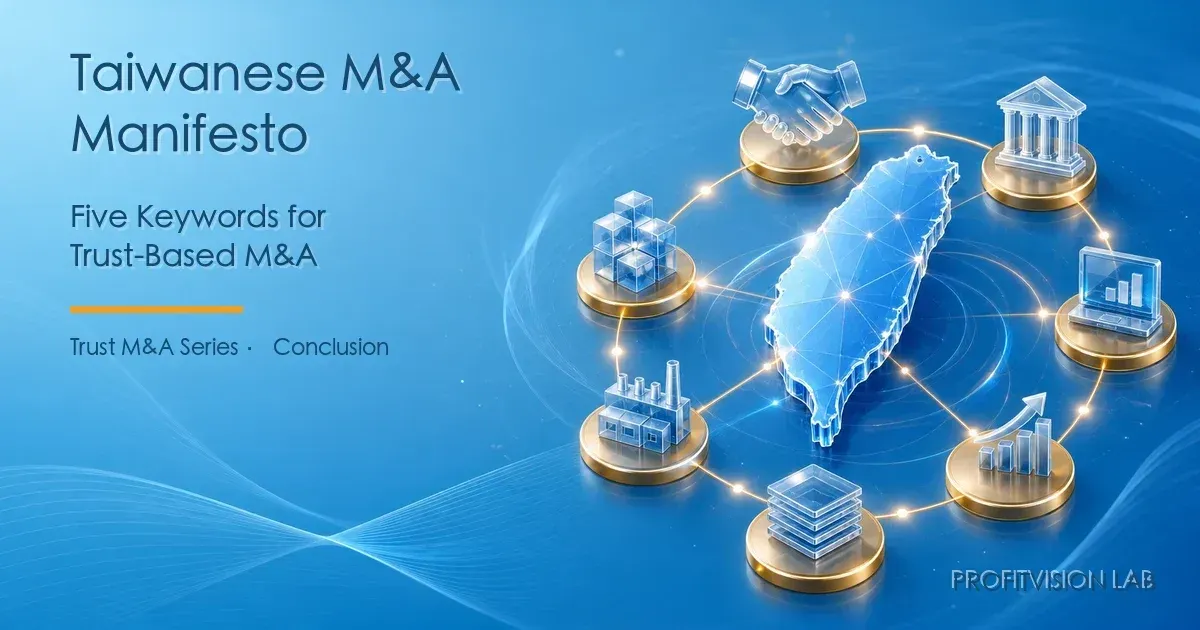
- No model is superior — only better-fitted: integration intensity must match the asset type. Berkshire doesn't interfere, CSU doesn't integrate, Danaher embeds deeply, Foxconn divides by node, TSG goes case by case — the same "integrate" or "let go" can be the right answer or a fatal error depending on the asset.
- But there is one shared dividing line: two-way trust vs. one-way trust. The best acquirers keep faith not only with the acquired, but also disclose honestly to their own original shareholders; the most dangerous ones only demand the market's trust, yet refuse to be transparent to shareholders.
- Taiwanese companies' DNA sits natively close to the success premises of trust-based M&A — Integrity, Mutual Aid, Sharing, Perseverance, Flexibility. This is not a new skill to learn, but an existing asset to be re-recognized.
- Three reminders for Taiwan's capital players: first cultivate the vision and breadth to imagine "a bigger version of yourself"; never mistake a momentary customer or technology node for a permanent moat; and let trust face not only outward, but inward.
What is the Taiwanese M&A Manifesto? It is a way to turn five native traits of Taiwanese business culture — Integrity, Mutual Aid, Sharing, Perseverance and Flexibility — from business instincts into an M&A methodology. It argues that durable acquisitions are not built by control alone, but by matching integration intensity to asset type, keeping trust two-way, and building an ecosystem in which the acquired company, the parent and the original shareholders can all compound together.
Back to the Question We Started With
This series set out from a question that looks simple but is in fact extremely hard: when you buy a company, do you choose to trust them, or to control them?
We never gave a standard answer, because there isn't one. What we did was step into the decision rooms of six world-class acquirers and watch how each, in its own way, answered that same question:
Buffett gives the seller "a permanent home" with a handshake; Amphenol uses institutions to lock down "non-interference"; Constellation trades the promise of "never sell" for the seller's loyalty; Danaher uses DBS to make the acquired better; Foxconn uses a clear division of labor to lock down the node that makes its core irreplaceable; Taiwan Steel Group uses real capital to set right a good company dragged down by bad management.
Six answers, six models. Now it is time to place them on a single map.
Six Models, One Spectrum
If we understand these six models along a single axis, it is this: after acquiring, how much decision-making power do you leave in the hands of the acquired? From "almost all of it" to "full takeover," the six models line up exactly as a spectrum from "trust" to "control."
Platform
Institutional
Character
System
Vertical
Opportunistic
← More trust (power left with the acquired) | More control (power pulled back to the parent) →
| Model | Exemplar | Form of trust | In one line |
|---|---|---|---|
| Character trust | Berkshire | Promise of a permanent home | "I give you a forever home." |
| Institutional trust | Amphenol | Institutionalized letting-go | "I use institutions to guarantee I won't interfere." |
| Platform compounding | Constellation | Promise of never selling | "I will never sell your company." |
| System-embedded | Danaher | Results of transformation | "I make you better." |
| Vertical extension | Foxconn | Strategic division of labor | "Guard your node, and I trust you." |
| Opportunistic | TSG | Opportunistic, rebuilt afterward | "Good assets + bad management + weak defense — I move in." |
There Is No Best Model, Only the Best-Fitted
The single most important insight of the whole series is this: no model is "the best" — only which one best fits your asset type and the boundary of your capability.
Berkshire buys moat companies "that need no fixing," so non-interference is correct; Constellation buys niche software "that loses its moat the more you integrate it," so not integrating is correct; Danaher buys industrial companies "with room to improve and a lack of improvement tools," so deep embedding is correct.
The same action — "integrate" or "let go" — placed on a different asset type, can be an elegant right answer or a fatal mistake. Foxconn's clear division with Sharp was efficient while panels were still scarce; but once panels commoditized and the node devalued, that same division became a contract hanging in mid-air. TSG's opportunism is a woodpecker when the target can be paired with turnaround capability; when only an equity spread remains, it reverts to pure financial arbitrage.
But There Is One Shared Dividing Line: Two-Way Trust, or One-Way?
The models may differ, but one thing separates the truly great acquirers from the rest — is their trust two-way, or one-way?
What Berkshire, Constellation and Danaher share is not only that they treat the acquired well, but that they are equally honest with their own shareholders: Buffett's letters are the gold standard of disclosure; Constellation's disclosure is minimal yet candid. They make promises to the acquired, and they answer to the shareholders who put up the capital. That is two-way trust.
And when we turn the lens back to Taiwan's largest acquisition empire, we see a stark contrast: it talks strategic trust, division of labor and empowerment to the acquired, yet toward its own original shareholders its disclosure and transparency are repeatedly called insufficient — a maze of layered cross-ownership, the spin-off of the juiciest orders into another market, the "we don't disclose, that isn't dishonesty" reply. It demands the market trust it, yet does not necessarily tell you the whole truth. That is one-way trust.
Why Is Taiwan's DNA Natively Close to "Trust-Based M&A"?
Having covered world-class cases, let's bring it home at last. Taiwanese companies stand at a turning point — they reached here on organic growth and contract-manufacturing execution; to go global, M&A is a lesson they cannot skip.
The good news: the cultural genes of Taiwanese companies sit natively close to the success premises of trust-based M&A. The conditions that make Amphenol's decentralization and Constellation's promise work — keeping one's word, entering with resources to share rather than a will to control, respecting local knowledge — are precisely the deepest hue of Taiwan's business culture.
Taiwan's successes in Southeast Asia, Japan and Europe were almost all built on "bringing technology and capital, yet respecting local decisions." That humility is not a weakness — it is the scarcest capital of trust-based acquisition. The problem was never that Taiwan lacks capability, but that it has not yet clearly recognized that what it natively owns is exactly the most valuable acquisition asset of this era.
A Taiwanese M&A Manifesto
And so the whole series finally distills into five words. They are at once the cultural traits of Taiwanese companies and the five keys to trust-based M&A:
These five words are nothing new to Taiwanese companies — they were already written into our business culture. The only difference is this: once they were the instinct of doing business; from now on, they must become the methodology of doing M&A.
Three Reminders for Taiwan's Capital Players
The manifesto is direction; landing it requires concrete vigilance. From the six cases we distill three reminders worth remembering most:
1. First cultivate "vision" and "breadth"
Organic growth is "doing what you already do, better"; M&A is "buying a version of yourself you are not yet." These are two different starting points. Taiwanese companies are supremely skilled at the former, still strangers to the latter. The question is not only "is this company cheap," but "what can I become after buying it?" — a breadth of mind that must be deliberately cultivated, not just a financial calculation.
2. Never mistake a momentary node for a permanent moat
The most painful lesson of the Foxconn–Sharp case: every moat built on a "single customer" or "single technology node" will be eroded by industry change. When doing vertical-integration M&A, treat "the node will devalue" as the default, not as an accident. Binding one big customer is efficiency in fair winds and a fatal weakness in foul ones.
So what's the answer? Not "don't do vertical integration," but to change what you pursue — don't just aim to "own a node," train the ability to "keep moving to the next node." A node is a depreciating asset, but the discipline of "continually identifying and rotating into the next key node" is the moat that truly never devalues. Foxconn itself has shown this path: panels devalued, so it rotated capital into semiconductors, then EVs and AI servers — Sakai morphing from cathedral of panels into AI data center is the very emblem of that "reallocation capability." Buying a node is only the entry ticket; turning before it devalues is the real skill.
For Taiwanese companies this reminder is even more intimate: when 90% of your revenue rests on one big customer, that is not a moat — it is handing your lifeline to someone else. The real solution is to upgrade "a relationship bound by one customer" into "a capability many customers cannot do without" — diversify customers, grow a second curve, and distill the edge of a single product into a core competence replicable across products and customers. Lock-in can be a starting point, but never the destination.
3. Trust should face not only outward, but inward
When you talk trust to the acquired, don't forget — your original shareholders are also people who handed you their money and trusted you. An ownership structure can be complex, but "formal compliance" does not equal "substantive transparency." Only an acquirer that is honest inward, too, goes the distance.
In Closing: This Map Is Yours
Six cases, six models, finally condensed into one axis (trust or control), one dividing line (two-way or one-way), and five words (Integrity, Mutual Aid, Sharing, Perseverance, Flexibility).
This series never intended to hand you a "just do this" answer. What it gives you is a map — so that facing any deal, any company, you know which questions to ask: what asset is this? Should I trust or control? Is my trust two-way?
Because at ProfitVision LAB we always believe one thing — I teach you how to think, not just what to do. The map is here; the road, you walk yourself.
When others build empires through control, Taiwan can use trust to grow something more enduring: an "ecosystem." And this ecosystem is the deepest hue of Taiwanese enterprise — everyone has a role, everyone lends a hand; upstream and downstream collaborate, and even horizontal peers form teams and swap capacity. The center-satellite factory system, the industrial clusters, the support network that arrives with a single phone call — none of it ever ran on who controls whom, but on the trust of watching each other's back and flourishing together. Empires run on conquest, and will collapse; an ecosystem where everyone has a role and everyone helps the other succeed will live on, passed down generation after generation.
What is trust-based M&A?
Trust-based M&A is a post-acquisition governance philosophy. Instead of first asking how to control the acquired company, it asks how much integration the asset actually needs and how much decision-making power should remain with the acquired team. It is not the same as doing nothing; it means matching trust or control to the asset type.
What are the five keywords of the Taiwanese M&A Manifesto?
The five keywords are Integrity, Mutual Aid, Sharing, Perseverance and Flexibility. They map to keeping promises and disclosing honestly, entering with resources rather than control, sharing supply-chain and shareholder synergies, staying through hard transitions, and respecting localized decision-making.
What investment framework does this series leave behind?
For any acquisition, ask three questions: what asset is being bought; does this asset require trust or control; and is the acquirer's trust two-way, or does it only ask the market and the acquired company to trust it?
- Intro: Five M&A Models — After You Buy, Do You Trust or Control?
- Part 1: Berkshire Hathaway — The Permanent Home, character-based trust
- Part 2: Amphenol — Institutional trust across 130 decentralized units
- Part 3: Constellation Software — The never-sell promise, platform compounding
- Part 4: Danaher / DBS — System-embedded, building trust through transformation
- Part 5: Foxconn Group — Vertical extension: control by nodes, control by ownership
- Part 6: Foxconn × Sharp — Strategic trust and its price
- Part 7: Taiwan Steel Group — The opportunistic conglomerate's woodpecker PE playbook
- Conclusion (this piece): A Taiwanese M&A Manifesto — Integrity, Mutual Aid, Sharing, Perseverance, Flexibility
Comments ()