Five M&A Models: Trust vs. Control After Acquisition
Most M&A failures aren't valuation mistakes — they're people mistakes. This opening piece maps five M&A archetypes around one question: after the deal closes, do you trust the people you acquired, or do you control them? A strategic framework for Taiwan enterprises going global.
Starting With One Question
Imagine you spent three years pursuing and finally acquiring a German precision manufacturing company you had long admired. The founder is second-generation — he took the factory his father built to €80 million in annual revenue, carving out an irreplaceable position in the automotive supply chain.
The deal closes. It's Monday morning. What is the very first thing you do?
The instinctive response for most acquirers is: send in a CFO, install a monthly reporting system, standardize procurement processes, and begin "introducing our management approach."
But there is another possibility: do nothing. Call the existing CEO and say: "Keep running it. I only need one thing — if something arises beyond your decision-making authority, let me know. Everything else is yours to decide. You are the boss."
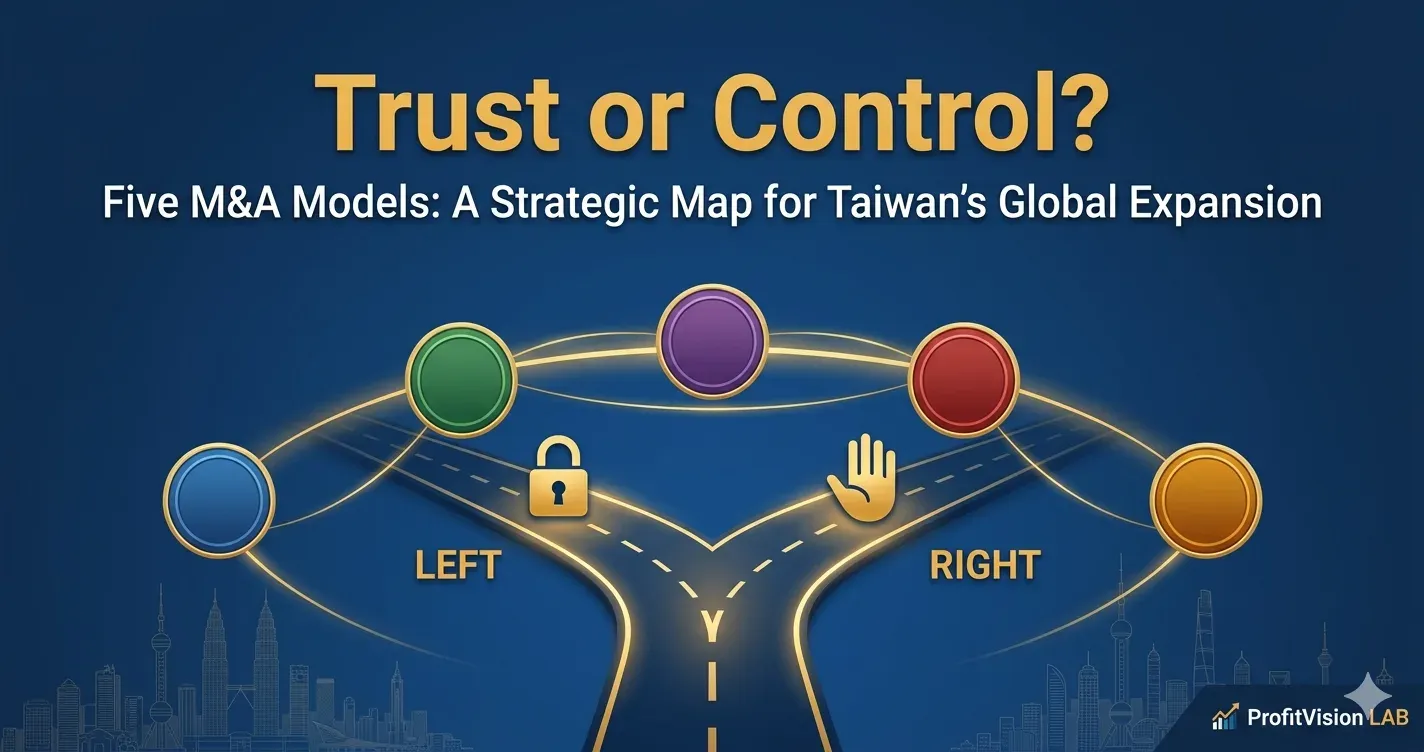
These two choices represent the most fundamental fork in the road of M&A: Are you buying assets, or people? Do you want control, or trust?
Five Models: A Map of the M&A World
After studying the world's major serial acquirers, a pattern emerges: their M&A philosophies can be distilled into five fundamentally different archetypes. The difference between them is not in financial structure or valuation methodology — it lies in a more fundamental question: after the acquisition, how do you treat the people you bought?
The Single Most Important Axis
Between the five models, countless comparison dimensions exist — integration depth, screening criteria, scalability limits, failure scenarios. But if only one axis could capture their essential difference, it would be this:
Model C (Constellation): Nearly all → Acquired CEOs barely know HQ exists
Model A (Amphenol): The vast majority → Only purchasing and capital are centralized
Model B (Danaher): Partial → Process and methodology unified, execution autonomous
Model D (Foxconn): Division-dependent → Technology autonomous, manufacturing centralized
Model E (Taiwan Steel): Variable → Depends on the case and the management team
Behind this axis lies a deeper question: Do you trust the people you acquired — or do you trust your own systems more?
Why Taiwan Enterprises Should Orient Toward Models A and C
This is not a theoretical recommendation — it is a judgment grounded in Taiwan's actual competitive position.
Taiwan enterprises going global have structural advantages in three conditions that happen to be the key prerequisites for Models A and C to succeed:
Condition 1: Integrity culture. Both A and C require "keeping promises" as the bedrock of trust — truly not interfering after acquisition, truly honoring the "never sell" commitment. Taiwan's business culture treats verbal commitments as sacred. This is the most natural starting point for building this kind of trust.
Condition 2: Willingness to share resources. The core logic of Model A is "I bring global purchasing scale to benefit you" — not "I come to control your processes." Taiwan's mutual-aid culture and satellite factory collaboration model are inherently oriented toward "sharing resources rather than extracting them."
Condition 3: Respect for local knowledge. Model A's "non-interference" reflects a deep humility: "You understand your market better than I do." Taiwan's successful ventures in Southeast Asia, Japan, and Europe are almost all built on this foundation — bringing technology and capital while respecting local decision-making.
Integrity — Promises are kept; commitments don't change with the wind
Mutual Aid — Arriving with resources to share, not with a controlling agenda
Sharing — Opening supply chain networks so acquired companies benefit from Taiwan's manufacturing edge
Grit — Long-term commitment; not retreating when things get difficult
Flexibility — Localized decision-making; not forcing the replication of Taiwan's management model
These five qualities are simultaneously Taiwan's cultural character and the five prerequisites for Models A and C to succeed. What Taiwan enterprises need is not to learn new capabilities — but to become more consciously aware of what they already possess.
What Comes Next: Seven Deep-Dive Research Articles
This introduction ends here. It is not an article with answers — it is a map that asks questions.
The seven articles that follow are each a story of how this map gets tested — verified or challenged — in the real world:
Every article returns to the same question: After the acquisition, do you trust them — or control them?
There is no right or wrong answer. But the choice shapes decades.