Amphenol (APH): When Org Design Becomes the Moat
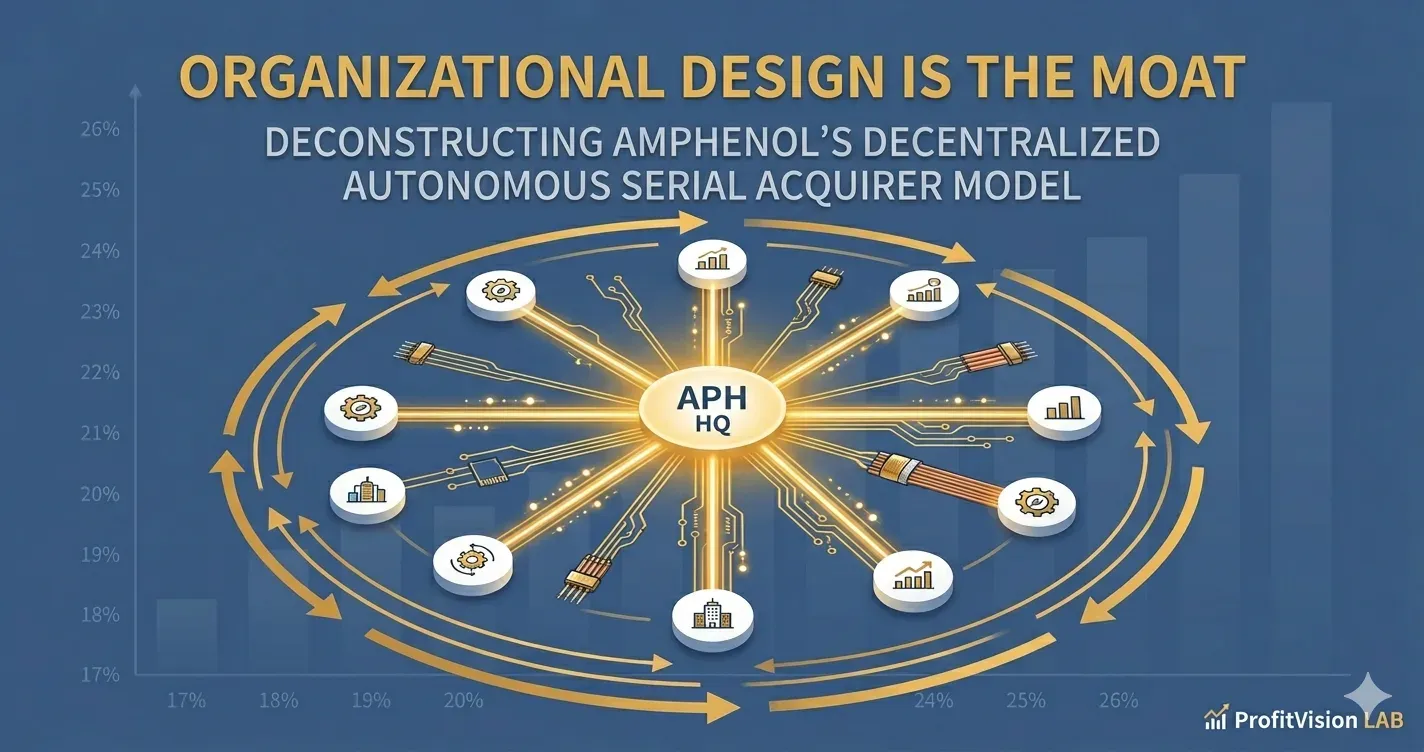
APH's economic moat is its organizational design, not its connectors. 130+ autonomous P&L units, systematic M&A with a 24-month margin ramp, and a GM entrepreneurial culture form a self-reinforcing flywheel that Danaher cannot replicate and TE Connectivity can only envy.
Section 1: Starting With One Question
A question that has puzzled investors for years: Why can APH's adjusted operating margin systematically exceed its largest competitor TE Connectivity by 500–600 basis points — and why is the gap widening?
The standard answer is "product mix differences" or "different market positioning." But this isn't convincing — both companies sell connectors, serve the same major customers (aerospace, automotive, data centers, military), and both have manufacturing bases in 40+ countries.
The real answer is buried in organizational design.
APH headquarters headcount: a few hundred (intentionally kept lean)
APH business units under management: 130+, across 40 countries
TE Connectivity structure: Three large divisions, centralized functional departments
This is not coincidence — it is a deliberate design choice. APH's management efficiency doesn't come from "better processes" but from "fewer processes."
Section 2: Extreme Decentralization — Dissecting APH's Organizational Architecture
Military / Aerospace / Industrial
5G / Data Centers / Consumer Electronics
Auto / Medical / Industrial Automation
✅ Set their own customer pricing strategy
✅ Direct their own engineering / R&D investment
✅ Hire and fire employees
✅ Choose manufacturing strategy (local vs. outsourced)
✅ Determine sales channels and geographic expansion
The GM's KPI is one concept: this business unit's P&L performance.
① Global purchasing scale negotiation (every BU benefits from group-level material cost leverage)
② Capital allocation and M&A (decides who to buy, at what price, post-deal financial structure)
③ Financial compliance and reporting (SEC-mandated centralized functions)
No centralized HR, IT, marketing, or R&D. This is deliberate design, not a resource constraint.
Four Mechanisms That Make This Design Work
Mechanism 1: Accountability Compression — In traditional large enterprises, business decisions pass through multiple approval layers, each with an opportunity to "do nothing" without bearing consequences. APH's extreme decentralization compresses this to the limit: the GM is the final decision-maker and sole accountability holder. This eliminates the "diffusion of responsibility" problem endemic to large organizations.
Mechanism 2: Market Proximity — Connectors are highly customized products. Customers designing a new platform need not a "global customer service center" but a local technical sales team that can respond within days and sit in the customer's design room. APH GMs are typically based near their customers — a reaction speed that TE's centralized organization structurally cannot match.
Mechanism 3: Internal Laboratory Effect — 130+ business units means 130+ simultaneous market experiments. In a centralized organization, such insights require formal intelligence collection mechanisms to propagate. In APH's decentralized architecture, knowledge flows naturally through informal GM exchanges.
Mechanism 4: M&A Absorption Capacity — This is the most underappreciated mechanism. The decentralized architecture allows APH to acquire a new company and simply make it the 131st business unit, without restructuring any existing organizational structure, without resolving any departmental conflicts, without standardizing any processes. This brings APH's "integration cost" close to zero — the fundamental reason it can acquire at high frequency with low failure rates.
Section 3: Systematic M&A — Full Deconstruction
The Complete M&A Process (Five Stages)
This doesn't mean APH is better than Danaher — both models have succeeded. But APH integrates faster because its philosophy is "don't integrate": you don't need to change a company's culture if you select companies with already great cultures from the start.
Section 4: Three Dimensions of the Organizational Design Moat
Dimension 1: Replicability
| Element | Can Be Quickly Copied? | Real Difficulty |
|---|---|---|
| Formal org chart (130 BUs) | ✅ Yes | Structure easy to copy, culture impossible |
| GM P&L accountability | ⚠️ Partially | Need GMs willing to own results; performance culture takes years to build |
| "HQ doesn't interfere" trust culture | ❌ No | Executives must consciously "restrain themselves from managing" — against human instinct |
| GM recruitment and retention system | ❌ No | APH GMs typically spend 10–20 years at the company; professional identity deeply rooted |
| M&A flywheel momentum | ❌ No | Every acquisition adds a bit more integration capability; competitors are always catching up |
Dimension 2: Operating Margin Gap Explained
Over half of APH's 600bps OPM advantage over TE can be attributed to the "management cost advantage" from organizational design: APH has no massive fixed-cost centralized HR, IT, or marketing functions.
Dimension 3: Crisis Resilience
| Crisis | APH Response | Peer Response | Conclusion |
|---|---|---|---|
| 2020 COVID-19 | Full-year only -5%, rapid recovery | Industrial stocks averaged -15% | Local decision-making speed advantage |
| 2018 US-China Trade War | Accelerated Vietnam/India footprint, minimal impact | Some peers faced major supply chain disruptions | Distributed manufacturing flexibility |
| 2023 Consumer Electronics Downturn | Full-year flat; defense + AI filled the gap | TE's automotive-heavy portfolio under pressure | End-market diversification value |
Section 5: The Flywheel — How Three Elements Create Self-Reinforcing Compounding
Section 6: Moat Boundaries and Risks
Section 7: Management Insights — Organizational Design as Competitive Strategy
Insight 1: "Not managing" is itself a management capability. Traditional management theory emphasizes "effective management control systems." APH's case shows that sometimes "deliberately reducing control density" is the more effective choice. Every centralized function HQ adds creates an "awaiting approval" friction point in every business unit. APH's choice: almost never create such friction.
Insight 2: M&A capability itself can be a moat. Most strategy textbooks treat M&A as a "tool to achieve strategic goals." APH's case shows that "sustained, high-frequency, high-success-rate M&A capability" can itself be a competitive advantage — because this capability is built through decades of organizational learning, not one smart decision, and competitors cannot replicate it short-term.
Insight 3: "Focus" creates more compounding than "diversification." Taiwan's conglomerate models teach us that diversification can bring scale; APH teaches us that focus creates compounding. Since 1987, every APH acquisition has stayed within "connectors / sensors / interconnect systems." This boundary seems to limit growth potential — but it actually ensures APH's organizational learning curve keeps improving with each acquisition.
What APH is most worth studying is not its financial metrics, but how it answered a fundamental organizational design question: "When an enterprise becomes too large to manage, do you continue centralizing control — or let it become a federation run by entrepreneurs?" APH chose the latter, and 40 years of practice has proven this choice correct.
Conclusion: APH Moat Assessment
| Moat Dimension | Rating | Notes |
|---|---|---|
| Organizational design replicability barrier | ⭐⭐⭐⭐⭐ | Requires 10–20 years to build; culture cannot be parachuted in |
| M&A integration capability | ⭐⭐⭐⭐⭐ | Organizational memory from 100+ successful acquisitions |
| Global sourcing scale advantage | ⭐⭐⭐⭐ | World's second-largest connector manufacturer purchasing power |
| Design-in switching cost barriers | ⭐⭐⭐⭐⭐ | 3–5 year product lifecycle lock-in |
| End-market diversification | ⭐⭐⭐⭐ | IT datacom 37% concentration slightly elevated; monitor |
| Management culture succession | ⭐⭐⭐⭐ | Norwitt succession risk exists but system is institutionalized |
| Financial resilience (current) | ⭐⭐⭐ | Post-CCS leverage elevated; largest near-term uncertainty |
Overall assessment: APH possesses the deepest and most difficult-to-replicate organizational design moat in industrial stocks. Current valuation (P/E ~40×) reflects a premium the market has already assigned for this. The CommScope CCS integration outcome is the central observation point for 2026–2027. The moat itself is intact; the financial leverage introduced by the acquisition warrants continued monitoring.
Data sources: APH Annual Report, SEC Filing, Amphenol official website, public research