
Taiwan Steel Group: The Woodpecker Playbook of a Homegrown Private Equity Firm
A Taiwan Steel Group M&A case study: the woodpecker playbook of a homegrown PE-style acquirer, from selection discipline and control contests to turnaround execution and the ceiling of opportunistic M&A.
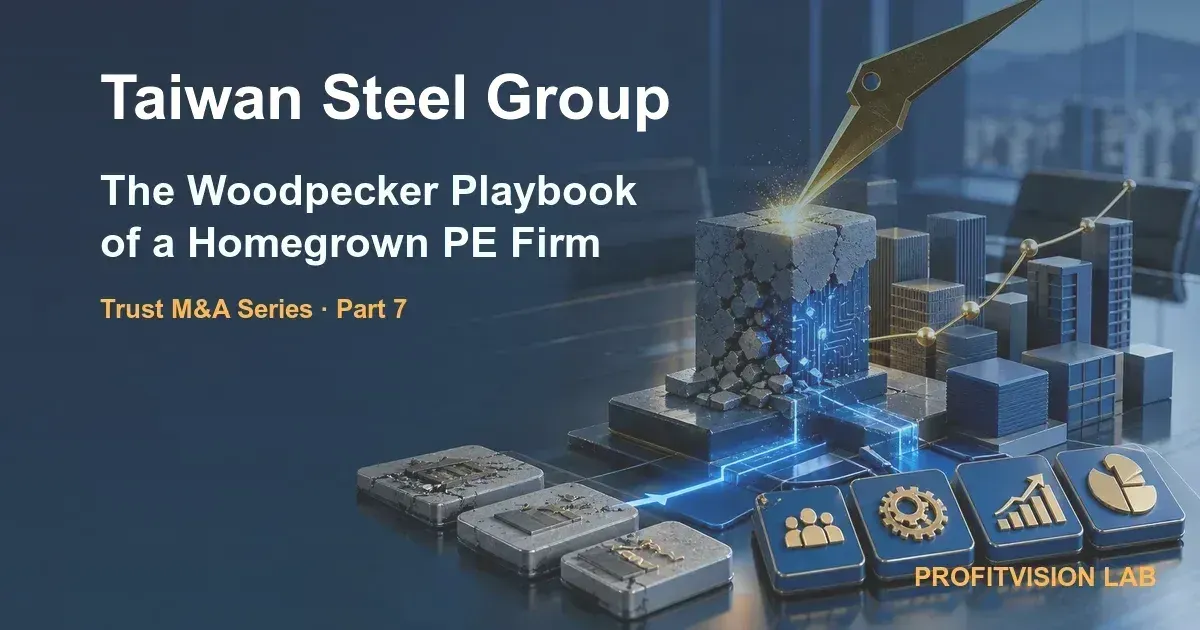
- Taiwan Steel Group's selection discipline goes far beyond "cheap." It targets a triple dislocation: an undervalued brand or fixed assets × a feuding, caretaker-only management team × an incumbent faction holding too few shares to defend itself. Cheapness is the result, not the cause.
- It is not a vulture, it is a woodpecker. The companies it breaches usually have incumbents with no meaningful equity base — barely qualified to hold the company at all. TSG commits real capital (often a combined 30–40% stake with allies, e.g. ~35% in Chun Yu), removes the pests, restores competitiveness, and returns shareholder value. This is constructive, not predatory.
- Its true nature is closer to a private equity (PE) firm: find an undervalued target → take it → deploy a professional team to absorb, restructure and revitalize → release the value. D-Link (友訊) is the proof: TSG sent in a former Broadcom Taiwan country head and a cross-border CFO — genuine operators, not just bean-counters.
- Its ceiling is the "glue." Cross-industry synergy is hard to realize, and the entire empire still rests heavily on founder Hsieh Yu-min's personal eye for targets and turnaround ability. Whether it can institutionalize that skill — evolving, as Buffett did, from "bargain-hunting" to "permanent home" — is Taiwan Steel Group's biggest test.
From Billions in Debt to NT$70 Billion in Revenue: A PE-Style Comeback
Taiwan Steel Group's story is one of the most dramatic comebacks on the Taiwan market.
Taiwan Steel Group (TSG) is led by Chairman Hsieh Yu-min. According to media reports, starting from billions of NT dollars in debt, over nearly two decades he built TSG into a diversified group with roughly NT$70 billion in total revenue and around 19–20 listed companies at home and abroad — spanning four major fields (steel, networking, chemicals & green energy, and health & sports) and twelve business groups, with sub-groups including Ching Hsin Hsin, Chun Yu, Gloria Material, Jeou Yang and Jing Gang.
(reported approx.)
taken over
Chemicals / Sports
But this map was not grown from one clear industrial strategy. It was stitched together from one acquisition after another — "see an undervalued good target, take it, then restructure and revitalize." To understand TSG, you first have to discard the label the media gave it and look at how it really operates.
It Buys More Than "Cheap": The Triple Dislocation
Calling TSG a mere "bargain hunter" sells it short. Examine its record closely and you find that its targets almost always share three traits — what I call the "triple dislocation."
It Is Not a Vulture, It Is a Woodpecker
The media labels TSG a "vulture" or "sniper." But the metaphor points the wrong way.
A vulture feeds on carrion — it profits from death and creates nothing. What TSG does is the opposite: it attacks companies that are still alive but being dragged toward decay by incompetent management. It is more like a woodpecker — it pecks open the bark, picks out the grubs gnawing at the trunk, and lets the tree grow healthy again.
Where is the difference? In whether the acquired company ends up better or worse. Across cases like D-Link, Chun Yu and Taiwan Styrene Monomer, after TSG took over it generally disposed of idle assets, refocused the core business, improved governance, and pulled chronically loss-making companies back into profit. For the minority shareholders trapped by a "caretaker cabinet," TSG's arrival was often the starting point of renewed value growth.
Real Capital, Not a "Cheap Proxy Trick"
A common claim circulates about TSG: that it seizes control with "a small stake plus a lot of proxies," barely spending a thing. This claim has the causation backwards.
The truth is that when TSG strikes, it and its allies often hold a sizable, real-money stake — in Chun Yu, for instance, a combined holding of around 35%. That is not "a small stake," that is hard cash committed. The reason it wins is not the proxy tool, but that the opponent is weak: the incumbents it targets hold too few shares even to defend themselves, and lose on legitimacy, on capital committed, and on operating plan to a TSG that arrives with both real money and a restructuring blueprint.
builds a stake
thin to defend
at the AGM
return value
To be balanced: Taiwan's proxy-solicitation system is genuinely contested, and the regulator (the FSC) has voiced concern over "acquiring control through proxy solicitation while holding a low stake," and set up a task force to review the rules. That institutional debate deserves to be taken seriously. But for TSG specifically, attributing its wins to a "proxy trick" underestimates its real edge — seeing accurately, betting heavily, and being able to fix the mess it buys.
In Essence, It Is a Private Equity Firm
Pull the threads together and TSG's true identity emerges: it is not a traditional industrial conglomerate but, more than anything, a homegrown private equity (PE) firm.
What is the standard PE move? Find an undervalued, badly run target → take control → deploy a professional team to restructure, refocus and improve governance → release the value (relist, sell, or harvest over time). What TSG does is almost identical. The only difference is execution: traditional PE typically works through private funds, takes the target private, restructures, and re-IPOs; TSG instead targets already-listed companies in the open market, takes control, and stays listed — restructuring while letting value show up in the share price.
A traditional industrial conglomerate pursues synergy — what it buys must mesh with the core. But across TSG's twelve business groups, screws, chemicals, networking and professional sports share almost no common technology or supply chain. By the "group synergy" standard, it fails.
Yet by the "PE portfolio" standard it makes complete sense: each target is an independent "activation project"; they need no synergy with one another, only to be each restructured to release value. Read TSG as "a long-hold Taiwan-equity PE fund that personally goes in to fix its portfolio companies," and every move acquires its logic. This also explains why it dares to span so many industries — because a PE firm's circle of competence is not "an industry," but "identifying and repairing undervalued companies."
Ten Signature Campaigns at a Glance: From Fasteners to Networking, From Turnaround to Arbitrage
Talk is cheap; let the record speak. The table below lays out ten of TSG's most representative campaigns over the past decade-plus, across five columns — what it bought, how much real capital it committed, who it sent in, and what it ultimately delivered. Among them are turnaround masterpieces (D-Link, Gloria Material), but also a case where it failed to win control and exited as pure financial arbitrage (Solar Applied Materials), and one where execution stumbled into controversy (Guantian Steel). Even a woodpecker sometimes pecks at empty wood.
| Target | Year | Core value acquired | Capital / stake committed | Team deployed | Medium-term turnaround |
|---|---|---|---|---|---|
| Chun Yu (春雨) | 2013 | 70-year fastener brand + land; long undervalued | TSG bloc incl. affiliates ~35% (not "1–2%") | Chairman Lin Hui-cheng | Revenue & profit hit 25-year high; stock ~×1.5 |
| Guantian Steel (官田鋼) | ~2015 (year unconfirmed) |
Half-century wire-rod / single-mill veteran | Undisclosed | Chairman Wang Chen-tse (promoted from GM) | Diversification added; but NT$480m debt dispute over a building purchase |
| Gloria Material (榮剛) | 2018 | Flagship specialty-steel maker + 50-ton arc furnace capacity | ~25–28% + proxies ≈ 60% (incumbents only ~15%) | Chairman Chen Yu-song (ex-China Steel technical VP) + 16-person team | Simplified & refocused; 2023 EPS ~NT$16 |
| Jeou Yang (久陽) | ~2018–19 | Fastener core + vehicle for green/environmental pivot | Undisclosed | Chairman Sun Cheng-chiang | 2020 revenue +59%; pivoted to environmental / logistics |
| Taiwan Styrene Monomer (台苯) | 2019 | KMT-legacy SM petrochemical veteran + assets | TSG bloc ~27% (incumbents ~25%) | Chairman Lin Wen-yuan (ex-Taipower, China Steel chairman) | SM debottlenecking; thin core margins, recent petrochemical headwinds |
| D-Link (友訊) | 2020 | "King of Taiwanese networking" brand + global channel | Won 6 of board (stake undisclosed, deliberately low-key) | GM Chen Wei-jun (ex-Broadcom Taiwan head), CFO Chen Yi (cross-border finance) | 3 straight profitable years over 1,200 days; US turned profitable; top-5% governance rating 2024 |
| Solar Applied Materials (光洋科) | 2018 in →2022 out |
Precious-metal recycling / semiconductor sputtering targets | Private placement at NT$19, 40,000 lots, ~NT$760m | Installed directors / independent directors (later all resigned) | Control bid failed, weak synergy; exited at NT$50 for ~NT$1.24bn gain (arbitrage exit) |
| Star Travel (燦星旅遊) | 2022 | Travel channel (rounds out health/sports/tourism map) | Undisclosed | Undisclosed | Renamed "TSG Star Travel" after takeover |
| Mutto Optronics (牧東光電) | 2024 | Optronics (strategic investment) | Gloria Material put in NT$434m via placement for 53.8% | Undisclosed | Just taken over; results pending |
| Hong-Yi Int'l (鴻翊國際) | 2024 | 35-year POS veteran (pivot to real estate) | Private placement (ratio undisclosed) | Undisclosed | Renamed "TSG Construction," repositioned to assets |
Note: stakes and amounts are largely reported approximations; some cases are deliberately low-key and marked "undisclosed." "Year" denotes the year control was obtained. Sources include Business Today, CM Media, Wealth, Commercial Times, Economic Daily, United Daily News and China Times.
The table reveals two things. First, TSG's "restructuring" is not empty talk — Chun Yu, Gloria Material, Jeou Yang and D-Link all show real improvements in revenue, profit or share price, and the chairs it installed were mostly genuine operators (Chen Wei-jun, Chen Yu-song, Lin Wen-yuan). Second, it does not win every battle, nor does every battle involve "restructuring": in Solar Applied Materials, with limited synergy plus reputational and political pressure, it chose a high-price arbitrage exit (looking, at that moment, much more like a financial investor), while Guantian Steel ran into a debt dispute. The honest conclusion: when the target can be paired with turnaround capability, TSG is a woodpecker; when only an equity spread is on offer, it reverts to pure financial arbitrage.
Genuine Operators, or Just Bean-Counters? The D-Link Case Answers
A key test: after taking over these twenty companies, who did TSG send in to run them? People who only read financials and cut costs, or genuine operators who understand the business? This decides whether it is a "vulture" or a "woodpecker."
The D-Link (友訊) case gives the clearest answer. D-Link was once Taiwan's most important networking brand, but in the five years before TSG's entry it lost money in four. After TSG took control in 2020, the team it installed looked like this:
- New GM Chen Wei-jun — formerly Broadcom's Taiwan country head (2012–2016), a bona fide international semiconductor/networking operating executive;
- New CFO Chen Yi — over 17 years of cross-border corporate finance experience, spanning Toyota's US headquarters and the Big Four accounting firms;
- Led by figures such as Kuo Chin-ho and Chang Chia-jui, the new team re-sorted resources and set up seven centers — sales, distribution, planning, product, logistics, finance and brand.
The roster says it all: TSG sent in professional managers with real international operating experience, not accountants who only read the books. Reports say that within about 70 days the new team sharply narrowed second-half losses by disposing of non-operating assets and improving governance; by "1,200 days under TSG," D-Link had been reborn — even the notoriously hard US market finally turned profitable, and it escaped price wars to refocus on brand value.
Five Trust Models Compared: Where Does TSG Stand?
| Dimension | Amphenol Institutional |
Danaher System-embed |
Foxconn Vertical |
TSG Opportunistic / PE |
|---|---|---|---|---|
| Selection criterion | Niche leader | Room to improve | Key node | Good assets × bad mgmt × weak defense |
| Mode of entry | Negotiated | Negotiated | Negotiated / JV | Open-market control contest |
| Turnaround capability | Decentralize | Full DBS embed | Parent-scale enable | PE-style activation by pro team |
| Effect on shareholders | Long compounding | Transform & add value | Node lock-in | Correct dislocation, return value |
| Biggest ceiling | Scale limit | Embed failure | Node devaluation | Synergy elusive; glue rests on one person |
The table makes TSG's position clear: it is the most aggressive in "mode of entry" (open-market control contests), but in "turnaround capability" and "returning value to shareholders" it is actually constructive — closer to a constructive investor that goes in with an operating team than to a pure financial arbitrageur that only takes and never builds. Its real weakness is not its method of entry, but what comes after the exit: synergy and succession.
The Ceiling: The Glue Rests on One Person
① Synergy is elusive; diversification does not compound. The twelve business groups share little common technology or customers; they are bound together because each "was once an undervalued good target," not because they amplify one another. This makes the group more an investment portfolio — able to diversify risk, but hard-pressed to produce 1+1>2.
② The glue rests heavily on the founder. The skill of "seeing accurately, betting boldly, fixing well" is, for now, highly concentrated in Hsieh Yu-min himself. Whether that judgment in selection and turnaround can be passed on once the core is gone is the biggest question mark — the very "can the glue be transplanted?" this series keeps asking.
③ Opportunistic trust lacks a system. Unlike Danaher's DBS or Constellation's capital-allocation discipline, TSG's turnarounds still rely more on "find the right person, handle case by case." For lasting durability, it must distill its successful turnarounds into a replicable methodology.
Professional sports may be one solution TSG is reaching for. It owns the TSG Hawks (CPBL baseball), TSG Falcons (P.LEAGUE+ basketball), TSG Sky Hawks (pro volleyball) and a football team — making it the first company in Taiwan's history to simultaneously run pro basketball, football, baseball and volleyball, anchored in Kaohsiung. Pro teams, civic pride, local ties — these may cultivate, for a group otherwise glued together only by "an eye for valuation," a "brand identity" glue that does not depend entirely on the founder. Whether it works will take time to prove.
The Taiwan Lesson: Can a "Woodpecker" Evolve into a "Permanent Home"?
This series' introduction paired the opportunistic conglomerate's representative as "Taiwan Steel Group · the early Berkshire." That pairing holds TSG's greatest opportunity, and its final test.
Because the early Buffett was a thoroughgoing opportunist too — he ran "cigar-butt" investing, buying dirt-cheap, beaten-up companies for one last puff of value. But under Munger's influence he evolved: from "buying mediocre companies at cheap prices" to "buying great companies at fair prices," and on to Berkshire's "permanent home, trust in character" philosophy (see Part 1 of this series). He completed the metamorphosis from "hunter" to "home."
Integrity — to go from "raider" to "trusted long-term major shareholder," by making target companies and minority holders believe: you came to make the company better.
Mutual aid — send genuinely capable teams to truly help the acquired grow stronger (as with D-Link), rather than tidying the finances and waiting to cash out.
Sharing — distill successful turnarounds into a replicable methodology, so value creation no longer rests on one founder's eye.
Perseverance — use pro sports and civic brands to shift the glue from "the founder personally" to "a transmissible brand and institution."
Flexibility — keep opportunism's greatest strength (selection discipline and agility) while adding what it most lacks (system and succession).
TSG has proven that financial discipline plus a genuinely capable turnaround team can raise a woodpecker into an empire. But whether the empire endures depends on whether it can, like Buffett, complete the evolution from "woodpecker" to "permanent home" — which is precisely the question this series leaves, in the end, to every capital player in Taiwan.
- Intro: Five M&A Models — After You Buy, Do You Trust or Control?
- Part 1: Berkshire Hathaway — The Permanent Home, character-based trust
- Part 2: Amphenol — Institutional trust across 130 decentralized units
- Part 3: Constellation Software — The never-sell promise, platform compounding
- Part 4: Danaher / DBS — System-embedded, building trust through transformation
- Part 5: Foxconn Group — Vertical extension: control by nodes, control by ownership
- Part 6: Foxconn × Sharp — Strategic trust and its price
- Part 7 (this piece): Taiwan Steel Group — The opportunistic conglomerate's woodpecker PE playbook
- Conclusion: A Taiwanese M&A Manifesto — Integrity, Mutual Aid, Sharing, Perseverance, Flexibility
Comments ()