
Foxconn × Sharp: I Didn't Buy You — I Bought the Panel That Makes Me Irreplaceable
A Foxconn × Sharp vertical-chain extension M&A case study: strategic trust, clear division of labor, Tai Jeng-wu's turnaround, LCD commoditization, and the fading value of a once-critical display node.
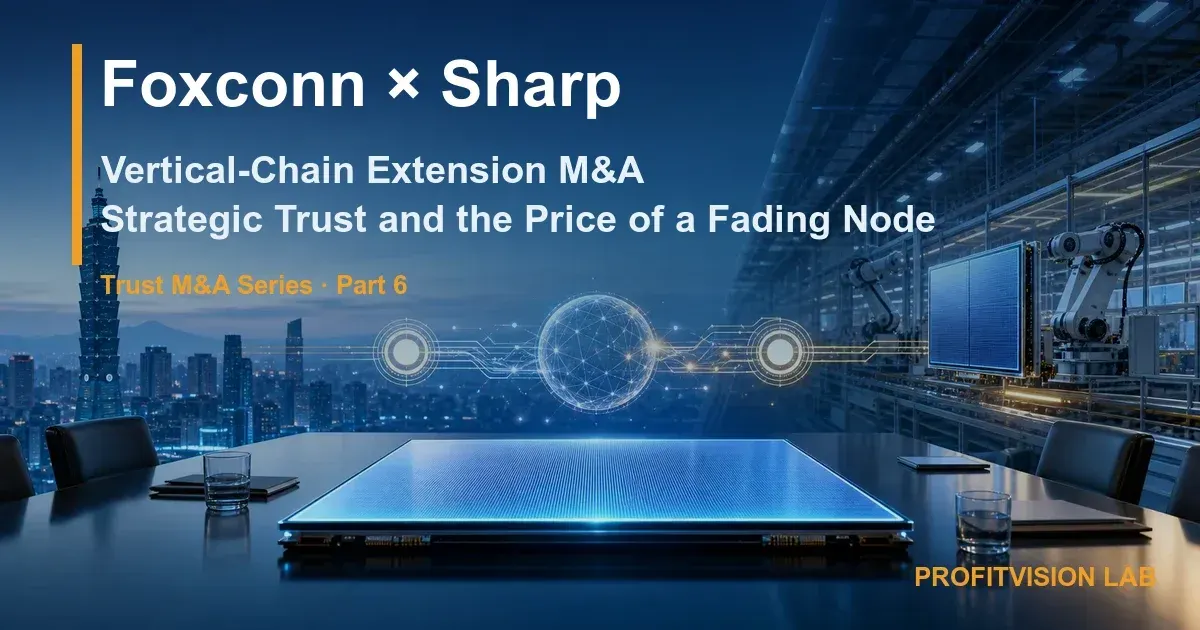
- The trust of vertical-extension M&A is "strategic trust": not a promise of no change (CSU), nor a promise of transformation (Danaher), but "as long as the division of labor is clear, I trust you" — technology to Sharp, manufacturing scale and cost discipline to Foxconn.
- The model is extremely efficient when the division is clear: Tai Jeng-wu turned Sharp from loss to profit within about a year of arriving in Japan, and Sharp returned to the First Section of the Tokyo Stock Exchange at the end of 2017. But its trust is "conditional" — once the strategic premise wavers, the foundation collapses with it.
- The real danger is not cultural difference itself, but "the decay of the strategic premise": when LCD panels went from scarce technology to loss-making commodity and the Sakai plant (SDP) became a money pit, the whole deal's strategic logic — "the panel is an irreplaceable key node" — was hollowed out. Is Sharp still the Sharp it once was?
- The most painful footnote: at the end of 2024, Tai Jeng-wu — the very man who once rescued Sharp — turned and sued Foxconn and Terry Gou, claiming an incentive contract worth over NT$1 billion had not been honored. Even trust between people fractured. The Taiwan lesson: in vertical-integration M&A, what you must guard against most is treating a "customer / technology node" as a permanent moat.
Model D refers to "vertical-extension M&A." What the buyer acquires is not a standalone moat, but a key node on the core business's value chain: components, channels, technology platforms, manufacturing capability, or a customer gateway.
Its basis for trust is neither "I'll never change you" nor "I'll transform you with my system," but a clear division of labor: you hold the technology or the node, I provide scale, capital and cost discipline. While the node stays scarce, the model works well; once the node is commoditized, the trust premise of the whole deal begins to loosen.
Why Did Terry Gou Have to Have Sharp? A Bet on a "Node"
Foxconn buying Sharp was never about the company Sharp — it was about the panel in Sharp's hands. To understand this deal, you first have to understand where Foxconn's anxiety came from.
Around 2012, Foxconn faced a structural dilemma: it was the world's strongest contract manufacturer, Apple's most important assembly partner, but its position on the value chain was too far "downstream." Assembly margins are razor-thin, while the real profit goes to upstream key components — chips, panels, sensors. Among them, the panel is one of the single highest-cost parts of an iPhone or iPad, and at the time that slice was eaten largely by Samsung.
Gou's calculation was clear: if Foxconn could command high-end panel technology, its value to Apple could be upgraded from "a replaceable assembler" to "a full-stack supplier hard to bypass," while reducing the supply chain's dependence on dominant upstream suppliers like Samsung. This is the core motive of vertical-extension M&A — the goal of acquisition is not diversification but "locking down a key node that makes the core business more irreplaceable."
And Sharp — in financial crisis, holding top-tier IGZO panel technology and a century-old brand — was exactly that node. As early as 2012, Gou had personally invested in Sharp's 10th-generation panel plant in Sakai, Osaka (SDP), getting a foot in the door.
A Four-Year Courtship: Why Did Japan Distrust This "Foreign Buyer"?
If this were merely a financial transaction, it would not have dragged on for four years. But it was more than a deal — it was the question of whether a Japanese national brand should be handed to a Taiwanese.
From Gou's declaration of intent in 2012 to formally taking over in 2016 — a full four years. In those years, Japanese society, Sharp's banking syndicate, and the government-backed Innovation Network Corporation of Japan (INCJ) were deeply wary of this foreign acquirer. They would sooner consider breaking up and restructuring Sharp with domestic forces than hand this century-old company with IGZO technology, whole, to a Taiwanese.
In February 2016, Sharp's board once accepted a Foxconn offer of about ¥700 billion (about US$6.2 billion). But on the eve of signing, Sharp disclosed a large list of "contingent liabilities," and Foxconn abruptly hit pause and reopened due diligence. In the end the price was cut to ¥388.8 billion (about US$3.8 billion), and the Foxconn group took about 66% of Sharp, closing the deal in August 2016.
(2012→2016)
(~US$3.8bn)
the Foxconn group
The four-year tug-of-war is itself a lesson: in cross-border, cross-cultural vertical-integration M&A, the biggest cost is often not the purchase price, but "the depreciation of trust." Before closing, Foxconn first had to convince an entire nation: I'm not here to dismantle you, I'm here to divide labor with you.
Tai Jeng-wu's Miracle Year: How Strategic Trust Works When the Division Is Clear
The person who truly turned this deal from "hostile" into "model case" was one man — Tai Jeng-wu.
In August 2016, Tai Jeng-wu, a Foxconn veteran nearing 65 and already preparing to retire, was sent by Gou to Japan to become Sharp's first-ever Taiwanese president. He had one key advantage: a deep grounding in Japanese from his youth, letting him speak directly with Sharp's engineers, unions and suppliers in their own language, rather than issuing orders through an interpreter.
The result stunned the industry: within about a year of arriving, Tai turned the chronically loss-making Sharp profitable — beyond Gou's expectations, and shattering the outside suspicion that "Foxconn would bleed Sharp dry." On December 7, 2017, Sharp's stock returned to the First Section (main board) of the Tokyo Stock Exchange — the most formal endorsement of the deal by Japan's capital markets.
What did Tai get right? The answer echoes the trust logic of the vertical-extension model precisely: he made the division of labor crystal clear. Cost and procurement discipline, the fate of unprofitable business lines, capital-expenditure approvals — these "Foxconn-style" disciplines he embedded without hesitation; but on panel technology, product R&D and brand management — "Sharp's lifeblood" — he kept the Japanese team in charge. Technology to Sharp, cost discipline to Foxconn; once that line was drawn clearly, both sides knew which part to guard.
Was the Cultural Tension Really "Resolved"? Or Just Temporarily Pinned Down by the Division of Labor?
On the surface, Tai resolved the Taiwan–Japan culture clash. But the more precise statement is: he used a clear division of labor to pin the cultural tension down temporarily — not to eliminate it.
Taiwanese corporate culture is "speed, flexibility, cost above all" — decide today, execute tomorrow, let the numbers talk. Japanese manufacturing culture is "monozukuri" (the craftsman spirit) — an almost obsessive devotion to craft, consensus-driven decisions, valuing long-term relationships over short-term numbers. Neither is superior, but they collide head-on in many situations: when Taiwan HQ demands cutting an "unprofitable but technically meaningful" product line, what the Japanese engineer feels is not efficiency, but an affront to craftsman dignity.
Tai could hold this tension down thanks to two things: his Japanese and his understanding of Japanese culture (so the tension wasn't amplified "in translation"), and the clear division line of the early integration (so both sides could give a little). But both have a shelf life — people hand over the baton, and division lines blur as the industry shifts.
In February 2022, Tai handed the baton to the younger Foxconn general Wu Po-hsun, completing a generational transition. The ballast had changed hands. And at almost the same time, the once crisply drawn division line was being washed away by a far greater force — the panel industry itself had changed.
The Fatal Assumption of Strategic Trust: Will That "Key Node" Stay Important Forever?
The model's entire logic rests on one sentence — "the node I acquire will stay irreplaceable." Foxconn bet that "high-end panels would always be a part of the iPhone hard to bypass." But the iron law of moat analysis is this: every moat built on a "single technology node" will be eroded by technological paradigm shifts and commoditization.
Panels are the textbook case. IGZO was once a scarce technology, but as Chinese panel makers (BOE, CSOT) poured in colossal capacity backed by national-scale capital, large-size LCD panels fell, in under a decade, from "high-margin scarce goods" to "a bone-cutting commodity." The "irreplaceable node" Foxconn bought began to depreciate the moment it bought it. This is not Foxconn mismanaging — it is the structural risk of strategic trust: what you trust is not a company, but an assumption; once the assumption fails, no amount of clear division of labor can save you.
Compare and you'll see it. Berkshire buys companies "that need no fixing, whose moats walk on their own"; CSU buys niche software "whose moat grows steadier the less you touch it"; Danaher buys industrial companies "with room to improve that get better after transformation." None of their moats depends on a single external assumption.
But Foxconn buying Sharp staked its moat's lifeline on one external assumption — the irreplaceability of the panel node. When that assumption wavered, the question arose: is Sharp still a panel company? If not, what exactly did Foxconn buy back then?
The Collapse of the Sakai Plant: When the "Key Node" Became a "Loss Black Hole"
All the tension finally converges on one plant — the SDP (Sakai Display Products) in Sakai, the 10th-generation LCD plant Gou first put his foot into, once billed as "the world's largest."
It was once the strategic symbol of this deal; now it became its biggest source of bleeding. Under the tsunami of Chinese capacity, large LCD TV panel prices ran below cost for years. According to public reports, Sharp's LCD-related business lost a cumulative ~US$2.8 billion over two years; Foxconn also booked large non-operating losses on Sharp in its statements (reaching the order of NT$10 billion in a single quarter).
In 2024, Foxconn and Sharp finally made the call: Sharp announced the Sakai plant would stop producing large LCD TV panels by the end of September 2024, and this former cathedral of panels went dark. Its next identity broke completely free of the word "panel" — this site with ample power supply would be converted into an AI data center, with reported plans to partner with SoftBank, KDDI and others.
Turning Sakai into a data center may be a pragmatic reallocation of resources from the perspective of Foxconn's new strategy (AI servers). But for the theme of "trust-based M&A," it reveals a deeper problem: when the acquired company's core asset is hollowed out and its identity redefined, the once-clear division line no longer exists.
So what is Sharp now? A panel maker (core business shrinking)? A home-appliance brand (constrained by Foxconn's cost discipline)? Foxconn's EMS manufacturing arm? Or the landlord of an AI data center? When an acquired company's identity blurs, the premise on which strategic trust rests — "each guards its own part" — no longer holds. Blurred division, fragile trust. This is the invisible clause this model writes outside the contract.
Four Trust Models Compared: What Sets Foxconn Apart From the First Three?
Place Foxconn into the coordinate system built by the first four parts, and the model's distinctiveness comes into focus.
| Dimension | Berkshire Character |
CSU Platform |
Danaher System-embed |
Foxconn × Sharp Vertical extension |
|---|---|---|---|---|
| Acquisition motive | Acquire moat assets | Perpetual rent compounding | Create value via transformation | Lock down a key node |
| Source of trust | Buffett's character | The "never sell" record | Results of transformation | Clarity of the division of labor |
| Integration intensity | Very low | Near zero | High (full embed) | Medium (depends on division) |
| Condition of trust | Almost unconditional | Just be profitable | Willing to be transformed | Division stays clear |
| Biggest failure risk | Succession crisis | Low-quality assets hard to exit | Embed failure → culture clash | Node devalues → premise collapses |
| Reliance on external assumptions | Low | Low | Medium | Very high (node stays vital) |
The row to underline is the last one: reliance on external assumptions. The trust of the first three models rests mainly on internal capability (character, discipline, system) and is relatively controllable; the trust of the vertical-extension model hangs on an external assumption it cannot control — whether the node will stay important. That is why it is the most efficient, yet also the most likely to collapse in an instant when the industry turns.
The Four Boundary Conditions of Vertical-Extension M&A
① The node's irreplaceability must survive a ten-year test. Before acquiring a key-component supplier, ask not "how important is it now," but "in ten years, will technological paradigm shifts and commoditization reduce its scarcity to zero?" The panel is the lesson here.
② Heavy reliance on a single major customer is double-edged. Foxconn locked down panels essentially to bind Apple tighter. But when your entire deal logic revolves around one customer, that customer's strategic turn (in-housing, shifting orders) can directly shake your acquisition premise. Concentration brings efficiency, and systemic risk.
③ Cultural tension is pinned down by "clear division," but never disappears. Tai's Japanese and prestige held the tension down, but the ballast hands over and the division line blurs. Cross-cultural integration cannot rely on a single key person; it must settle into transmissible institutions, or the tension rebounds the moment that person leaves.
④ When the acquired's identity is forced to be redefined, honestly face "are we still dividing labor?" Sakai going from panel plant to AI data center is a pragmatic pivot, but it also means the original division contract has lapsed. The most dangerous thing here is for both sides to pretend the line still exists — delay only makes the depreciation of trust more brutal.
The Most Painful Footnote: When the Man Who Saved Sharp Sues You
If the lights going out at Sakai was the collapse of the "strategic premise," there is another fracture, in a far more intimate place — between people.
At the end of 2024, news shook business circles in Taiwan and Japan: Tai Jeng-wu, the man who once personally lifted Sharp out of the abyss, filed suit against Foxconn and founder Terry Gou. According to reports, Tai claimed that when he answered the call to go to Japan to fix Sharp, he had signed an incentive contract with Foxconn worth over NT$1 billion, which to this day has not been honored. Foxconn responded that it would "handle everything in accordance with the law."
The rights and wrongs of this lawsuit are for the law to clarify; this article makes no judgment. But from the angle of "trust-based M&A," it is a stinging metaphor: even the most successful vertical-integration deal, even the key person who executed the division of labor most beautifully and embodied the mutual trust best, may in the end break with the parent over the distribution of spoils.
The Taiwan Lesson: Don't Treat a "Customer" or "Technology Node" as a Permanent Moat
Foxconn is Taiwan's most daring M&A player, beyond dispute. Buying Sharp took vision and capital that few companies in all of Taiwan could muster. Tai's miracle year further proved that Taiwanese can command a Taiwan–Japan cross-cultural integration. These are real abilities, worthy of pride.
But this case's true value is that it demonstrates the hidden line vertical-extension M&A must most beware: when your acquisition logic is to bind a certain customer or lock down a certain technology node, you must constantly ask yourself — will this customer, this node, still be this important five years from now?
Far too many Taiwanese companies stake their entire fortunes on the logic of "binding one big customer." That is efficiency in fair winds and a fatal weakness in foul ones. The lesson of the Foxconn–Sharp case is not "don't do vertical integration," but: when you do vertical-extension M&A, treat "the node will devalue" as the default assumption, not as an accident.
Integrity — keep promises to employees and key generals (including incentives). If you can't keep your own people's trust, even the most beautiful integration leaves a crack.
Mutual aid — a clear division of labor doesn't mean everyone minds their own business. Genuinely empower the other side in its area of strength, rather than treating it as a tool to bind a customer.
Sharing — truly bring the parent's scale and resources into the acquired, rather than only extracting node value from it.
Perseverance — when a node devalues and the industry turns, have the resolve to accompany and transform together (as with Sakai's AI pivot), rather than dismembering the loss-maker and walking away.
Flexibility — when the premise of the division changes, honestly redefine the relationship, rather than clutching an expired division contract and pretending all is as before.
The vertical-extension model is the M&A model Taiwanese companies know best, and the most dangerous. Best, because it is closest to supply-chain thinking; most dangerous, because it most easily mistakes "a momentary key node" for "a permanent moat."
- Intro: Five M&A Models — After You Buy, Do You Trust or Control?
- Part 1: Berkshire Hathaway — The Permanent Home, character-based trust
- Part 2: Amphenol — Institutional trust across 130 decentralized units
- Part 3: Constellation Software — The never-sell promise, platform compounding
- Part 4: Danaher / DBS — System-embedded, building trust through transformation
- Part 5: Foxconn Group — Vertical extension: control by nodes, control by ownership
- Part 6 (this piece): Foxconn × Sharp — Vertical extension, strategic trust and its price
- Part 7: Taiwan Steel Group — The opportunistic conglomerate, finance-driven trade-offs
- Conclusion: A Taiwanese M&A Manifesto — Integrity, Mutual Aid, Sharing, Perseverance, Flexibility
Comments ()