
Arista Networks (ANET) Deep Research: The Real Networking King of AI Data Centers
Arista Networks is a Layer 4 AI infrastructure candidate in networking interconnect. This report analyzes EOS, merchant silicon, Ethernet AI fabrics, Cisco and NVIDIA Spectrum-X competition, Q1 2026 growth, valuation, and key risks.
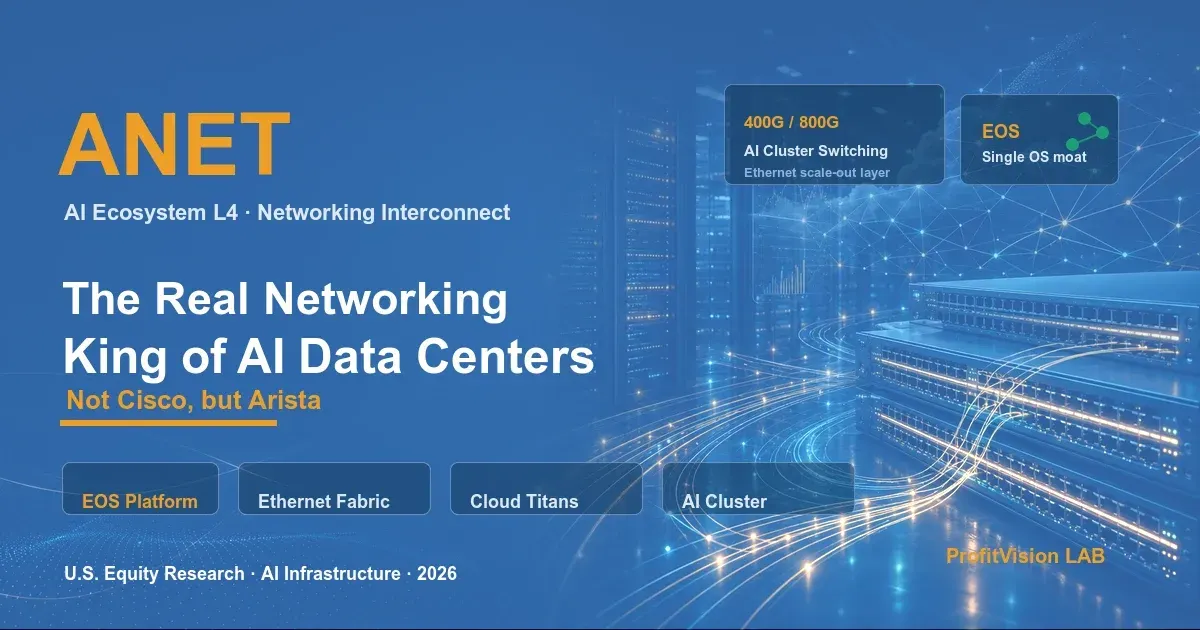
When GPU clusters scale, networking stops being a support layer. It becomes the bottleneck that decides whether AI compute can actually be used.
Core thesis: Arista Networks is not simply "the next Cisco." It is a cloud-native networking platform built for hyperscale data centers and AI clusters. Its moat is not just hardware. The deeper lock-in is EOS, a single network operating system that lets cloud-scale customers manage extremely complex Ethernet fabrics with lower operational friction.
Arista reported Q1 2026 revenue of $2.709 billion, up 35.1% year over year, with non-GAAP EPS of $0.87. Management guided Q2 2026 revenue to approximately $2.8 billion. In the PVL AI ecosystem map, ANET sits in Layer 4: Networking Interconnect, the layer that turns raw GPU capacity into usable distributed compute.
Why Does AI Turn Networking Into a Structural Growth Market?
Traditional enterprise networking was designed around north-south traffic: users send requests into the data center, servers respond, and traffic flows in relatively predictable paths. AI training clusters are different. Thousands of GPUs must exchange gradients with one another every few milliseconds. The traffic pattern becomes east-west, bursty, latency-sensitive, and unforgiving.
This is why AI networking is not just a cyclical equipment refresh. It is a redesign of the data center fabric. If GPUs cannot communicate efficiently, expensive AI accelerators sit idle. In that world, the network is no longer plumbing. It is part of the AI compute engine.
| PVL Filter | Current Reading | Verdict |
|---|---|---|
| Capital / Ownership | Large institutional ownership; hyperscaler spending remains the key demand driver. | Pass |
| Moat | EOS single-codebase architecture, CloudVision, AI Ethernet fabric know-how, and deep customer integration. | Pass |
| Volatility | Prefer waiting for earnings-related IV expansion or a cleaner technical reset before options entry. | Watch |
| Technical Setup | Strong long-term trend, but valuation and positioning require patience. | Watch |
EOS Is the Moat, Not Just the Switch
Most investors describe Arista as a switch vendor. That is true but incomplete. The real moat is EOS, the Extensible Operating System. From the beginning, Arista chose a single software image and a cloud-friendly architecture. That sounds technical, but the investment meaning is simple: the customer does not only buy hardware ports. The customer integrates its automation scripts, telemetry workflows, monitoring tools, and network operations around EOS.
Why does a single network OS matter? In large AI and cloud environments, operational consistency can matter more than box-level features. A single OS reduces configuration drift, simplifies automation, lowers training cost for engineers, and makes the network easier to observe and debug. Once a hyperscaler runs a major environment on EOS, switching away is a multi-year operational decision.
Competitive Landscape: Why Not Cisco?
Cisco remains an enormous company with a deep enterprise installed base. But Arista's advantage is that it was born inside the cloud era. Hyperscale customers prefer open APIs, automation, merchant silicon flexibility, and software consistency. Cisco's legacy strength was enterprise procurement, certification, and bundled architecture. Arista's strength is high-performance, programmable, cloud-scale networking.
The sharper long-term risk is not Cisco catching up in a traditional way. The sharper risk is that hyperscalers build more of the networking stack internally, or that NVIDIA's Spectrum-X attempts to package GPU, NIC, switch, and debugging software into a more closed AI networking stack.
The NVIDIA Spectrum-X Question
NVIDIA wants to own as much of the AI infrastructure stack as possible. Spectrum-X is strategically important because it tries to pull Ethernet networking closer to the GPU platform. If NVIDIA can convince customers that a closed, GPU-optimized networking stack reduces training risk, ANET's role could shift from operating standard layer to equipment supplier in selected deployments.
Arista's defense is to become the mature implementation layer for open Ethernet AI fabrics. Many hyperscalers do not want full dependence on one vendor. If Arista can keep making EOS / CloudVision the operating standard for open AI networking, it remains deeply relevant even in NVIDIA-heavy environments.
Financial Quality
Arista combines growth with unusually strong profitability. Q1 2026 revenue grew 35.1% year over year to $2.709 billion, and non-GAAP EPS reached $0.87. The company has historically carried little debt, generated strong free cash flow, and maintained high operating margins. This matters because AI infrastructure vendors can look exciting on revenue growth alone; ANET is one of the rare cases where the growth story is backed by clean profitability.
Valuation and Tactical View
ANET is rarely cheap. The stock tends to trade like a high-quality compounder with AI optionality. That does not mean investors should chase every breakout. For PVL, the practical conclusion is more disciplined: keep ANET on the AI infrastructure watchlist, but wait for either a valuation reset, a clean Stage 2 continuation setup, or elevated implied volatility that improves the risk-reward of options selling.
Key Risks
- Customer concentration: hyperscaler capex cycles can create sharp quarterly volatility.
- Self-built networks: large cloud customers can experiment with internal network OS projects and white-box switching.
- NVIDIA stack risk: Spectrum-X could absorb part of the AI back-end networking value pool.
- Valuation compression: if growth decelerates, ANET's multiple can reset quickly.
FAQ
What does Arista Networks do?
Arista provides high-performance Ethernet switching, routing, and network software for cloud, AI data center, campus, and high-performance environments. The core differentiator is EOS, its unified network operating system.
Why is ANET important to AI?
AI training clusters require extremely fast GPU-to-GPU communication. Ethernet AI fabrics are one path to building scalable, open AI infrastructure, and Arista is one of the strongest pure-play vendors in that layer.
What is the biggest investment risk?
The biggest risks are hyperscaler customer concentration, valuation, and the possibility that customers or NVIDIA internalize more of the AI networking stack.
Sources: Arista Networks FY2024 Annual Report, Arista Q1 2026 financial results press release, company investor materials, SEC filings, StockAnalysis, Bloomberg public market data, and ProfitVision LAB industry notes as of June 2026.
© 2026 ProfitVision LAB · I teach you how to think, not just what to do.

Comments ()