Datadog (DDOG) Deep Research: The Observability Platform at the Center of AI Infrastructure
Cloud observability's pure-play leader. Q1 2026: first $1B quarter (+32%), ARR $4B+. LLM Observability hits first material billing. Data Retention Moat: switching means rebuilding 20+ modules. Rule of 40 = 54. Cisco-Splunk risk real but bounded. PVL: ✅ Deep Research.
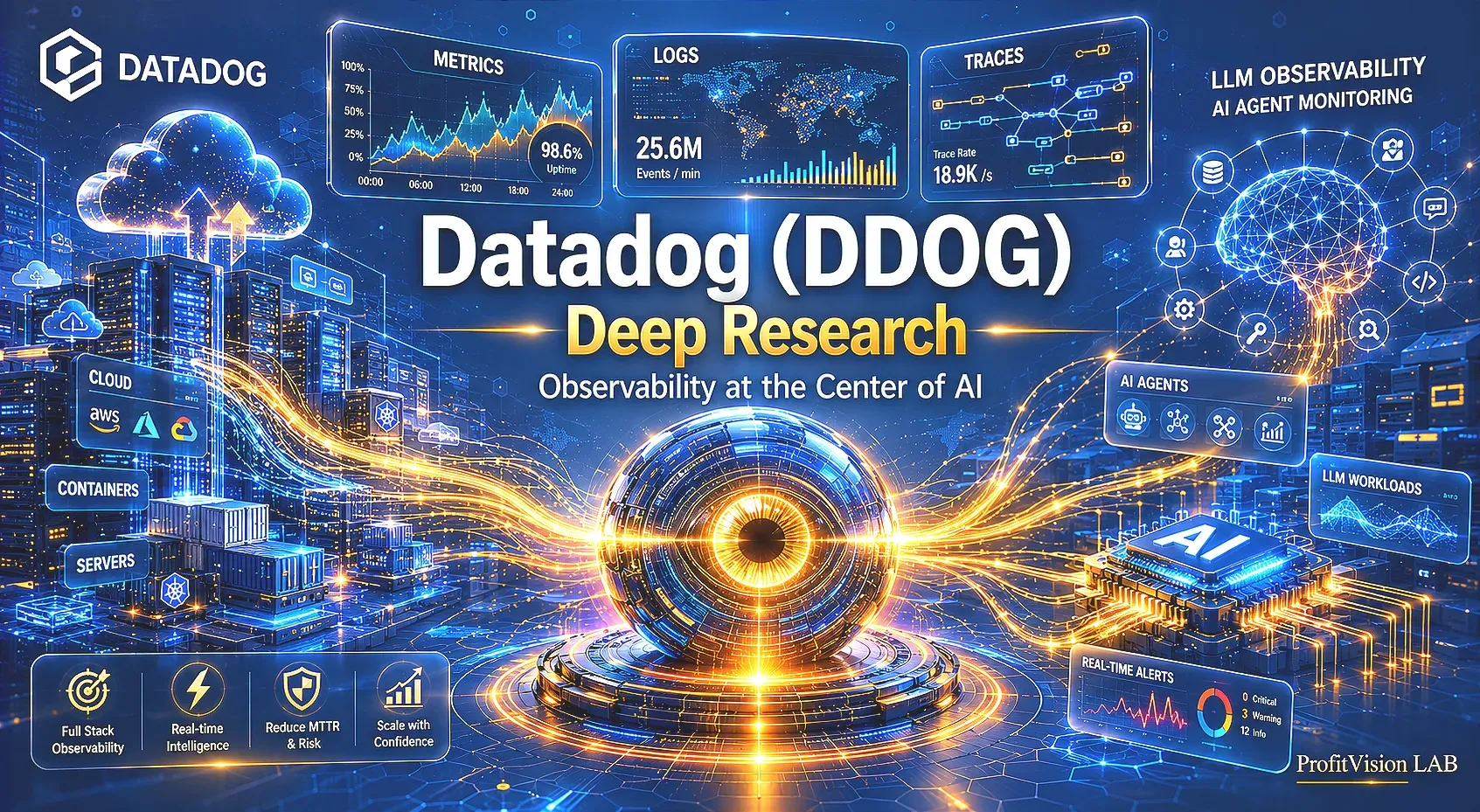
First $1B Quarter (+32% YoY), ARR $4B+ — When AI Agents Become Enterprise Standard, "Who Monitors Them" Becomes Non-Negotiable
🔍 PVL Four-Filter Screen (4LDS)
| Filter | Metric | Data / Status | Result |
|---|---|---|---|
| Filter 1: Institutional Momentum | Post-earnings reaction / EPS beat | Q1 2026 Non-GAAP EPS $0.60 vs. est. $0.51 (+17.65% beat); stock surged post-earnings | ✅ Pass |
| Filter 2: Economic Moat | NRR / $100k+ customers / margin | NRR below 120% improving QoQ; 22% Non-GAAP margin; 4,550 $100k+ ARR customers = 90% of ARR | ✅ Pass |
| Filter 3: Volatility Profile | IV Rank / earnings cadence | High-growth tech; IV spikes materially pre-earnings; consistent beat history creates options-selling opportunities | ✅ Pass |
| Filter 4: Technical Setup | Price trend / relative strength | Strong post-Q1 rebound; trading above key moving averages; bullish technical structure | ✅ Pass |
Chapter 1: Industry Landscape — Cross-Layer Positioning Between L2 and L3
Within PVL's Four-Layer AI Investment Map, Datadog occupies a strategically rare cross-layer position: the intersection of L2 Data Plane (the "Perception & Memory Layer" of AI infrastructure) and L3 Governance Guardrail. This dual-layer exposure means DDOG benefits simultaneously from two distinct AI tailwinds: L2's "explosion of cloud application volume driving monitoring demand," and L3's "post-deployment AI Agent compliance, reliability, and cost visibility requirements."
In 2026 — the year of AI Agent proliferation — this positioning carries more strategic value than at any prior point. Traditional IT monitoring answers: "Is my server down?" Modern observability answers: "What is my AI Agent doing, why did it make the wrong decision, and is my cost spiraling?" Datadog's LLM Observability product line bridges exactly this gap — from traditional monitoring to AI-era governance. No competitor — not Splunk, New Relic, or Dynatrace — has an equivalently complete AI monitoring ecosystem.
Traditional monitoring says: "I set up alerts; the system will notify me when something breaks." Observability says: "I can actively infer what is happening inside the system — and why — from the data it produces." The gap is the difference between waiting for a fire alarm and having a real-time thermal map of the building.
Observability rests on three pillars: Metrics (quantitative measures), Logs (timestamped event records), and Traces (request flow across distributed services). Datadog covers all three natively, and has extended this framework into AI with LLM-specific dimensions: token usage costs, model inference latency, prompt version tracking, and AI Agent decision traceability. When an AI Agent makes an incorrect decision, Datadog can tell you exactly which LLM call, which prompt, and which infrastructure constraint caused the failure — a capability that requires full-stack observability, not point solutions.
Q1 2026 Milestones: Three Numbers That Confirm Acceleration
First $1B Quarter
Highest Q1 Since 2022
All-Time High
Improving Sequentially
Value Chain Positioning
Market Size: A Dual-TAM Opportunity
Cloud observability (core TAM): approximately $30B in 2025, projected to reach $65B by 2030 (CAGR ~17%). LLM observability (emerging TAM): approximately $2.7B in 2026, projected to reach $9.3B by 2030 (CAGR 36.2%). Combined TAM exceeds $70B — against DDOG's current ARR of $4B, penetration sits at roughly 5–6%, leaving a long and validated growth runway.
Chapter 2: Business Model & Economic Moat — The Data Retention Effect Is the Deepest Moat
Platform Model: The More Modules, the Harder to Leave
Datadog's core business model is platform + usage-based billing. Customers typically enter through a single module — usually Infrastructure Monitoring or APM — and progressively adopt more modules as their operational complexity grows. With over 20 paid modules spanning infrastructure monitoring, APM, log management, security monitoring, CI/CD monitoring, synthetic testing, LLM Observability, and AI Agent Monitoring, each additional module deepens lock-in without adding a new vendor relationship.
| Core Module | Function | AI-Era Application |
|---|---|---|
| Infrastructure Monitoring | GPU / CPU / memory / container metrics | GPU utilization monitoring for AI training clusters |
| APM | Microservice tracing, latency analysis | LLM API call latency and failure tracing |
| Log Management | Centralized log storage and search | Long-term retention of AI Agent decision logs |
| Security Monitoring | Threat detection, SIEM capability | AI Agent anomalous behavior detection |
| LLM Observability | LLM cost, performance, quality monitoring | Core AI beneficiary product; first material billing Q1 2026 |
| AI Agent Monitoring | Agent decision tracing, workflow visibility | Officially launched 2026; the frontier growth engine |
M5 Moat Assessment
Datadog's technical moat is built on its Unified Agent architecture: a single lightweight agent deployed on a server automatically collects metrics, logs, and traces across all dimensions, with seamless integration across 700+ third-party services (AWS, Kubernetes, PostgreSQL, etc.). This architecture minimizes installation overhead while enabling cross-layer correlation analysis that point solutions cannot replicate. LLM Observability's key differentiator is full-stack correlation: no standalone LLM monitoring tool can simultaneously surface "LLM token usage," "underlying GPU memory pressure," and "Kubernetes pod health" in a single correlated view. Datadog can — because it already monitors every layer.
33,200 customers, of which 4,550 have ARR above $100K and collectively contribute 90% of total ARR. High-value customer growth (+20.7% YoY) is outpacing total customer growth by 2x — indicating a deliberate strategic shift toward larger, stickier enterprise accounts. The net migration from New Relic to Datadog has reached 3,950 companies (a 3.4:1 inflow ratio), further consolidating scale advantage.
The Data Retention Effect is Datadog's strongest moat — and one of the highest-rated switching cost moats in this seven-company research series. Once a customer has accumulated 12–24 months of historical monitoring data (logs, metrics, traces), switching platforms means losing all historical context — "What was this service's p95 latency one year ago?" becomes unanswerable. The deeper lock is multi-module integration: a customer using five modules simultaneously (Infrastructure + APM + Logs + Security + LLM Observability) would need to replace five separate tools, evaluate five new vendors, and re-integrate 700+ third-party connectors — a project that no large enterprise can execute without material operational risk.
Network effects are Datadog's weakest moat dimension. They manifest primarily through the integration ecosystem (700+ community-maintained integrations) and shared dashboard templates within the platform. These are meaningful but not the core competitive driver — compared with Snowflake's Data Marketplace or MongoDB's developer community, DDOG's network effects are modest.
Among cloud-native developers and DevOps practitioners, Datadog is the default mental model for observability. Consistent Gartner APM and Observability Magic Quadrant leadership, the annual DASH developer conference, and substantial open-source integration contributions have established elite brand credibility with technical decision-makers. LLM Observability's early-mover positioning (launched 2024, first to market) has seeded an "AI monitoring first choice" brand identity that compounds as AI workloads proliferate.
Moat Vulnerabilities
Scenario 1: CloudWatch / Azure Monitor free-tier suppression. AWS CloudWatch and Azure Monitor offer baseline monitoring at zero marginal cost with deep integration into their respective clouds. For single-cloud SMBs, "good enough free monitoring" is Datadog's most persistent sales obstacle. However, at multi-cloud enterprises and high-reliability organizations — the segment contributing 90% of DDOG's ARR — the differentiation remains substantial.
Scenario 2: Cisco-Splunk enterprise bundling. Cisco's $28B acquisition of Splunk creates a formidable enterprise bundling capability. If Cisco packages Splunk Observability into large enterprise ELA (Enterprise License Agreement) contracts at subsidized pricing, DDOG's pricing power in the Fortune 500 segment could face compression.
Scenario 3: OpenTelemetry commoditization. The OpenTelemetry + Prometheus + Grafana open-source stack provides a zero-license-fee alternative for engineering-heavy teams. If the operational complexity of self-managing this stack continues to decline, some mid-market enterprises may opt for DIY observability.
Scenario 4: LLM observability market fragmentation. LangSmith (LangChain), Arize AI, and Weights & Biases are AI-native monitoring tools embedded deeply in specific AI development workflows. If AI developers establish a "LangSmith for AI + CloudWatch for infrastructure" pattern, Datadog's cross-layer integration value proposition may underperform in AI-native customer segments.
Chapter 3: Competitive Dynamics — Pure-Play Leader vs. Giant Bundles
The observability competitive landscape underwent structural change in 2025–2026: New Relic was taken private (Francisco Partners + TPG), and Splunk was absorbed by Cisco. The remaining large-cap pure-play listed observability companies are now just two: Datadog and Dynatrace. This consolidation is unambiguously favorable for DDOG — both primary competitors are now operating under constraints (private equity cost discipline; corporate integration priorities) that limit their ability to compete aggressively on product investment and market share.
| Competitor | FY2025 Revenue | Status | Core Strength | Gap vs. DDOG |
|---|---|---|---|---|
| Datadog (DDOG) | $3.43B | Public, high-growth | Full-stack integration, AI monitoring, developer brand | — (reference) |
| Dynatrace | $1.43B | Public, stable growth | AI-driven root cause analysis (Davis AI) | ~40% of DDOG's market share |
| Splunk (Cisco) | $0.94B* | Cisco subsidiary | Log analytics, SIEM, deep enterprise relationships | Integration underway; innovation pace likely to slow |
| New Relic | $0.94B* | Private (FP + TPG) | Simplified pricing, developer-friendly | Post-privatization investment likely conservative |
| AWS CloudWatch | N/A (bundled) | Free with AWS | Zero additional cost, AWS-native depth | Single-cloud limitation; insufficient observability depth |
*Splunk and New Relic figures from their last public filings prior to going private.
LLM Observability: First-Mover Advantage in an Early Market
The LLM observability tools market (2026 Top 7 includes Datadog, LangSmith, Arize AI, Weights & Biases, and others) remains in early-stage fragmentation. Datadog's structural advantage: no additional procurement required. Enterprises already running DDOG for infrastructure monitoring can activate LLM Observability by adding a module to their existing contract — zero new vendor evaluation, zero new security review, zero new integration project. This distribution advantage is nearly impossible for AI-native point solutions to replicate.
"No standalone LLM monitoring tool can simultaneously surface 'LLM token usage,' 'underlying GPU memory pressure,' and 'Kubernetes pod health status' in a single correlated view. Datadog can — because it already monitors every layer of the stack."
— PVL core observation on DDOG's LLM Observability differentiation
Chapter 4: Financial Resilience — The $1B Club, 22% Non-GAAP Margin
Q1 2026 Financial Snapshot
| Metric | Q1 2025 | Q1 2026 | YoY Change | Notes |
|---|---|---|---|---|
| Total Revenue | $762M | $1,006M | +32% | First $1B quarter; highest Q1 growth rate since 2022 |
| ARR | ~$3.1B | $4B+ | +29%+ | All-time high |
| NRR | Below 120% | Below 120% (QoQ improving) | Improving | Direction: upward |
| Non-GAAP Operating Income | ~$150M | $223M | +49% | 22% margin; profit expanding alongside revenue |
| Non-GAAP EPS | ~$0.44 | $0.60 | +36% | Beat consensus $0.51 by 17.65% |
| $100K+ ARR Customers | 3,770 | 4,550 | +20.7% | 90% of ARR; enterprise momentum accelerating |
Growth + Profit Running in Parallel: Rule of 40 Case Study
The Rule of 40 is the gold standard for evaluating SaaS company financial health. A score above 40 indicates the company is achieving a healthy balance between growth and profitability — what institutional investors call a "compounding machine." Scores above 50 are exceptional and typically command valuation premiums.
Datadog Q1 2026: 32% (growth) + 22% (Non-GAAP margin) = 54 points. This is well above the 40-point threshold and demonstrates that DDOG is simultaneously accelerating revenue growth and expanding margins — the most desirable configuration in SaaS finance. Most high-growth SaaS companies sacrifice margins to fund growth; DDOG is achieving both.
Five-Quarter Financial Trend: Gross Margin, Net Margin & Capital Returns
| Quarter | Revenue | YoY | Non-GAAP Gross Margin |
GAAP Gross Margin |
Non-GAAP Net Margin |
FCF Margin |
|---|---|---|---|---|---|---|
| Q1 2025 | $762M | +25% | 81.2% | 79.2% | 19.7% | ~24% |
| Q2 2025 | $809M | +26% | 81.7% | 79.5% | ~22% | ~20% |
| Q3 2025 | $869M | +26% | 81.6% | 79.4% | ~21% | ~25% |
| Q4 2025 | $934M | +25% | 82.0% | 79.9% | ~24% | ~30% |
| Q1 2026 | $1,006M | +32% | 82.0% | 79.5% | 22.2% | ~20% |
Q2–Q4 2025 Non-GAAP net margins are PVL estimates based on earnings release data. GAAP net margins are omitted — stock-based compensation (SBC, approximately 18–22% of revenue per quarter) renders GAAP net income negative and uninformative as a standalone metric.
Trend Interpretation: Three curves, three stories. Gross margin is the most stable: Non-GAAP holds at 81–82%, GAAP at 79–80%, across all five quarters — evidence of consistent pricing power and controlled infrastructure costs. Non-GAAP net margin follows a seasonal pattern: Q4 spikes to ~24% on enterprise year-end deal volume; Q1 resets lower (~20–22%) as RSU grants and sales compensation reset — a structural cycle, not a business deterioration. FCF margin mirrors this seasonality: Q4 peaks at ~30% as annual contract prepayments land; Q1 dips to ~20%. The five-quarter directional trend across all three metrics is: gradual improvement, confirming that Datadog's scaling economics are working.
Traditional ROE requires stable GAAP net income as a numerator. Datadog's heavy stock-based compensation (SBC) expense results in consistent GAAP net losses, which in turn create negative retained earnings. This leaves shareholders' equity small or erratic, making ROE calculation either negative or distorted by a denominator effect. This pattern is common among high-growth tech companies at DDOG's stage — and does not imply the business is burning cash. FCF margin has held at 20–25% for five consecutive quarters.
PVL recommended alternative metrics: ① FCF Margin (20–25%, five-quarter range); ② Rule of 40 Score (current 54, well above the 40-point threshold); ③ Non-GAAP ROIC (Non-GAAP after-tax income ÷ invested capital). These three together provide a far more useful picture of capital efficiency than GAAP ROE for a company at this growth stage.
Multi-Module Adoption: The Best Proxy for Customer Depth
Datadog does not disclose per-module revenue, but management regularly provides directional commentary on "average modules per customer." Historical data shows early adopters in 2021 typically used 2–3 modules; by 2025–2026, the proportion of customers using 6+ modules has risen materially. This deepening directly correlates with NRR resilience — the more modules deployed, the higher the switching cost and the more stable the renewal rate.
LLM Observability generated its first material billing contribution in Q1 2026. On the Q1 earnings call, management explicitly stated: "AI workload monitoring is an increasingly common requirement in large enterprise deals." This signals the transition from "AI monitoring as pilot" to "AI monitoring as paid enterprise standard."
Four Earnings Calls: Management Perspective Arc (Q2 2025 → Q1 2026)
| Quarter | Core Theme | Key Management Commentary | Investment Implication |
|---|---|---|---|
| Q2 2025 August 2025 |
Cloud optimization headwinds fading | Management noted the enterprise cloud optimization cycle was approaching its end, with new deal signings and expansion momentum recovering. LLM Observability customer count growing rapidly but not yet generating material revenue. Cisco-Splunk still in integration mode; DDOG win rates at mid-to-large enterprises holding strong. Net New Relic migration inflows accelerating. | Early rebound signal; AI monetization in "pre-revenue accumulation" phase |
| Q3 2025 November 2025 |
AI workloads become structural growth driver | CEO Olivier Pomel emphasized that AI-native companies were the fastest-growing customer segment, with large-scale AI model training and inference deployments accelerating infrastructure monitoring demand. Multi-module adoption deepening measurably — customers using 6+ products rising as a share of ARR. AI Agent Monitoring entered beta testing. | AI beneficiary story moving from "concept" to "execution"; multi-module deepening is NRR recovery's underlying driver |
| Q4 2025 February 2026 |
AI monitoring enters standard enterprise procurement | Management stated for the first time that "AI monitoring — including LLM Observability — has become a standard topic in large enterprise IT procurement discussions." FY2026 full-year guidance beat consensus, reflecting high management confidence in accelerating AI monetization. Q4 FCF hit a quarterly high, confirming cash generation capability. | AI moving from "pilot" to "budgeted line item" is the critical inflection; guidance beat is the leading indicator of business acceleration |
| Q1 2026 May 7, 2026 |
LLM Observability first material contribution; AI is incremental demand | CEO explicitly stated: "AI workloads are not cannibalizing existing workloads — they are purely incremental demand." This directly addressed market concerns that AI efficiency gains would compress traditional monitoring spend. LLM Observability generated first material billing contribution; AI Agent Monitoring officially launched. NRR confirmed improving sequentially. FY2026 guidance raised. | Jevons Paradox confirmed in the observability market; sequential NRR improvement is the most direct validation of moat durability |
Four-Quarter Narrative Arc: "Cloud optimization tail end, AI accumulating" (Q2 2025) → "AI workloads becoming structural, multi-module deepening" (Q3 2025) → "AI enters standard procurement, guidance beats" (Q4 2025) → "LLM Observability monetization confirmed, AI is incremental" (Q1 2026). This arc represents DDOG's AI beneficiary story completing the "concept → trial → purchase" three stages and entering the fourth stage: budget line-item normalization.
Revenue Visibility and Free Cash Flow
Datadog's subscription billing (with some modules on annual or multi-year contracts) provides above-average revenue visibility relative to pure consumption-based models. Non-GAAP FCF margin has consistently held at 20–25%, representing healthy cash generation capacity. GAAP net losses stem primarily from non-cash stock-based compensation and are disconnected from the business's cash generation reality.
Chapter 5: Valuation & Scenario Analysis — What Premium Does Rule of 40 Score 54 Deserve?
Datadog should be valued on an EV/NTM (Next Twelve Months) Revenue framework appropriate for high-quality SaaS, with a premium justified by its Rule of 40 score of 54. Historical valuation range: post-IPO peak (2021) at 40–50x (bubble pricing); 2023 correction trough at 12–18x; current re-rating as AI beneficiary story validates, placing the reasonable debate range at 15–22x NTM Revenue.
| Scenario | Core Assumptions | FY2026E ARR (Implied) | NRR | Non-GAAP Margin | EV/NTM Rev | Investment Implication |
|---|---|---|---|---|---|---|
| 🐂 Bull Case | LLM Observability becomes enterprise standard; ARR accelerates to $5B+; margins expand to 25% | $4.3–4.5B | 125%+ | 24–26% | 20–25x | Significant upside from current levels; AI monitoring second curve validated |
| ⚖️ Base Case | 28–32% growth maintained; NRR stable below 120%; margins gradually expanding | $4.0–4.2B | Below 120% | 22–24% | 15–20x | Current valuation rational; Rule of 40 supports premium |
| 🐻 Bear Case | Cisco-Splunk enterprise bundling erodes share; CloudWatch free-tier pressure intensifies; NRR slides to 115% | $3.7–3.8B | 115% | 19–21% | 11–14x | Current valuation elevated; competitive compression faster than expected |
The Core Valuation Debate: Can the Growth Re-Acceleration Sustain?
Q1 2026's 32% growth rate is the highest Q1 growth since 2022, prompting the critical question: is this structural acceleration (AI-driven multi-module expansion) or base effect (comparably weak Q1 2025 baseline)? Management was explicit on the earnings call — AI workloads are incremental demand drivers, not a base-period correction. If subsequent quarters confirm this thesis, current valuations remain rational. LLM Observability's first material billing contribution in Q1 2026 is the most compelling structural acceleration signal yet seen.
Chapter 6: Risk Factors — Four Scenarios Where the Thesis Breaks
Every "Deep Research" rating carries an obligation to identify the specific conditions under which the investment thesis fails. The following four risk scenarios are not low-probability tail risks — they are credible scenarios that demand ongoing monitoring.
Risk 1: Cisco-Splunk Enterprise Bundling — The Most Immediate Structural Threat
Cisco's $28B acquisition of Splunk created a combined entity with unmatched enterprise bundling capabilities. If Cisco packages Splunk Observability into Fortune 500 ELA contracts at subsidized rates — bundled alongside Cisco's networking, security, and collaboration products — Datadog's pricing power in the enterprise segment could face sustained compression. This risk is real but bounded: Cisco-Splunk integration has been slower than anticipated, and the product overlap between Cisco's core business and observability creates internal prioritization conflicts. Watch signal: Cisco announces formal ELA bundling of Splunk Observability at discounts exceeding 40% vs. standalone pricing.
Risk 2: Hyperscaler Free-Tier Expansion — Real but Structurally Capped
AWS CloudWatch and Azure Monitor continue to improve their native monitoring capabilities, maintaining zero marginal cost for single-cloud deployments. For SMBs on a single cloud, "good enough free monitoring" is a persistent barrier to Datadog acquisition. However, this risk is structurally capped: the 4,550 customers contributing 90% of DDOG's ARR are predominantly multi-cloud, high-reliability enterprises for whom CloudWatch's depth is insufficient. The true risk is suppression of DDOG's SMB expansion opportunity, not erosion of the existing enterprise base. Watch signal: A major hyperscaler announces a genuinely cross-cloud, full-stack observability product — currently a structural impossibility given competitive dynamics.
Risk 3: OpenTelemetry Commoditization — The Slow Boil
The OpenTelemetry standard (CNCF-governed open observability instrumentation) is progressively reducing vendor lock-in at the data collection layer. Combined with Prometheus (open-source metrics) and Grafana (open-source visualization), technically sophisticated enterprises can build a fully functional observability stack at zero license cost. This is a slow-moving structural risk: managing this stack at enterprise scale remains operationally complex, and DDOG's value proposition — unified analysis and 700+ pre-built integrations — remains compelling. But as the open-source ecosystem matures, pricing pressure on the lower end of DDOG's customer base is probable. Watch signal: DDOG's $100K ARR customer growth falls below 15% for two consecutive quarters despite strong overall revenue growth.
Risk 4: LLM Observability Fragmentation — The AI-Native Point Solution Risk
LangSmith (LangChain), Arize AI, and Weights & Biases are AI-native monitoring tools that have established deep penetration in AI developer workflows. If the AI developer community establishes a "LangSmith for AI observability + CloudWatch for infrastructure" pattern as the default — bypassing Datadog's cross-layer integration advantage — DDOG's second growth curve thesis would be materially compromised. This risk is higher among AI-first companies (startups, AI labs) and lower among traditional enterprises adopting AI. Since traditional enterprises represent the bulk of DDOG's ARR base, the risk is partially mitigated. Watch signal: Management stops quantifying LLM Observability growth or explicitly acknowledges elongating AI pilot-to-production cycles.
Chapter 7: Investment Thesis & Tactical Outlook — PVL Rating: ✅ Deep Research
Datadog is the most financially balanced name in this seven-company research series: high growth, expanding margins, moderate competitive concentration risk, and a rare cross-layer AI beneficiary position. The triple confirmation of "first $1B quarter + $4B+ ARR + Rule of 40 = 54" — combined with LLM Observability's first material billing contribution — makes DDOG the clearest "Deep Research" case in Batch 2.
PVL Classification: ✅ Deep Research — Relative to the initial Batch 2 assessment, new data (Q1 2026 large beat, ARR acceleration, LLM Observability materialization) has materially strengthened the rating from "Deep Research boundary" to "Deep Research core."
✅ Bull Case — Three Core Constructive Arguments
- Data Retention Moat × Multi-Module Lock-In = Most Durable NRR Foundation: Historical monitoring data accumulated on Datadog is irreplaceable context — switching means losing 12–24 months of performance baselines. Multi-module usage compounds this: replacing five tools simultaneously, finding five new vendors, re-integrating hundreds of connectors is operationally prohibitive for any large enterprise. This makes DDOG's NRR more recession-resistant than most SaaS peers.
- LLM Observability's "Natural Upsell" Distribution Advantage: 33,200 existing customers represent a pre-qualified sales pipeline for AI monitoring. For existing DDOG users, activating LLM Observability is a module add-on inside a familiar interface — zero new security review, zero learning curve. LangSmith and Arize cannot replicate this frictionless distribution at enterprise scale.
- Competitive Landscape Structurally Improving: New Relic privatized. Splunk absorbed into Cisco's enterprise empire. Datadog is now the only large-cap pure-play listed observability platform. Over the next three years, top-tier enterprise observability procurement will likely consolidate to a two-horse race: DDOG and Dynatrace.
⚠️ Bear Case — Three Core Risk Arguments
- Cisco-Splunk Enterprise Bundling — Long-Duration Erosion Risk: Cisco's enterprise ELA bundling capability is formidable. A sustained strategy of offering Splunk Observability at deep discounts inside Cisco's enterprise contracts could compress DDOG's pricing power at the Fortune 500 level in a way that takes multiple quarters to manifest in public metrics — making it a slow-building but high-impact risk.
- CloudWatch / Azure Monitor Free-Tier Pressure — SMB Cap: Free-tier hyperscaler monitoring remains DDOG's persistent top-of-funnel obstacle for SMB acquisition. If AWS or Azure materially strengthens native monitoring quality, DDOG's new logo growth in the under-$100K ARR segment could stall, capping total customer count and limiting the next expansion layer.
- Usage-Based Billing Volatility — Earnings Risk: LLM Observability and several AI modules are partially consumption-billed. AI workload usage can be lumpy — enterprise AI pilots pause, seasonal AI demand patterns differ from traditional software. In any quarter where AI workload consumption disappoints, the usage-based component creates earnings risk that the headline Rule of 40 score does not fully capture.
Key Monitoring Metrics
| Metric | Cadence | Healthy Signal | Warning Signal |
|---|---|---|---|
| NRR Trajectory | Quarterly | Sustained above 120%, directionally improving | Two consecutive quarters below 115% → competitive erosion |
| $100K+ ARR Customer Growth | Quarterly | ≥ 20% YoY | < 15% → enterprise expansion decelerating |
| LLM Observability ARR Contribution | Quarterly calls | Management actively disclosing and quantifying growth | Stops mentioning or downgrades language → AI module not monetizing |
| Cisco-Splunk Competitive Actions | Continuous | Splunk integration remains slow and fragmented | Cisco announces ELA bundling with deep observability discounts → reassess competitive moat |
| Rule of 40 Score | Quarterly | ≥ 50 points | Below 45 → growth/margin balance deteriorating |
Upgrade / Downgrade Triggers
- Upgrade to "Active Positioning": NRR recovers above 125%; LLM Observability ARR explicitly quantified at $300M+; Rule of 40 breaks above 60.
- Downgrade to "Watch List": Two consecutive quarters with NRR below 115%; Cisco announces large-scale ELA bundling of Splunk Observability; ARR growth falls below 20%.
- Downgrade to "High Caution": NRR breaks below 110%; major hyperscaler announces comprehensive free full-stack observability suite; Rule of 40 falls below 40.
Chapter 8: Tracking Log
📋 Tracking Log
| Date | Event | Judgment | Outcome |
|---|---|---|---|
| 2026/05/27 | Initial publication | Q1 2026 earnings (reported 2026/05/07) | ✅ Deep Research (rating strengthened) | — |
Next scheduled update: Post-Q2 2026 earnings (expected August 2026)
Early update triggers: Material NRR anomaly; Cisco-Splunk major bundling pricing announcement; LLM Observability ARR first explicit quantification
Frequently Asked Questions
Investing involves risk, including the possible loss of principal. Please assess your own financial situation carefully before making any investment decisions.
Data sources: Datadog Inc. Q2–Q4 2025 earnings calls (August, November 2025; February 2026), Q1 2026 earnings call (May 7, 2026), SEC Filings, StockTitan, The Business Research Company, public records (as of May 2026).