
The 225% Growth Mirage: Dissecting TOYO Solar's Three Hidden Landmines
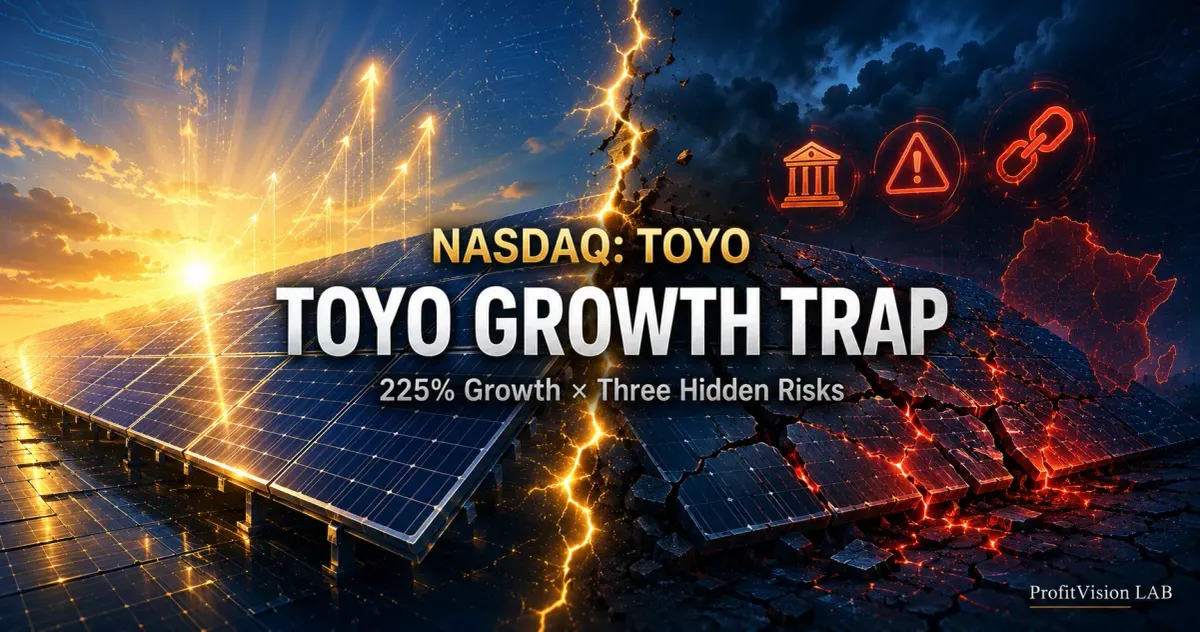
The CPA has flagged going-concern doubt in the audit report, the Ethiopia factory faces an AD/CVD circumvention investigation, and Section 45X eligibility is disputed. Behind TOYO's 225% revenue growth lie three structural landmines.
- TOYO's real parent company is Abalance Corporation (TSE: 3856) — a former Japanese IT firm with a market cap of just ~$66M that rebranded into solar energy seven years ago. TOYO has zero connection to any traditional Japanese industrial conglomerate.
- A $3M acquisition of a Vietnamese solar manufacturer was packaged through a SPAC and listed on NASDAQ at a $543M valuation — a 181× markup driven by narrative engineering, not value creation.
- 225% revenue growth is real, but the CPA has flagged "substantial doubt about the company's ability to continue as a going concern" in the audit report — the most severe level of financial warning.
- The Ethiopia factory — TOYO's core growth engine — faces a formal AD/CVD circumvention investigation filed by eight U.S. solar manufacturers. If the finding goes against TOYO, 4GW of production capacity is effectively blocked.
- The 33.5% gross margin depends on IRA Section 45X manufacturing credits. The "One Big Beautiful Bill" restricts eligibility for companies using Chinese-origin materials — directly connected to the Ethiopia case.
The company is called TOYO. To Western investors, it sounds like it belongs alongside names like Toyo Seikan, Toyo Engineering, or Toyo Tires — decades-old Japanese industrial brands.
TOYO Co., Ltd. has no connection to any of them.
What it actually is: a former IT company spent $3 million to buy a Vietnamese solar factory, packaged it into a SPAC, and brought it to NASDAQ at a $543 million valuation.
That's not a judgment. It's public record. Here's the full unboxing.
I. What Is TOYO, Really?
The Real Corporate Chain
TOYO Co., Ltd. is incorporated in the Cayman Islands — not Japan. Its ultimate controlling shareholder is Abalance Corporation (TSE: 3856), a Tokyo-listed company with a market cap of approximately $66 million USD.
| Level | Entity | Notes |
|---|---|---|
| Ultimate parent | Abalance Corporation (TSE: 3856) | Formerly REALCOM Inc., an IT company. Rebranded to Abalance in 2017. |
| Intermediate | Fuji Solar Co., Ltd. | Wholly owned Japanese subsidiary of Abalance |
| Core asset | Vietnam Sunergy Joint Stock Company | Acquired by Abalance for ~$3M. On Bloomberg NEF Tier 1 list since 2019. |
| Listed vehicle | TOYO Co., Ltd. (Cayman Islands) | Incorporated November 2022. Listed on NASDAQ via SPAC merger July 2024. |
Abalance's market cap: ~$66M. Its NASDAQ-listed subsidiary TOYO's market cap: ~$543M. The parent is worth 12 cents for every dollar the market assigns to the subsidiary. That inversion deserves a full stop.
- Tax optimization: No corporate income tax, capital gains tax, or withholding tax on dividends
- Structural flexibility: Minimal disclosure requirements for shareholding structures and beneficial ownership
- Light regulation: Corporate governance standards far below those required in the U.S., Japan, or Taiwan
This doesn't make a company fraudulent by definition. But it does mean: investors receive materially less governance transparency than they would from a company listed domestically in its home market. When a Cayman-incorporated company also carries a SPAC listing, a going-concern qualification, and an active regulatory investigation, each layer of opacity compounds.
Practical rule: When a company is incorporated in the Cayman Islands, BVI, or Bermuda, raise your due diligence standard — don't substitute "NASDAQ-listed" for actual due diligence.
Five Layers of Packaging
II. Why Does the Cash Hole Keep Growing Despite 225% Revenue Growth?
Because the capital consumed by rapid expansion exceeds what the business is generating in free cash. Here are the numbers:
| Metric | FY2023 | FY2024 | FY2025 | TTM |
|---|---|---|---|---|
| Revenue | $62.4M | $177.0M | $427.4M | $518.6M |
| Revenue YoY | — | +184% | +141% | +225% |
| Net Income | $9.9M | $40.9M | $37.2M ↓ | — |
| Net Income YoY | — | +313% | −9% | — |
| Working Capital Deficit | −$86.4M | −$69.6M | −$123.9M ↓↓ | — |
The contradiction is clear: revenue grew 585% over three years; net income declined 9% in 2025; and the working capital hole widened from −$69.6M to −$123.9M.
What About Q1 2026?
Q1 2026 looks exceptional: revenue $142.8M (+177% YoY), gross margin 33.5%, net income $28.4M — nearly 76% of the entire FY2025 net income in a single quarter.
The question isn't whether these numbers are real. It's what's generating them. The U.S. 1GW module plant started commercial production in October 2025 — making Q1 2026 the first full quarter capturing IRA Section 45X manufacturing credits. Those credits flow directly into gross margin. The jump from 8–12% (industry baseline) to 33.5% is the 45X effect, not an underlying competitive moat.
III. Is the Ethiopia Factory a Growth Engine or a Tariff Bomb?
Right now, it's a bomb — with an uncertain fuse length. To understand why, you need to understand China's solar industry evasion playbook.
The Same Script, a Different Location
In 2012, the U.S. imposed antidumping (AD) and countervailing duty (CVD) orders on Chinese crystalline silicon photovoltaic products — Solar I. Chinese manufacturers responded by shifting production to Southeast Asia. In 2023, the U.S. found circumvention: Southeast Asian factories were using Chinese-origin wafers and simply completing final assembly locally. Solar III orders took effect in June 2025, closing the Southeast Asia route.
From June 2025 through year-end, U.S. imports of solar products from Ethiopia surged from zero to over $300 million.
On May 12, 2026, eight U.S. solar manufacturers filed a formal anti-circumvention petition with the Department of Commerce, naming two companies: TOYO Solar Manufacturing and Origin Solar Manufacturing.
What the Petition Alleges
The core allegation: TOYO's Ethiopia facility takes Chinese-origin silicon wafers, processes them into solar cells in Ethiopia, then assembles modules — either in Ethiopia or Vietnam — for export to the United States, evading Solar III duties. Trade data shows approximately 70% of Ethiopian solar product components are subject to existing duty orders.
TOYO's response (May 18, 2026): Chief Strategy Officer Rhone Resch called the petition "misleading and inaccurate," stating that all polysilicon used in Ethiopia comes exclusively from the United States and Malaysia.
This is competing claims. What matters is what the Department of Commerce finds — not either party's press release.
Worst-Case Timeline
IV. What's Left of TOYO's Gross Margin Without IRA Subsidies?
The answer: 8–12%, the competitive floor of solar manufacturing. IRA Section 45X Advanced Manufacturing Production Credit provides a per-watt tax credit for domestically manufactured solar cells and modules — it flows directly into gross margin, not as a separate subsidy line item.
The Subsidy Boundary Is Narrowing
The "One Big Beautiful Bill" introduced a critical restriction: after July 4, 2025, companies whose materials or processing involve "prohibited foreign entities" (Chinese-affiliated entities) are ineligible to claim Section 45X credits.
This provision is directly linked to the Ethiopia investigation:
Commerce finds Ethiopia facility uses Chinese-origin wafers (AD/CVD confirmed)
→ TOYO flagged as having Chinese material involvement
→ Section 45X eligibility challenged or revoked
→ U.S. plant gross margin reverts from 33.5% to 8–12%
→ Entire valuation thesis collapses
TOYO has stated publicly that its 2026 guidance does not incorporate Section 45X credits, framing this as not wanting to rely on government subsidies. The more analytical reading: they may not be certain they qualify.
| Scenario | Gross Margin | Basis |
|---|---|---|
| Current (with 45X) | 33.5% | Q1 2026 actual |
| 45X removed (U.S. plant) | 8–12% | Solar manufacturing industry baseline |
| First Solar (FSLR) ex-subsidy | ~20% | CdTe thin-film technology moat provides baseline premium |
TOYO and First Solar are not comparables. First Solar has a genuine technology moat: its cadmium telluride (CdTe) thin-film process is proprietary, not replicable from commodity silicon. TOYO's standard silicon-based products, stripped of subsidy, compete directly against Chinese manufacturers who have been driving module spot prices from $0.25/W in 2023 to approximately $0.10/W in 2025.
V. What Did the CPA Say in the Audit Report?
The CPA who audited TOYO's financial statements included the following language in the audit report:
"Substantial Doubt About the Company's Ability to Continue as a Going Concern."
This is not boilerplate. A going-concern qualification is the highest-severity warning a CPA can issue — it means the auditor has determined that the company faces a real risk of being unable to continue operating in the foreseeable future.
Why Did the CPA Reach This Conclusion?
| Year-End | Working Capital Deficit | Trend |
|---|---|---|
| 2023 | −$86.4M | — |
| 2024 | −$69.6M | ↑ Slight improvement |
| 2025 | −$123.9M | ↓↓ Significant deterioration |
The company is profitable on paper — FY2025 net income of $37.2M. But the working capital hole widened from −$69.6M to −$123.9M, suggesting:
- Receivables buildup or inventory financing from rapid expansion
- Heavy capex consuming cash faster than operations generate it
- High dependency on external financing — if capital markets tighten, the company is exposed
What Is a SPAC, and Why Does It Matter Here?
A SPAC (Special Purpose Acquisition Company), also called a "blank check company," works as follows:
- Sponsors form a shell company and IPO it on an exchange (typically at $10/share) with no operating business.
- Within a set window (usually 18–24 months), they identify an acquisition target and complete a merger — bringing the target company public via the shell.
- Post-merger, original SPAC shares convert to shares of the combined company.
SPAC vs. Traditional IPO:
| Dimension | Traditional IPO | SPAC Merger |
|---|---|---|
| Scrutiny level | High (underwriter due diligence) | Relatively lighter |
| Time to market | 6–18 months | 3–6 months |
| Forward projections | Heavily restricted | Permitted (higher risk) |
| Pricing mechanism | Market demand-driven | Negotiated in advance |
SPACs are not inherently fraudulent. Academic research, however, consistently shows that SPAC-listed companies significantly underperform traditional IPOs over 12–36 months post-listing. Choosing the SPAC route often signals that a target company would face difficulty clearing traditional IPO underwriting standards — or needs capital urgently and cannot wait.
A company that went public via SPAC, carries a going-concern qualification, and faces an active regulatory investigation will have its financing capacity and market credibility retested after every adverse development. The SPAC valuation premium tends to erode rapidly when reality arrives.
VI. Three Scenarios: Worst to Best
- Commerce finds Ethiopia facility circumvented Solar III duties → 4GW capacity blocked from U.S. market
- Section 45X eligibility revoked due to Chinese material linkage → U.S. plant gross margin reverts to 8–12%
- Working capital deficit widens → emergency capital raise, significant dilution
- Going-concern qualification escalates → lenders tighten credit
- Commerce investigation proceeds; Ethiopia exports restricted but not fully blocked
- TOYO successfully demonstrates non-Chinese polysilicon sourcing; 45X eligibility maintained
- U.S. plant ramps to partially offset Ethiopia shortfall
- Revenue retreats from $518M to $250–350M range; gross margin holds at 20–25%
- Commerce investigation concludes Ethiopia compliant; no duties imposed
- Section 45X eligibility confirmed; 30%+ gross margins maintained
- Ethiopia 4GW + U.S. 1GW reach full utilization
- Working capital improves organically through earnings growth
VII. This Article Is Not a Short Thesis
TOYO's revenue growth is real. Vietnam Sunergy's supply chain experience, accumulated since 2018, is real. The policy tailwind for domestic U.S. solar manufacturing is real. Onozuka's track record in cross-border energy finance is real.
None of that changes what the CPA wrote.
Before buying into the 225% growth story, investors need clear answers to three questions:
- If Ethiopia is blocked, does the business model still work?
- If Section 45X eligibility is lost, what multiple does this company deserve?
- Will the working capital deficit of −$123.9M resolve itself before the next financing round?
If you don't have answers, a P/E of 7× is not cheap. It's risk that hasn't been priced.
The market is reading the revenue line. The CPA is reading the balance sheet. This article stands on the CPA's side of the table.
All content in this article is for research and educational purposes only and does not constitute investment advice or a solicitation to buy or sell any security. The analysis of TOYO Co., Ltd. is based on publicly available information, including SEC filings, industry reports, and third-party sources. The author makes no representation as to the completeness or timeliness of this information. Scenario analyses presented are hypothetical and actual outcomes may differ materially. Investing involves risk. Readers should conduct independent research and consult a qualified financial advisor before making any investment decision. ProfitVision LAB holds no position in TOYO and does not intend to initiate one.

Comments ()