What Is an Options Contract? A Stock Investor's Guide to the Insurance Analogy
Most stock investors think of options as complex speculation tools. This guide reframes everything: an options contract is simply a structured insurance policy. Learn what buyers and sellers each pay and collect — and why understanding this asymmetry is the first step toward options mastery.
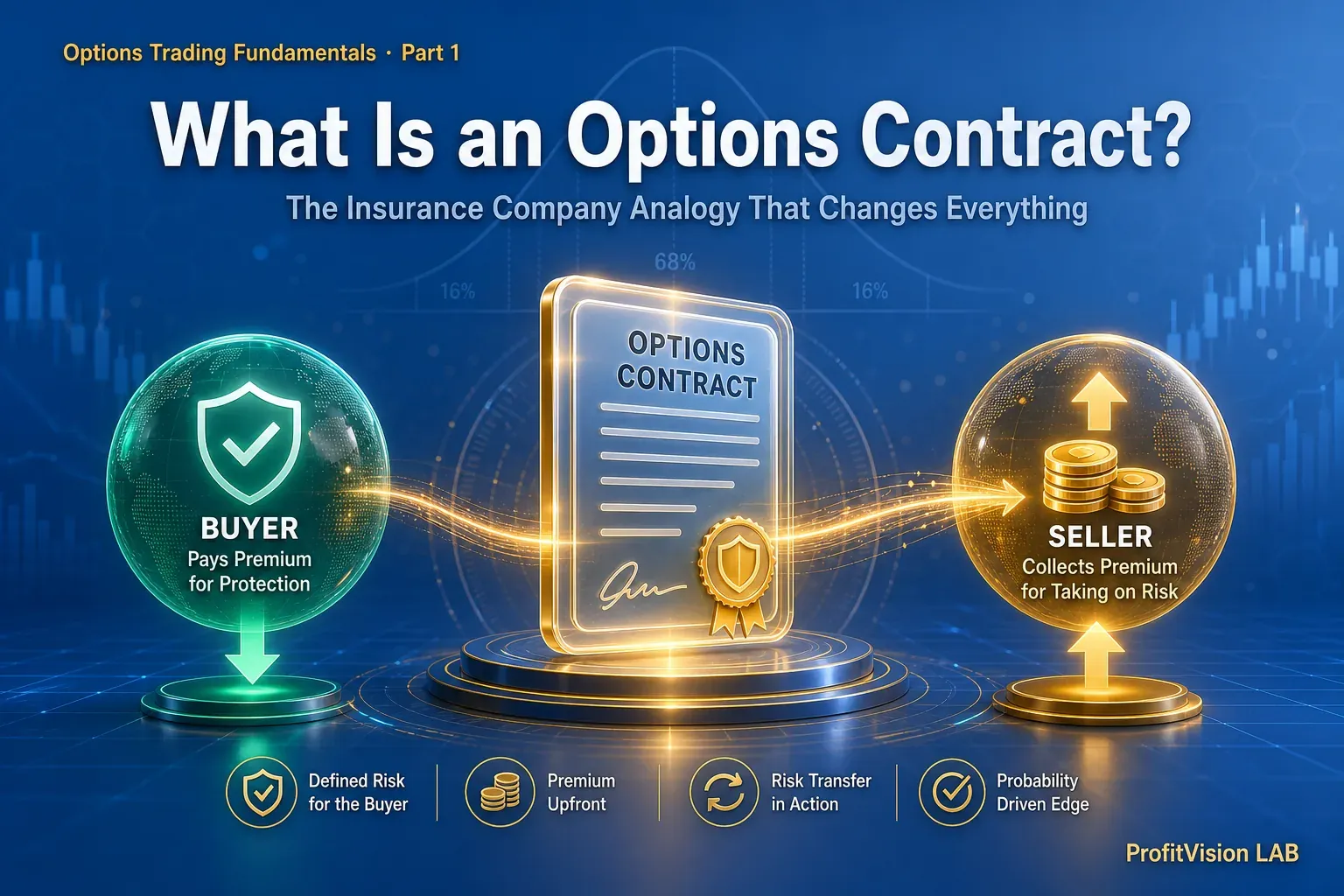
- Options are not "high-risk gambling tools" — they are financial insurance contracts: the buyer purchases protection, the seller collects the premium
- There are two types of options: Calls (bullish) and Puts (bearish). Each type has a buyer and a seller, giving four distinct roles to play
- The biggest difference from owning stocks: options have an expiration date. Every day that passes costs the buyer time value, while the seller earns it
- This series' goal: take you from "stock-only investor" to someone who can read an options chain — and understand why the seller side is better suited for long-term, systematic trading
Starting from What You Already Know: How Stocks Feel
If you've only ever bought stocks, your mental model of investing probably looks like this: you believe in a company → you buy shares → if the stock rises you profit, if it falls you lose, and there's no time pressure — you can hold until you're ready to sell.
This logic is completely intuitive: you own an asset, and time is neutral to you. Buy today, hold for a year, hold for five years — time passing doesn't make your stock disappear on its own.
Options work nothing like this. Options have something stocks don't: an expiration date. That single difference changes the entire logic of how options behave — and understanding it is the single most important first step into options trading.
The Insurance Company Analogy: Options in 60 Seconds
When you buy car insurance, the insurer is selling you an option
You own a $100,000 car. To protect against unexpected loss, you pay $3,000 a year for insurance. The policy means:
→ If your car is damaged, the insurer pays you (your loss is covered)
→ If nothing happens, the insurer keeps your $3,000 premium (your premium is gone)
From your perspective (the policyholder): you paid $3,000 for peace of mind — knowing someone will cover you if things go wrong.
From the insurer's perspective: it collected $3,000 and accepted the obligation to pay out if something goes wrong.
Options work exactly the same way. Replace "insurance company" with "options seller," replace "policyholder" with "options buyer," and replace "premium" with "premium" — and you have the basic structure of an options contract.
This analogy carries one very important implication: insurance companies are profitable over the long run. Because most of the time, loss events are rare — premiums collected exceed claims paid out. The options seller's logic is identical: most contracts expire worthless, and the seller pockets the premium.
The Two Forms of Options: Calls and Puts
Options come in two basic forms, representing two different types of "insurance contract":
| Type | Right Granted | Market Direction | Insurance Analogy |
|---|---|---|---|
| Call | The right to buy shares at the agreed strike price before expiration | Bullish (expecting the stock to rise) | "Upside insurance" — if it rallies, you can buy low and sell high |
| Put | The right to sell shares at the agreed strike price before expiration | Bearish (expecting the stock to fall) | "Downside insurance" — if it drops, you can still sell at the original price |
The Put Analogy for Stock Investors
Say you own AAPL shares at $200. You're worried the stock might drop sharply over the next three months, but you don't want to sell (because you're long-term bullish). So you pay $5 to buy a Put, locking in the following:
"No matter how low AAPL falls over the next three months, I have the right to sell it at $190."
That is buying a Put — you've purchased "downside insurance." If AAPL drops to $160 three months from now, you can still sell at $190 and your loss is capped. If AAPL never falls, your only cost is the $5 premium you paid.
The counterparty who agreed to buy your shares at $190 is the options seller.
The Four Roles: Buyers and Sellers, Fully Unpacked
Every options contract — Call or Put — has two sides: a buyer and a seller. That gives us four distinct positions in the options market:
- Direction: Bullish
- Cost: premium paid (maximum loss)
- Upside: theoretically unlimited if the stock surges
- Win rate: lower (stock must rally before expiration)
- Direction: Neutral to bearish (not expecting a rally)
- Income: premium collected (maximum profit)
- Risk: theoretically unlimited if the stock surges sharply
- Win rate: higher (profit as long as stock doesn't rally)
- Direction: Bearish
- Cost: premium paid (maximum loss)
- Upside: substantial profit if the stock sells off hard
- Win rate: lower (stock must fall before expiration)
- Direction: Neutral to bullish (not expecting a decline)
- Income: premium collected (maximum profit)
- Risk: potentially large if the stock drops sharply
- Win rate: higher (profit as long as stock doesn't decline)
ProfitVision LAB's core strategy is Sell Put (and the derived Bull Put Spread) — playing the role of the insurance company, collecting premiums, and letting time work for you. Subsequent articles in this series will explain in detail why we favor this side of the trade.
A Complete Example: From Stock Thinking to Options Thinking
Scenario: AAPL is currently trading at $200. You believe it is unlikely to fall below $180 over the next three months.
Stock investor mindset: just buy shares
You spend $20,000 to buy 100 shares of AAPL. If the stock rises to $220 in three months, you make $2,000 (+10%). If it drops to $180, you lose $2,000 (−10%). There is no expiration pressure while you hold.
Options seller mindset: sell a Put
Instead of buying stock, you sell one AAPL Put:
- Strike price: $180 (you agree to buy shares at $180 if assigned)
- Expiration date: three months from now
- Premium collected: $3 per share, i.e., $300 (one contract = 100 shares)
Outcomes at expiration:
✅ AAPL closes above $180 (the most common outcome): the contract expires worthless, you keep the $300 premium, and nothing else happens.
❌ AAPL falls to $165: you are assigned and must buy AAPL at $180 (market price is only $165), a paper loss of $15/share ($1,500), minus the $300 premium = net loss of $1,200.
The key difference: you don't need to be precisely right on direction — you only need "AAPL not to fall below $180" to win. That condition is far more relaxed than needing it to actually go up.
The Three Most Important Properties of Options
Property 1: Time is the buyer's enemy, the seller's ally
Because options have an expiration date, every day that passes erodes some of the time value the buyer paid for. This daily automatic decay is called Theta (time decay) in options terminology. For the buyer, time is a depleting resource; for the seller, time is premium that accrues automatically, day after day.
Property 2: Premium size is determined by Implied Volatility (IV)
When the market expects a stock to swing wildly in the future, premiums are high (everyone wants to buy insurance); when the market expects calm, premiums are low. This "market expectation of future volatility" is called Implied Volatility (IV). What sellers want is to sell premiums when IV is relatively elevated — collecting richer compensation for the risk they take on.
Property 3: Leverage — controlling large positions with small capital
One options contract represents 100 shares. At $200, buying 100 shares of AAPL costs $20,000; but a single AAPL Put might cost only $300–$500 in premium. This leverage effect amplifies both gains and losses for buyers; for sellers, it means margin is required to back the obligation they've accepted.
Your Learning Path in This Series
❓ Frequently Asked Questions
- Is the Options Seller Strategy Right for You? A Complete Self-Assessment Guide
- Why I Choose the Options Seller Side: Not a Technique, but a Path Worth Walking for Life
- The Four-Filter System for Options Sellers: A Systematic Approach from Screening to Entry
- Options Market Statistics: The Data Behind the Seller's Structural Edge
Disclaimer: All content in this article is for research and educational purposes only and does not constitute investment advice. Individual stocks, ETFs, and strategies mentioned are used solely to illustrate concepts and do not represent any buy or sell recommendation. Options trading involves substantial risk. Seller strategies can, under certain market conditions, produce losses significantly exceeding the premium collected. Investors should assess their own risk tolerance and make independent investment decisions.
© 2026 ProfitVision LAB · Shiba the Disciplined · I teach you how to think, not just what to do