
M-03 Failure Reset & Re-entry: A Failed Breakout Is Not the End of the Story
Learn the M-03 Failure Reset framework: how to distinguish a temporary failed breakout from pattern termination, rebuild a tighter base, and evaluate a valid re-entry after a stop-loss.
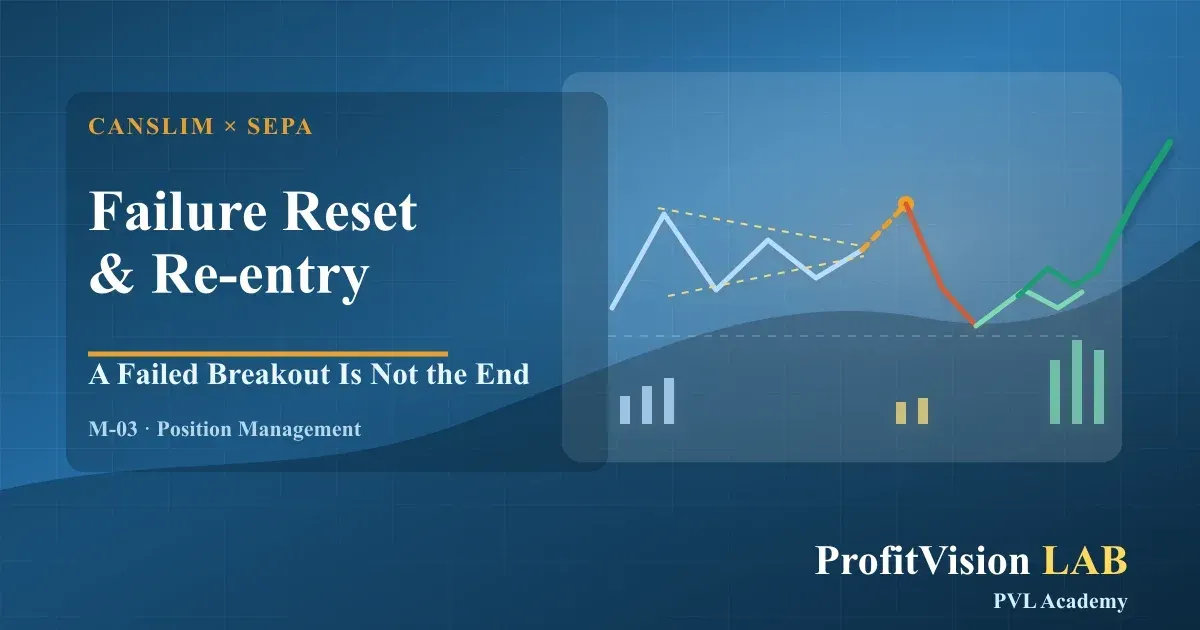
- A Failed Breakout is a normal part of trading — it does not mean the stock is "broken."
- What is truly problematic is a "permanent failure": fundamental deterioration, loss of market leadership, end of Stage 2.
- "Failure Reset" means the stock retests the base, consolidates again, and forms a tighter, more mature second base.
- The key for re-entry: the second breakout must have stronger volume, the base must be tighter, and weak hands must have been shaken out during the first failure.
- O'Neil's "N" factor (New Highs) is essentially a protective mechanism preventing you from chasing a failed breakout without a proper reset.
Failure Reset is a post-stop re-evaluation process, not an excuse to hold and hope. You must exit first before waiting for a valid reset.
The key to re-entry is not a simple rebound after a decline. The stock must rebuild a tighter, more mature base and show stronger volume and cleaner supply on the second breakout.
Operating conclusion: after a failed breakout, complete the 72-hour checklist first. If the 50-day moving average, fundamentals, relative strength, industry group, and market trend still support the setup, wait for a new Pivot Point rather than chasing the bounce.
Failed Breakouts: The Most Frustrating Scenario for Traders
Imagine this scenario: you have done thorough research, waited for the perfect VCP pattern, entered at the correct Pivot Point, set your stop-loss — and then on day three after entry, you get stopped out. The stock continues lower and retreats back into the base. This is a pain that every serious technical trader has experienced.
Mark Minervini offered a perspective that has given many of his students genuine relief: a failed breakout is a normal part of a well-functioning system — it is not a failure of your judgment. Even Minervini himself has 35–40% of his trades result in losses. The real difference is: what do you do after the failure?
"I'm not a trader who is always right. I'm a trader who knows when I'm wrong and admits it quickly." — Mark Minervini
Two Types of Failure: Temporary vs. Permanent
After a failed breakout, the first task is to determine whether this is a "temporary failure" or a "permanent failure." This judgment determines whether you should continue tracking the stock and wait for a re-entry opportunity.
✅ Temporary Failure (Keep Tracking)
- Breakout occurred on insufficient volume (low-volume breakout)
- Market was simultaneously in a correction (unfavorable market conditions)
- Stock retested but held the 10-week line (50MA)
- Fundamentals have not deteriorated (EPS still accelerating)
- Industry group as a whole is still in a strong zone
- RS Rating still above 70
⛔ Permanent Failure (Stop Tracking)
- Fundamentals have deteriorated (EPS miss, guidance cut)
- Stock broke below 150MA or 200MA
- Stage 2 uptrend has officially ended, entering Stage 3
- RS Rating fell below 50, relative strength line broken down
- Institutions heavily distributing (A/D Rating D or E)
- Industry group as a whole has been abandoned by the market
The Failure Reset Mechanism: Why the Second Attempt Is Often Stronger
When a breakout fails and price retreats to the base area, it seems like "wasted effort" — but in reality, the market has completed a critical task: flushing out the weak hands.
During the first breakout, the buyers included:
- Patient institutional investors (long-term holders)
- Intermediate-term technical traders (such as SEPA system users)
- Short-term speculators (noise holders who chased in on the breakout signal)
The retest process following a failed breakout is equivalent to the market filtering out the least patient holders on your behalf. What remains is a group of long-term investors willing to continue holding. When the new pattern completes and the second breakout launches, the supply overhang has been greatly reduced — there is far less resistance to the upside.
This is exactly why many of history's largest moves began after a "second breakout following the first failure."
The Failure Reset Pattern: Visual Breakdown
How to read it: Failure Reset is not "buy the dip."
The correct sequence is: exit first, wait for support to hold, wait for volatility to contract,
then require a second strong-volume breakout.
Five Conditions for Re-entry
Not every "reset after failure" pattern is worth re-entering. Minervini's system sets strict conditions for re-entry, preventing you from repeatedly losing on a pattern that has already died:
The amplitude of the second base must be smaller than the first. If the first VCP's maximum pullback was 15%, the second should not exceed 12%. Tightness itself is proof of strength.
During the reset process, the 50MA (10-week line) must hold. If the stock breaks below the 50MA, this is no longer a "reset" — it is pattern deterioration, the Natural Reaction deterioration described in M-01.
No negative earnings reports or guidance cuts during the reset period. If fundamentals develop a problem during the reset, this is no longer a "temporary failure" — it is a sign of permanent failure.
If the first breakout failed because the market was correcting, wait until the market re-enters a Confirmed Uptrend before considering re-entry. The 3rd to 7th week after a Follow-Through Day (FTD) is the optimal window.
This is the most critical confirmation signal. The second breakout's volume must exceed the 50-day average by at least 40%, and must be clearly higher than the volume on the first breakout. This indicates more institutional participation in the second attempt.
The Psychological Hurdle: Re-entering After Already Taking a Loss?
For many investors, the biggest obstacle to re-entry is not technical — it is psychological: "I already got hurt by this stock once. Why should I trust it again?"
Minervini's response: You are not trusting a stock. You are trusting the integrity of a pattern. If all five re-entry conditions are met, the entry conditions are logically no worse than the first attempt — fewer floating shares, weak hands flushed, cleaner supply structure. But note: this is not a statistical guarantee. Failure is still possible, and all stop-loss discipline still applies.
O'Neil's "N" factor — "New Products, New Highs" — the "New Highs" component contains an important logic: don't chase price immediately after a failure; wait for the stock to build a new, healthy base and break out to new highs. This is completely consistent with SEPA's Failure Reset concept: first wait for the pattern to "repair itself," then wait for the breakout to re-confirm.
The stop-loss MUST be executed first before the concept of Failure Reset applies. The premise of this concept is: you have already exited per your stop-loss plan, there is no open position in your account, and you are watching the pattern from the sidelines to see whether it resets in a healthy way.
If you choose NOT to execute your stop-loss because you intend to "wait for a Failure Reset re-entry" — that is not a Failure Reset. That is holding through losses hoping for recovery (averaging down). The difference is not in how the market moves afterward, but in whether you exited first: exiting and waiting is discipline; holding and waiting is avoidance.
Failure Reset vs. Pattern Termination: How to Tell the Difference?
| Characteristic | Failure Reset (Re-entry Possible) | Pattern Termination (Stop Tracking) |
|---|---|---|
| Pullback depth | Holds above 50MA | Breaks below 50MA, or even 200MA |
| Volume during reset | Contracting, selling pressure weakening | Persistently high volume, institutional exit |
| Fundamentals | EPS still accelerating, no guidance cut | EPS miss or guidance cut |
| Pattern tightness | New base tighter than old base | Volatility range expanding, pattern chaotic |
| RS Rating | Still above 70, relative strength intact | Fell below 50, relative weakness |
| Industry group | Group still in top 40 | Group fell out of top 40 |
| Stage analysis | Still in Stage 2 | Stage 3 characteristics appearing |
Failure Reset and Base Count
There is an important detail here: when the first breakout "succeeded but later pulled back" versus "failed immediately (insufficient volume, immediately retreated)," the treatment in Base Count is different.
- Valid breakout followed by pullback (rallied more than 20% before retreating to base): Counts as completing one base; this is now the N+1 base after re-consolidation
- Invalid breakout (low-volume breakout, immediately reversed, never rallied more than 5%): Does not count as completing a base; the Failure Reset is still considered the same base
Base Count will be discussed in detail in M-06 (Sell Signals). For now, establish this concept: breakouts after the 4th or 5th base carry far higher risk than those from the 1st or 2nd base. If a Failure Reset still puts you in an early base, that is a good sign — there is still significant upside potential. If multiple valid breakouts have already occurred and this would be a 4th base, proceed with extra caution.
Three Historical Examples: How Do You Wait for a New Entry After Failure?
Failure Reset is often misunderstood as "buy it lower." That is not the point. The real question is whether the market rebuilds structure after the failed breakout: does price hold key support, contract again, and then confirm demand through a fresh Pivot Point? These three examples make the distinction easier to see.
ANET | Arista Networks, 2024
ANET's late-March 2024 flat-base breakout failed to make progress. Shares fell back below the prior buy point, causing the base count to reset.
The meaningful second opportunity came later, when the stock formed a new stage-one cup base and broke out again after the May 2024 earnings report. This was not bottom fishing; it was waiting for a new base and a new pivot.
TEAM | Atlassian, 2017
TEAM broke out past a 38 buy point in July 2017, then quickly fell back below the entry. It did not reclaim the pivot immediately; instead, it spent roughly 10 weeks building a new base.
The later breakout from a 39.35 entry succeeded. The lesson is clean: after the first failure, do not rush back in. Wait for the new structure to complete, then treat it as a fresh trade.
NVDA | Nvidia, 2023-2024
NVDA broke out from a double-bottom base in November 2023, but did not immediately extend in a straight line. It soon formed a base-on-base / flat-base structure.
The cleaner second entry came when the stock cleared the new consolidation in January 2024. This shows that a leading stock may not be terminating; it may be building the next base camp above the prior base.
ANET and TEAM are closer to standard Failure Reset: first failure, rebuild the base, then evaluate the new buy point. NVDA is the strength-side contrast: the first breakout did not collapse; it tightened near the highs and formed another actionable structure. The common thread is simple: you do not buy because price is lower. You buy only when the structure is complete again.
Practical Action Checklist: What to Do After a Failed Breakout
- ☐ Confirm stop-loss has been fully executed — no open position
- ☐ Identify the reason for failure: low-volume breakout? Poor market conditions? Fundamental problem?
- ☐ Confirm whether 50MA held (this is the first checkpoint for whether the reset is valid)
- ☐ Confirm RS Rating is still above 70
- ☐ Review latest earnings or guidance — confirm no fundamental deterioration
- ☐ Add to watchlist; set an alert for "new Pivot Point forming"
- ☐ Continue tracking but do not rush to re-enter — wait for all five conditions to be met
- ☐ New base volatility range smaller than previous base
- ☐ 50MA held throughout the entire reset process
- ☐ Fundamentals (EPS acceleration, ROE ≥ 17%) still sound
- ☐ Market is in a Confirmed Uptrend (3–7 weeks after FTD)
- ☐ Breakout day volume ≥ 140% of 50-day average (i.e., more than 40% above average)
Connecting Back to M-01 and M-02
M-01 teaches you how to judge whether a pullback in a live position is a Tennis Ball or Natural Reaction; M-02 teaches you how to read confirmation and violation signals; M-03 answers the question: "If the signals have already told me this trade has failed and I have been stopped out, how should I approach this stock again?"
Together, the three articles form the complete closed loop of SEPA position management:
- After entry → continuously observe confirmation / violation signals (M-02)
- A pullback appears → determine whether it is a normal Tennis Ball or a concerning Natural Reaction (M-01)
- Stopped out → determine whether it is a temporary failure (wait for reset, re-enter) or a permanent failure (stop tracking) (M-03)
Reframe "failed breakout" from "I was wrong" to "the market has given me an opportunity to re-evaluate with a healthier pattern." The prerequisite: the stop-loss has been executed, the account is flat, and you are observing from the perspective of a fresh outside observer watching whether the pattern resets — not holding a losing position waiting for "breakeven." A Failure Reset, when all conditions are met, often provides a cleaner supply structure, but each trade must still be independently assessed.
Phase 3: Position Management & Exit (M Series)
M-01 Tennis Ball vs. Natural Reaction | M-02 Confirmation & Violation Signals | M-03 Failure Reset & Re-entry (this article) | M-04 Primary Base | M-05 Power Play | M-06 Sell Signals & Top Characteristics | M-07 Risk Management & Position Sizing
Frequently Asked Questions
What is Failure Reset?
Failure Reset is the process of exiting after a failed breakout, waiting for the stock to rebuild a tighter base, and then evaluating a new Pivot Point as a fresh trade.
Can you buy back immediately after a failed breakout?
No. Immediate buybacks are often rebound chasing or revenge trading. A valid re-entry requires a new structure, volume confirmation, and evidence that the original failure has been resolved.
How do you distinguish Failure Reset from pattern termination?
A reset usually holds the 50-day moving average, consolidates on lighter volume, keeps relative strength, and preserves fundamentals. Termination often involves heavy-volume selling, key moving-average breaks, earnings deterioration, or group weakness.
What is the biggest difference between Failure Reset and holding a loser?
The difference is whether you already exited. Waiting after a stop is discipline. Staying in the position and hoping it comes back is misusing Failure Reset as a justification for holding a loser.
Further Reading and System Position
- After a stop-loss is triggered, wait at least one new pattern formation before re-evaluating the same stock
- Do not chase the bounce; wait for the stock to re-consolidate and form a tighter contraction pattern
- After a stop-loss, log the "failure reason category": premature pattern, market environment, or fundamental change?
- Re-entering immediately after a stop-loss (chasing the bounce) — turning the stop-loss into the first step toward averaging down
- Rationalizing averaging down: "just a temporary pullback," abandoning the original stop-loss level
- Misinterpreting "waiting for a reset" as "waiting for it to come back so I can sell"
- After multiple consecutive stop-losses, psychological pressure may cause judgment standards to loosen or tighten — both are problematic
- During rapid broad market declines, stop-loss level design may not be sufficient to reflect systemic risk
- "Waiting for a new pattern" requires patience — the psychological pressure of idle capital during the waiting period is difficult to quantify



Comments ()