Tennis Ball vs. Egg: Decoding How a Stock Reacts After a Pullback
Tennis Ball and Egg behavior are core SEPA position management tools. This article explains Natural Reactions, Tennis Ball Action, Egg behavior, and the Squat pattern so investors can judge whether to hold through a pullback or raise risk controls.
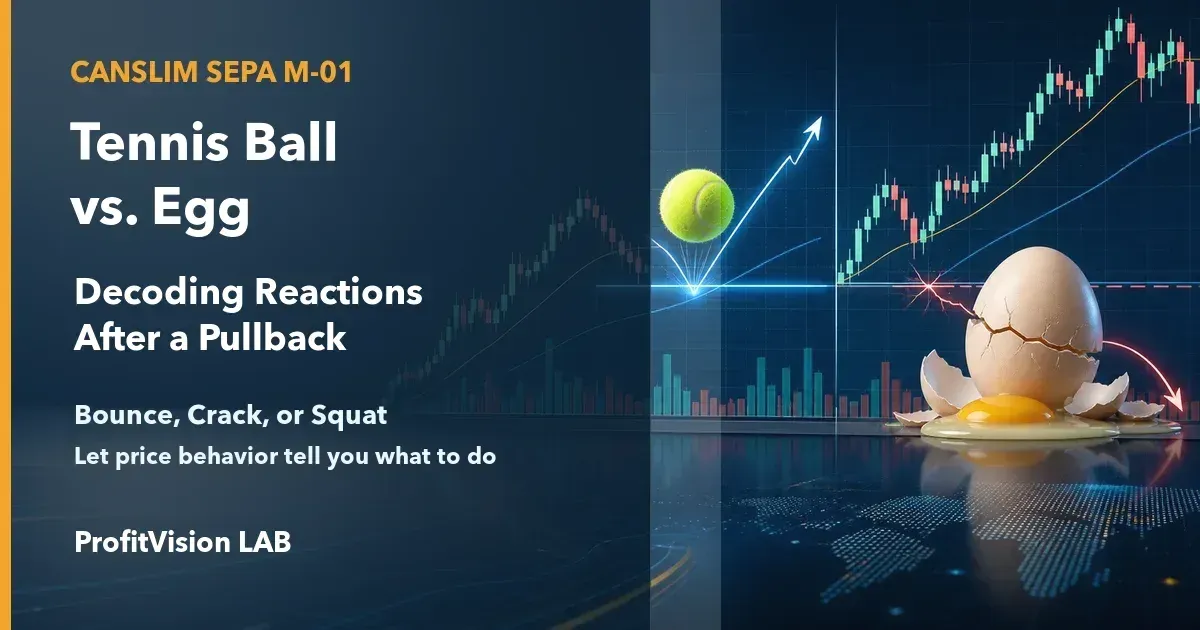
- After you buy, every pullback is a Natural Reaction — a normal, healthy retreat within an uptrend (Minervini labels them as ~5–7 day reactions). What you actually have to judge is how the stock reacts afterward: does it bounce back like a Tennis Ball, or crack like an Egg? As legendary fund manager Bill Berger put it: "Son, I buy tennis balls and sell eggs."
- Tennis Ball (healthy): volume contracts on the reaction; price touches support (a moving average or prior low) and snaps back quickly on expanding volume — institutional control is intact, stay in the position.
- Egg behavior (warning): the pullback is deeper or longer than expected, volume fails to contract, it can't bounce back, and may break support and stall below it — the stock has "cracked." Raise your alert level and evaluate reducing or exiting.
- Squat Pattern: the stock "squats" right at a breakout point — it approaches the breakout but stalls first, often with a 1-day shakeout, then launches via a "Reversal Recovery" on volume. It's the final shakeout before the move — an add-to-position opportunity.
- 2-Day Reversal Recovery: A high-volume down day immediately followed by a high-volume up day (reversal confirmation), showing that institutions are defending and selling pressure has been absorbed by buyers.
The Hardest Psychology of Holding: Decision-Making During a Pullback
Every investor knows in theory: "I shouldn't exit during a normal pullback." But in real-time, every dip in a live position triggers an intense emotional response — fear of giving back gains, doubt about whether the original thesis is still valid, worry that this decline is the start of a trend reversal.
This is exactly why Minervini, in the position management section of SEPA, emphasizes building an objective behavioral recognition framework. When you have clear criteria to distinguish "a normal pullback" from "a concerning pullback," the emotional pull is dramatically reduced.
"Don't make position decisions based on fear. Make them based on what the stock is telling you." — Mark Minervini (founder of the SEPA methodology) Master Trader Program
Tennis Ball vs. Egg: How Does the Stock React After a Pullback?
First, get the terms straight: every normal pullback is itself a "Natural Reaction" — a healthy part of an uptrend that you're meant to hold through. The question isn't "did it pull back," but "how does it react after the pullback": a strong stock acts like a tennis ball, snapping back on volume the moment it hits support; a weak stock acts like an egg — it drops, cracks, and can't bounce. Below is the framework for those two reactions.
✅ Tennis Ball Action
- Volume contracts during the pullback — no heavy selling pressure
- Pullback depth is within expected range (typically not exceeding the depth of the final VCP contraction)
- Price bounces quickly after touching support (10MA, 50MA, or prior VCP low)
- Volume expands on the recovery day — institutions are absorbing supply
- Overall pattern: shallow pullback, low volume; fast recovery, high volume
- Conclusion: Hold the position — this is healthy "recharging"
❌ Egg Behavior
- Volume fails to contract during the pullback, or volume expands on down days
- Pullback is deeper than expected, or takes longer than expected to find a floor
- Recovery is weak, with no meaningful volume expansion
- Stock breaks prior support and consolidates below that level
- Overall pattern: deep or prolonged pullback, higher volume; weak recovery, low volume
- Conclusion: Raise your alert level — evaluate whether to reduce or exit the position
Micron Technology 2012–2013: A Teaching Case Study
Minervini presented the Micron Technology (MU) 2012–2013 chart, which lays these concepts out within a single Stage 2 uptrend: one normal Natural Reaction (pullback) after another snapping back on strong Tennis Ball Action, a Squat mid-move — and then, in the later stages, reactions that start turning into "eggs" that can't bounce.
That price move demonstrates:
- Multiple Tennis Ball pullbacks during the primary advance — low-volume retreats to the 20MA followed by quick recoveries to new highs
- A Squat pattern mid-move — an almost invisible pause, followed by an explosive volume surge
- An "egg-like" reaction in the later stages — a pullback without sufficient volume contraction that can't bounce back, foreshadowing the stock entering a correction phase
The Squat Pattern: Recognition and Application
The Squat Pattern: Definition & Recognition
In Minervini's work, a Squat is not just any consolidation — it specifically means a "squat on a breakout attempt" (he labels it Breakout Attempt – Squat): the stock pushes up to a key level (a prior high, the pivot band, or the top of a consolidation) ready to break out, but instead of powering straight through, it squats there — stalling, even pulling back briefly, like crouching down before a jump.
It often comes with a "1-day shakeout": price briefly dips below the breakout line / support, shaking out the weak hands, then quickly reclaims it. On the surface it looks like a failed breakout — in reality it's the final shakeout before the launch.
What confirms the squat is healthy is the "Reversal Recovery" that follows — the stock reverses back up within the next 1–8 days, recovers the lost ground and makes new highs (Minervini labels these 1-Day / 2-Day / 4-Day / 8-Day Reversal Recoveries; the 2-Day Reversal Recovery in the next section is one of them).
So the full script is: approach the breakout → Squat (often with a 1-day shakeout) → Reversal Recovery → launch. In Minervini's examples (BDSI, YY, Sungy Mobile), this pattern marked the start of +55% to +80% moves within 1–3 months.
How to act: when you see the "squat + shakeout," don't panic-sell, and don't chase the false breakout candle; place a limit order above the breakout point and wait for the high-volume up day of the Reversal Recovery (volume exceeding any recent down day) before entering or adding, with your stop below the low of the shakeout day.
How Does a Squat Differ From a "Normal Pullback"?
- Normal pullback (Natural Reaction): happens mid-trend — the stock pulls back 5–10% from the high, then recovers, and you judge whether the reaction is a Tennis Ball (bounce) or an Egg (crack).
- Squat: happens at the breakout point — the stock approaches a breakout but "squats" first, usually with a 1-day shakeout to flush out weak holders, then launches via a Reversal Recovery. It's not "a rest mid-trend," but "the final crouch before the breakout."
2-Day Reversal Recovery: The Bounce Confirmation Signal
The 2-Day Reversal Recovery is a specific price-action signal Minervini emphasizes in his program. It shows that even when a high-volume down day appears, institutional money is absorbing the selling quickly:
- Day 1: A relatively high-volume down day (selling pressure appears)
- Day 2: Immediately followed by a high-volume up day that closes back above most or all of Day 1's decline (institutions counter-attacking, absorbing supply)
The 2-Day Reversal Recovery tells you: even though selling pressure appeared, there is a larger buying force absorbing it. This is typically a hold signal, not an exit signal.
A Quantitative Framework for Holding Decisions
| Observation | Likely Interpretation | Suggested Action |
|---|---|---|
| Low-volume pullback to 10MA, quick recovery | Tennis Ball — healthy consolidation | Hold position, no action needed |
| Stalls at a breakout with a 1-day shakeout, then a high-volume reversal recovery | Squat → Reversal Recovery (pre-breakout shakeout) | Wait for high-volume up day confirmation, consider adding to position |
| High-volume down day, next day high-volume recovery | 2-Day Reversal Recovery — institutions defending | Hold position, selling pressure absorbed |
| High-volume down day, next day weak low-volume bounce | Early signs of Egg behavior | Raise alert level, evaluate proximity to stop-loss |
| Persistent pattern: low-volume rallies, high-volume declines | Egg behavior confirmed, trend may be weakening | Consider reducing to half position; exit near stop-loss |
| Closes below the final VCP low (stop-loss line) | Stop-loss triggered | Exit at next open, no hesitation |
- Tennis Ball (healthy): do nothing on size, but trail your stop up to just below this reaction's low — lock in profit one bounce at a time.
- Egg behavior (warning): cut to half size and move the stop on the remaining half to breakeven. You don't have to dump it all at once — give the pattern a chance to prove itself, but take half the risk off first.
- High-volume break of key support: exit the rest, don't wait for a bounce. Here the cost of "one more day" is turning a small gain into a small loss, and a small loss into a big one.
- Wrong from the start: after you buy (or after the breakout) it isn't "profitable immediately" — instead it closes back below the breakout point the same day or the next. The breakout failed; the eggshell cracked.
- High-volume break of a key MA / prior low: it slices the 50-day MA or a prior swing low on volume far above recent norms and closes near the day's low — that's institutions distributing, not a shakeout.
- The largest down day of the whole advance: a single-day decline or single-day volume that's the biggest since the move began — an alarm that character is reversing.
- High, climactic key reversal: after an extended run, it makes a new high but reverses to close down on huge volume, engulfing the prior few days' gains — classic distribution.
- The whole volume rhythm flips: from "high-volume rallies, low-volume pullbacks" to "low-volume bounces, high-volume declines," more down days than up, closing repeatedly at the lows — the exact mirror image of the six healthy traits (profitable immediately, follow-through buying, more up days than down, more good closes than bad, tennis-ball action, healthy volume).
The Psychological Foundation of "Letting Winners Run"
One of SEPA's three core objectives is "capturing maximum gains," which means you must be able to tolerate normal volatility without exiting prematurely. The Tennis Ball Action and Squat recognition framework is exactly what gives you the confidence to "let winners run" — not through blind holding, but through objectively observing whether the stock's behavior matches your expectations.
When you see a stock consistently produce Tennis Ball bounces (low-volume, quick recoveries) on every pullback, you have an objective basis for continuing to hold. When you begin to see Egg behavior (high-volume declines, weak low-volume recoveries that can't bounce), you know it's time to raise your guard — but you don't necessarily need to exit immediately.
Trading application: "Letting winners run" is foraging off the enemy — let the market (the trend) feed your position, instead of grinding it out by constantly injecting fresh capital and trading in and out. A winning position's gains are the market "hauling grain" for you; the longer you hold and let compounding work, the more you grow your spoils on the market's resources rather than burning your own ammunition. Conversely, cutting a winner to chase the next name is abandoning the food at your feet to shoulder the supply line yourself — exhausting, costly, and you won't get far.
The real purpose of this objective framework isn't to make you a better forecaster — it's to let the stock's behavior override your emotions: low-volume shallow dip, shut up and hold; high-volume break of support, shut up and execute.
- Low-volume pullback + support holds: normal consolidation, no position change
- Weak, low-volume recovery that can't bounce (Egg): raise alert, consider trimming
- Breaks key support (prior low, moving average) + high volume: exit, do not wait for a bounce
- Misreading low-volume pullbacks as "distribution," exiting too early and missing subsequent gains
- Holding through a high-volume breakdown by rationalizing it as "normal volatility" — this is averaging down, not discipline
- Confusing the three behaviors (Tennis Ball / Egg / Squat), leading to contradictory judgments
- When overall market volatility is elevated, volume signals become noisier and pattern identification becomes harder
- For heavily ETF-owned stocks, volume patterns are influenced by passive flows and may not reflect active institutional intent
- In the first two weeks after entry, there is insufficient pattern history for reliable identification — more observation is needed