
PVL Price Action Execution Framework: Trading Is Not Prediction
Lesson 01 of the PVL Price Action Execution Framework explains how CANSLIM and SEPA tools, from Stage 2 and VCP to Pivot Point, 1 RU, Confirmation and Sell Rules, become a repeatable trading decision process.
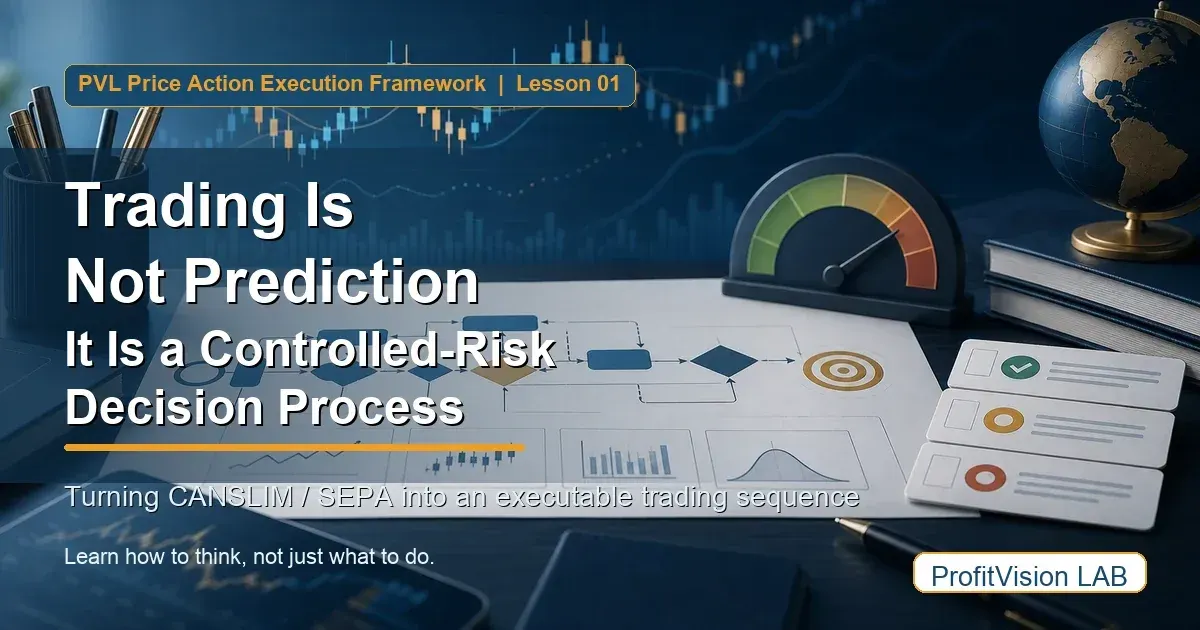
This is Lesson 01 of the PVL Price Action Execution Framework: turning CANSLIM and SEPA from stock selection, base development, entry location, position management and review into a sequence that can be executed every day.
- CANSLIM and SEPA already provide the methodology. PVL's job is to convert that methodology into a daily execution sequence.
- The real question before an entry is not which stock will move. It is whether the market, the stock, the base, the entry location and the risk all line up.
- A buy point is not a standalone signal. Pivot Point, Pocket Pivot Point, Cheat, Handle and Gap Up Entry must be interpreted within Stage 2, Trend Template and VCP context.
- Before entering, answer three questions: why can I buy, where might I be wrong, and how much can I lose at most?
Most traders do not fail because they know too few terms. They fail because they do not know what to do when a signal appears in real time. A chart breaks out, volume expands, a stock gaps up after earnings, or a handle tightens near the highs. The vocabulary is familiar, but the decision is still chaotic.
PVL defines trading this way: trading is not predicting the future. It is taking a measurable, stoppable and reviewable risk when the conditions are aligned.
Why does an execution framework matter?
An execution framework matters because trading tools are only useful when they are placed in the right order. Without order, every concept becomes a reason to act. A Pivot Point becomes a reason to chase. A Pocket Pivot Point becomes a reason to ignore the broader structure. A strong earnings gap becomes a reason to forget the stop.
The purpose of the PVL Price Action Execution Framework is to slow the decision down. Not to become hesitant, but to ask the right questions before capital is exposed.
Concept 1: trading is not prediction
A prediction asks, "Will this stock go up?" A trading plan asks, "If I am wrong, where is the evidence that I am wrong? If I am right, what should the stock begin to do? If the answer is unclear, why am I taking the trade?"
This distinction changes everything. Once risk is defined first, position size can be calculated. Once position size is calculated, the entry is no longer an emotional reaction. Once the entry is no longer emotional, Confirmation, Violation, Sell Rules and review can actually function.
Concept 2: a buy point is only one node in the process
When investors study technical analysis, they often focus on the buy point: Pivot Point, Pocket Pivot Point, Cheat, Handle, Gap Up Entry. These tools matter. But none of them should be evaluated in isolation.
| Condition | Healthy Context | Risky Context |
|---|---|---|
| Market | CANSLIM M supports action and the major indexes are in a confirmed uptrend. | Distribution days are rising and breakout failure risk is elevated. |
| Stock Stage | The stock is in Stage 2 and passes the Trend Template. | The stock is still in Stage 1 or already entering Stage 3. |
| Base Quality | VCP contraction is visible, the last T is tight and volume has dried up. | Price action is loose, overlapping and supply has not been absorbed. |
| Risk Location | The entry is close enough to the final T or relevant low for a controllable stop. | The stock is extended and the stop is too wide for the planned risk unit. |
The order matters: market first, stock qualification second, base maturity third, entry location fourth, risk calculation fifth, and only then execution.
PVL's eight-step decision flow
Lesson 01 sets the map. The later lessons will expand each tool, but the full structure must come first.
Why do more terms sometimes make trading worse?
More knowledge can create more excuses. A stock breaks above a prior high and you want to call it a Pivot Point. A stock rallies on volume and you want to call it a Pocket Pivot Point. A stock gaps after earnings and you want to call it a BGU. Each label may be correct, but the label alone does not complete the trade plan.
The mistake is not misunderstanding the term. The mistake is using one term to justify an incomplete trade: a stock outside Stage 2, a loose base without contraction, a gap with an unacceptably wide stop, or a breakout that is already extended beyond a proper entry window.
PVL reverses the process. A term is not a reason to buy. It is a checkpoint inside a larger decision sequence.
How do CANSLIM, SEPA and PVL divide the work?
CANSLIM, SEPA and PVL are not competing frameworks. They answer different questions.
| Layer | Main Question | Core Tools |
|---|---|---|
| CANSLIM | Which stocks deserve research? Which stocks may be market leaders? | C / A / N / S / L / I / M, EPS growth, RS Rating, A/D Rating, market direction. |
| SEPA | When can I buy? How much can I buy? When do I exit? | Stage 2, Trend Template, VCP, Pivot Point, PPP, Cheat, BGU, Confirmation / Violation, Sell Rules. |
| PVL Execution Framework | What is today's executable decision sequence? | Weekend process, watchlist, entry plan, 1 RU, position sizing, after-market review. |
CANSLIM helps decide what is worth studying. SEPA helps decide whether the stock is actionable. PVL turns both into a daily question: can I act today, at what size, and what will prove me wrong?
The three questions before entry
If you remember only one part of Lesson 01, remember these three questions.
- Why can I buy?
Do market direction, Stage 2, Trend Template, VCP and entry location support the same decision? - Where might I be wrong?
For a Pivot Point, where is the final T low? For a PPP, where is the day's low? For a BGU, where is the gap-day low or early intraday low? - How much can I lose at most?
Use 1 RU to calculate position size. A wider stop means fewer shares. Lower confirmation means a smaller planned position.
If these three questions cannot be answered, the entry is not a trade plan.
1 RU: turning emotion into numbers
In the PVL operating framework, 1 RU means one Risk Unit. Its purpose is not to complicate trading. Its purpose is to turn "I think this can work" into "this is the amount I am willing to pay if this judgment is wrong."
Shares to buy = allowed risk per trade / risk per share
Risk per share = entry price - stop price. If the stop gets wider, position size must go down.
This is why early-entry tools cannot be used with careless size. A Low Cheat or Pocket Pivot Point may offer a closer stop, but confirmation is lower. A Gap Up Entry may have a strong catalyst, but the stop is often wider. Location, confirmation, stop distance and size must be judged together.
After entry, the job is to read market feedback
After a trade is entered, the market starts voting on the thesis. SEPA's position management can be viewed through two categories:
- Confirmation: the market is validating the trade.
- Violation: the market is challenging or invalidating the trade.
Fast progress after entry, follow-through buying, constructive pullbacks on lower volume, strong closes and support at 10MA / 21MA / 50MA are examples of Confirmation. Lack of progress, a break back into the pivot area, high-volume downside action, weak rebounds and repeated failures are examples of Violation.
Confirmation and Violation are not single-candle labels. They are a scoreboard that accumulates over time. The question after each session is simple: did today confirm the plan or violate it?
Sell Rules are not an afterthought
Many investors plan the entry carefully, then improvise the exit. That is where the trade plan breaks. Sell Rules must exist before the trade is entered.
- Error Sell: the stop is triggered and the original thesis is invalidated.
- Strength Sell: the stock becomes extended or hits resistance after a fast advance, so partial profits may be taken.
- Structural Sell: the stock breaks key moving averages, the pivot area or accumulates multiple Violations.
- Top Sell: signs such as Climax Run, Distribution Days, Churning, Key Reversal Day or late Base Count risk appear.
Lesson 08 will go deeper into this topic. Lesson 01 only needs to establish the principle: selling is part of the plan, not something to decide under stress.
How will the eight lessons unfold?
Trading Is Not Prediction
The full decision sequence: market, stock, base, entry, risk, management, sell and review.
Stage 2 and Trend Template
Decide whether the stock belongs on the actionable watchlist.
VCP and Time Contraction
Judge whether supply has been absorbed and the base is mature.
Pivot Point and Pivot Zone
Build the standard breakout entry around a completed VCP.
PPP, Cheat and Handle
Use earlier entries only when right-side structure and risk allow it.
Gap Up Entry and Earnings Catalysts
Handle BGU, gap-day lows, ATR context and post-earnings confirmation.
Confirmation / Violation
Read the daily feedback after entry.
Sell Rules, Position Size and Review
Connect Sell Rules, 1 RU, position sizing and trade review.
Practical homework for Lesson 01
Do not rush to look for a buy point after this lesson. Build two checklists first.
Before the session: can I act today?
- Does the market support long exposure?
- Which stocks on my watchlist are in Stage 2 and pass the Trend Template?
- Which stocks are forming VCP, Handle, Cheat or approaching a Pivot Point?
- Which stocks have earnings or catalysts that could create Gap Up Entry or event risk?
- If an entry triggers today, is the stop and 1 RU position size already calculated?
After the session: what feedback did the market give?
- Was today's action a Confirmation or a Violation?
- Did the stock hold the 10MA / 21MA / 50MA or pivot area?
- Did volume support the advance or the decline?
- Did any position trigger a stop, trim or add condition?
- If the trade failed, which layer failed: market, stock selection, base, entry, size or execution?
Do not turn this framework into a stock-picking signal service
The PVL Price Action Execution Framework is not designed to tell you which stock will rise tomorrow. It is designed to make you ask better questions before and after capital is committed.
When the key questions can be answered, an entry may have meaning. When they cannot be answered, the best trade may be no trade.
This is Lesson 01 of the PVL Price Action Execution Framework. It is designed to be read alongside the existing CANSLIM and SEPA series: CANSLIM × SEPA overview, Stage Analysis and Trend Template, VCP, Pivot Point / Pocket Pivot Point / Gap Up Entry, and Risk and Position Sizing.
ProfitVision LAB Is Not a Signal Service
We break down the process behind investment judgment: how to research, how to wait, how to enter, and how to exit. If you want to build a system instead of chasing signals, subscribe to PVL.


Comments ()