
AB InBev × 3G: The Acquisition Machine That Perfected Frugality — When Discipline Goes Too Far
3G Capital built AB InBev, the world's largest brewer, on zero-based budgeting and extreme cost discipline. Applied to consumer brands that need long-term investment, discipline taken too far bites back — two dividend cuts and Kraft Heinz's impairment tell the tale.
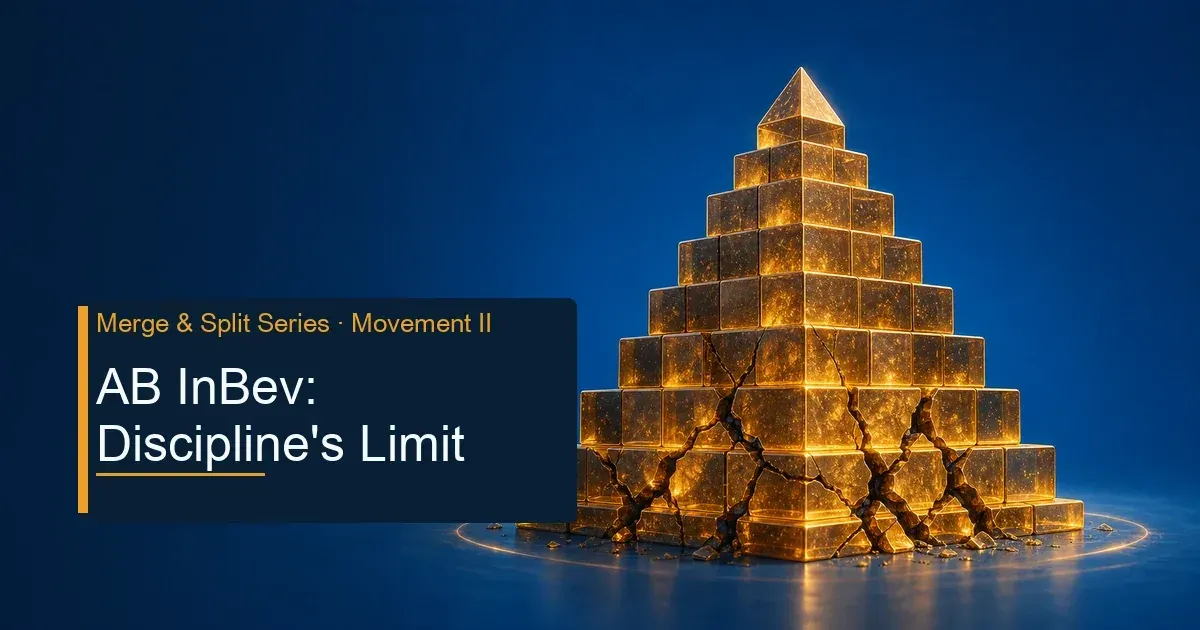
- One playbook of discipline, two endings. The last piece, Broadcom (AVGO), demonstrated how a "disciplined merge" builds a compounding machine; this one, AB InBev (BUD) and the 3G Capital behind it, ran an almost identical cost-discipline playbook — yet drove it past the tipping point. It teaches us something more profound: discipline is a virtue, but taken too far it bites back.
- 3G's signature model is zero-based budgeting (ZBB) + extreme cost discipline + debt-funded mega-acquisitions: merging Brazil's Brahma into AmBev, then merging with Interbrew to form InBev, then swallowing Anheuser-Busch (2008, ~US$52bn) and SABMiller (2016, over US$100bn), taking the throne of the world's largest brewer — at one point commanding close to 30% of global beer.
- But frugality pushed to the extreme cut its way into trouble: after SABMiller the company carried an enormous debt load and slashed its dividend twice, in 2018 and 2020; ZBB over-cut marketing and innovation, wounding organic growth and leaving the company eroded by craft beer and a new generation of consumers. It knows how to buy and how to cut — but not really how to "nurture."
- The most famous cautionary case is Kraft Heinz — built by 3G and Berkshire in a 2015 merger, then hit by massive impairments in 2019, with even Buffett publicly admitting he had "overpaid." Apply the same Broadcom-style discipline to consumer brands that need long-term brand investment, and past the tipping point it bites back.
The Same Discipline — Why Did One Become a Legend and the Other Crash?
Last time, we watched Broadcom's (AVGO) Hock Tan take the model of "buy mature franchises → cut costs hard → focus on the core → harvest cash" to its extreme, building a compounding machine worth over a trillion dollars. Having read that piece, you might well conclude this playbook is a cure-all: with enough discipline and enough cold blood, acquisitions will create value.
This piece is here to throw cold water on that idea. Because there is another group of people who ran an almost identical script — buy mature brands, cut with zero-based budgeting down to the bone, borrow heavily to do ever-larger acquisitions — yet failed to replicate Broadcom's miracle, and instead fell into a long struggle after reaching the summit. They are Brazil's 3G Capital, and the global beer empire they built with their own hands: AB InBev (Anheuser-Busch InBev, ticker BUD).
This series' core belief has never been that "merging is always good" or "merging is always bad," but that discipline and timing decide everything. This piece, however, adds a more subtle layer: discipline itself has a sweet spot — and a tipping point. Both are cost-driven serial acquirers, yet Broadcom merged just right, while 3G swung the knife too far. This is Movement II's most important pairing — it lets us see clearly that discipline is not a matter of "the more, the better": discipline applied in the right place is a virtue; discipline pushed past its limit bites back.
Who Is 3G Capital? Three Brazilians' Holy War on Cost
To understand AB InBev, you must first understand three Brazilians. The soul of 3G Capital is the legendary trio of Jorge Paulo Lemann, Marcel Telles and Beto Sicupira. They were not trained brewers but capitalists from finance and investment-banking backgrounds — and that single fact is the key to understanding everything they did: in their eyes, a beer company is not a cultural asset but an income statement waiting to be optimized.
In 1989, they bought the then poorly run Brazilian brewery Brahma. Once in charge, they imported the performance culture of investment banking wholesale: set extremely aggressive targets, tie employees to cost and profit through bonuses, and cut every "unnecessary" expense without mercy. Brahma was reborn in their hands, its profitability leaping dramatically — and the methodology that would later make them famous worldwide took shape right there.
What is worth savoring is that the trio's partnership was itself a decades-long trial of discipline. They applied the same high-pressure, high-performance standards to themselves first: restraint, focus, an obsession with every last number. Lemann began as a tennis player before moving into investment banking, and carries an athlete's compulsion to win in his bones; Telles and Sicupira turned that compulsion into a replicable, transferable "system." Their true product was never beer, but a standardized operating system for squeezing higher profit out of any mature business. Beer was merely this system's most successful field exercise.
Their culture carries a famous label: "Dream Big" + meritocracy + ownership. It sounds rousing and inspirational, but in practice its other face is cold-blooded — top performers receive enormous bonuses and rapid promotion; those who cannot keep up are eliminated without mercy. It is a high-pressure, high-performance machine whose sole faith is cost and profit.
The Beer Empire's Acquisition Chain: From Brahma to World No. 1
Lay out 3G's three-plus decades of beer acquisitions and you see a clear trajectory of "merging ever bigger" — with every deal larger than the last:
| Year | Move | Amount (approx.) | What it bought |
|---|---|---|---|
| 1989 | Bought Brahma | — | A Brazilian brewery, the model's starting point |
| 1999 | Brahma merged with Antarctica → formed AmBev | — | Dominance of the Brazilian / Latin American market |
| 2004 | AmBev merged with Belgium's Interbrew → InBev | — | Entry into Europe, becoming a global-scale giant |
| 2008 | InBev acquired Anheuser-Busch → AB InBev | ~US$52bn | America's national brand, Budweiser |
| 2016 | AB InBev acquired SABMiller | Over US$100bn | The throne of world's largest brewer (the biggest beer deal in history) |
From a regional Brazilian brewery to, after swallowing SABMiller in 2016, the world's largest brewer — a colossus at one point commanding close to 30% of global beer — the execution along this acquisition chain is textbook-grade. Budweiser, Stella Artois, Corona (in select markets), Beck's… most of the international heavyweights you can name were folded into the same empire.
The Model, Unpacked: Zero-Based Budgeting — Turning Frugality Into a Science
3G's signature weapon is a cost-management philosophy called zero-based budgeting (ZBB). It shares a bloodline with Broadcom's "cut costs hard," but 3G pushed it to a near-religious degree. The model boils down to four moves:
(1) Zero-based budgeting: every dollar must justify itself anew. Traditional budgeting asks "what did we spend last year, plus or minus a few percent?"; ZBB instead starts from zero every year, requiring every line of spending to re-prove its right to exist — and whatever cannot be justified gets cut. This forces out astonishing cost discipline — but its side effect is that "saving money" becomes the supreme virtue, and every investment "without a visible immediate return" (brand, innovation, R&D) is congenitally first in line for the knife.
(2) Extreme cost discipline: save everything that can be saved. From banning executives from business class, to shared desks, to cutting every perk and administrative expense deemed "wasteful," to mass layoffs of overlapping headcount after each acquisition — 3G pressed costs to levels outsiders found hard to imagine. The speed at which operating margins climbed after each deal repeatedly dazzled Wall Street.
(3) Meritocracy + enormous incentives: use bonuses to drive people to cut. Top performers earn staggering bonuses and absurdly fast promotions; those who miss their targets are out quickly. The entire organization is engineered into a machine whose "only KPI is saving money and making profit" — everyone carries a powerful incentive to cut, to save, to hit the number.
(4) Debt-funded mega-acquisitions: use leverage to amplify all of the above. The high profits and stable cash flows carved out by the knife are 3G's best collateral for borrowing from banks and the debt markets. They used massive leverage to swallow rivals larger than themselves, then used post-merger cost synergies to support returns and pay down debt — then went looking for the next, even bigger target. "Cutting costs" is not merely an operating tactic; it is the fuel of the entire acquisition flywheel.
Put the four moves together and you will notice they trace almost the same blueprint as Broadcom's "buy, cut, focus, harvest" from the last piece — and that is no coincidence. They belong to the same family of capital allocation: the belief that the true value of a mature asset is usually being wasted by lax incumbent management, and that discipline is the key to unlocking that value. The only difference: Broadcom inserted the key into a lock called "technology customers cannot switch away from," while 3G inserted the same key into "consumer brands held together by emotion and habit" — and that second lock has a completely different structure.
Different how? The tech lock's core is switching cost: once a customer has designed your chip into their system, they cannot leave — cut your marketing budget and the orders still come. A consumer brand is the exact opposite. Its core is "whether the consumer feels like reaching for you again tonight," and that willingness must be fed by two kinds of continuous investment. The first is the necessary spending of brand-building and consumer engagement — advertising, shelf presence, sports sponsorships, on-premise work in bars and restaurants. On a ZBB ledger these look like "fat"; in reality they are the brand's life-support costs: stop them for six months and nothing visibly breaks, but the brand wilts like an unwatered plant — by the time the leaves turn yellow, the roots are already rotting. The second is relentless product innovation — the craft-beer surge, low-alcohol, zero-alcohol, fruit flavors, seasonal editions. Younger consumers drink less but choose harder; beer stopped being a "one flavor conquers all" business long ago. Today's brewer must operate like a fast-moving consumer brand: launching, testing and culling new products every year, with R&D and trial-and-error as a standing fixed cost. In one line: a tech moat guards itself; a brand moat is an army you must pay every single day. Treat the second the way you treat the first — and the lock can be opened, but it is also far easier to twist until it breaks. This foreshadowing will detonate, chapter by chapter, below.
The Best Owner Test: Yes in the Early Years — But Later?
This series' iron rule is: "Am I the best owner of this business?" — only if you can bring it value no one else can should you buy it and keep it.
In the early years, 3G passed this test — and passed it beautifully. The breweries it bought had been laxly managed, bloated in cost, mediocre in profit; in 3G's hands, ZBB forced out efficiency, meritocracy forced out performance, and profitability leapt. For a "lax, fat, undisciplined" mature brand, 3G genuinely was the better owner — it carved away the fat and revealed the muscle.
But the problem lay in "afterwards." Once the fat was gone and the knife started cutting into muscle, the best-owner status began to wobble. An owner who can only "buy, cut, harvest" but cannot "nurture" becomes, for an asset already squeezed dry, the worst owner instead — no longer investing in the brand's future, only making withdrawal after withdrawal from its past. This is the deepest crack in the 3G model: its best-owner status comes with an expiry date. Past that point, discipline flips from creating value to consuming it.
Let the Numbers Speak: After the Summit, the Story Changed
(2008)
(2016)
(2018 / 2020)
| Aspect | Before the summit (pre-SABMiller) | After the summit (2016 to date) |
|---|---|---|
| Scale and standing | One of the world's leading brewers | Firmly the world's largest, close to 30% of global beer |
| Debt | Manageable, with M&A ammunition | Enormous debt load; deleveraging became the main theme |
| Dividend | Market expected continued growth | Slashed twice, in 2018 and 2020 |
| Organic growth | Still had an M&A story to tell | Core brands stagnant, eroded by craft / the new generation |
| Share price | Lifted by acquisition expectations | Persistently weak after SABMiller, never regaining prior highs |
Note: amounts are approximate, in US dollars, as of 2026; descriptions of market share, debt and share-price trajectories are broad summaries compiled from public information, and past returns do not indicate future performance.
Set against Broadcom's scorecard from the last piece — "market value past a trillion, dividends growing year after year" — AB InBev's post-summit story is almost the exact opposite script. Both reached the top of their industries; Broadcom then took off, while AB InBev sank into years of deleveraging and growth stagnation. The difference lies not in what they did, but in whether they overdid it — and in whether the industry they operate in could withstand that "overdoing."
The Honest Side: When Discipline Goes Too Far, How Hard Does It Bite Back?
The honest side of this piece must be written more heavily than in any other — because the AB InBev / 3G story is, at its core, a cautionary tale of "discipline biting back." Its achievements are beyond dispute, but the price it paid is just as striking.
(1) Over-leverage, two dividend cuts. To swallow the US$100bn-plus SABMiller, AB InBev took on an enormous debt load. When core-business growth slowed and cash flow fell short of expectations, the heavy debt turned from "tailwind" into "shackles" — the company was forced to slash its dividend sharply twice, in 2018 and 2020, to preserve cash and pay down debt. For a consumer champion once regarded as a model of steady dividends, cutting the payout was a deeply humiliating signal — and a direct blow to long-term shareholders' trust.
(2) ZBB cut marketing and innovation — and cut too far. Zero-based budgeting is congenitally unfriendly to spending "with no visible short-term return" — and brand marketing and product innovation are exactly that kind of spending. Years of cost-above-all weakened the marketing muscle and innovation cadence of AB InBev's core brands, wounding organic growth. When a beer company stops investing in "making people want to drink it," market share can only coast on the inertia of its installed base.
(3) Eroded by craft beer and a new generation of consumers. During the very years AB InBev was busy cutting costs and deleveraging, the market's tastes changed: craft beer rose, and younger generations drank less while seeking out the niche and the local. A machine optimized for "efficiently producing mass-market brands" proved sluggish in responding to a shift that demanded agility, innovation and emotional brand investment. What it does best — mass-producing national brands at the lowest cost — happens to be the least valuable capability of this new era.
(4) The most fundamental doubt: "It can buy and it can cut — but can it nurture?" This is the sharpest question hanging over the 3G model. Buying inefficient assets, carving off the fat, squeezing out the cash — at this, it performs with virtuosity. But raising a brand over the long term, keeping it alive and vital a decade later — that requires patient investment, tolerance for innovation that loses money in the short run, and long-term cultivation of consumers' emotions: precisely the things ZBB discipline is worst at, and instinctively cuts first.
In other words, 3G's discipline is an exceedingly sharp knife. In the "fat-removal" phase, it has no equal; but when the task is to "fertilize, irrigate, and grow a tree," the same knife comes down on the roots. Only by admitting this can you understand the true cost of "discipline gone too far" — it is not a shortage of discipline, but discipline applied in the wrong place, and pushed past its limit.
A side note: does a performance-driven talent machine breed the wrong company?
Shift the lens from the income statement to human-capital reserves and another layer of the problem appears. 3G's meritocracy drives people with outsized bonuses — and those bonuses hang almost entirely on near-term financial numbers: how much cost was cut, how many points of margin were gained. Year after year, a single-KPI filter like this changes what kind of people a company grows: everyone promoted is a manager who excels at cutting costs and hitting this quarter's numbers, while the people who know how to nurture a brand and commit to ten-year plays can never score well under this system — they are either sidelined or walk out on their own. The organization's talent bench gets homogenized by its own scorecard — and when the day comes that the company needs the ability to "nurture," it finds nobody left on the bench who can.
More dangerous still is the time lag built into the incentives: cut the brand's life-support spending and the damage only surfaces three to five years later — but the bonus lands this year. Under such a system, a rational manager finds that killing the goose for its eggs is actually the "optimal" play — a design flaw, not a character flaw. One classic remedy is management's old friend, the Balanced Scorecard: measure the leadership team not on the financial perspective alone, but simultaneously on the customer perspective (brand health, consumer satisfaction and repurchase), the internal-process perspective (new-product pipeline, the cadence of innovation and experimentation), and the learning-and-growth perspective (talent development, bench depth). With four perspectives holding each other in check, managers stop sawing off ten-years-from-now's roots to collect this year's bonus. Consider: if AB InBev's bonus formula had weighted brand-equity metrics and new-product revenue share equally with EBITDA margin, would Kraft Heinz's US$15.4bn brand impairment ever have happened?
Kraft Heinz: The 3G Model's Most Famous Cautionary Monument
If AB InBev is the chronic case of "discipline overdone," then Kraft Heinz is this model's most violent — and most public — crash. And even Buffett went down with it.
In 2015, 3G Capital joined forces with Warren Buffett's Berkshire Hathaway to merge Heinz and Kraft into the food giant Kraft Heinz. The script was a carbon copy of the beer empire: combine two mature food brands, apply ZBB, cut costs hard, lift short-term profit. At first, Wall Street was once again dazzled by the gleaming margins.
But the plot turned fast and hard. By 2019, Kraft Heinz was forced to recognize goodwill and intangible-asset impairments on the order of well over ten billion US dollars against its flagship brands (including Kraft and Oscar Mayer), and the stock plunged in a single day. The market suddenly saw it: these old food brands, their marketing and innovation budgets slashed to the bone, were quietly aging in brand value, slipping out of consumers' minds — the costs had indeed been saved, but the brands' "future" had been saved away along with them.
The backdrop of the era was crueler still. Kraft Heinz had been optimized into a machine for "efficiently producing traditional packaged food" — at precisely the moment consumers were migrating en masse toward fresher, healthier, less-processed, more local and niche food. On one side, a legion of old brands cut down to zero innovation ammunition; on the other, fast-iterating small brands and private labels attuned to the new generation — the battle was effectively decided before it began. ZBB is a genius at "defending and saving," but nearly crippled at "meeting change," because its instinct is to cut everything "not yet showing a return" — and exploration, the very thing it cuts, is the only path through change.
Kraft Heinz and AB InBev are two versions of the same story: the same 3G discipline, applied equally to consumer brands, suffering the same double erosion of growth and brand after reaching the top. Together, they form this series' most powerful evidence on "discipline overdone" — discipline can bring a company back to life, but it cannot keep it forever young; keeping a brand evergreen depends on "nurturing," not "cutting."
Cost Discipline's Sweet Spot vs. Tipping Point: AB InBev Against Broadcom
Place this piece's AB InBev side by side with the last piece's Broadcom, and this series' most important pairing emerges — both are disciplined, cost-driven serial acquirers; one merged just right, the other merged too hard.
| Dimension | Broadcom (merged just right) | AB InBev / 3G (merged too hard) |
|---|---|---|
| Core playbook | Buy mature franchises, cut costs, harvest cash | Nearly identical: buy, cut with ZBB, borrow and buy again |
| Industry character | B2B tech: customers can't switch, locked in by technology | B2C consumer: runs on brand emotion, needs long-term feeding |
| Consequence of cutting | Cutting redundancy doesn't harm the moat (the moat is the technology) | Cutting marketing / innovation = cutting the brand's future |
| Can it "nurture"? | Keeps doubling down on core technology (custom AI chips) | Can buy and cut, but not really nurture brands |
| After the summit | Market value past a trillion, dividends growing year after year | Dividend slashed twice, share price persistently weak |
The critical watershed hides in the "industry character" row. Broadcom cut a tech company's redundancy, and its moat (technology lock-in that customers cannot switch away from) sat beyond the reach of the cost knife; 3G cut a consumer brand's marketing and innovation — and that is the consumer brand's moat itself. The same knife of discipline, applied to a tech company, trims fat; applied to a consumer brand, it severs roots. That is the essential difference between the "sweet spot" and the "tipping point" — the question is not how much discipline you have, but whether "the moat of this particular industry can survive being cut like this."
M&A Discipline Scorecard: AB InBev / 3G
Continuing Movement II's "M&A Discipline Scorecard," we run the six checkpoints over this machine that "merged too hard" — and compared with Broadcom's five-for-five green, the "△" marks here are conspicuously more numerous:
| Checkpoint | Verdict | Notes |
|---|---|---|
| (1) Capital-allocation discipline | ✅ | Extremely strong early on; every deal's cost synergies penciled out, with ZBB pushing efficiency to the limit |
| (2) Best owner | △ | Yes early, doubtful later — cut too far, couldn't nurture brands, degenerating into an owner who "only withdraws, never invests" |
| (3) Synergy realization | ✅ | Cost synergies real and delivered in size — the one thing 3G has never fumbled |
| (4) Financial discipline | △ | Over-leveraged after SABMiller; dividend slashed twice in 2018 / 2020, under heavy deleveraging pressure |
| (5) Integration ability | ✅ | ZBB is a standardized, replicable integration system, executed at world class |
| (6) Shareholder returns | △ | Share price persistently weak after SABMiller, dividend cut; long-term returns far below the expectations at the summit |
Verdict: the "cautionary edition" of disciplined M&A — it demonstrates how the same Broadcom-style discipline, once pushed too far and applied to consumer goods that "need long-term brand investment," bites back. Three of the six checkpoints score "△," all concentrated in the "later period": the best-owner status degraded, finances over-leveraged, shareholder returns disappointing. It is not a counterexample but a mirror — reflecting discipline's boundary: discipline can carry you to the summit, but after the summit, cutting alone cannot get you down the mountain.
A Lesson for Taiwan: Cost Discipline Is Worth Learning — Just Don't Cut Into the Bone
This matters most for Taiwan's consumer and food groups. Take a group running national brands like Uni-President (1216): its moat is exactly brand affection, distribution and long-accumulated consumer trust — all of which must be continuously invested in and "nurtured," not chopped with a single ZBB stroke. The negative example is the precedent of Wei Chuan / Ting Hsin: once a food brand loses consumers' long-term trust, no amount of cost savings can buy it back — a reminder that a consumer brand's most expensive asset is trust, and trust cannot be repurchased by cutting costs.
The crucial self-question is: when I bring this knife down, am I cutting "waste" — or "the future"? The operator who can tell those two apart is the one who has truly understood this piece's warning in Movement II — merge with discipline, but never let discipline cut until the tree loses its roots.
Up Next: From a Beer Empire to a Transformer in Energy and Digital
AB InBev has demonstrated the backlash of "discipline gone too far." Next time, we fly to Europe for an entirely different case — Schneider Electric. It, too, grew through acquisitions, but its story is about how M&A can refocus and transform a traditional electrical-equipment maker into a leader in energy management and industrial digitalization.
If AB InBev teaches us the price of "cutting too far," what Schneider will teach us is how acquisitions can serve as tools of "transformation" and "refocusing" — not to become cheaper, but to move toward a more right future. See you next time, with Schneider.
- Introduction: Merge & Split — The Art of Capital Allocation
- Movement I [Split]: GE, Abbott, eBay, Siemens, Daimler, Ferrari, Haleon, GE×Wabtec, Novartis, Philips, Universal Music, Hitachi, Sony (13 pieces)
- Movement II [Merge] · Broadcom: The Man Who Merges Best, LVMH
- Movement II [Merge] · AB InBev (this piece): The Acquisition Machine That Perfected Frugality — When Discipline Goes Too Far
- Movement II [Merge]: Schneider, Exor, Fujifilm
- Conclusion: The Wisdom of Merge & Split

Comments ()