CANSLIM Explained: How O'Neil Decoded Market Leaders with Seven Letters
CANSLIM Series C-01 · Overview "He who knows when he can fight and when he cannot will be victorious." —— Sun Tzu · The Art of War · Attack by Stratagem Markets are battlefields. Most investors enter armed with nothing but vague intuition. A small minority enters with a rigorous, historically tested checklist for selecting the strongest candidates. William O'Neil spent decades studying every major winner in the U.S. market since the 1880s and distilled their shared characteristics into sev
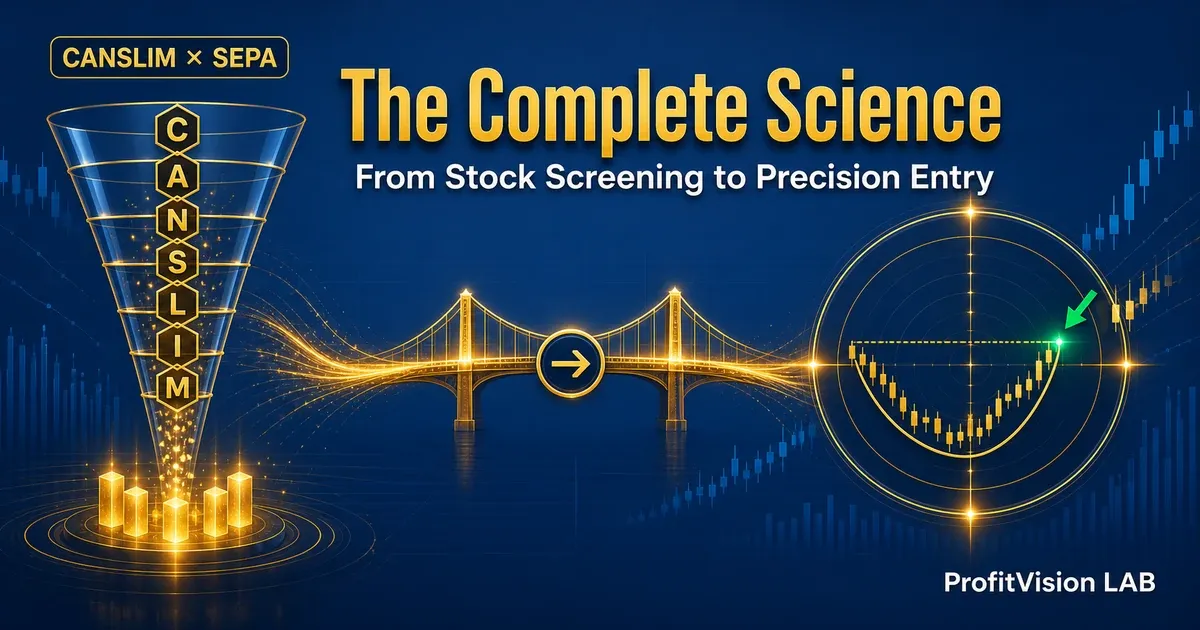
- CANSLIM is a seven-dimensional stock selection system: EPS acceleration, annual growth, new catalysts, supply/demand, leadership, institutional sponsorship, and market timing
- Each letter captures a "superperformer trait" — historically, the biggest winning stocks exhibited most or all of these characteristics before their major advances
- CANSLIM's greatest enemy is knowing the rules but failing to follow them — letting emotion override the system
- This is the first article in the series: understanding the foundational logic of all seven criteria and how they connect to Minervini's SEPA entry methodology
- Criticism is worth hearing: knowing the boundaries of CANSLIM's effectiveness is an honest obligation for every practitioner
What Is CANSLIM? Origins and Core Logic
CANSLIM is the seven-dimensional stock selection framework created by William O'Neil. Its research database was built by analyzing the shared characteristics of every era's greatest winning stocks in the U.S. market from the 1880s to the present. It is neither pure technical analysis nor pure fundamental analysis — it is a cross-validation system that uses fundamentals to confirm "this stock deserves to move higher" and technicals to confirm "the market is beginning to recognize its value."
O'Neil founded Investor's Business Daily (IBD) in 1983 and systematized the methodology in his book How to Make Money in Stocks. His research conclusion was unambiguous: before every era's greatest winning stocks made their biggest advances, they displayed a highly consistent cluster of measurable characteristics — and CANSLIM is the acronym that names that cluster.
Quarterly
Growth
ROE ≥ 17%
Catalyst
New Story
Demand
Vol breakout
or Laggard
(top ≥ 90)
Sponsorship
Rising trend
Direction
Uptrend
The financial media company O'Neil founded in 1983, known for its proprietary quantitative data: RS Rating (Relative Strength), EPS Rating, Accumulation/Distribution (A/D) Rating, and Industry Group Rankings. Many of CANSLIM's core metrics — especially RS Rating — are only available through IBD or its screening platform MarketSurge. For serious practitioners, a MarketSurge subscription is a practical prerequisite for executing the system.
The Philosophy Behind CANSLIM: Why Is "Strength Begets Strength" a Pattern, Not a Coincidence?
A common first reaction to CANSLIM is: "Chasing EPS acceleration, chasing relative strength, waiting for breakouts — isn't that just buying at the top?" This question strikes at CANSLIM's core philosophical tension: "High" is relative. "Potential unrealized" is absolute.
O'Neil's research database shows that the greatest winning stocks were often already significantly above their prior lows at the start of their biggest advance — yet they still had 100% to 2000% of upside remaining. This finding inverts the "buy low, sell high" instinct and introduces a more important concept: don't buy what's "cheap" — buy when a leader is just being confirmed by the market.
The Inner Logic of the Seven Letters: A Filtering Funnel
CANSLIM's seven dimensions are not a flat checklist — they form a narrowing funnel from broad to specific. Each layer filters out another batch of insufficient candidates:
| Filter Layer | CANSLIM Letter | The Question | What Gets Eliminated |
|---|---|---|---|
| Layer 1: Fundamental Acceleration | C + A | Is EPS growth accelerating? | Mediocre, declining, or financially engineered earners |
| Layer 2: Growth Catalyst | N | Is there a concrete new driver behind the growth? | Companies moving on momentum alone, with no business breakthrough |
| Layer 3: Supply/Demand Structure | S | Is the share supply structure favorable for a big move? | Bloated floats, excessive dilution, diffuse ownership |
| Layer 4: Market Recognition | L | Is it a leader or a laggard? | Low-RS "cheap" stocks and fundamentally sound companies being ignored by the market |
| Layer 5: Institutional Sponsorship | I | Is smart money flowing in? | Institutionally avoided stocks, poor A/D ratings, no big-money backing |
| Layer 6: Market Timing | M | Does the overall market support a breakout? | Any forced entry during bear markets or meaningful corrections |
EPS measures the profit a company generates per share over a given period (typically a quarter). CANSLIM's "C" requires the most recent quarter's EPS to grow at least 25% year-over-year; "A" requires sustained annual EPS growth of ≥25%. O'Neil's historical research found that virtually all superperformance stocks exceeded this threshold before their major advances — it's the minimum effective dividing line between "a rocket accelerating" and "a plane at cruise altitude." The 25% figure is not arbitrary magic; it was extracted from a massive database of historical winners.
Challenging CANSLIM: The Three Strongest Criticisms
The cases you highlight — YHOO, AMZN — are all successes. What about the stocks that met all the CANSLIM criteria and still failed? By omitting them, the entire argument rests on a selectively curated historical narrative.
This is a legitimate and necessary challenge. CANSLIM's win rate is not 100% — O'Neil himself acknowledged that a significant portion of qualifying candidates will still fail. The system's value is not "being right every time" but rather the asymmetric payoff structure: strict stops keep losses small; letting winners run makes profits large. Survivorship bias is a limitation shared by all historical research, but CANSLIM's M factor (market direction) provides an additional layer of protection — sitting entirely on the sidelines in bear markets substantially reduces exposure to failing setups.
Academic research suggests markets are approximately semi-strong efficient. By the time EPS acceleration is public knowledge, the price already reflects it. Buying "at the breakout" means chasing after information has been fully priced in — the expected value should approach zero.
EMH has faced sustained challenges in academic research. A large body of behavioral finance work — including Kahneman-Tversky's Prospect Theory and Jegadeesh-Titman's Momentum Effect — shows markets are not perfectly efficient. In particular, the momentum effect shows statistically significant persistence globally: stocks that have been strong over the past 12 months tend to continue outperforming for the next several months. CANSLIM's L (Leader) and I (Institutional Sponsorship) are the institutionalized application of this effect. Moreover, institutional position-building takes weeks to months, creating an observable "information diffusion window" that can be tracked.
Buffett, Graham, and other value investing giants warn that buying at extreme PE multiples is dangerous speculation. Yet CANSLIM embraces high-PE, high-EPS-growth companies — isn't that buying at the top of a bubble?
This criticism conflates time frames. Buffett's holding period is "forever" — he doesn't need to care about technicals. CANSLIM's time frame is an intermediate trend (months to two years), where "PE expansion" itself is a source of return — not a risk, but a calculated component of the thesis. This requires the practitioner to have disciplined stop-loss rules: once the fundamental story breaks, exit decisively. Buffett doesn't need stops because he's buying permanent assets; CANSLIM practitioners must use stops because they're buying "an accelerating pulse." These are different weapons that cannot negate each other.
CANSLIM in Practice: The Standard Screening Workflow
The following is an actionable CANSLIM screening workflow using MarketSurge or IBD tools:
- Step 1 — Market Confirmation (M): Check whether IBD's market assessment shows "Confirmed Uptrend." If the market is in "Correction," stop all stock selection and move to the sidelines entirely.
- Step 2 — Fundamental Screen (C + A): In MarketSurge, filter for: most recent quarter EPS growth ≥25%, annual EPS growth ≥25%, ROE ≥17%. This step typically narrows thousands of stocks down to dozens or hundreds.
- Step 3 — RS Rating Screen (L): Keep only stocks with RS Rating ≥ 70. In strong bull markets, raise the bar to ≥80 or ≥90 to concentrate firepower on genuine market leaders.
- Step 4 — Institutional Sponsorship Confirmation (I): A/D Rating must be C or better (B or A is preferred). Watch the recent trend in the number of institutional holders — a rising count signals institutions are stepping in.
- Step 5 — Pattern Confirmation (S + N): Check whether the chart is forming a healthy base (VCP, Cup with Handle) and confirm the presence of a concrete catalyst (new product, new contract, earnings surprise).
- Step 6 — Wait for the SEPA Entry Point: Stocks that pass the above filters enter your watchlist. Wait for Mark Minervini's SEPA system (Pivot Point breakout + volume confirmation) to trigger before committing capital.
CANSLIM's Limitations: An Honest Self-Critique
Understanding the effective boundaries of any system is as important as understanding the system itself. CANSLIM has several known limitations that every practitioner should honestly confront:
- Near-total failure in bear markets: The M factor is designed to address this, but in practice, judging "when the market has truly turned" requires extensive experience. Beginners frequently mistake bear market rallies for new bull market confirmations.
- Transaction costs are meaningful for smaller accounts: CANSLIM's "build position → stop out → rebuild" cycle can generate significant friction costs when commissions are high or account size is small.
- Time demands are real: At least 30–60 minutes of post-market research per day is needed to maintain a watchlist, track positions, and assess market conditions. This is a genuine challenge for part-time investors.
- Tool access has a subscription barrier: MarketSurge and IBD subscriptions may not be cost-effective for smaller accounts. Alternatives exist but are less complete than the official tools.
The most frequent mistake: "I screen on C and A for fundamentals, then I enter whenever I want" — completely ignoring M (market direction) and S (supply/demand). That's equivalent to reading only the first two letters of a seven-letter system and assuming you've mastered the whole thing. Even the strongest fundamental candidates get dragged lower when the broad market is in correction.
How CANSLIM Connects to SEPA: The Missing Piece
CANSLIM is a highly effective stock screening tool, but its execution guidance is intentionally broad — "buy near the pivot point," "volume expands 40–50%" — leaving substantial room for interpretation in practice.
Mark Minervini's SEPA (Specific Entry Point Analysis) is the system built to fill that gap. Minervini is himself a deep practitioner of O'Neil's research framework; building on CANSLIM, he precision-engineered the entry point, systematized position management, and quantified exit timing, creating a step-by-step advanced framework that can be executed with discipline.
"O'Neil gave me the map. SEPA is the operations manual that taught me how to actually march on it." — Synthesized from the system perspective in Minervini's books
CANSLIM Foundations (You are here)
C-01 CANSLIM Overview (This Article) | C-02 C+A: The Science of EPS Acceleration | C-03 N+S: New Catalysts & Supply Structure | C-04 L+I: Leaders & the Institutional Code | C-05 M: Market Timing & the Bridge to SEPA
SEPA Advanced Series: S-01 The Five Pillars of SEPA → E-02 VCP Pattern → M-06 Sell Rules
- Prioritize candidates where the four core criteria (C+A+L+M) are met; all seven do not need to be perfect before acting
- Use the seven criteria as a ranking and filtering tool — not a buy signal in itself
- Do not aggressively add to positions until the market (M factor) reaches Confirmed Uptrend
- Treating CANSLIM as a buy formula while ignoring execution timing
- Requiring all seven to be perfect before acting — making it nearly impossible to find any setup
- Applying the system to micro-cap or thinly-traded stocks with minimal institutional participation
- Bear markets and distribution phases: even strong multi-criteria setups can follow the market lower
- Industry structure breakdown (N factor reversal)
- When M factor breaks down, the advantages of the other six criteria can be overwhelmed by systematic market risk