CANSLIM M Factor: Market Direction Is the Final Arbiter of All Your Stock Selection Work
CANSLIM Series C-05 · M Factor · Bridge to SEPA 「天時不如地利,地利不如人和。」— 孟子·公孫丑下 —— Mencius · Duke of Gong Sun, Part II Mencius ranked favorable timing, favorable terrain, and human unity — and concluded human unity matters most. But that doesn't mean timing is unimportant. The deeper point is this: without favorable timing, even the best terrain and the strongest unity will often fall short. Market direction is the timing factor in investing. After decades of research, O'Neil arrived at an unc
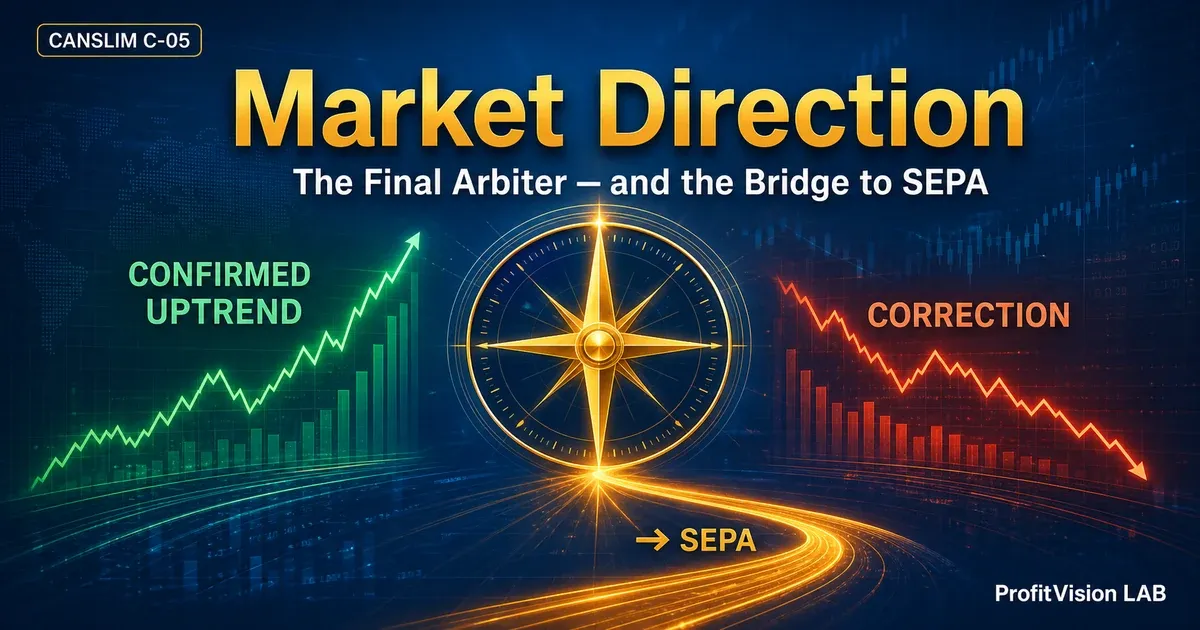
Market direction is the timing factor in investing.
After decades of research, O'Neil arrived at an uncomfortable but unavoidable conclusion: in major bear markets in U.S. history, approximately 75% of stocks ultimately decline substantially from their highs (O'Neil's historical observation of U.S. markets — not a precise guarantee for every bear market).
No matter how strong the fundamentals, no matter how precise the technical setup — when the tide is going out, most boats go with it.
The M factor is CANSLIM's last line of defense, and the most frequently ignored one.
- M Factor (Market Direction): a Confirmed Uptrend is the entry window; sit fully in cash during corrections
- The Follow-Through Day (FTD) is O'Neil's quantitative tool for confirming a market bottom — a high-volume surge on Day 4 or later of a rally attempt
- Distribution Day counting: 4–5 distribution days within a rolling window is an early warning that the market is weakening
- The M factor is CANSLIM's gatekeeper: only when the market gives the green light does the stock selection work of the first six letters have any meaning
- This article also closes the CANSLIM series and explains how to make a seamless transition from the seven criteria into Mark Minervini's SEPA system
The M Factor: Why "Going with the Trend" Is the Most Important Piece of the System
Among CANSLIM's seven letters, M (Market Direction) is the only criterion entirely unrelated to individual stock quality. It doesn't ask "is this a good company?" — it asks "does the current market environment support your strategy?"
O'Neil noted in his writing that across major bear markets in U.S. history since the 1880s, approximately 75% of stocks ultimately declined substantially from their highs (cited from O'Neil's historical observations; different statistical methods and time periods may yield different figures). The core implication: even if you've correctly identified a strong candidate using all six other CANSLIM criteria, once the broad market enters a primary downtrend, individual stocks will typically follow.
"The smart investor doesn't fight the market — they learn to read what the market is saying and act in the direction it points." — William O'Neil, How to Make Money in Stocks
The Four Market States: CANSLIM's Operating Map
IBD identifies four market states, each calling for a different operating posture:
✅ Confirmed Uptrend
- A Follow-Through Day has triggered
- Distribution Day count is low (<4)
- Most leading stocks are advancing
- Action: build positions actively; execute full CANSLIM+SEPA strategy
⚠️ Uptrend Under Pressure
- Distribution days have accumulated to 4–5
- Leading stocks showing topping signs
- Major indexes above key support but unstable
- Action: reduce new entries, tighten stops, avoid pyramiding
⛔ Market in Correction
- Major indexes break 50MA on elevated volume
- Excessive distribution; leaders breaking support
- New breakout failure rate is very high
- Action: move fully to cash; wait for FTD to re-engage
❓ Rally Attempt
- Market bouncing from a recent low
- No valid FTD yet
- Bounce may be a dead-cat or a genuine bottom
- Action: stay on the sidelines; wait for FTD confirmation on Day 4+
Follow-Through Day (FTD): The Quantitative Bottom-Confirmation Tool
The FTD is O'Neil's market bottom confirmation mechanism, designed to filter "dead-cat bounces" (bear market rallies) from genuine bottom formations. Its logic is grounded in a market microstructure observation: a genuine new uptrend requires active institutional participation, and that participation leaves a visible signature in specific volume patterns.
A Distribution Day occurs when a major index (S&P 500 or Nasdaq) closes down ≥0.2% on volume higher than the prior trading session. A single distribution day is not alarming. But accumulating 4–5 distribution days within 25 trading days (approximately 5 weeks) signals institutional investors are systematically reducing exposure. IBD's "The Big Picture" column tracks the distribution day count daily — it is the most direct reference tool for assessing current market state.
Count Removal Rules: A distribution day is automatically removed from the count if the index subsequently rallies more than 5% above the distribution day's closing price, or if more than 25 trading sessions have elapsed since that day.
Challenging the M Factor: The Two Strongest Criticisms
A substantial body of academic literature (Sharpe 1975, Dalbar studies, etc.) shows that retail investors who attempt to "time the market" typically underperform simple buy-and-hold strategies. FTD false signals run at 20–30%, meaning you'll be frequently whipsawed in and out — burning transaction costs and opportunity costs. Rather than predicting the market, it's better to be fully invested and ignore the noise.
This criticism targets "arbitrary, emotion-driven market timing" — not "systematic market filtering based on quantitative signals." Long-term buy-and-hold does have statistical merit, but it requires investors to tolerate 40–60% drawdowns without selling. Most real human beings cannot do that — which is precisely why Dalbar research consistently finds retail investors earn far less than the index (because they panic-sell at bottoms). CANSLIM's M factor doesn't predict the market; it enters after the market has confirmed a reversal, and retreats after systematic distribution has appeared. This is signal-following, not forecasting.
You acknowledge that 20–30% of FTDs ultimately fail. That means roughly one in every three or four "entry signals" is built on a false premise. Positions established after a false FTD often suffer quick losses when the market weakens again. Is the cost worth it?
False signals are a real cost — but they are limited and controllable. After a failed FTD, the market typically shows weakness within 1–3 weeks (rapid distribution day accumulation, leaders breaking support). A CANSLIM practitioner executing strict 7–8% individual stock stop-losses will typically limit the account damage from a false FTD to a 3–7% total account loss. Compare that to a practitioner who ignores the M factor in a bear market and holds through a 30–50% drawdown. Trading a 3–7% "calibration cost" for the ability to participate in genuine new uptrends is a positive expected value trade-off.
The CANSLIM "Temple Calculation" Process: A Complete Decision Tree
Gate 0 — M Factor (Gatekeeper, Highest Priority)
Question: Is the market currently in a Confirmed Uptrend?
- ✅ Yes → continue evaluating
- ⛔ No (Correction or Under Pressure) → stop; move to sidelines; wait for FTD
Gate 1 — C+A Factors
Question: Most recent quarter EPS ≥25%? Annual EPS ≥25%? ROE ≥17%?
- ✅ All pass → continue
- ⛔ Any fail → eliminate; move to next candidate
Gate 2 — N Factor
Question: Is there a quantifiable, sustainable new catalyst driving EPS acceleration?
- ✅ Concrete N confirmed → continue
- ⛔ Story without fundamental support → eliminate
Gate 3 — S+L+I Factors
Question: RS ≥70? Industry group in top 40? A/D ≥ C? Institutional holder count rising?
- ✅ All pass → add to watchlist
- ⛔ Any fail → downgrade to monitoring; wait for improvement
Gate 4 — SEPA Entry Conditions (Bridge from CANSLIM to Minervini's System)
Question: Is there a valid VCP pattern? Is there a clear Pivot Point? Does breakout volume expand ≥40%?
- ✅ Conditions met → execute entry (per SEPA position sizing rules, see M-07)
- ⛔ Pattern not ready → continue waiting; do not chase
From CANSLIM to SEPA: Why the Bridge Is Necessary
CANSLIM completes the work of answering "what to buy" — screening the market for stocks with the strongest fundamental and technical characteristics. But it leaves a critical gap: exactly when and how to enter?
O'Neil's original guidance is "buy on the breakout from a base on high volume, with volume expanding 40–50%" — directionally correct, but operationally it leaves several questions unanswered:
- A breakout can happen at 9:31 AM or 3:55 PM — the risk/reward is dramatically different
- "Base breakout" encompasses multiple pattern types (VCP, Cup-and-Handle, Flat Base) — each with a slightly different optimal entry
- How much of an initial position to take? What triggers a pyramid add? Where exactly is the stop?
Mark Minervini's SEPA (Specific Entry Point Analysis) is the system built to answer these questions. Minervini is himself a deep practitioner of O'Neil's framework; on top of CANSLIM, he engineered a more precise approach to entry point execution.
🔗 CANSLIM → SEPA Bridge Map
CANSLIM provides:
- Stock screening criteria (C+A+N+S+L+I)
- Market timing assessment (M factor, FTD, Distribution Day count)
- The answer to "what to buy"
SEPA adds:
- VCP Pattern Identification: precision-engineering the "base" into a geometry of minimum resistance
- Three Precision Entry Tools: Pivot Point, Pocket Pivot, Gap Up — each suited to different market conditions
- Staged Position Building: the ½ → ¾ → full position 3-C system
- Position Confirmations and Violation Signals: how to judge whether to hold after entry
- Sell Signals and Topping Characteristics: the complete "when to sell" framework
- Risk Management and Position Sizing: maximum account risk limits per trade
CANSLIM + SEPA = The eye to identify leaders + The precision to enter at the right moment + The discipline to manage positions
With this, the five-article CANSLIM series is fully covered. You now have a framework for scanning the market, identifying leaders, confirming institutional sponsorship, and assessing market timing. The SEPA series takes you to the next level: deploying the right stocks at the right moment in the right way into your portfolio.
CANSLIM Foundations
C-01 Seven-Letter Overview | C-02 C+A: EPS Acceleration | C-03 N+S: Catalysts & Supply | C-04 L+I: Leaders & Institutions | C-05 M: Market Timing (This Article)
SEPA Advanced Series (Bridge Begins Here)
S-01 Five Pillars of SEPA → S-04 Stage Analysis → E-02 VCP Pattern → E-04 Three Entry Tools → M-06 Sell Rules → M-07 Risk Management
- Confirmed Uptrend: full exposure available, build positions aggressively
- Uptrend Under Pressure: reduce exposure below 50%, avoid new pyramids
- Rally Attempt / Correction: no new positions; wait for FTD confirmation
- 5–6 distribution days: proactively reduce overall account exposure
- Treating FTD as a guaranteed buy signal (FTDs have a meaningful failure rate; monitor subsequent market action)
- Maintaining high exposure during pressure periods assuming "my individual stocks are strong enough"
- Conflating broad market state with individual stock action (strong markets have weak stocks; weak markets have strong stocks)
- Early in bear markets, FTD failure rate is elevated — the index may resume its decline even after a valid FTD
- When index gains are driven by a handful of mega-caps while market breadth is deteriorating
- In sharp V-shaped recoveries, waiting for FTD confirmation means missing much of the initial move