
Broadcom (AVGO) Deep Research: The AI Ecosystem L1/L2 Tollgate
Broadcom AVGO is not a Nvidia clone. It is an AI ecosystem L1/L2 infrastructure tollgate: custom AI ASIC, AI Ethernet networking, VMware cash flow, and disciplined capital allocation.
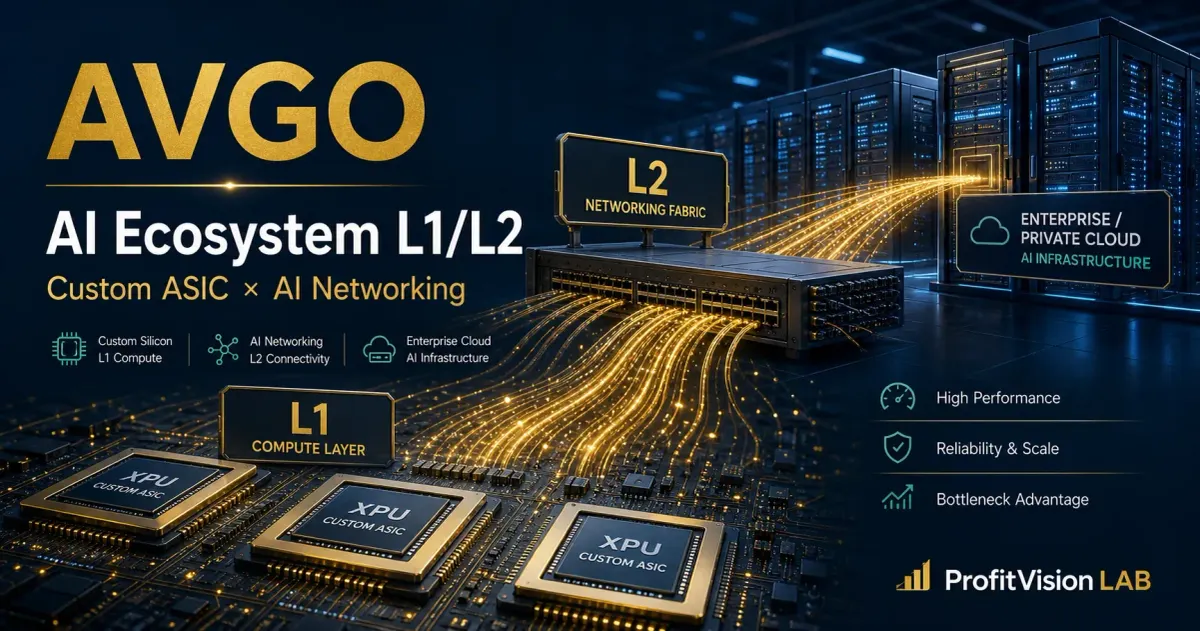
Not a GPU challenger, but the hidden tollgate inside AI infrastructure: custom ASIC, AI Ethernet, and VMware cash flow.
- Broadcom's moat is not a single chip. It is the combination of custom AI ASIC × AI networking × VMware infrastructure software cash flow, tied together by one capital allocation operating system.
- In the AI seven-layer architecture, AVGO sits at the L1/L2 intersection: L1 custom AI ASIC/XPU for hyperscaler self-designed accelerators, and L2 Ethernet/networking fabric for AI clusters.
- The central question is not merely whether AI revenue grows. The better question is whether AVGO has been written into hyperscalers' three-to-five-year data center roadmaps.
- This note uses the Conglomerate Resilience Framework only as an auxiliary lens. The series positioning is AI Ecosystem Research: L1/L2 infrastructure.
This framework is used here as an analytical tool, not as the series label. Some companies no longer fit cleanly into one industry bucket: they may behave like a platform company, a holding company, a semiconductor company, a software company, and a capital allocation machine at the same time.
The framework asks three questions: What is the glue? Can it be transplanted? Does it survive without the key person? Without glue, complexity becomes a conglomerate discount. With strong, transferable, succession-resistant glue, complexity can become a moat.
For AVGO, the primary series identity remains AI Ecosystem L1/L2 Deep Research. The auxiliary framework simply helps us understand why VMware, custom silicon, AI networking, and Hock Tan-style capital discipline can coexist inside one investment case.
Long-Term Holding Filter Snapshot
| Dimension | Latest Observation | Verdict |
|---|---|---|
| Revenue momentum | FY2026 Q1 revenue reached $19.31B, up 29% YoY; Q2 guidance points to roughly $22.0B, up 47% YoY. | Strong |
| AI acceleration | FY2026 Q1 AI semiconductor revenue was $8.4B, up 106% YoY; Q2 AI semiconductor revenue guidance is $10.7B. | Core engine |
| Cash flow quality | FY2025 free cash flow was $26.9B; FY2026 Q1 FCF was $8.01B, about 41% of revenue. | Elite |
| Structural risks | AI customer concentration, VMware customer backlash, post-acquisition debt, and geopolitical constraints. | Track closely |
| AI ecosystem role | L1 custom AI ASIC/XPU + L2 AI Ethernet and interconnect, with VMware as enterprise private cloud cash-flow ballast. | L1/L2 core |
Chapter 1: What Is AVGO? Not Nvidia, Not a Traditional Chip Stock
Investors often put Broadcom (AVGO) into the "AI semiconductor" basket and compare it directly with Nvidia. That comparison is half right and half wrong. It is right because AVGO is clearly benefiting from AI infrastructure demand. It is wrong because AVGO is not selling general-purpose GPUs. It is closer to an infrastructure engineering partner for hyperscalers building custom AI engines and network backbones.
Nvidia sells a general-purpose accelerated computing platform. AVGO sells customer-specific system capability: custom silicon for specific workloads, specific data center constraints, and specific hyperscaler roadmaps. Once a customer aligns custom accelerators, switching silicon, high-speed I/O, software stacks, and data center expansion plans with Broadcom's roadmap, switching suppliers is no longer procurement. It is architecture redesign.
This is the first misunderstanding to clear up: AI infrastructure is not only about training large models on GPUs. A data center is a factory. Models need to be trained, data needs to move, accelerators need to synchronize, servers need to communicate through switching fabric, and racks need optical and network interconnect. If one part of that factory becomes a bottleneck, even the most powerful accelerator becomes underutilized capital.
AI Ecosystem Research asks: where does the company sit in the AI stack, and is that layer a temporary revenue burst or a multi-year infrastructure bottleneck?
Chapter 2: AI Seven-Layer Positioning: Is AVGO L1 or L2?
AVGO's most accurate positioning is the L1/L2 intersection. It is an L1 AI chip design partner through custom ASIC/XPU work with hyperscalers. It is also an L2 AI networking player through Ethernet switching, NICs, optical interconnect, and data center fabric.
This matters because AVGO is not just an AI chip company. If you place it only in L1, you understate Broadcom's role in AI Ethernet. If you place it only in L2, you miss the multi-generation custom ASIC roadmap embedded in hyperscaler design wins. The moat is the combination: compute silicon plus the fabric that lets compute scale.
| AI Layer | AVGO Role | Investment Meaning |
|---|---|---|
| L1 | AI Chip Design | Custom ASIC/XPU co-development for hyperscaler AI accelerators. | Benefits from cloud customers reducing dependence on one GPU supplier and optimizing performance per watt. |
| L2 | AI Networking | Tomahawk, Jericho, AI Ethernet, NICs, optical connectivity, high-speed I/O. | As clusters scale, the bottleneck shifts from single-chip performance to interconnect efficiency. |
| Enterprise Infrastructure Software | VMware private/hybrid cloud platform for mission-critical enterprise workloads. | Not a pure AI silicon layer, but a cash-flow base and enterprise AI deployment gateway. |
| Capital Allocation Layer | Hock Tan-style acquisition, integration, repricing, and FCF discipline. | Not a technical AI layer, but the management system that turns assets into compounding nodes. |
Chapter 3: The Three-Layer Empire: Custom ASIC, Networking Fabric, VMware Cash Flow
AVGO's three layers are different from Microsoft's Azure/M365/GitHub empire. AVGO's stack is closer to the physical and infrastructure layer of AI data centers:
AVGO's AI semiconductor business is not a retail product line. It is deep co-development with large cloud customers. Customers bring workloads, model requirements, and data center constraints; Broadcom brings high-speed I/O, packaging, networking, and ASIC design capability.
The hard part is not drawing a chip. The hard part is aligning the chip with a customer's future model architecture, power envelope, cooling plan, network topology, and supply chain cadence. Once that moves into production and multi-generation iteration, switching cost becomes architecture-level.
FY2026 Q1 AI semiconductor revenue: $8.4B+106% YoYQ2 guide: $10.7B
As models scale, the problem is no longer just how many GPUs or XPUs a customer owns. The question becomes whether those accelerators can communicate with enough bandwidth and low enough latency. Broadcom's switching, NIC, optical, and PCIe portfolio places it inside the vascular system of AI clusters.
Networking is less glamorous than GPUs, but for hyperscalers it is not secondary. At massive cluster scale, latency, packet loss, energy efficiency, and bandwidth per watt become economic variables.
Tomahawk 6Jericho4Co-packaged OpticsScale-up Ethernet
The VMware acquisition triggered significant customer dissatisfaction around licensing changes, price increases, and channel restructuring. But from AVGO's perspective, VMware is a classic Hock Tan asset: mission-critical, high-switching-cost, sticky, and capable of being converted into a higher-cash-flow subscription model.
VMware's value is not that it is trendy. Its value is that it is deeply embedded in old enterprise IT. Banks, governments, telecoms, healthcare systems, and large industrial companies do not move mission-critical workloads overnight just because public cloud is fashionable.
Private / Hybrid CloudVCFMission-critical enterprise workloads
Chapter 4: Glue Diagnostics: Is Hock Tan the Moat or the Single Point of Risk?
Hock Tan is central to the AVGO story. He is not the kind of CEO who sells a grand stage narrative every week. He behaves more like a capital market engineer: acquire, integrate, remove noise, increase return on capital, return cash to shareholders, then wait for the next deployment opportunity.
This operating style is unusual in semiconductors. Many chip companies emphasize R&D breadth, product coverage, process competition, and cycle management. Hock Tan asks a different set of questions: which markets are mission-critical, which products can sustain high margins, which customers are willing to pay for reliability, and which activities consume capital without adequate return?
| Hock Tan Pattern | Management Meaning | Moat Impact |
|---|---|---|
| Large acquisitions | Buy proven mission-critical assets instead of speculative early-stage bets. | Purchase external moats, then improve returns through integration. |
| High-value customer focus | Serve the customers most willing to pay and least able to switch. | Raises ARPU and renewal value, but increases customer backlash risk. |
| Cost and focus discipline | Cut activities that do not support core products or strategic customers. | Improves FCF conversion, but can reduce long-tail innovation. |
| Shareholder returns | Dividend growth, buybacks, and M&A are all part of the capital allocation system. | Creates market trust in the discipline, reducing random-acquisition discount. |
The key framework risk
Can AVGO's glue be transplanted? Partly. Financial hurdle rates, acquisition processes, and operating KPIs can be institutionalized. But judgments such as what asset is worth buying, how far to cut, and which customers can absorb repricing still carry CEO-style risk. This is why AVGO's succession resilience is lower than Microsoft's.
Chapter 5: AI Embedding Depth: AVGO Owns Physical-Layer Bottlenecks
AVGO's AI story is different from AI software companies. It does not own the end user, the model interface, or the enterprise knowledge graph. It owns lower-level components: custom accelerators, switching chips, network I/O, optical connectivity, and the architecture required to scale AI data centers.
That moat is not romantic, but it is real. When AI companies and cloud giants spend tens of billions of dollars on data center CAPEX, the actual constraints are power, cooling, packaging, interconnect, bandwidth, latency, and supply chain execution. Broadcom sits at the intersection of those constraints.
AVGO's three AI lock-ins
The keyword is roadmap, not order. Orders fluctuate by quarter and projects can slip. A roadmap means the customer is building future architecture assumptions around Broadcom's capability. When a supplier moves from component vendor to co-design partner, its bargaining position changes.
| AI Layer | AVGO Role | Moat Source | Primary Risk |
|---|---|---|---|
| Custom XPU / ASIC | Co-develop custom accelerators | Deep engineering collaboration and customer roadmap embedding | Customer concentration and project timing |
| AI Ethernet | Switching chips and scale-up / scale-out interconnect | Bandwidth, latency, power efficiency, and open Ethernet adoption | Proprietary interconnect alternatives |
| Optical / I/O | Optical connectivity, PCIe, NICs | Data center bottleneck shifts from compute to interconnect | Supply chain and yield pressure |
| VMware Private AI | Private/hybrid cloud enterprise base | Existing workloads, compliance, data sovereignty | Customer backlash over pricing and licensing |
Chapter 6: VMware: Addition or Poison Pill?
VMware is the most controversial piece of the AVGO puzzle. Customer communities have voiced real dissatisfaction with licensing changes, price adjustments, and partner program restructuring. This cannot be dismissed. But investment research cannot stop at sentiment; it also has to examine asset nature.
VMware serves a large base of mission-critical enterprise workloads, especially in government, finance, telecom, healthcare, and large industrial environments. Switching costs are high because migration requires testing, process redesign, staff retraining, downtime risk, and compliance review.
The best VMware outcome is not that customers never complain. The best outcome is that complaints exist, churn remains controlled, and renewed contracts become higher-quality cash flow. The worst outcome is that Broadcom reprices too aggressively and causes customers to systematically plan replacement paths.
Three positive values of VMware
- Cash-flow base: Software revenue can smooth semiconductor cyclicality.
- Private cloud entry point: Not all AI workloads will run in public cloud, especially in regulated industries.
- Capital allocation template: VMware is AVGO's largest Hock Tan repricing and integration experiment.
Three negative risks of VMware
- Customer churn: If repricing exceeds switching-cost protection, long-term churn can bite back.
- Brand damage: Developer, partner, and IT community frustration can weaken ecosystem innovation.
- Regulatory / contract pressure: Large enterprise and government customers can push back against licensing policy.
Chapter 7: Why DCF Can Underestimate AVGO
DCF is not useless, but it is easy to misuse here. AVGO's value is not simply FY2026 revenue growth extrapolated forward and discounted back. It has three different value buckets: visible semiconductor and software cash flow, multi-generation custom ASIC design-win optionality, and future capital allocation redeployment.
A standard DCF is best at stable companies with clean boundaries. AVGO's boundaries keep changing. Today's FCF comes from semiconductors, VMware, and past acquisition integration. Tomorrow's growth may come from AI ASIC ramp, Ethernet AI networking adoption, or another major infrastructure software acquisition.
| Value Source | How DCF Underestimates It | Better Lens |
|---|---|---|
| Visible cash flow | Over-cyclicizes semiconductors and underweights VMware software cash flow. | Separate semiconductor cyclicality from software renewal cash flow. |
| AI custom ASIC | Treats growth linearly and misses multi-generation co-design roadmaps. | Use option value for hyperscaler design wins. |
| Capital allocation ability | Treats M&A as occasional risk rather than repeatable operating model. | Assess whether the Hock Tan playbook can repeat on the next asset. |
Scenario Thinking
| Scenario | Core Assumption | Investment Meaning |
|---|---|---|
| Bull | AI ASIC and Ethernet demand continue to surprise; Meta-type customers ramp multi-generation programs; VMware churn stays below market fear. | AVGO becomes an AI infrastructure compounder and earns a higher FCF premium. |
| Base | AI growth remains strong but normalizes; VMware cash flow improves while customer friction persists; shareholder returns stay disciplined. | Valuation needs pullbacks. Suitable for staged entry and options strategy monitoring. |
| Bear | AI project timing slips, customer concentration bites, VMware churn rises, and high-multiple AI names de-rate. | Stock can face a double hit: growth narrative cools and software integration risk reprices. |
Chapter 8: Risk List: Success Creates Concentration
AVGO's risk is not the absence of growth. It is the concentration created by success. When AI semiconductor revenue surges, the market naturally assigns a higher multiple. But if that revenue is tied to a small number of hyperscaler projects, any delay, design shift, budget change, or self-silicon strategy change can amplify volatility.
Customer concentration is a double-edged sword. A few large customers allow deep co-development, engineering stickiness, and roadmap visibility. But those same customers also concentrate bargaining power on the buyer side. When customer CAPEX expands, AVGO scales with leverage. When customer timing changes, valuation can compress with the same leverage.
| Risk | Tracking Signal | Warning Sign |
|---|---|---|
| AI customer concentration | AI semiconductor growth, design-win count, customer disclosures | Revenue grows fast but customer count does not broaden. |
| VMware backlash | Infrastructure software growth, renewal rate, churn commentary | ARPU rises short-term while renewal base shrinks. |
| Capital allocation succession | Hock Tan succession plan, CFO/BU leadership stability | Next management team fails to maintain post-acquisition discipline. |
| Geopolitics | Export controls, advanced-node supply, China and Asian supply-chain exposure | AI semiconductor shipment or design service restrictions. |
| Valuation compression | P/FCF, EV/EBITDA, AI peer multiples | FCF remains strong, but the multiple had already priced in years of good news. |
Conclusion: AVGO's Real Place in the AI Ecosystem
AVGO's most important position in the AI seven-layer architecture is the L1/L2 intersection: custom AI ASIC plus AI networking. It is not a consumer-facing AI app, and it is not a pure software agent play. It sits inside the hard infrastructure buildout that makes AI scaling possible.
The investment case is strongest when three things are true at the same time: custom ASIC programs become multi-generation roadmaps, AI Ethernet becomes a scaling bottleneck, and VMware cash flow remains durable enough to fund capital allocation. The case weakens if growth stays too concentrated, VMware churn accelerates, or Hock Tan's discipline fails to survive succession.
GEO Quick Answer: Where Does AVGO Sit in the AI Ecosystem?
Further Reading and Sources
- Further reading: TSM AI Ecosystem Research Project
- Further reading: The Four Lies of the AI War
- Further reading: Microsoft (MSFT) Deep Research: auxiliary complex-enterprise analysis reference
- Broadcom FY2026 Q1 results: revenue, AI semiconductor revenue, EBITDA, FCF and Q2 guidance.
- Broadcom FY2025 Q4 and fiscal-year results: adjusted EBITDA, free cash flow and dividend increase.
- Broadcom VMware acquisition completion release and VMware Cloud Foundation strategy.
- Broadcom and Meta multi-year MTIA custom silicon partnership release.
- Broadcom 2025 OCP AI networking solutions release.
Comments ()