TSMC (TSM): Physical Monopolist of the AI Era
TSMC is the only physical chokepoint of the AI era — over 90% of advanced AI chips pass through its fabs. Q1 2026: record 66.2% gross margin, HPC at 61% of revenue, $52–56B capex locking in the N2/A16 and CoWoS moat. Geopolitics remains the only tail risk worth respecting.
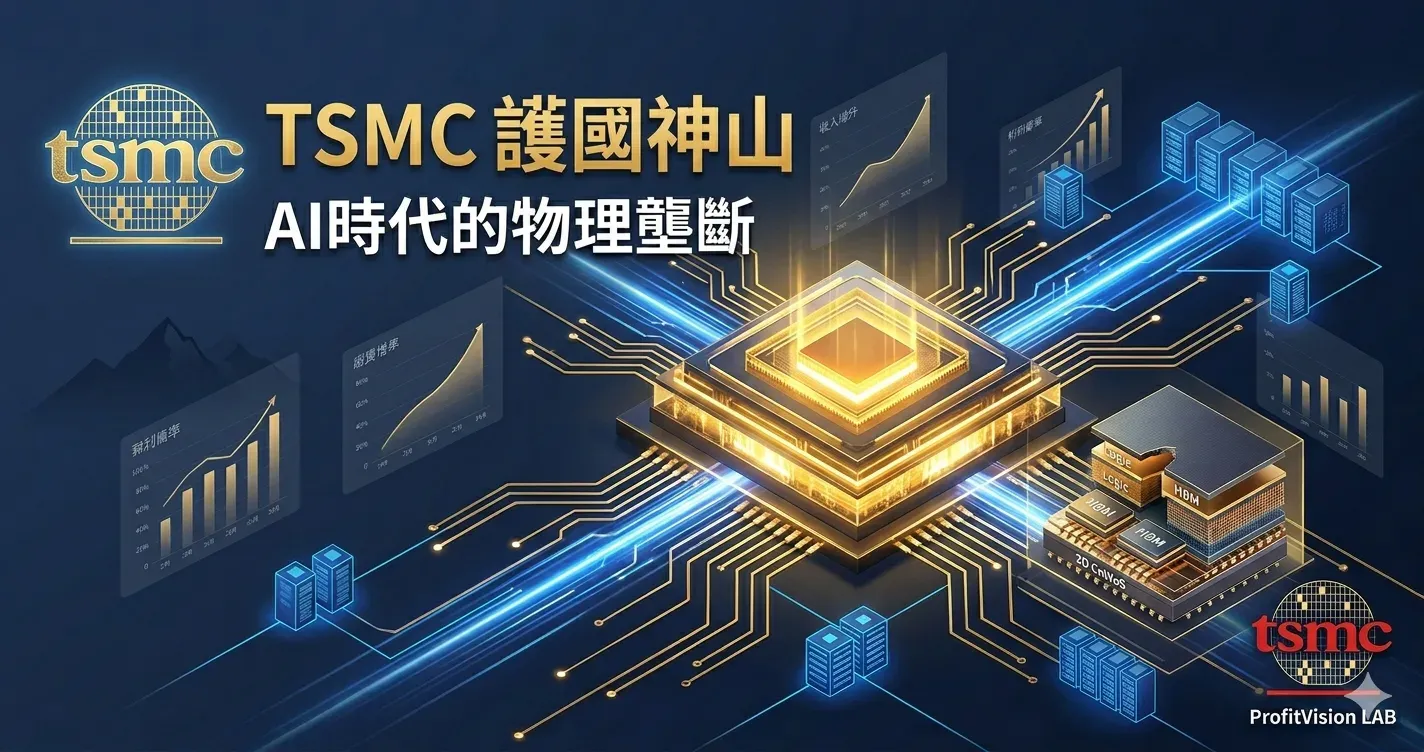
TSMC is the AI era's only physical chokepoint: regardless of brand, over 90% of advanced AI chips must pass through its fabs. Q1 2026's 66.2% gross margin blew past the high end of guidance, and the HPC platform surged to 61% of revenue — the AI capex cycle isn't cooling, it's concentrating. With a record $52–56B capex earmarked for N2/A16 and CoWoS advanced packaging, TSMC is widening its technology moat faster than Samsung Foundry or Intel Foundry can close the gap. The only real risk is geopolitics — but even then, no alternative can replicate its function within a five-year horizon.
Chapter 1|Industry Map: Where Does TSMC Sit?
This chapter answers one question: what role does TSMC play in the AI semiconductor value chain, and why would the entire chain break without it?
The simplest way to think about semiconductors is the separation between design and manufacturing. TSMC invented the "pure-play foundry" model in 1987 — focus exclusively on manufacturing, design nothing, and let NVIDIA, AMD, Apple and others hand over their chip designs for production. This division of labor multiplied the pace of innovation across the entire industry: fabless designers focused on architecture, while TSMC focused on process shrink.
Four decades later, the result is striking: TSMC controls over 70% of the world's leading-edge chip manufacturing, and that share is still expanding under the AI wave.
TSMC's position is unique: it is the physical core of the entire chain. No matter how advanced the upstream equipment or how elegant the downstream design, the act of actually etching transistors onto silicon is something only TSMC does at the leading edge.
Market Size & Growth Drivers
The global semiconductor foundry market hit a record $320B in 2025, up 16% YoY. TSMC's share of the pure-play foundry segment sits at 70%+ and continues to expand under AI demand. The engine behind this growth is simple: every new generation of AI GPU or custom ASIC demands a more advanced process node and more complex advanced packaging (CoWoS) — and TSMC holds a near-monopoly in both.
Chapter 2|Business Model & Moat: Why Can't Anyone Replace It?
The essence of a moat is a single question: how much time and capital would it take a competitor to replicate you? Measured against TSMC, the honest answer is probably never.
Revenue Breakdown (Q1 2026)
By process node (share of wafer revenue):
Advanced nodes (7nm and below) contributed 74% of wafer revenue in Q1 2026.
By end platform (share of total revenue):
HPC now exceeds 60% of revenue. NVIDIA alone is estimated to contribute 22–25% of TSMC's total.
Moat Analysis
| Moat Type | TSMC's Expression | Strength |
|---|---|---|
| Scale Economies | $52–56B annual capex — far above Samsung Foundry and Intel Foundry combined; unit costs decline with scale | 🟢 Very Strong |
| Technology Lead | N2/A16 in production; Samsung's 2nm yield still off-target; Intel 18A at least 2–3 years behind | 🟢 Very Strong |
| Switching Costs | PDK (Process Design Kit) lock-in — switching foundries means redesigning the chip; takes 2–3 years | 🟢 Very Strong |
| Network Effects | Most customers → most design tape-outs → fastest yield improvement → more customers choose TSMC | 🟡 Moderate-Strong |
| Pricing Power | Announced 5–10% price hike across sub-5nm in early 2026 — customers couldn't refuse | 🟢 Very Strong |
Morningstar assigns TSMC a Wide Moat rating. The core insight is this: process technology is a function of accumulated time and engineering experience — it cannot be bought with money alone. Samsung and Intel's yield issues at the leading edge aren't about capital; they're about tacit knowledge that takes decades to build.
Scenarios Where the Moat Could Erode
1. Technology Plateau: If transistor scaling hits physical limits and the battleground shifts entirely to advanced packaging, the yield gap narrows and competitors get a shot at reclaiming customers. Low probability today, but the post-A16 era carries uncertainty.
2. Forced Geopolitical Diversification: If Taiwan Strait tensions escalate, US/EU/Japan governments could mandate supply chain diversification — structurally diluting TSMC's share. The Arizona fab is a hedge, but costs run 20–30% higher than Taiwan.
3. Custom Silicon Growth: Hyperscalers designing more in-house ASICs shifts the customer mix, not the demand pool — limited impact on TSMC.
Chapter 3|Competitive Landscape: Who's the Real Threat?
Is there anyone in the foundry market who can actually threaten TSMC? Short-term, no. Medium-term, conditionally yes. Long-term, structural risk exists — but most of it is overstated today.
| Metric | TSMC (TSM) | Samsung Foundry | Intel Foundry (IFS) | SMIC |
|---|---|---|---|---|
| Leading Node | N2 (in production), A16 (H2 2026) | 3nm (HVM), 2nm (dev) | 18A (in development) | 7nm (low volume) |
| Yield | Best-in-class | 3nm yield issues persist | 18A not ready until 2027 | Export-control limited |
| Pure-Play Share | ~70%+ | ~10–12% | ~6% (incl. IDM) | ~5% (mature nodes) |
| 2026 Capex | $52–56B (record) | ~$18–20B | Being cut | Constrained by export rules |
| Real Threat? | — | Limited, 3–5 yrs out | Not at this time | Blocked by controls |
"We see AI demand for semiconductors as real and sustained — we don't see any sign of it slowing. Our process technology leadership gives customers the confidence to trust us with their most critical designs." — C.C. Wei, Chairman & CEO, TSMC, Q1 2026 Earnings Call
Chapter 4|Financial Resilience: Q1 2026 Blowout, Beats Across the Board
TSMC's Q1 2026 report is the strongest quarter in recent memory. The 66.2% gross margin didn't just beat the high end of guidance — it set an all-time record.
Historical Financial Trends
| Metric | 2022 | 2023 | 2024 | 2025 | 2026 Q1 | 2026 Q2 (E) |
|---|---|---|---|---|---|---|
| Revenue | $73.6B | $70.6B | $88.3B | $122.3B | $35.9B | $39.0–40.2B |
| YoY Growth | +33% | -4.2% | +25% | +38.5% | +40.6% | ~+32% |
| Gross Margin | 59.6% | 54.4% | 56.1% | 59.9% | 66.2% | 65.5–67.5% |
| Operating Margin | 49.5% | 42.6% | 45.7% | 51.2% | 58.1% | 56.5–58.5% |
| Net Margin | 39.7% | 36.1% | 38.1% | 40.8% | 50.5% | — |
| Capex | $36.3B | $32.1B | $30.0B | $40.9B | $52–56B (full-year guidance) | |
Where the 2026 Capex ($52–56B) Is Going
| Capex Use | Strategic Significance |
|---|---|
| N2 ramp (Taiwan) | Battleground for NVIDIA and Apple's next-gen chips; N2P in parallel development |
| A16 (GAA + backside power delivery) | HVM in H2 2026; generational performance leap; first node combining two revolutionary technologies |
| Arizona Fab 21 buildout | Phase 2 tool install (2026); Phase 3 under construction; Phase 4 permitting |
| CoWoS / advanced packaging expansion | AI chip packaging demand exploding — CoWoS is the current supply bottleneck |
Chapter 5|Valuation & Scenarios: Which Script Is the Market Pricing?
I don't forecast price targets. Instead, I run three scenarios and let you decide which script the current price is pricing.
Current Valuation Benchmarks
| Metric | Current (Apr 16, 2026) | Historical Avg | Interpretation |
|---|---|---|---|
| Trailing P/E | ~35–36x | ~20–25x | 58% EPS growth justifies premium |
| Forward P/E | ~21–22x | ~15–20x | On 2026E EPS, premium compresses |
| Analyst Consensus | Buy (50 analysts) | — | Strong Buy 43% / Buy 43% / Hold 14% |
| 12-Mo Median PT (ADR) | $355 | — | Implied 23%+ upside |
Three Scenarios
Assumptions: AI capex accelerates; N2 yield beats expectations; no major geopolitical event; CoWoS ramps at full speed
Financials: 2026 revenue $155B+; gross margin 65–67%; Forward P/E expands to 25–28x
ADR Implication: Upside toward $400–420; not yet fully priced in
Assumptions: AI demand steady; N2 yield ramps on plan; Section 232 tariff impact limited
Financials: 2026 revenue $148–155B (+30%); gross margin 63–66%; Forward P/E 22–24x
ADR Implication: Fair range $330–370; analyst target $355 near midpoint
Assumptions: AI capex clearly slows; geopolitical tensions escalate; N2 yield disappoints
Financials: 2026 revenue $135–142B; gross margin 60–62%; Forward P/E compresses to 17–20x
ADR Implication: Pullback to $220–260; 15–25% downside from here
Chapter 6|Conclusion & Tactical Positioning
Core view (one sentence): TSMC is the most certain physical monopolist of the AI era, its moat is widening faster, and Q1 2026 is the strongest fundamental confirmation yet — the question isn't whether to research it, but when and how to enter.
Three Reasons for the Bull Case
① HPC at 61%, still accelerating: A 20% QoQ jump in the HPC platform isn't a short-term anomaly — it's confirmation of structural mix shift. Hyperscalers are racing to build out compute, and TSMC is the only fab capable of manufacturing the most advanced AI chips.
② 66.2% gross margin breaks the ceiling: Pricing power (the 5–10% hike) and cost control are more than enough to offset N2 ramp pressure. The long-term gross margin target has been revised upward from "56%+."
③ $52–56B capex = moat locked for the next 3 years: N2, A16, and CoWoS leadership are being cemented by record capex. The returns will land through 2027–2028.
Three Reasons for the Bear Case
① Geopolitics is a tail risk no valuation model can quantify: Any flare-up around Taiwan can compress the multiple instantly, regardless of fundamentals.
② Section 232 tariff uncertainty is unresolved: On the call, C.C. Wei noted active engagement with US officials, but policy risk can't be ruled out and may influence customer order patterns.
③ AI capex cycles turn fast once they pause: No signs of slowdown today, but any hyperscaler cutting capex guidance would hit TSMC's visibility immediately.
🏔️ Long-Term Investor View: Buying the "Sacred Mountain," Not Just a Stock
TSMC is a pillar of Taiwan's GDP and the country's irreplaceable node on the global technology map. In recent years, "buying the Sacred Mountain" has become more than an investment in Taiwan — it's a cultural identity. Some retail investors buy one share every single day, accumulating a target share count before a life milestone; others buy a fixed amount every month, treating it as a form of long-term savings with more meaning than a bank deposit.
Behind this behavior is a simple but powerful logic: if you believe the AI era will keep advancing, TSMC is how you participate — without having to watch the tape daily, without having to guess the market's next move.
Why TSMC Works as a Long-Term Holding
Dollar-Cost Averaging (DCA) Strategy
For long-term investors, how you buy matters more than how much you buy. TSMC's share price is short-term sensitive to geopolitics and sentiment, but long-term it tracks EPS growth. Here's a clear-headed DCA framework:
| Element | Recommendation | Rationale |
|---|---|---|
| Buying Cadence | A fixed date each month (e.g., the 1st) | Removes the "wait for a lower price" mental trap; averages the entry cost |
| When to Add | Irrational selloffs driven by geopolitical panic (10–15%+ drawdowns) | Fundamentals unchanged — Mr. Market offers a discount; add rationally |
| When to Reduce | Clear reversal of the AI capex cycle (hyperscalers slashing guidance); two consecutive quarters of EPS down 20%+ YoY | Reduce on broken fundamentals — not on a falling price |
| Holding Mindset | Review earnings quarterly; ignore the daily tape | TSMC is a "hold the business model" position, not a price trade |
| Position Cap | Given the geopolitical concentration risk, keep it under 20–25% of the portfolio | No matter how sacred the mountain, don't put all your eggs in one basket |
Metrics Long-Term Holders Should Watch
| Metric | Positive Signal | Warning Signal |
|---|---|---|
| HPC Platform Share | Sustained above 55%, QoQ growth positive | Two consecutive quarters under 45% |
| Gross Margin | Holds above 60% | Breaks below 55% (severe N2 yield issue) |
| Annual Capex Guide | Flat or increasing (management confidence in demand) | Material downward revision (visibility deteriorating) |
| Hyperscaler Capex Total | Google/AWS/Microsoft/Meta combined +20%+ YoY | Any one announces a significant cut |
| Geopolitical Indicators | Stable US-Taiwan relations, Arizona fab progressing | Rising military tensions in the Strait, expanding export controls |
⚙️ Options Tactics (Advanced Investors)
The framework below applies once the name passes the filter screen. Current verdict: Active Watch — not triggered yet.
| Element | Notes |
|---|---|
| Strategy | Bull Put Spread (bullish premium collection with defined risk) |
| Timing | After A/D Rating improves to B+ and post-earnings IV drops back near 30% |
| Strike Logic | Short put 10–12% below spot (near Bear Case support); long put 5% further down (defined risk) |
| Expiration | 45–60 DTE, avoiding the next earnings date (mid-July for Q2). Current DTE 44 fits the window. |
| Liquidity | Open Interest 1.66M — ample liquidity; use limit orders |
| Downgrade Triggers | A/D Rating falls below C (automatic reject); Taiwan Strait event; hyperscaler capex guidance cut |
| Filter | Metric | TSM Reading | Verdict |
|---|---|---|---|
| ① Flow & Ownership | PV Institutional Buying Strength | 44 (large-cap ADV waiver applied) | ✓ PASS |
| PV Relative Strength | 93 (threshold ≥ 80) | ✓ PASS | |
| ② Moat | PV Earnings Quality Score | B (80) | ROE, EPS growth and FCF quality all clear thresholds | ✓ PASS |
| ③ Volatility | IV Rank | 42.3% (above 30% threshold) | ✓ PASS |
| ④ Technicals | Price vs 50MA / Support | Price holds above the 50-day MA; short-put strike can be tucked below prior swing support. | ✓ PASS |
📋 Tracking Log
| Date | Event | Verdict | Outcome |
|---|---|---|---|
| 2026/04/16 | Initial research published (incl. Q1 2026 earnings + MarketSurge data) | ⏸️ Active Watch | — |
Next scheduled update: After Q2 2026 earnings (mid-July 2026)
Early-update triggers: A/D Rating improves to B+ (upgrade to Pass); Taiwan Strait event; hyperscaler capex cut of 15%+
Teaching you how to think, not just what to do.
Data sources: TSMC official earnings (Q1 2026), MarketSurge (A/D Rating C, RS Rating 93, IV 43%, DTE 44, OI 1.66M), Investing.com earnings call transcript, TrendForce, Tom's Hardware, CNBC.