
Moody's (MCO): The Tollbooth of Global Capital
Moody's dropped 19% from peak — yet 2025 was a record year: $6.6T in debt rated. Is the moat cracking, or is the market mislabeling a macro headwind as permanent damage? Five-layer moat, three bear-case stress tests, full financials, scenario valuation.
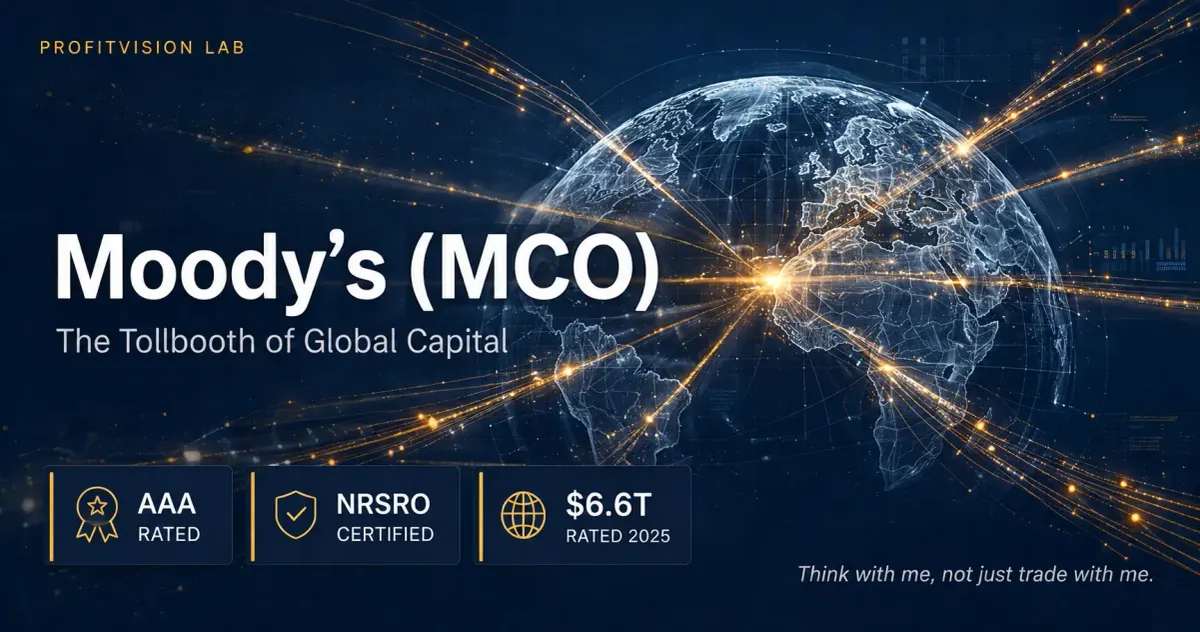
Moody's (MCO): The Tollbooth of Global Capital
Moody's dominant position in credit ratings is protected by five structural moats — regulatory certification, liability anchoring, network effects, data compounding, and oligopoly pricing. The recent ~19% pullback does not reflect moat impairment. It reflects the market over-pricing short-term interest rate headwinds as a permanent earnings risk. The business is doing fine. The stock is on sale.
I. Industry Map — What Business is Moody's Really In?
Most people think Moody's is a "rating agency." That's like saying the NYSE is a "stock printer." The more precise framing: Moody's is a legally mandated gatekeeper for global capital markets.
When a corporation wants to issue bonds, when a government wants to borrow, when a bank needs to calculate its capital requirements under Basel III — all roads lead to a Nationally Recognized Statistical Rating Organization (NRSRO). In the US, only 10 such organizations exist. Moody's and S&P together control roughly 80% of the market.
This isn't a business that wins because it's the best. It wins because regulators and contracts require its output. That's a different animal entirely.
The business has two segments:
- Moody's Investors Service (MIS) — the legacy ratings business. Transactional, cyclical, tied to issuance volumes. When debt markets freeze, revenue drops.
- Moody's Analytics (MA) — subscription data, risk models, KYC tools, ESG research. Recurring revenue, growing ~10% per year, structurally immune to issuance cycles.
The genius of MCO's current structure: MIS gives you the moat; MA gives you the growth engine. Together, they create a business that is both deeply defensive and quietly compounding.
II. The Five-Layer Moat — Why No One Can Replicate This
Congress and the SEC have written Moody's ratings into law. Insurance investment guidelines, bank capital ratios, money market fund mandates — all reference NRSRO ratings by name. To displace Moody's, you would need to rewrite financial regulation across dozens of jurisdictions. Timeline: a decade minimum.
Institutional investors don't just want accurate credit analysis. They need analysis from an entity that can be held legally accountable. Moody's bears legal and reputational liability when it's wrong. An AI tool, in current legal frameworks, cannot. This is a structural moat that technology alone cannot erode.
The more bonds Moody's has rated over 100+ years, the richer its historical default database becomes. This data advantage compounds over time — more rated issuers, more observed defaults, better models. New entrants face a cold-start problem that money cannot simply solve.
Moody's Analytics customers embed MA risk models into their workflows — credit underwriting, regulatory reporting, stress testing. Switching costs are enormous. Customer retention runs 90%+. The longer a client uses MA, the deeper the integration, the higher the switching cost.
With two players controlling 80% of the market, and regulatory requirements ensuring demand, MCO has exceptional pricing power. Over the past decade, MIS fee increases have consistently outpaced inflation. Issuers have nowhere else to go.
III. Financial Dashboard — The Numbers Behind the Narrative
| Metric | FY2023 | FY2024 | 2026E Guidance |
|---|---|---|---|
| Total Revenue | $5.9B | $7.1B | $7.6–7.8B |
| MIS Revenue | $3.4B | $4.4B | ~$4.6B |
| MA Revenue | $2.5B | $2.7B | ~$3.0B |
| Adjusted EPS | $10.67 | $13.66 | $14.00–14.50 |
| Free Cash Flow | $1.8B | $2.3B | >$2.5B est. |
| Operating Margin | 43% | 47% | ~47% guided |
From Q4 2025 Earnings Call: "2025 was a record year for Moody's. We rated $6.6 trillion in debt, including large-scale financings from Alphabet, Amazon, and Meta. The AI investment cycle is not reducing demand for credit ratings — it is directly increasing it."
IV. Why Did the Stock Drop 19%? A Forensic Breakdown
The market sold MCO down from ~$547 to ~$443 in roughly six months. Understanding why is the key to deciding whether this is an opportunity or a warning.
- High interest rate environment suppressed debt issuance volumes in 2023–2024
- M&A deal flow paused in rate uncertainty — temporarily reduced structured finance ratings
- Both headwinds reverse as rates normalize — already showing in 2025 record volume
- AI disruption fears: overstated on a 1–5 year horizon given regulatory framework
- Regulatory risk from SEC: been discussed for years, no structural change materialized
- PE multiple compression in "quality compounder" names across the board
- Private credit growth (direct lending) bypasses public bond markets — reduces some MIS addressable market
- Some large investment-grade issuers negotiating rating fees more aggressively
- Not existential, but worth monitoring over a 5+ year horizon
- Revenue cyclicality: when credit markets freeze, MIS revenue can drop meaningfully (2022 was a reminder)
- Litigation tail risk: post-2008 settlement precedent creates ongoing legal exposure
- Both risks are known and priced into MCO's historical PE band
V. Three Hardest Questions — Bear Case, Answered Honestly
These are the three most lethal arguments against owning MCO. Each deserves a serious answer — including acknowledging where the bear case has legitimate merit.
Bank capital adequacy calculations, mutual fund investment restrictions, insurance company investment mandates — these legal frameworks explicitly reference "NRSRO-recognized ratings" by name. Even if an AI delivers faster, more accurate credit analysis, it carries no legal standing under current regulatory frameworks. Changing this requires coordinated regulatory reform across multiple jurisdictions. Timeline: 10+ years minimum.
Institutional investors don't just need accurate analysis. They need analysis from an entity that bears legal and reputational liability when wrong. Moody's faces lawsuits, settlements, reputational consequences. Current AI tools cannot assume equivalent legal accountability — this is a matter of legal personhood, not model quality.
2025 ratings volume: $6.6T — an all-time record. AI companies (Alphabet, Amazon, Meta) are themselves massive bond issuers, their own financing creates credit rating demand. MA customers adopting MCO's GenAI tools show 97% retention and grow 2× faster than non-adopters. AI is deepening the moat, not eroding it.
Private credit is growing fast, but it's still a fraction of total credit markets. Investment-grade and high-yield public bonds remain the primary mechanism for large-scale corporate and sovereign financing. The Fortune 500, sovereign governments, supranationals — none of them fund themselves through private credit. MCO's core market remains intact.
Moody's Analytics provides credit models, risk data, and analytics to private credit funds. As private credit grows, it creates more demand for MA's analytical infrastructure. MCO is positioned on both sides of the trade.
Ten years ago, MCO was a pure-play cyclical ratings company. Today, MA constitutes ~38% of revenue, is growing at 10%+ annually, carries 90%+ retention, and is priced like a SaaS business — because it largely is one. The blended multiple reflects a fundamentally different business than the market perceives when it hears "credit rating agency."
At the current price, MCO trades at roughly 33–35× forward earnings — still premium, but meaningfully below its peak multiple. A lot of cyclical risk is already in the stock. The question is whether you're paying a fair price for a best-in-class compounder.
VI. Forward Outlook — 2026 and Beyond
Three Catalysts Worth Watching
- Rate environment normalization: Every 25bps the Fed cuts tends to unlock M&A activity and investment-grade refinancing. More deals = more ratings = MIS revenue recovery. The 2025 record volume is a preview of what rate normalization unlocks.
- MA ARR acceleration: If Moody's can sustain 10%+ MA growth into 2027, the stock's blended multiple will continue to compress relative to intrinsic value. Watch MA ARR per customer as the key metric.
- GenAI within MA: MCO is embedding AI capabilities into its analytics products — credit copilots, automated regulatory reporting tools, AI-enhanced KYC workflows. Customers adopting GenAI tools churn 2× less. This is the engine of the next compounding cycle.
2026 Management Guidance
| Item | 2026 Guidance | Street Consensus |
|---|---|---|
| Revenue | $7.6B – $7.8B | $7.7B |
| Adjusted EPS | $14.00 – $14.50 | $14.20 |
| Operating Margin | ~47% | 46.8% |
| Free Cash Flow | >$2.5B | $2.6B |
| MIS Issuance Assumption | Mid-single-digit growth | In-line |
VII. Conclusion — The Four-Layer Defensive Screen Verdict
At ProfitVision LAB, every stock goes through a structured four-layer evaluation before any options strategy is deployed. Here's where MCO stands:
| Screen | Criterion | MCO Status | Result |
|---|---|---|---|
| Layer 1 · Institutional Flow | A/D Rating ≥ C+, RS ≥ 80 | RS ~78, recovering. A/D neutral. | Watch |
| Layer 2 · Moat Quality | ROE ≥ 17%, EPS growth > 25%, SMR A/B+ | ROE ~30%, EPS +28% YoY, SMR: A | Pass ✓ |
| Layer 3 · Volatility | IV Rank > 30% | IV Rank ~38% post-pullback | Pass ✓ |
| Layer 4 · Technical | Price above 50MA, support below strike | Testing 50MA. Needs confirmation. | Conditional |
Bottom Line
Moody's is a business that earns the right to exist through regulatory mandate, compounded over 100 years of accumulated data, defended by liability structures that technology alone cannot replicate. The current pullback reflects a macro panic being misread as a moat impairment. The moat is intact. The business printed a record year while the stock fell 19%.
For options sellers: the combination of elevated IV (IV Rank ~38%), a name trading below its intrinsic trend, and structural support zones below current price creates a setup worth monitoring for a Cash-Secured Put or Bull Put Spread entry — once technical confirmation is in place.
For long-term holders: MCO has compounded at ~15% annually for a decade. The thesis for the next decade is structurally sound. Entry at a discount to the trend is the gift the market occasionally offers on quality compounders.
Think with me, not just trade with me.
U.S. Equities · Options Selling · Deep Research · AI Investing
This article is for educational and research purposes only. It does not constitute investment advice or a solicitation to buy or sell any security. All investments involve risk. Past performance does not guarantee future results.
© 2026 ProfitVision LAB · Shiba the Disciplined · Think with me, not just trade with me.

Comments ()