PMCC Pro: You're Not Collecting Rent — You're Collecting Panic
Running PMCC on IBIT as a "stable rent trade" is the wrong framework. IBIT is a volatility vehicle — high IV is your edge, not your obstacle. Three core adjustments: defensive LEAP (Delta 0.80–0.90, 24 months), flexible Short Call (IV Rank-based), roll at 50% profit.
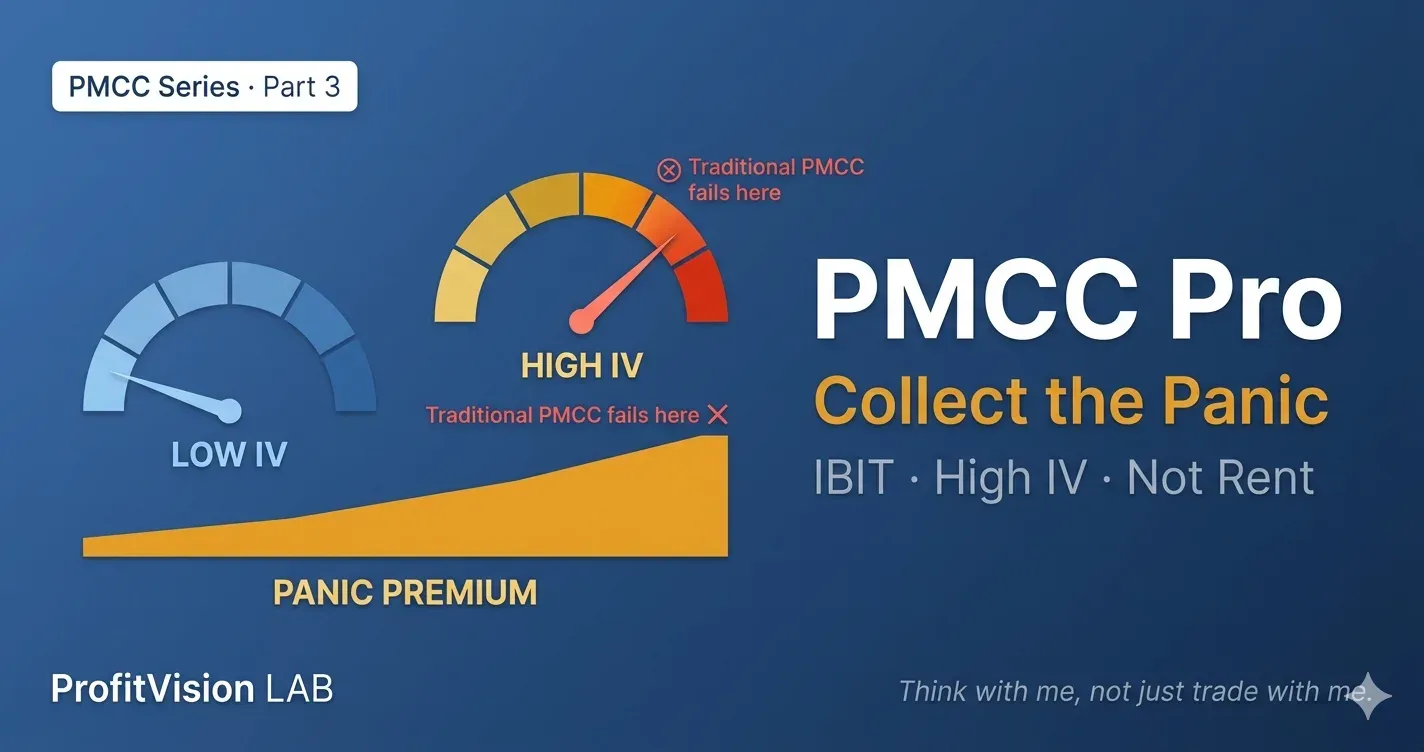
IBIT is a volatility vehicle at its core. Traditional PMCC thinking breaks down here — but traders who understand how to harness high IV can convert market panic into reliable cash flow.
Chapter 1: IBIT's True Nature — What Are You Actually Holding?
Before discussing mechanics, answer one question: What is IBIT?
On the surface, IBIT (iShares Bitcoin Trust ETF) is BlackRock's spot Bitcoin ETF, letting investors hold Bitcoin exposure through a brokerage account. But at its core, IBIT is a Volatility Vehicle — it tracks an asset with no dividends, no earnings, and no intrinsic value floor.
These characteristics determine one thing: applying the traditional PMCC "stable rent collection" framework to IBIT is dangerous.
Chapter 2: Two Failure Scenarios for Traditional PMCC
Standard PMCC logic works like this: the LEAP acts as a "low-cost stock substitute," and the Short Call generates monthly income. This works well on slow, fundamentally-anchored growth stocks like Apple or Microsoft. But IBIT's behavior is completely different.
Failure Scenario 1: Sharp Rally Locks You Out
you bore the LEAP's capital cost but captured almost none of the move
This is the most common complaint from traditional PMCC traders: "I got the direction right, but I didn't make money." The cause is a Short Call strike set too close to current price — a sharp rally simply runs over it.
Failure Scenario 2: Sharp Drop Damages the LEAP
the overall position shows a net loss
Many traders assume the Short Call provides meaningful downside protection. But under IBIT's extreme volatility, the monthly premium collected is very limited relative to the LEAP's potential drawdown. The LEAP position itself — its depth and its structure — is the real risk control.
Chapter 3: High IV Is Your Edge — The Panic Premium Mindset
IBIT's high IV is a double-edged sword: it makes LEAPs more expensive, but it also makes the Short Calls you sell worth significantly more. The key is making sure the blade cuts in your direction.
What IV Really Represents: The Market Pricing Uncertainty
When you sell a Short Call, the premium you collect has two components: Intrinsic Value and Time Value. Time Value is primarily driven by IV — the higher the market's expectations for future volatility, the more panic premium it's willing to pay.
Relatively lower premium
Significantly higher premium
For the same Delta and same DTE, the Short Call premium on IBIT can be 3–4× more than on MSFT. That difference is "panic premium" — market participants willing to pay a higher price to hedge against IBIT's uncertainty.
"Every Short Call you sell is converting the market's panic into deterministic cash flow in your account.
You're not collecting rent. You're collecting panic."
When Is Panic Premium Highest?
| Market Scenario | IV Rank Reference | Short Call Premium | Recommended Approach |
|---|---|---|---|
| Post-crash panic / sharp Bitcoin selloff | IV Rank > 60 | Significantly elevated | Ideal selling opportunity — can set Strike further OTM |
| Sideways consolidation, elevated uncertainty | IV Rank 40–60 | Moderately elevated | Normal operating cadence |
| Bitcoin in accelerating bull run | IV Rank < 30 | Depressed | Caution — use more conservative Strike or pause new positions |
No panic = no premium. No premium = PMCC isn't worth running.
Accept the volatility, harvest the panic — that's the correct posture for IBIT PMCC.
Chapter 4: The Three Core Adjustments — Defensive, Flexible, Roll Fast
With IBIT's nature and IV advantage understood, the next step is concrete operational changes. Traditional PMCC requires three core modifications to work on IBIT:
Adjustment 1: More Defensive LEAP
| Parameter | Traditional PMCC (Growth Stock) | IBIT Adjusted Version | Rationale |
|---|---|---|---|
| Expiration | 12–18 months | 18–24 months | More buffer time to absorb a sharp drop |
| Delta | 0.75–0.85 | 0.80–0.90 | Deeper ITM provides more stable hedge effectiveness |
| OTM-ness | Slight OTM | Deep ITM | Reduces time value erosion rate under high IV |
| Add/adjust trigger | Down 20–25% | Evaluate at down 15% | IBIT drawdowns can far exceed typical trigger thresholds |
Adjustment 2: More Flexible Short Call
| Parameter | Traditional Approach | IBIT Recommendation |
|---|---|---|
| Strike distance | 5–8% OTM | Dynamic based on IV Rank: low IV → further Strike; high IV → slightly closer acceptable |
| DTE | 30–45 days | 14–30 days (shorter DTE reduces breach risk) |
| Cadence | Fixed monthly opens | IV-dependent — pause during low IV environments |
| Directional consideration | Direction-agnostic, just collect premium | When clearly bullish momentum, skip or use far-OTM Strike |
Adjustment 3: Roll Faster
On most underlyings, Short Calls are typically held until close to expiration or until breached. IBIT operates by different rules:
| Trigger Condition | Recommended Action | Rationale |
|---|---|---|
| Short Call reaches 50% profit | Buy back; assess whether to re-open immediately | After 50% profit, the remaining premium doesn't justify continued Gamma exposure |
| IBIT approaches Short Call strike (<3% away) | Immediately evaluate rolling up | IBIT's single-day moves can blow through the strike — proactive beats reactive |
| Major Bitcoin catalyst (ETF news, regulatory headline) | Buy back Short Call first; re-open after clarity emerges | News-driven moves are hardest to predict — protect the LEAP first |
| Remaining DTE < 7 days | If any value remains, consider rolling to next cycle | Final-week Gamma acceleration makes the risk/reward unfavorable |
High IV means the market can move fast. On IBIT, the cost of "wait and see" far exceeds the cost of "act now."
Rolling quickly isn't panic ��� it's disciplined risk management.
Chapter 5: When NOT to Run IBIT PMCC
IBIT PMCC has specific conditions under which it works. The following scenarios call for reducing position size or pausing entirely:
| Scenario | Reason | Recommendation |
|---|---|---|
| Bitcoin in clear accelerating bull run (parabolic move) | Short Call can be breached at any moment; LEAP upside gets locked | Pause new Short Calls — let the LEAP ride the move |
| IV Rank persistently below 20 (market overly complacent) | Premium collected is too low; risk/reward is unfavorable | Wait for IV to recover before opening new positions |
| Major regulatory uncertainty (ETF suspension, systemic risk events) | LEAP may face structural losses | Reduce size; avoid large positions during these windows |
| Portfolio already has heavy Bitcoin-related exposure | Excessive concentration in a single asset class | IBIT PMCC should be one component of a diversified portfolio — not the entire strategy |
Chapter 6: Series Wrap-Up — Three-Layer Framework, One Core Sentence
The PMCC Trilogy is now complete. Looking back at the three articles, they form a coherent and complete learning architecture:
The core concepts of all three articles, distilled into one table:
| Level | Core Question | Answer |
|---|---|---|
| Intro | What is a LEAP? | Low-cost stock substitute; Delta 0.75–0.85; 12+ months to expiration |
| Intro | Which underlyings are suitable? | Slow bull / growth stocks / high-IV names; avoid broad indices and extreme volatility |
| Advanced | 1-year or 2-year LEAP? | 2-year is more conservative; 1-year has higher leverage but demands active management |
| Advanced | When to roll? | Trigger evaluation at 6–7 months remaining — don't wait until near expiration |
| Pro | How is IBIT different from a regular stock? | No fundamental anchor; extreme volatility; persistently high IV |
| Pro | Is high IV a problem or an advantage? | An advantage — provided your LEAP is defensive enough and your Short Call is flexible enough |
PMCC isn't about guessing direction. It's about building a cash flow structure
that works in your favor under uncertainty.
The Intro taught you to pick the right stock.
The Advanced article taught you to manage time.
The Pro article taught you to use volatility as an edge.
That's the complete three-layer PMCC framework.
Tracking Log
| Date | Event | Assessment | Outcome |
|---|---|---|---|
| 2026/03/20 | Initial publication (Pro article) | Trilogy complete | — |
Next scheduled review: if IBIT ETF structure changes materially, or if major Bitcoin regulatory policy shifts occur.
Options trading involves substantial risk, including the potential loss of the entire premium paid. Leveraged positions may result in losses exceeding principal. Please evaluate all strategies according to your personal financial situation and risk tolerance.
IBIT is an ETF that tracks Bitcoin prices. Cryptocurrency markets are highly volatile and may not be appropriate for investors with low risk tolerance.
Data sources: publicly available market information, SEC Filings, Tastytrade, and public educational resources.