PMCC Intro: What Is a LEAP? Low-Cost Stock Exposure
LEAP is the most underrated tool in options. It lets you replicate stock Delta exposure using 20–30% of the capital, freeing the rest for deployment. This is the true starting point of PMCC. Part 1 of the PMCC Trilogy.
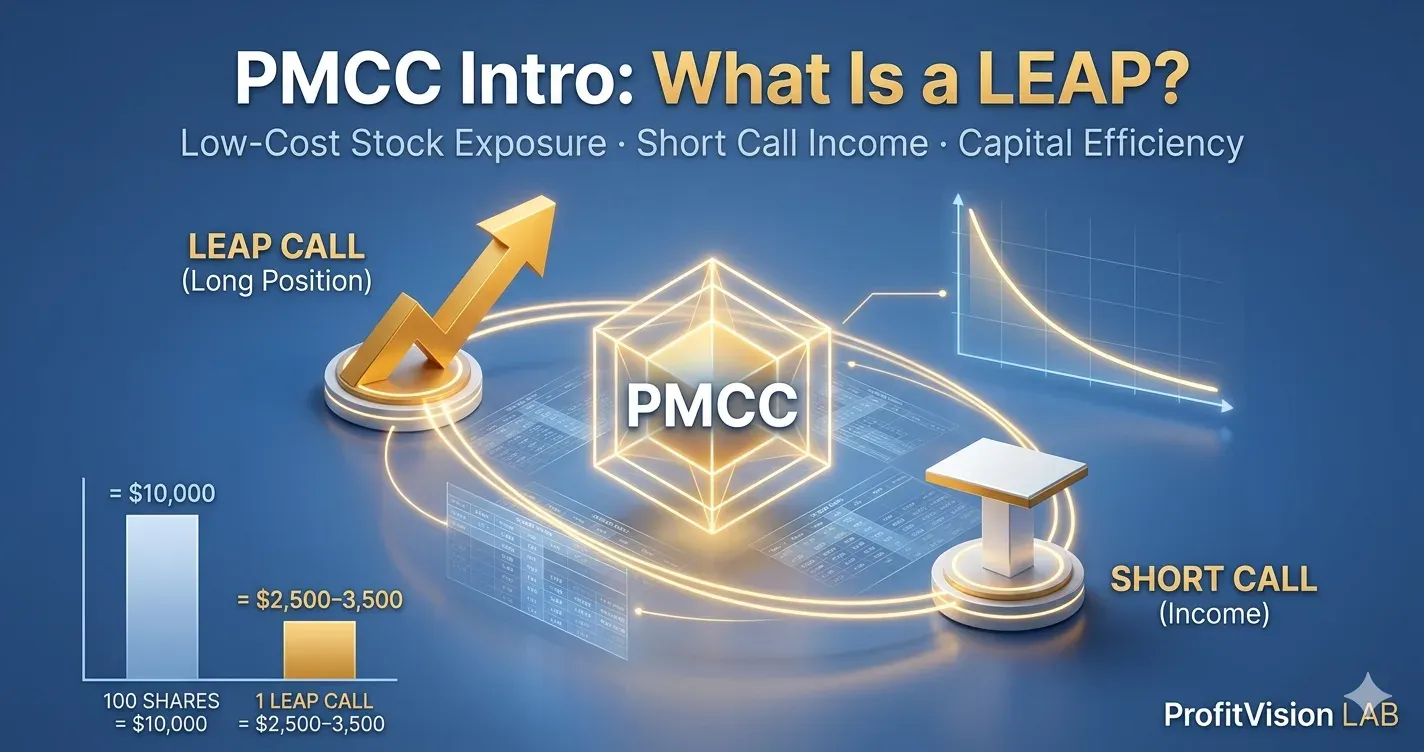
Replace stock with a long-dated Call, then sell a Short Call to collect premium — this is not free income. It is a deliberately engineered trade-off.
PMCC is not for the fastest-rising stocks. It's for the most steadily-rising stocks.
Most people first hear "building cash flow with options" and get drawn in — without realizing that sentence only tells half the story. The essence of PMCC is a trade-off: you sell a portion of your underlying's future upside in exchange for cash flow today. Whether that trade-off is worthwhile depends entirely on what you chose as the underlying.
Using a long-dated Call (LEAP) instead of shares is the capital efficiency core of this strategy. But choose the wrong underlying, and the cost savings from the LEAP will be entirely cancelled out by the cap imposed by the Short Call.
I. What Is a LEAP? Why Use It Instead of Stock?
A LEAP (Long-term Equity Anticipation Security) is a long-dated options contract with an expiration of one year or more. It is the foundation of the PMCC strategy — used to replace the position that would otherwise require outright stock ownership.
Why replace stock with a LEAP? The answer is capital efficiency.
Suppose you're bullish on a company at $100. You have two choices:
| Approach | Capital Required | Gain if Stock +20% | Capital Efficiency |
|---|---|---|---|
| Buy 100 shares outright | $10,000 | $2,000 (+20%) | 1× |
| Buy 1 deep ITM LEAP Call (Delta ≈ 0.80) | ~$2,500–$3,500 | ~$1,600 (+46–64%) | 2–3× |
The same upside move, with far less capital. The freed-up capital can be deployed elsewhere or held as margin. This is the PMCC starting point — establish the position at lower cost first, then sell Short Calls on top of that position to generate income.
The Three Key Characteristics of a LEAP
① High Delta: moves like a stock
A deep ITM LEAP (Delta ~0.75–0.85) tracks the underlying stock closely. When the stock rises $1, your LEAP rises approximately $0.75–$0.85. This makes it a functional "low-cost stock substitute" within the strategy.
② Long-dated: slow Theta erosion
Time value (Theta) decay is inversely proportional to days remaining — the further the expiration, the slower the daily erosion. A LEAP with 700 days remaining loses far less per day to Theta than a 30-day short-term Call. This is the LEAP's core defensive advantage.
③ Lower capital requirement: the key to PMCC access
LEAP margin requirements are far lower than owning stock outright. This allows investors with smaller accounts to build meaningful positions in high-priced underlyings like SPY, QQQ, or NVDA.
II. The Complete PMCC Structure: LEAP + Short Call
PMCC (Poor Man's Covered Call) gets its name from an analogy: a traditional Covered Call requires 100 shares of stock, which demands significant capital. PMCC replaces the stock with a LEAP — "even the poor man" can run it.
The structure:
It looks perfect — hold the LEAP for upside exposure, sell Short Calls for income, a two-for-one. But the problem is embedded in the Short Call leg.
The Short Call's True Nature: What Are You Selling?
When you sell a Short Call, you make a commitment: you agree to sell your position at the strike price if the stock reaches it. If the underlying rises above the strike, your gains are capped there — no matter how much further it runs.
PMCC's essence is a trade-off: you sell a portion of your underlying's future upside in exchange for cash flow today. This is not free income — it is a deliberate choice.
Understanding this makes the core question of PMCC clear:
If the underlying tends to surge sharply, selling upside is punishing yourself.
If the underlying rises steadily, selling upside is a reasonable exchange.
If the underlying chops sideways long-term, your LEAP erodes and the Short Calls don't generate much.
III. Underlying Selection: 10× More Important Than Technique
Once you understand that PMCC means selling upside, the importance of underlying selection becomes overwhelming. You can master Short Call rolling to a fine art, but if you choose the wrong underlying, the strategy is broken at its foundation — no technique will fix it.
The Ideal PMCC Underlying: The Slow-and-Steady Bull
A "slow bull" means an asset that trends upward gradually and predictably over time. Its characteristics allow every component of PMCC to operate at its best:
| Slow Bull Characteristic | Impact on PMCC |
|---|---|
| Long-term uptrend, steady pace | LEAP appreciates gradually — no sudden explosion |
| Volatility within a predictable range | Short Call rarely gets blown through unexpectedly |
| Very few extreme single-day moves | No need for frequent emergency adjustments |
| Moderate IV (not too high, not too low) | Short Call premium is attractive but manageable |
Typical examples:
- Major index ETFs (SPY, QQQ): most predictable volatility profile; good for beginners to practice
- Large-cap cash-flow tech leaders: MSFT, AAPL — mature companies with steady drift
- Pricing-power consumer names: low volatility, durable uptrend
Dangerous Type 1: Growth Stocks — Surge-and-Stall Breaks the Rhythm
Running PMCC on NVDA, PLTR, or similar high-growth names — the issue isn't whether they'll rise. It's that their way of rising breaks every assumption PMCC requires.
Typical growth stock behavior pattern:
- Extended sideways consolidation
- Sudden explosion of +30% in a matter of days
- Enters a new period of choppy digestion
This "discontinuous trend" creates PMCC's fatal problem:
You sell Short Calls month after month during the consolidation, collecting small premium each time.
Then the stock rips 25% in a single week.
Your LEAP gains — but your Short Call gets blown through.
You collected many small wins, then got capped out of the biggest move that mattered.
Three months of accumulated premium, wiped out (or worse) by a single surge.
This is not a technique problem. It is a fundamental mismatch between the strategy and the underlying.
Dangerous Type 2: High-Volatility Assets — Not Built for Income
At the extreme end: IBIT (Bitcoin ETF), COIN, MSTR. The issue with these isn't whether they rise — it's that their path is completely unpredictable.
You might see +20% in one week, then −30% the next month. In this environment, both legs of PMCC break down:
- Upside → Short Call gets blown through; you miss the big move
- Downside → LEAP erodes rapidly; limited protection
This is no longer an "income strategy" — it becomes high-difficulty volatility trading. If you want to run PMCC on IBIT, you need an entirely different mental framework. That's the topic of the Pro article.
IV. Three Screening Questions for PMCC Underlyings
Before establishing any PMCC position, run these three questions:
| # | Question | Ideal Answer | Danger Answer |
|---|---|---|---|
| Q1 | Does this underlying trend "slowly and steadily upward" — or "consolidate, then burst"? | Slowly and steadily upward | Consolidate, then burst |
| Q2 | Over the past year, did it ever post a single-month gain exceeding 15%? | Rarely or never | Yes — and more than once |
| Q3 | If you sold an OTM Call right now, would you be comfortable getting assigned (having your position called away)? | Yes — it's unlikely to run that fast | No — too much uncertainty |
Q3 is the most powerful gut-check. If the idea of being capped by your Short Call makes you anxious, your instinct is already telling you the underlying is wrong for PMCC.
V. Summary: PMCC Succeeds or Fails on Stock Selection, Not on Technique
Many people invest their time in "how to roll a Short Call," "when to extend the LEAP," "how to set the optimal strike" — all legitimate technique questions, covered in detail in the Advanced and Pro articles.
But all technique questions have a prerequisite: you chose an underlying that actually allows you to sell upside.
On a slow-bull underlying, even imperfect technique produces steadily positive PMCC results. On a growth-surge underlying, even perfect technique will extract a penalty at the worst possible moment.
"PMCC is not for the fastest-rising stocks. It's for the most steadily-rising stocks."
Key Takeaways
| Concept | Core Understanding |
|---|---|
| What is a LEAP | A long-dated Call (12+ months to expiration) with high Delta (0.75–0.85) that simulates stock exposure at a fraction of the capital |
| PMCC essence | LEAP (long position) + Short Call (income) = trading a portion of future upside for current cash flow |
| Ideal underlying | Slow-and-steady bull: long-term stable uptrend, predictable volatility, no extreme single-month moves |
| Dangerous types | Growth stocks (surge-and-stall) and high-volatility assets (IBIT, COIN) — both turn the Short Call into your enemy |
| Core screening logic | Ask yourself: "Would I be comfortable being capped by this Short Call?" Uncomfortable = wrong underlying |
When you choose a 1-year LEAP (rather than 2-year), you've made a trade-off between capital efficiency and time management. The 1-year LEAP costs less — but it has a hidden problem: time starts to become your enemy.
The Advanced article covers: the 1-year LEAP's Theta curve, when you must roll, how to adjust the Short Call accordingly, and the difference between "active management" and "being forced to react."