
Palantir Q1 2026: Growth Reaccelerates, Valuation Re-breaks — Best Earnings Ever, Stock Still Fell
Palantir Q1 2026: revenue +85%, Rule of 40 at 145%, NDR at 150%, US revenue surpassing 100% growth for the first time. The best earnings print in company history. The stock fell 6.59%. Forward P/E climbed from 75x to 110x+. The valuation reckoning is entering a new phase.
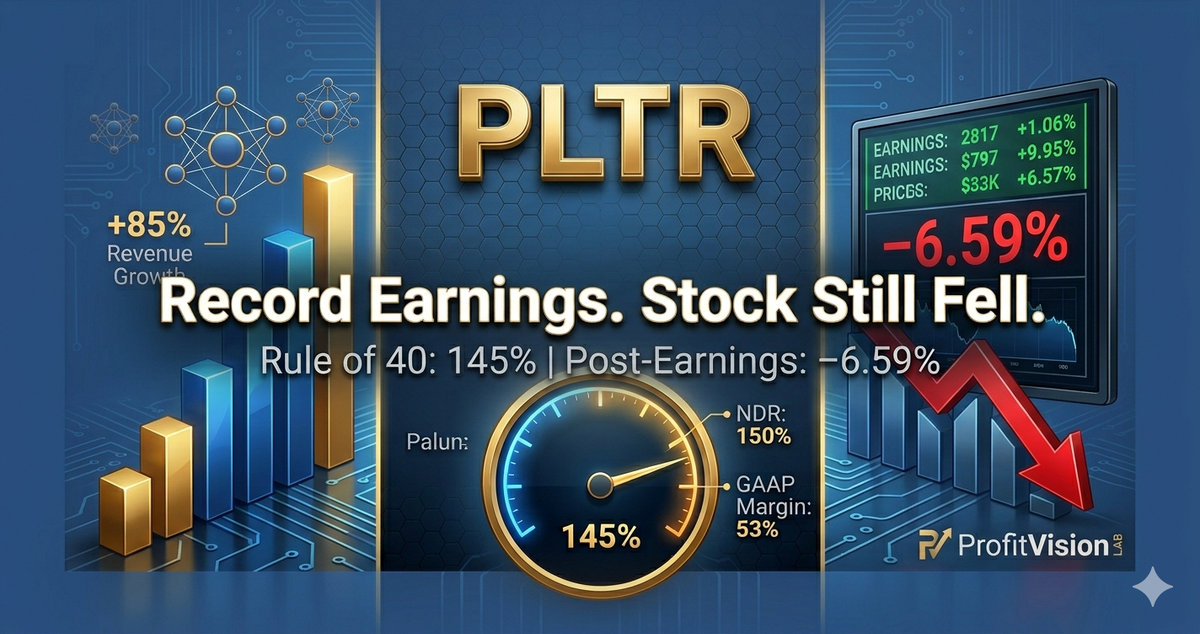
Rule of 40 climbed from 127% to 145%. Revenue growth reaccelerated from 70% to 85%.
Karp declared they "shattered the metric." The stock fell 6.59% on earnings day.
The market just told you something important.
At that point, Q4's Rule of 40 was 127%. Forward P/E was ~75x. We said the valuation was at the edge.
Three months later: Rule of 40 is 145%. Forward P/E is 110x+.
The earnings demolished every estimate. The stock fell 6.59% on earnings day.
That divergence is the only signal that matters right now.
I. Q4 2025 → Q1 2026: Every Number Accelerated
| Metric | Q4 2025 (Prior Report) | Q1 2026 (This Report) | Trend |
|---|---|---|---|
| Total Revenue YoY | +70% | +85% ($1.633B) | ↑ Reaccelerating |
| US Revenue YoY | +93% | +104% (first 100%+ since DPO) | ↑ Historic milestone |
| US Commercial YoY | — | +133% ($595M) | ↑ Triple-digit |
| US Government YoY | — | +84% ($687M) | ↑ |
| Rule of 40 | 127% | 145% | ↑ +18 pts |
| Net Dollar Retention (NDR) | 139% | 150% | ↑ +11 pts |
| Adj. Operating Margin | ~57% | 60% | ↑ Expanding |
| Adj. FCF (quarter) | $2.3B (full year) | $925M (single quarter) | ↑ Annualizing $3.6B+ |
| GAAP Net Income Margin | — | 53% ($871M) | ↑ Rare in enterprise software |
| Forward P/E (est.) | ~75x | ~110x+ | ↑ More expensive, not less |
| Post-earnings stock move | Up | −6.59% | ↓ Anomalous signal |
II. Earnings Call: Karp Declared "We Shattered the Metric"
Palantir's Q1 2026 call opened at the highest rhetorical register Karp has used since the IPO. On the Rule of 40 reaching 145%, he said:
"We have shattered the metric, a feat matched only by other fellow AI infrastructure companies: NVIDIA, Micron and SK hynix."
Placing Palantir alongside NVIDIA is not a modest comparison. It is a deliberate narrative escalation — designed to shift investor mental models from "expensive SaaS" to "AI infrastructure compounding machine."
He also stated:
"almost every single highlighted example of AI that actually is producing results in the U.S. is actually Palantir Technologies."
"our biggest problem currently is demand in the U.S."
Translation: the constraint is not sales capacity — it is the ability to scale delivery fast enough to absorb demand.
Q1 Key Financial Metrics
FY 2026 Guidance — Raised Again
| Metric | Prior Guidance (Q4 2025) | Updated Guidance (Q1 2026) | Revision |
|---|---|---|---|
| Full-Year Revenue | $7.182B–$7.198B | $7.65B–$7.66B | +$460M |
| Annual Growth Rate | +61% | +71% | +10 pts |
| US Commercial Revenue | — | +120%+ YoY | New guidance line |
| Q2 Revenue Guidance | — | $1.80B midpoint | +7.4% vs. consensus |
III. Customers and Contracts: Count Growing Moderately, But Each Account Spending Explosively
This is the most analytically important data set in the quarter.
What this data combination actually says:
Customer count grew from 954 → 1,007 (+53 net new). NDR expanded from 139% → 150%.
The interpretation: new customer acquisition is moderate, but existing accounts are expanding at an explosive rate.
This is the signature of deep entrenchment with anchor clients — not mass-market rapid adoption.
Short-term: exceptionally powerful. Long-term: growth concentration risk has not diminished — it has intensified.
IV. The Signal That Matters Most: Best Earnings Print Ever. Stock Down 6.59%.
This is the thesis of this article. Everything else is context.
In a conventional market logic framework:
- Revenue +85%, beating consensus by 5.84%
- Adjusted EPS $0.33 vs. $0.28 expected (beat +17.86%)
- Full-year guidance raised by $460M
- Rule of 40 at 145% — all-time high
These figures should have driven a significant rally. The stock fell 6.59%.
The market is not saying the numbers are bad. It is saying: at this price, even these numbers cannot deliver sufficient future returns.
Forward P/E has moved from ~75x to 110x+. Forward Revenue is approximately 46x.
At these entry multiples, even if Palantir continues compounding at 85% for two more years, the math for long-term rational return becomes extremely difficult to construct.
The post-earnings decline is not noise. It is the market speaking in valuation language.
Valuation Context: Palantir vs. Enterprise Tech Peers
| Company | Forward P/E (approx.) | Notes |
|---|---|---|
| PLTR (Palantir) | ~110x+ | Among the most expensive in the S&P 500 |
| CRWD (CrowdStrike) | ~70x | High-growth security leader |
| DDOG (Datadog) | ~55x | Observability platform |
| NVDA (NVIDIA) | ~30x | The company Karp compared Palantir to |
Karp explicitly placed Palantir alongside NVIDIA in his earnings commentary. NVIDIA trades at ~30x forward earnings. Palantir trades at ~110x+. That is a 3.7x premium to the company Karp used as his own benchmark.
If you believe Palantir deserves NVIDIA-level status: it is actually overvalued relative to NVIDIA at 110x vs. 30x.
If you don't believe it deserves that status: it is even more overvalued.
Either way, the math does not resolve in favor of buying at current levels.
V. Rule of 40 at 145%: What the Number Actually Means
In our last report, we described 127% as "treating the abnormal as the new normal." At 145%, we need a stronger framing.
Rule of 40 = Revenue Growth Rate + FCF Margin
| Component | Q4 2025 | Q1 2026 | Assessment |
|---|---|---|---|
| Revenue Growth Rate | 70% | 85% | Exceptionally rare: reaccelerating at $6B+ ARR |
| Adj. FCF Margin (est.) | ~57% | ~60% | Holding at abnormally elevated levels |
| Rule of 40 Total | 127% | 145% | +18 pts QoQ |
In virtually all SaaS history, companies reaching $1.5B+ quarterly revenue see growth rates begin to decelerate — the Law of Large Numbers imposing gravity. Palantir defied this gravity in Q1. That is genuinely exceptional.
Where the risk lives:
The 145% Rule of 40 is entirely contingent on 85% revenue growth being sustained.
If growth decelerates from 85% to 60% in any single quarter — itself still a remarkable result — the Rule of 40 drops immediately to approximately 120%.
Markets will not interpret this as "still strong." Markets will interpret it as: the deceleration thesis has begun to play out. That is the valuation reckoning trigger — and it does not require the company to deteriorate.
VI. 53% GAAP Net Margin: Real Cash or Accounting Construction?
Q1 2026 GAAP net income: $871M. Net margin: 53%. At a company generating $1.6B in quarterly revenue, this is a genuine cash flow signal — not creative accounting.
The Economic Moat case for Palantir has always rested on its cash generation, not its narrative. A 53% GAAP margin validates that the moat is structurally real.
However, stock-based compensation (SBC) has not disappeared. The question investors must ask: at what level does SBC dilution offset GAAP profitability gains for long-term shareholders?
Bull case anchor: real Free Cash Flow. Bear case anchor: real valuation. Both are simultaneously true.
VII. Updated Entry Framework: After Q1, the Standards Must Rise
The prior entry framework was built around a ~75x forward P/E starting point. Post-Q1, despite the 6.59% decline, the valuation has not improved — because earnings estimates were revised upward simultaneously.
Condition 1: Forward P/E Entry Zones (Updated)
| Forward P/E Range | Assessment | Action |
|---|---|---|
| > 80x | Bubble zone (current level) | Do not enter |
| 60x – 75x | Elevated | 5%–10% starter position only |
| 45x – 60x | Watch zone | Build to 15%–25% of target |
| 35x – 45x | Rational territory | Accumulate toward core position |
| < 35x | Sweet spot | Long-term core (extremely rare to reach) |
Conditions 2–5 (Updated Post-Q1)
- ② Revenue Growth Must Hold Above 60% (threshold raised from 40%): Q1 delivered 85%. If any quarter prints below 60%, market interpretation will be "deceleration has begun" — not "still impressive." The raised base demands a raised threshold.
- ③ NDR Must Hold Above 140% (threshold raised from 125%): NDR at 150% in Q1. If it falls below 130%, it signals that the anchor-client expansion engine is losing momentum — the primary driver of current growth.
- ④ Large Deals (≥$10M) Must Stay Above 40 Per Quarter: Q1 delivered 47. This is the clearest leading indicator of whether anchor-client concentration is healthy growth or concentrated fragility. A drop below 30 is a warning signal.
- ⑤ Technical: Institutional Accumulation Confirmation Required Before Entry: The 6.59% post-earnings decline is a caution flag. Do not enter until price reclaims and holds the 200-day MA for at least two weeks. A price decline is not a buying signal. Institutional capital returning is the buying signal.
VIII. Three Questions to Track Before Q2 Earnings
Having absorbed Q1's data, here are the three variables that will determine whether the Q2 print validates or invalidates the current valuation thesis:
- Can growth hold above 70% on a harder comparable base? Q1 2027's comps will be extremely difficult. Any deceleration narrative begins here.
- Will NDR sustain above 140%? At 150%, it is near theoretical ceilings for enterprise software at scale. Mean reversion is a structural risk.
- What is the trajectory of U.S. Government revenue? +84% YoY in Q1 is extraordinary. But government contract cycles are lumpy, and budget pressure (DOGE, discretionary cuts) could introduce volatility in H2 2026.
Three interpretations for post-earnings selling on a beat-and-raise quarter:
① Buy the rumor, sell the news — short-term traders exiting positions they built into earnings
② Valuation reckoning accelerating — even these numbers cannot justify 110x+ forward P/E
③ Institutional repositioning — large holders trimming at strength, not a directional signal
Without technical confirmation of institutional accumulation rebuilding, do not interpret the decline as a gift.
IX. Conclusion: The Numbers Don't Lie — But You Must Understand What They're Saying
Palantir's Q1 2026 is a report that silences every fundamental critic. 85% revenue growth, 145% Rule of 40, 53% GAAP net margin — no enterprise software company at this scale is producing results like this.
But investing is never about who has the best company. It is about whether the price you pay leaves you adequate future return.
📌 ProfitVision LAB — Q1 2026 Core Conclusion
Rule of 40 rising from 127% to 145% is not a reason to buy. It is a reason the valuation becomes harder to justify, not easier.
Forward P/E moving from 75x to 110x+ means you are bearing more risk now than before the great earnings print — not less.
Entry framework: begin considering below 60x forward P/E; hold the thesis while growth stays above 60% and NDR above 140%; reexamine if large deal count drops below 40 per quarter.


Comments ()