
Palantir: Epic Earnings, Valuation Reckoning — You're Not Buying the Company, You're Buying Time Expectations
Palantir Q4 blowout: 70% revenue growth, Rule of 40 at 127%, NDR at 139%. Epic earnings, but also an epic valuation at 75x forward P/E. A 30% decline does not make it cheap — it makes it merely overpriced. Five bear arguments and five rational entry conditions explained.
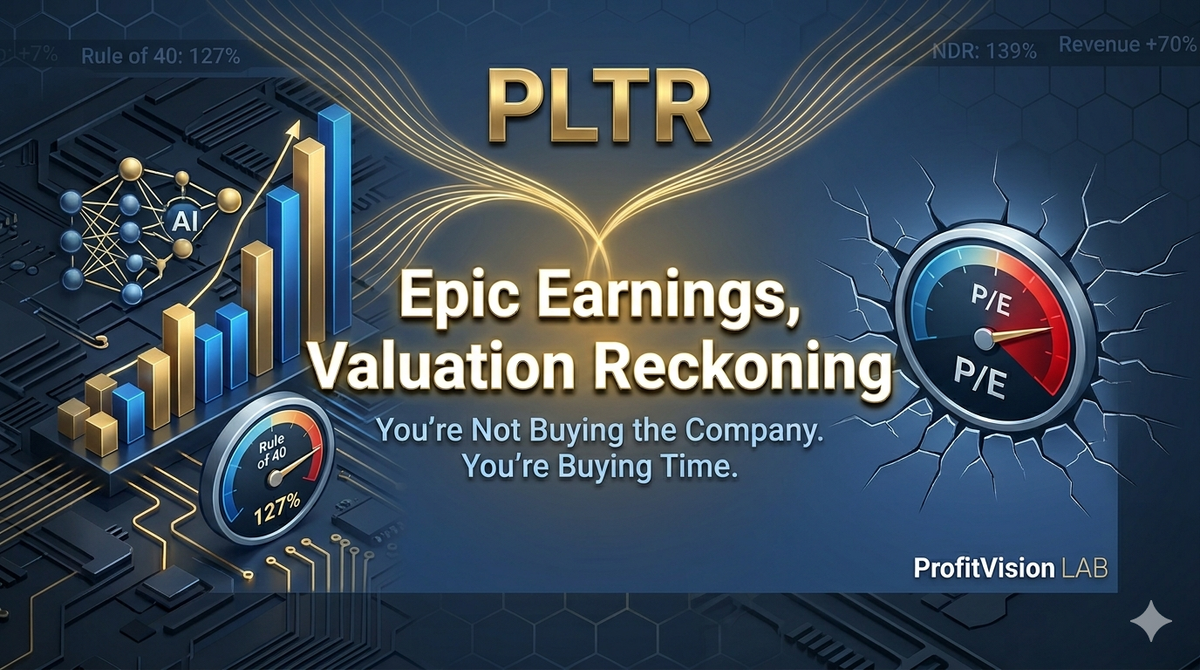
Epic earnings, epic valuation — Palantir isn't bad. It's so good
that the market forgot valuation can still be reckoned.
Bad companies are obvious — when they fall, nobody is surprised.
What truly destroys investors is the company that is undeniably great — so great that you start believing it can never fall.
Palantir (PLTR) is exactly that kind of company. Its product is exceptional. Its narrative is bulletproof. Its political Economic Moat is formidable. Even its free cash flow is remarkable. This is not an ordinary SaaS company, nor a generic AI story. PLTR is a rare hybrid: national-security demand × enterprise-grade AI engineering × government budget absorption capacity.
This is precisely why Palantir embodies the market's most classic paradox:
- Stronger fundamentals → higher valuation
- Higher valuation → lower margin for error
- Lower margin for error → one ordinary quarter could trigger a full valuation reckoning
When the market starts asking "Is it buyable after a 30% drop?" — that is your signal to pause.
A 30% decline is not a buying opportunity. It is a valuation reckoning in progress.
Down 30% does not mean cheap. It means the bubble has moved from "irrational" to merely "overpriced."
I. Earnings Call: This Isn't Growth — It's a Blowout
Reading Palantir's latest earnings call in isolation, you might believe the company is rewriting the history of enterprise technology. Management's tone was not "cautiously optimistic" — it was closer to a victory declaration.
CRO Ryan Taylor called Q4 performance "nothing short of historic." CEO Alex Karp described it as "truly iconic performance." This is not corporate boilerplate — this is narrative amplification designed for markets.
Q4 Key Financial Metrics
CFO Glazer's Full-Year 2026 Guidance
| Metric | 2026 Guidance | Notes |
|---|---|---|
| Full-Year Revenue | $7.182B – $7.198B | +61% YoY |
| Adj. Operating Income | $4.126B – $4.142B | — |
| Adj. Free Cash Flow | $3.925B – $4.125B | — |
| Rule of 40 (Guided) | 118% | Still abnormally elevated |
Rule of 40 in context: In SaaS benchmarking, 40% = passing grade, 60% = strong, 80% = exceptional, 100%+ = rare anomaly. A guided 118% does not just place Palantir among the strongest — it places it in a category the framework was never designed to measure.
II. The Technical Narrative: "Two Weeks" SAP Migration — Miracle or Marketing?
CTO Shyam Sankar stated on the call that Palantir's AI FDE can now support complex SAP ERP migrations (ECC → S/4) — compressing what might have been years of integration work into two weeks.
This claim positions Palantir not merely as an AI tool, but as an AI engineering platform capable of absorbing enterprise transformation budgets wholesale.
Yet this is precisely where investors must apply skepticism. In enterprise environments, the constraint is almost never the AI itself — it is:
- Data governance and access controls
- Role-based access and audit trails (RBAC / audit)
- Compliance requirements (finance, healthcare, government move slowly)
- IT security review cycles
- Integration with legacy systems (ERP / CRM / SCM)
- Organizational resistance and cross-departmental coordination
"Two weeks to completion" likely describes a POC, a single-module success, or a high-maturity enterprise environment. It may well be accurate — but it does not imply scalability. Markets repeatedly commit the error of treating single miracles as universal rules.
III. Rule of 40: From 127% to 118% — Durability Is the Real Question
Palantir's Rule of 40 expanded from 114% in Q3 to 127% in Q4, with management guiding 118% for full-year 2026.
The Rule of 40 is a dual-engine metric: Revenue Growth Rate + Profit Margin (or FCF Margin)
Today's 118% Rule of 40 is only sustainable because growth remains at 61% while margins hold at abnormally elevated levels.
If growth decelerates from 61% to 40% — even with margins unchanged — the Rule of 40 drops by roughly 20 points immediately.
Markets will not say "still impressive." Markets will say: Growth is decelerating. The story is getting downgraded. That is the valuation reckoning trigger.
IV. The Bear Case: Not Denying Palantir — Denying How the Market Is Pricing It
The paradox at the core of Palantir's valuation: the stronger its fundamentals, the more irrational the multiple the market assigns. The bear camp consensus is not "bad company." It is: great company, wrong price.
(1) Relative Valuation: The Jefferies Warning
Jefferies analyst Brent Thill's thesis: Palantir's trading multiples already exceed those of the most expensive peers in its peer group (CRWD, SNOW, NET) by roughly 2x.
Three narrative risk scenarios:
- AI hype cycle cooling
- AI disintermediation (Agentic AI directly threatening SaaS pricing power)
- Top-line growth deceleration
Palantir's stock price is not supported by earnings — it is supported by narrative. When the narrative loosens, the multiple collapses first.
(2) Time-Cost Framework: You Are Buying Time, Not a Company
When a stock's current price already discounts multiple years of earnings growth forward, investors face a scenario where: the company keeps compounding, but the stock goes nowhere — or down.
This is because markets are simply mean-reverting the future back to the present. A valuation trap does not require the company to deteriorate. It only requires the company to become slightly less miraculous.
(3) Law of Large Numbers: High Growth Rates Cannot Persist Indefinitely
Karp himself acknowledged on the Q&A:
"inexplicable growth in revenue, but not inexplicable growth in customers."
Translation: The customer count is not exploding — each customer is spending dramatically more.
Near-term, this is powerful (NDR at 139%). Long-term, it implies growth is highly concentrated in a small number of expanding accounts. A handful of large customers pulling back would fracture the growth rate materially.
(4) Accounting Risk: SBC Is a Hidden Tax, Non-GAAP Is Not Free Lunch
Companies add back stock-based compensation (SBC) in Non-GAAP metrics as if it carries no cost. But the economic reality of SBC: the company is not paying cash — it is paying with shareholders' ownership stakes.
SBC is a shareholder tax. At elevated valuations, SBC becomes more corrosive: a higher stock price allows the company to deliver enormous dollar-value compensation with a smaller share count. Investors absorb a double blow:
① Multiple compression → stock price falls
② Equity dilution → per-share value is eroded
You think you are investing in an enterprise. You are financing its payroll.
(5) Agentic AI Disintermediation: The Threat to the SaaS Narrative
The market is increasingly concerned that companies like OpenAI and Anthropic are not merely building models — they are penetrating the application layer directly, creating AI agents and automated workflows that erode traditional SaaS pricing power. AI is not just upgrading SaaS. AI may ultimately replace it. Even the strongest SaaS platform cannot fully escape multiple compression in that scenario.
V. The Overlooked Risk: International Is Not an Upside — It Is a Constraint
Karp stated plainly on the call:
"we really don't have the bandwidth to do anything that's difficult outside of America."
This means Palantir's growth story is fundamentally an American story. Unlike Microsoft or Salesforce, which can sustain elevated multiples through global expansion, Palantir's TAM is geographically concentrated. As U.S. market penetration increases, growth rates will naturally moderate — and with them, the explosive narrative premium that supports the current multiple.
VI. The Truth About Palantir: Epic Company × Epic Valuation
Is Palantir a great company? Yes — arguably among the strongest enterprise AI platforms of this era.
But markets do not reward the best company. Markets reward the best price-to-value trade-off.
You are not buying the company. You are buying: company × price.
At an epic valuation, the company does not need to collapse for investors to lose. It only needs to become normal.
And normal, for a high-multiple stock, is catastrophic.
VII. When Can You Buy? Watch the Multiple, Not the Decline Percentage
Buying Palantir is not about measuring how far it has fallen. It is about assessing: Has the valuation reckoning run its course?
Condition 1: Forward P/E Must Return to a Calculable Range
| Forward P/E Range | Assessment | Recommended Action |
|---|---|---|
| > 55x | Bubble Zone | Do not buy |
| 45x – 50x | Starter Position | 10%–20% of target allocation |
| 35x – 40x | Accumulate | Entering rational territory |
| < 30x | Core Sweet Spot | Long-term core position (rare to reach) |
Conditions 2–5: Additional Entry Criteria
- ② Revenue Growth ≥ 40% YoY: ≥45% = still in blowout territory; 35%–45% = acceptable; <35% = multiple must reset dramatically. If growth falls to 30%, the multiple gets cut immediately.
- ③ FCF Margin Holding Above 25%: Palantir's Economic Moat is not its narrative — it's Free Cash Flow. If FCF margin falls below 20%, competitive or cost pressures are eroding the moat.
- ④ NDR Sustaining Above 125%: NDR below 120% signals customer expansion is stalling and the narrative is beginning to crack.
- ⑤ Technical: Institutional Accumulation Signals (2+ of the following): Reclaim 200-day MA and hold 4 weeks / Weekly chart forming higher lows / A/D rating recovering from D to C / 50-day MA breakout retesting without failure. A deep decline is not a bottom. Institutional capital returning is the bottom.
VIII. How to Evaluate "Two-Week Deployment" and AI Miracles: Verify With Metrics, Not Emotions
To validate whether management's "rapid deployment" claims are genuinely scalable, track three variables:
- Is customer count growth accelerating?
- Are large contracts becoming more distributed — or more concentrated?
- Are sales cycles shortening and conversion rates improving?
If the data shows: flat customer count growth + elevated NDR + expanding top accounts — that is not rapid mass adoption. That is deep entrenchment with a small number of anchor clients. It is a powerful model, but it does not represent unlimited scalability.
IX. Conclusion: Palantir's Problem Is Not the Company — It's Investors Treating Miracles as the Baseline
Palantir's earnings and earnings call are genuinely remarkable. This is a company that has proven it can pull AI from the laboratory directly into battlefield command systems and enterprise operations.
But the market's question has never been "Is the company exceptional enough?" The market's question is: Does the price you pay leave you adequate future return?
📌 ProfitVision LAB Core Conclusion
In a valuation reckoning, the greatest risk is not picking the wrong company — it is buying too early.
Down 30% does not mean cheap. It means the bubble has moved from irrational to merely overpriced.

Comments ()