
Palo Alto Networks (PANW): The Platformization Bet
PANW's resilience in the SaaSpocalypse: integrated platforms resist AI disruption. NGS ARR $6.33B (+33%), 1,550 platform customers (+35%), CyberArk + Chronosphere reshape to a five-platform strategy. June 2 earnings is the next decisive checkpoint.
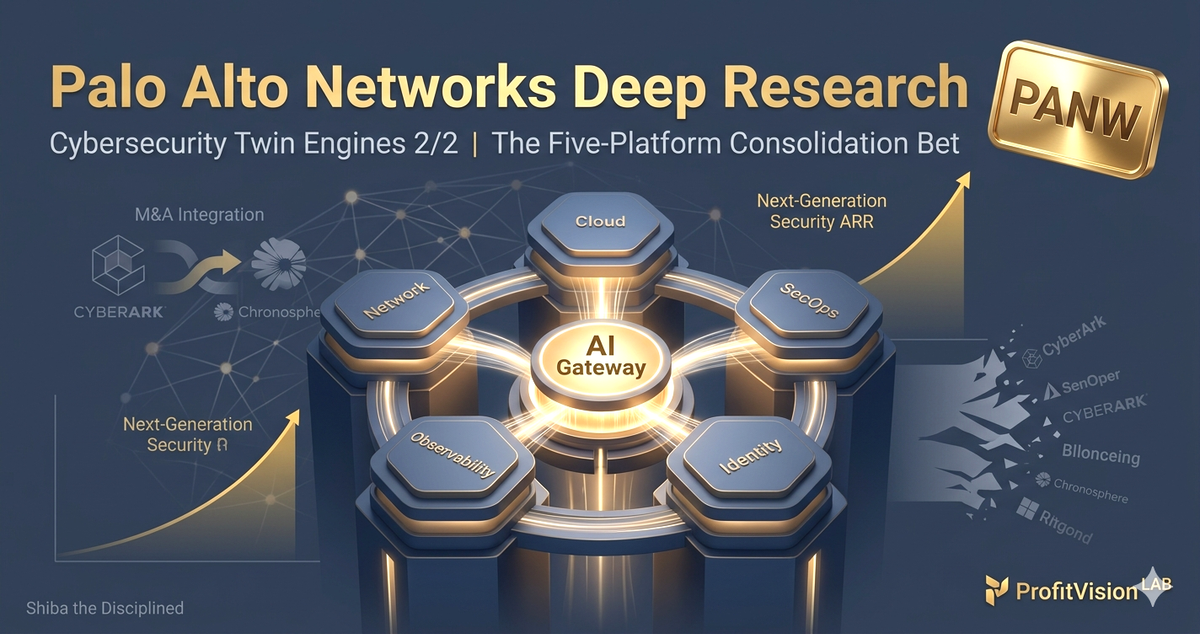
PANW is the most fascinating individual case in the SaaSpocalypse — it is not pure SaaS (still has hardware revenue), but its software transformation has reached a critical inflection: NGS ARR $6.33B with +33% YoY growth, platformization customers at 1,550 (+35% YoY), and FY26 full-year guidance of $8.52-$8.62B. CEO Nikesh Arora has publicly articulated an FY30 NGS ARR target of $20B, supported by transformational acquisitions of CyberArk (identity) and Chronosphere (observability) that redraw platform boundaries. This research dissects the real mechanics of the platformization strategy — and where the largest risks lie in this century-defining bet. The June 2 FY26 Q3 earnings release is the next decisive checkpoint.
Macro Backdrop: In the SaaSpocalypse, Are Platforms the True Safe Harbor?
If CRWD (Note 1) demonstrated that "the cybersecurity sub-sector is more resilient in the SaaSpocalypse," PANW's story is the other side of that thesis — not just "cybersecurity holds up," but more specifically, "integrated platforms hold up."
The core narrative of the SaaSpocalypse is "seat compression" — AI agents replace human users, and seat-based subscription models get cut in half. But this narrative has limited bite against PANW for two reasons: first, PANW's network security business was never seat-based to begin with (it bills on firewall throughput and cloud asset count); second, PANW's platformization strategy itself is "selling integration complexity to customers," and AI agents actually make that complexity more valuable — because agents need a trusted execution environment, which is precisely what PANW sells.
The April 30 launch of AI Gateway exemplifies this strategy — PANW positions itself as "the critical control plane for autonomous agents." When the market worries that AI agents will replace software, PANW's response is "no problem, but agents also need a security gateway, and that's me." The truth of this strategy will be tested by the NGS ARR data in the June 2 earnings release.
• YTD (start of 2026 to 5/1): approximately -18%
• Same period IGV: approximately -21% (cumulatively -30% from September peak)
• Same period SMH: approximately +30% (semiconductors relatively strong)
• Same period CRWD: approximately -10%
• Conclusion: PANW falls less than IGV but more than CRWD — reflecting that the market has indeed applied some discount for "integrated-platform execution risk," but it remains far more resilient than pure application-layer SaaS.
From the 52-week range, PANW has corrected from a $223.61 high to a $139.57 low (drawdown ~38%) and has now rebounded ~30% to its current $182.21. Technical reading is "Strong Buy." The next critical timepoint is the June 2 FY26 Q3 earnings release — management must demonstrate that NGS ARR acceleration can be sustained, or the platformization narrative will be questioned.
The Four-Layer Defensive Screen — Quick View (5/2)
This series uses ProfitVision LAB's proprietary Four-Layer Defensive Screen (4LDS) as the starting checkpoint for any options-level decision. PANW's screen as of May 2, 2026:
| Layer | Indicator | Latest Reading (5/2) | Verdict |
|---|---|---|---|
| Layer 1: Institutional Flow | Relative strength / accumulation-distribution | 5/1 close $182.21, mkt cap $148B; technical Strong Buy | ✅ Near-pass |
| Layer 2: Moat | NGS ARR YoY / FCF margin / platformization customers | NGS ARR $6.33B (+33%); FY26 FCF margin guide 37%; platform customers 1,550 (+35%) | ✅ Pass |
| Layer 3: Volatility | 30-day IV / IV Rank (estimated) | 30-day IV ~32-38%; IV Rank estimated 40-55% (may rise pre-earnings) | ✅ Pass |
| Layer 4: Technicals | Price vs 50MA / support structure | Price has reclaimed 50MA but not yet 200MA; $140 is strong support | ⏸️ Partial pass |
PANW's fundamentals and moat fully clear — but the technical layer is not fully repaired, and the June 2 earnings release is binary risk. Suggest reassessment after June 2: if NGS ARR maintains acceleration and CyberArk integration progresses on plan, tactical view upgrades to "pass"; otherwise, downgrades to "continued hold."
Chapter 1: Industry Map — The Largest Bet on Cybersecurity Consolidation
Chapter 1 unpacks the industry environment PANW operates in. Core thesis: PANW is the largest bettor in the cybersecurity-consolidation wave — it has no choice but to become the ultimate winner of the "integrated platform," because the growth in its legacy hardware business has already peaked. Understanding this strategic starting point is essential to reading the M&A logic and financial numbers that follow.
From Hardware Giant to SaaS Platform — PANW's Transformation Backdrop
PANW's history is a textbook case of "hardware company turning SaaS." Founded in 2005 by Nir Zuk, its earliest core business was next-generation firewalls (NGFW) — a network-security hardware appliance. During its peak years (2014-2018), PANW was the global NGFW market leader, but this business had two structural problems:
First, the hardware market's growth ceiling was reached. When enterprises fully migrated to cloud, the expansion room for hardware firewalls was compressed — customer cloud traffic no longer needed to traverse physical firewalls but instead used cloud-native solutions like SASE (Secure Access Service Edge). This was a chronic bleed for PANW's legacy business.
Second, hardware gross margins compressed. Hardware is a device-based business with gross margins typically in the low 60s; software is a subscription business with margins reaching 80%+. While PANW remained hardware-led, its EV/Revenue multiple could not match pure SaaS — directly capping equity expansion.
So in 2018, after CEO Nikesh Arora (former Google senior executive) joined, PANW launched a series of large-scale transformations: shifting focus from hardware to software, from product sales to subscription, from single product to integrated platform. This transformation has been running for seven years and is now in its critical "final mile" — pushing NGS ARR from $6.33B toward the century target of $20B.
The Three-Platform Strategy: PANW's Integration Architecture
To understand the platformization strategy, we first see the three-platform architecture — Nikesh Arora's core strategic framework introduced in 2023:
| Platform | Key Products | Direct Competitors | Commercial Significance |
|---|---|---|---|
| Strata (Network Security) | NGFW, Prisma Access (SASE), Strata Cloud Manager | Cisco, Fortinet, Zscaler | Transformation of legacy business |
| Prisma (Cloud Security) | Prisma Cloud (CNAPP), Code to Cloud, Prisma AIRS | CrowdStrike, Wiz, Lacework | Cloud-native new battlefield |
| Cortex (Security Operations) | Cortex XSIAM, XDR, XSOAR, Xpanse | Splunk, CrowdStrike NG-SIEM | SOC automation transformation |
The strategic logic of these three platforms is "integration beats best-of-breed" — taken individually, PANW may not be the strongest in any one platform. But when customers use PANW for network + cloud + SOC simultaneously, the synergy from integration overrides any individual product gap. This is the core thesis of platformization.
Latest May Update: CyberArk and Chronosphere Redraw the Boundaries
In late 2025 PANW announced two highly substantial acquisitions, completed or near-completed in 2026:
CyberArk (Identity Security): The global leader in identity and privileged access management (PAM). Integrating it, PANW upgrades from a three-platform architecture to a four-platform architecture — adding the Identity platform. The strategic significance is that PANW is no longer just a "network + cloud + SOC" integrator but a comprehensive platform vendor encompassing every critical cybersecurity domain.
Chronosphere (Observability): An emerging enterprise-grade observability platform whose customers are mostly large cloud-native enterprises. Integrating it, PANW's three-platform architecture grows by another — Observability. The strategic significance: PANW is connecting "cybersecurity" with "observability" — seamlessly transitioning from monitoring infrastructure health to detecting security threats.
Together, PANW has evolved from "three-platform strategy" to "five-platform strategy": Strata + Prisma + Cortex + CyberArk Identity + Chronosphere Observability. This expansion is the largest bet of the platformization strategy — and brings massive execution risk, as detailed in subsequent chapters.
Network Security
Cloud Security
Security Operations
Identity Security (new)
Observability (new)
Agent control plane (4/30)
Industry Trend: Vendor Consolidation Is a Tailwind for PANW
Note 1 already introduced the vendor-consolidation trend — large enterprises consolidating from 50+ security vendors down to 5-10. This trend is pure tailwind for PANW, because:
When customers decide to consolidate security vendors, their core question is: "Which one can replace the most other vendors?" PANW answers this directly through its five-platform architecture: "I can replace network, cloud, SOC, identity, and observability in one shot." This is a proposal no single-product vendor can match.
The data confirms it — in Q2 FY26, PANW's "platformization customers" (those using 2+ platforms simultaneously) reached 1,550, +35% YoY; NRR is at 119%. This means existing customers continue adding platforms, with average contract size continuously expanding. The next chapter dissects the real mechanics of this "integration moat."
Chapter 2: Business Model & Moat — The Real Mechanics of Platformization
Chapter 1 covered PANW's strategic framework; this chapter dissects "how that strategy actually operates at the customer." Core thesis: PANW's moat is not the products themselves but the structural mechanism that prevents customers from leaving the five-platform combination. The distinction matters for investing — product advantages can be replicated by new entrants; structural mechanisms cannot.
NGS ARR's Real Meaning: Not Subscription, but "Platform Subscription"
Understanding PANW's moat starts with understanding its disclosed core KPI — NGS ARR (Next-Generation Security Annual Recurring Revenue). This metric counts only PANW's software and cloud-service subscription revenue, excluding hardware sales and one-time licenses.
But NGS ARR carries deeper meaning — it is not "individual product subscriptions" but "platform subscriptions." PANW's sales model differs from typical SaaS: customers do not separately purchase Strata, Prisma, or Cortex; they sign a "platform contract" allowing flexible allocation across platforms within the contract. This is conceptually similar to CRWD's Falcon Flex but cross-platform — with even more flexibility.
This contract structure has several commercial implications:
First, lock-in periods are longer. Single-product contracts typically run 1-3 years; platform contracts typically run 3-5 years. The deeper the customer commits, the more predictable PANW's revenue.
Second, cross-selling becomes automated. When customers can flexibly invoke any platform within their contract, they naturally add more platforms after trial. This shifts the sales team from "pushing customers to buy" to "helping customers deploy" — substantially lowering GTM cost.
Third, comparison becomes harder. When customers manage NGS as a "platform budget" rather than comparing products one by one against competitors, they tend to "renew the whole contract" rather than "swap individual items." This is the most subtle aspect of switching cost — changing the unit of comparison from product to platform.
Integration Moat: The Multiplier Effect of 3+ Platform Customers
PANW's "platformization customers" KPI discloses customers using 2+ platforms simultaneously. From Q2 FY26 data:
| Platforms Used | Avg Contract Size vs 1-Platform | Renewal Rate (NRR) |
|---|---|---|
| 1 platform | 1.0x (baseline) | ~110% |
| 2 platforms | 2.5-3x | ~115% |
| 3 platforms | 5-7x | 119% (disclosed) |
| 4+ platforms | 10-12x | >120% est. |
Note the structure — moving from 1 to 3 platforms expands the contract 5-7x, with NRR rising from 110% to 119%. This 9-point NRR delta is enormous in SaaS valuation — a company at 110% NRR is priced as "mature stage," while one at 120%+ NRR is priced as "expansion stage," with multiples differing by 30-50%.
So PANW's strategic objective is in fact remarkably simple: push every customer from 1 platform toward 3+ platforms. The progress KPI is "platformization customer count" — rising from ~1,150 in Q2 FY25 to 1,550 in Q2 FY26, +35% YoY. If that pace can be maintained, PANW's NGS ARR acceleration is secured.
Platformization Tactics: Free Period + Co-Engineering + Refund Clauses
Pushing customers from 1 platform to 3 doesn't happen by talking — PANW has designed an entire GTM playbook for it. These tactics are the execution detail behind the platformization strategy.
Tactic 1: Free Period. Once a customer signs a platform contract, PANW offers 6-12 months of free trial for additional platforms — provided the customer commits to including them in the contract after trial. This lowers the psychological barrier to trying new platforms, accelerating adoption.
Tactic 2: Co-Engineering. For strategic accounts (Fortune 500, government), PANW deploys engineering teams to work alongside customer IT, transforming customer-specific needs into custom features in PANW's platform. This is win-win — customers get tailored solutions, and PANW gets deployment data and renewal commitments.
Tactic 3: Refund Clauses. For customers worried about lock-in, PANW offers "satisfaction-backed refund" clauses — sounds like a concession, but actually minimizes the sales psychological barrier. Historically, less than 3% of customers actually invoke these clauses, but the existence of the clause materially increases signing rates.
Together, these three tactics formed the core engine accelerating platformization over the past three years. But Tactic 1 (free period) is also the most-debated element — which the next section dissects.
The Real Cost of the Platformization Strategy
What is the cost of the free period? This is the market's biggest critique of PANW's strategy. If new platforms are free for the first year, then short-term revenue growth includes some "non-revenue-generating deployments." Critics argue this is buying growth with subsidies, and when subsidies end, real growth will collapse.
PANW's rebuttal operates on two levels:
First-level rebuttal: post-free-period conversion rates. Historical data shows over 80% of customers convert to paid contracts after the free period ends — meaning the free period is not "subsidizing customers," it is "lowering trial barriers so customers can see value." Once they see value, they pay. This differs fundamentally from "subsidy-driven user acquisition" subscription models like streaming.
Second-level rebuttal: FCF margin trajectory. If platformization were truly subsidies-for-growth, FCF margin would be compressed by the free period. Yet PANW's FY26 FCF margin guide is 37%, with FY28 target 40%+ — saying the free-period cost has not crushed cash flow but is steadily expanding it.
Combining these two rebuttals, the true state of platformization is: "reasonable short-term cost, structural long-term dividend." But this thesis is not fully validated yet — the next checkpoint is FY26 Q3 and Q4 earnings, particularly whether "platformization customers" KPI maintains its +35% YoY pace.
The SaaSpocalypse attacks "seat-based subscriptions," but platformization is "platform-based contracts" — a structure that decouples PANW revenue from seat count. Even if AI agents replace human users, enterprises still need platform-grade security infrastructure, and that infrastructure becomes more valuable as agent count grows. This is PANW's structural moat.
Scale-Economics Moat: Cortex XSIAM's AI Training-Data Advantage
Beyond platform integration, PANW has another less-discussed but critical moat — scale economics. Concretely manifested in Cortex XSIAM (AI-driven SOC platform).
XSIAM's core value lies in its AI detection model. The training data comes from PANW's global customer base of security events — the more customers deployed, the broader the geographic coverage, the deeper the industry diversity, the more accurate the AI model. This logic resembles CRWD's Threat Graph, but PANW's training data spans broader categories (network + cloud + endpoint + identity), giving XSIAM unique strength in "cross-domain threat correlation."
From an industry perspective, XSIAM is PANW's offensive weapon against Splunk (SIEM legacy) and CrowdStrike NG-SIEM (challenger). Splunk was acquired by Cisco for $28B in 2024, with integration progress below expectations; CrowdStrike's NG-SIEM is still in early expansion. In this window, XSIAM is rapidly capturing share via PANW's distribution — a key observation point ahead of latest May earnings.
Why Does Nikesh Arora Dare to Articulate $20B?
At PANW's 2025 investor day, CEO Nikesh Arora publicly articulated an FY30 NGS ARR target of $20B — meaning roughly 3x growth in four years from the FY26 base of $8.6B. How credible is this target?
Decomposing it: $20B / $8.6B ≈ 2.32x, corresponding to a 4-year CAGR of roughly 23%. That growth rate doesn't sound outlandish — vs PANW's 3-year NGS ARR CAGR of ~35%, decelerating to 23% is plausible.
But the breakdown of getting to $20B looks like this:
| Growth Driver | FY30 Estimated Contribution | Key Assumption |
|---|---|---|
| Organic growth (existing platforms) | $13-14B | NGS ARR maintains 18-20% CAGR |
| CyberArk contribution | $3-4B | Identity security integration + expansion |
| Chronosphere contribution | $1-2B | Observability integration |
| Future M&A | $1-2B | Continued boundary-filling acquisitions |
This breakdown means roughly 25-30% of the $20B target relies on M&A rather than pure organic growth. This is the heart of platformization — buying time with M&A rather than waiting for organic R&D. The valuation discount the market applies to this strategy reflects "integration execution risk." The next chapter dives into that risk.
Where the Moat Could Break (Honestly Stated)
Up to this point Chapter 2 has been mostly positive — but a serious research note must list the scenarios where the moat could break.
Risk Scenario 1: M&A Integration Failure
CyberArk + Chronosphere combined exceeds $30B in transaction value — PANW's largest integration challenge ever. Historically, PANW's M&A track record is mixed — for example, Demisto's 2019 integration into Cortex XSOAR underwhelmed; Bridgecrew's 2021 integration into Prisma Cloud allowed Wiz and others to catch up on differentiation.
Two specific risk points: First, CyberArk's core customer base is "identity-security professionals," whose overlap with PANW's existing customer base is actually low — expected cross-sell may underdeliver. Second, Chronosphere is a cloud-native upstart whose culture may clash with PANW's enterprise-customer DNA — talent attrition and technical regression are real risks.
Risk Scenario 2: CRWD's Reverse Erosion
Note 1 already mentioned that CRWD's endpoint-security advantage may allow it to reverse-erode PANW from platformization. When large enterprises evaluate "consolidate to 5 vendors," PANW and CRWD are both candidates — if customers prioritize CRWD (because endpoint security ranks highest), PANW becomes the consolidated-away party.
How real is this risk? Currently medium. CRWD's pure cloud-native architecture and rapid module expansion put pressure on PANW, but PANW's leadership in network and cloud security remains a near-term gap CRWD cannot close. Long-term, this competition will be fierce.
Risk Scenario 3: Hardware Drag
Although PANW has shifted focus to NGS ARR, legacy hardware (NGFW) still accounts for a meaningful share of total revenue. If hardware decay accelerates, total revenue growth gets dragged — and even if NGS ARR accelerates, the market may discount on slower GAAP growth.
From Q2 FY26 data, PANW's total revenue growth is +15% while NGS ARR growth is +33% — the 18-point gap reflects the hardware drag. If hardware decay accelerates from "slow" to "fast," the gap widens and valuation comes under pressure.
1. Customer feedback on CyberArk integration (especially identity-security professionals' attitude)
2. CRWD's penetration speed in PANW's large accounts
3. Hardware decay velocity (acceleration drags total revenue)
AI Gateway: Repositioning PANW as the AI Agent Control Plane
On April 30, 2026, PANW announced a product critical to its long-term narrative — AI Gateway. The launch timing was no coincidence — at the moment of peak SaaSpocalypse narrative, PANW used a product to declare its "anti-AI-disruption" positioning.
The core positioning of AI Gateway: when enterprises deploy AI agents, PANW provides the security gateway through which agents interact with the outside world. Specific capabilities: first, observability and audit of agent traffic (which agent called what API when); second, policy control over agent behavior (which APIs allowed, which denied, which require approval); third, security protocols for inter-agent communication.
The strategic significance can be framed as: when the SaaSpocalypse narrative says "AI agents replace SaaS," PANW responds not by defending "I won't be replaced" but by stating "no problem, but agents need a security gateway too — and that's me." This repositions PANW from "SaaS application layer that may be disrupted" to "infrastructure AI cannot do without." If this positioning is accepted by the market, PANW's EV/NGS ARR multiple should see a structural re-rating.
But the truth of this positioning will be tested by Q3 and Q4 revenue — whether AI Gateway can rapidly win customer adoption and translate into actual ARR contribution is the most-watched indicator after June 2 earnings.
Countering Anthropic Mythos: PANW's Reverse Technical Argument
When Anthropic launched the Mythos model in January 2026, the entire cybersecurity sector panicked — the market worried that Mythos-class AI could directly replace cybersecurity platforms' detection capabilities. PANW's response operates on two levels:
First-level response is internal integration: PANW has integrated Anthropic Claude models into Cortex XSIAM to accelerate threat intelligence correlation and the natural-language investigation interface. This action mirrors CRWD's integration of Claude Opus 4.7 into Falcon — both convert "AI disruptors into proprietary capability reinforcement."
Second-level response is differentiated argument: PANW publicly emphasizes that even Mythos-class AI capable of finding code vulnerabilities still needs an "execution environment" to deploy patches and monitor. This execution environment is what PANW sells — AI does not replace the execution environment; it actually amplifies demand for it. When enterprises deploy 1,000 AI agents, each needs PANW platform-grade security control — meaning AI expansion is net positive for PANW.
These two responses constitute PANW's most complete rebuttal to the SaaSpocalypse. Whether they are accepted by the market depends on supportive earnings data going forward.
Chapter 3: Competitive Landscape — PANW's Multi-Front War in Cybersecurity
Chapter 2 dissected PANW's internal moat; this chapter pulls the camera back to the competitive landscape. Core thesis: PANW is the company in cybersecurity "fighting the most enemies simultaneously" — its greatest advantage (broadest boundary) and greatest risk (longest front line).
Network Security Battlefield: vs Cisco, Fortinet, Zscaler
PANW's traditional strength is network security. Three opponents in this battlefield:
Cisco: Legacy network hardware giant with the broadest customer base and channels. But Cisco's transformation to cloud security lags PANW, and the 2024 Splunk acquisition's integration progress is slow — currently lagging in SOC.
Fortinet (FTNT): Cost-leadership representative. Fortinet's SD-WAN and firewall appliances price 20-30% lower than PANW, with strong SMB and mid-market positions. The threat to PANW is "low-end erosion" — when budget-sensitive customers choose Fortinet, PANW loses long-term upgrade-path customers.
Zscaler (ZS): Pure cloud-native leader in SASE and SSE. ZS doesn't sell hardware — its biggest threat to PANW is that fully-cloud customers prefer ZS over PANW (because ZS lacks hardware-business legacy baggage). But PANW's Prisma Access has been catching up; the gap narrowed materially in 2026.
Cloud Security Battlefield: vs CrowdStrike, Wiz, Lacework
Cloud security (CNAPP, Cloud-Native Application Protection Platform) is Prisma Cloud's home turf:
CrowdStrike: The protagonist of Note 1. CRWD's cloud security module (Falcon Cloud Security) is rapidly expanding, challenging PANW with the "single agent, multiple modules" architecture advantage. PANW's counter is "platform integration" — using PANW lets customers solve cloud + network + SOC at once; CRWD cannot match that integration breadth.
Wiz: Acquired by Google for $32B in 2025. Wiz's agentless architecture deploys faster than PANW or CRWD in multi-cloud environments — the most threatening new entrant in cloud security. But after Google's acquisition, Wiz's neutrality is questioned, giving PANW and CRWD a window to win customers back.
Lacework: Acquired by Fortinet in 2024; integration slow; no longer a major threat to PANW.
SOC Battlefield: vs Splunk, CrowdStrike NG-SIEM
Cortex XSIAM's goal is to displace Splunk's core SOC position:
Splunk (acquired by Cisco): SIEM legacy, but innovation slowed after Cisco integration. XSIAM directly targets Splunk's customers — using "AI-native + platformization" to win large-enterprise SOC budgets. From Q4 2025 data, XSIAM's customer-acquisition velocity hit a new high.
CrowdStrike NG-SIEM: CRWD's SIEM module is in early expansion but growing fast. Direct threat to XSIAM — PANW and CRWD are the two main candidates when customers evaluate "next-gen SIEM."
Identity Security Battlefield: New Boundary Post-CyberArk
After CyberArk integration, PANW directly enters the identity and privileged access management (PAM) battlefield:
Okta: Identity management leader. Okta focuses on workforce identity (IDaaS); CyberArk focuses on privileged accounts (PAM) — they don't directly overlap, but as PANW platformizes CyberArk, it will gradually enter Okta's territory.
Microsoft Entra ID: The cloud-bundling threat in identity security. Entra ID is bundled in M365, "free" to SMB customers — long-term headwind for PANW's CyberArk push in SMB.
The Real Reality of Multi-Front War
Putting all four battlefields together, PANW is fighting 7-8 competitors simultaneously — the longest front line in cybersecurity. Two interpretations:
Positive read: PANW's boundary is the broadest, meaning it has the best chance of being "the surviving vendor" in vendor consolidation. When customers want fewer security vendors, PANW alone can replace several — the core advantage of platformization.
Negative read: A long front line means a loss on any single battlefield erodes the whole narrative. If CRWD squeezes endpoint share, Zscaler keeps SASE leadership, or CyberArk integration falters — these single-point losses gradually undermine platformization credibility.
From an investing lens, PANW's competitive risk is not "being killed by a single competitor" — it is "being unable to win every front in a multi-front war." But this isn't necessarily bad — as long as PANW doesn't fall behind on most fronts, platformization remains effective.
Cloud-Bundling Threat from Microsoft and Google
Beyond the four direct battlefields, PANW faces a more invisible but more enormous long-term threat — reverse bundling pressure from cloud giants:
Microsoft: Through M365 E5, embedding Defender, Entra ID, and Purview turns cybersecurity basics into "already paid for via existing licenses." For SMB, this means PANW must prove it is "much better than free." For large enterprise, this means PANW's identity security (post-CyberArk integration) faces Entra ID's existing penetration from day one.
Google: After acquiring Wiz for $32B in 2025, Google is integrating Wiz's cloud-native security into Google Cloud. For GCP customers, this creates "bundle-discount" temptation — when customers can pay for cloud security via a single GCP invoice, PANW's Prisma Cloud loses pricing leverage.
PANW's strategy against both: "deeper, broader, and more independent than Microsoft / Google" — positioning itself as a "neutral platform across multi-cloud, hybrid architectures." This works for large multinationals (where multi-cloud is normal) but may convince less in single-cloud SMBs.
From an investing lens, this threat amplifies over time. Short-term, PANW still has platformization tailwinds; over 3-5 years, cloud bundling pressure will become a long-term valuation overhang. This is also the root reason platformization must accelerate — before cloud bundling fully arrives, lock customer security budgets into PANW platform contracts.
Chapter 4: Financial Resilience — Reading the FY26 Q2 Numbers
After moats and competition, this chapter validates the thesis with financial data. Core thesis: PANW's financial structure is the textbook template for "hardware company turning SaaS" — stable growth, expanding FCF margin, quantifiable platformization progress. This structure underpins relative resilience in the SaaSpocalypse.
FY26 Q2 Financial Snapshot
PANW's fiscal year starts in August; FY26 Q2 was disclosed in February 2026:
| Metric | FY26 Q2 | FY25 Q2 | YoY |
|---|---|---|---|
| Total Revenue | $2.59B | ~$2.25B | +15% |
| Subscription & Support Revenue | ~$2.00B | ~$1.69B | +18% |
| NGS ARR | $6.33B | ~$4.76B | +33% |
| RPO (Remaining Performance Obligations) | $16.0B | ~$13.0B | +23% |
| Non-GAAP Operating Margin | 30.3% | ~28.5% | +180bps |
| Non-GAAP EPS | $1.03 (beat 9.6%) | — | — |
| FCF margin (FY26 full-year guide) | 37% | — | — |
| Cash & short-term investments | $4.16B | — | — |
| Platformization customers | 1,550 | ~1,150 | +35% |
Reading the Numbers I: The Real Significance of NGS ARR Acceleration
NGS ARR rose from $4.76B in FY25 Q2 to $6.33B in FY26 Q2, +33% YoY — slightly decelerating from FY25 full-year +35%, but still high. More importantly, PANW's FY26 full-year NGS ARR guide is $8.52-$8.62B (+53-54% YoY) — implying H2 acceleration.
But note: FY26 H2 acceleration includes CyberArk M&A contributions. Stripping out CyberArk, organic NGS ARR growth is around 28-30% — still top-tier. The key observation point is the June 2 Q3 release — management must demonstrate organic growth has not declined, or the platformization narrative will be questioned.
Reading the Numbers II: $16B RPO and Visibility
RPO (Remaining Performance Obligations) is a key SaaS visibility indicator — representing signed but not-yet-recognized contract value. PANW's $16B RPO vs FY26 full-year guide of $11.28B means PANW's signed visibility far exceeds recognized revenue — a "future revenue already locked" signal.
Specifically, $16B / $11.28B ≈ 1.42x, meaning PANW has locked roughly 17 months (about 1.4 years) of future revenue. This is critical for options-selling strategies in the SaaSpocalypse — when business visibility is high, individual stock "black swan" risk is relatively lower.
Reading the Numbers III: FCF Margin from 37% to 40%+ Trajectory
PANW's FY26 FCF margin guide is 37%, with FY28 target 40%+. This trajectory reflects the SaaS-transformation "cash flow maturity" stage:
- FY24: 32% (transformation start)
- FY25: 35% (continued expansion)
- FY26 (guide): 37% (platformization gaining force)
- FY28 (target): 40%+ (approaching maturity)
From 32% to 40%+ is 800bps expansion across four years — a "steady, uninterrupted" margin evolution rhythm. This trajectory is far more stable than NOW (FY26 cut from 36% to 35%), reflecting PANW's revenue mix shifting toward higher-margin subscriptions after hardware depreciation cycles run their course.
Reading the Numbers IV: 1,550 Platformization Customers and the Multiplier Structure
Chapter 2 explained the multiplier structure of platformization customers. Here is the actual data trajectory:
| Period | Platformization Customers | YoY Growth |
|---|---|---|
| FY24 Q2 | ~750 | — |
| FY25 Q2 | ~1,150 | +53% |
| FY26 Q2 | 1,550 | +35% |
Note the deceleration — from FY25 +53% to FY26 +35%. This deceleration looks negative but actually means platformization customers' "absolute base" is increasingly large, making continued high growth harder. From an investing lens, the key is not "deceleration" but "absolute number continues rising" — as long as platformization customers keep growing, the strategy is working.
Debt Structure and M&A Funding
PANW's balance sheet structure:
- Cash and short-term investments: ~$4.16B
- Long-term debt: originally low (<$1B), but post-CyberArk + Chronosphere estimated to rise to $15-20B
- Annual FCF run-rate: ~$4-4.5B est. for FY26
- Debt/EBITDA: post-deal estimated 2.5-3x (up from 0.5x)
This means PANW deployed substantial M&A capital for CyberArk + Chronosphere, with debt/EBITDA jumping from 0.5x to 2.5-3x. This is the inflection from "cash-rich software leader" to "moderately-leveraged M&A integrator." The market's concern is — if integration falters, leverage amplifies downside.
Chapter 5: Valuation & Scenarios — A Three-Tier Rate Stress Test
The previous four chapters built PANW's fundamental case. This chapter places it under "market pricing" pressure — core thesis: PANW's current valuation reflects the pessimistic case of "platformization-strategy credibility under discount." The June 2 earnings release is the decisive checkpoint for whether this discount gets corrected.
Current Valuation Snapshot (as of May 2, 2026)
| Valuation Metric | Current | 5-Year Median | Position |
|---|---|---|---|
| Forward P/E | ~52x (incl. M&A amortization) | ~58x | Lower bound |
| EV / NTM Revenue | ~12x | ~14x | Lower bound |
| EV / NTM NGS ARR | ~17x | ~22x | Materially low |
| P / NTM FCF | ~36x | ~38x | Neutral |
The most critical signal: EV/NGS ARR compressed from median 22x to 17x — a 23% discount reflecting market concern over platformization execution risk. But comparing CRWD (EV/ARR 21x) reveals that PANW is actually cheaper on "software-subscription purity" — another reason for PANW's relative resilience in the SaaSpocalypse.
Three-Tier Rate Stress Test
| Scenario | Rate Assumption | PANW Valuation Response | Operational Implication |
|---|---|---|---|
| A: Tightening | 10Y yield +50bps | EV/NGS ARR compresses to 14-15x; stock down 12-18% | Don't catch falling knife; watch $140 prior low |
| B: Baseline | 10Y yield flat | Range-bound $170-200; valuation reverts to median | Bull Put on dips (avoid June 2 earnings) |
| C: Easing | 10Y yield −100bps | EV/NGS ARR repairs to 22-25x; stock up 25-35% | SaaS valuation-repair beneficiary, but rebound may trail CRWD |
Scenario A Decode: Why Drawdown Smaller than CRWD
Under +50bps rate rise, PANW is more resilient than CRWD, three reasons:
First, PANW's FCF margin 37% (vs CRWD 25%) provides a thicker valuation floor.
Second, PANW's "duration" is shorter — partial hardware revenue is less rate-sensitive than pure subscription.
Third, PANW's RPO $16B provides strong visibility — even amid stock drawdown, the market can see "future revenue locked in."
But PANW has weaknesses CRWD does not — high leverage post-CyberArk deal. Rising rates lift PANW's debt service costs, a new downside risk.
Scenario B Decode: Why This Is Baseline
Current consensus is "rates flat to slightly easing." In this scenario, PANW's valuation is not rate-driven but driven by "June 2 NGS ARR acceleration" and "CyberArk integration progress" — two fundamental indicators.
Historically, PANW typically range-trades during "idiosyncratic-driven" phases — earnings volatility increases, but the medium-term path tracks NGS ARR. This is the best environment for options-selling, but the earnings date must be avoided.
Scenario C Decode: Why Rebound May Trail CRWD
Under rate easing, PANW benefits but may rebound less than CRWD, three reasons:
First, PANW's valuation elasticity is smaller — current EV/NGS ARR 17x repairing to 25x is 47% room, but CRWD's 21x → 30x is 43%. Roughly comparable.
Second, PANW's M&A integration risk remains the largest barrier to multiple expansion. Even under easing, if integration falters, PANW's repair lags CRWD.
Third, both names have already rebounded once in the SaaSpocalypse (PANW from $140 +30% to $182, CRWD from $342 to $447) — remaining upside under Scenario C is roughly comparable.
Performance in the Rotation Endgame
Placing PANW in the "semis killed, SaaS not yet" → "semis not yet, SaaS killed" → "semis profit-taking, SaaS repairs" playbook:
When semiconductors finally see profit-taking, capital prefers the trio of "FCF certainty + integration narrative + platform moat." PANW edges CRWD on this trio — FCF margin 37% > CRWD's 25%, integration narrative clearer, platform boundary broader. But correspondingly, PANW's execution risk is also higher, so rebound velocity may trail CRWD.
Valuation Conclusion: Integration Risk vs Boundary Expansion
PANW's true valuation state right now:
- EV/NGS ARR 17x (vs median 22x): reflects "M&A integration risk discount"
- Forward P/E 52x (vs median 58x): reflects "growth deceleration concern"
- Not reflected: potential CyberArk + Chronosphere integration acceleration of NGS ARR; AI Gateway and other new boundaries' revenue contribution
The key variable for this dislocation is the June 2 earnings release. If management can demonstrate platformization progress (especially platformization-customer growth and early CyberArk integration results), the EV/NGS ARR discount corrects. Otherwise, the discount widens. This is a clear binary catalyst — entry timing must anchor on earnings.
Chapter 6: Tactical Deployment — Using PANW in the SaaSpocalypse
Core thesis: PANW is a core position for SaaS allocation, but pre-June-2 uncertainty exceeds CRWD — a "phased entry + post-earnings add" strategy is appropriate.
Core View (One Sentence)
PANW is the largest bettor in the cybersecurity-consolidation wave. Platformization is the most effective immunity to "seat compression" within the SaaSpocalypse — but the latest five-platform expansion has pushed execution risk to historic highs. June 2 earnings is the next critical validation of this century-defining bet.
Bull Case
- Platformization structural moat: 1,550 platformization customers, NRR 119% — strongest immunity within the SaaSpocalypse
- FCF margin 37% → 40%+ trajectory: FY28 target articulated, historical path stable, high credibility
- CyberArk + Chronosphere expand the boundary: from three platforms to five — substantive support for the FY30 $20B NGS ARR target
- AI Gateway repositioning as agent control plane: the strongest reverse defense under AI-disruption narrative
Bear Case
- M&A integration risk: $30B+ deal value the largest in PANW history; CyberArk culture integration and Chronosphere cloud-native team retention are real risks
- Multi-front strategic complexity: fighting 7-8 opponents simultaneously; loss on any front erodes the narrative
- Hardware drag: NGFW decay acceleration drags total revenue growth
- Debt/EBITDA from 0.5x to 2.5-3x: increased leverage amplifies downside
The Four-Layer Defensive Screen — Final Verdict (5/2)
| Layer | Key Indicator | Current Reading | Verdict |
|---|---|---|---|
| Layer 1: Institutional Flow | 1-week relative strength | Strong Buy signal (11 buy / 1 sell on MA), recovering this week | ✅ Near-pass |
| Layer 2: Moat | NGS ARR / FCF margin | +33% / 37% (guide); platformization customers +35% | ✅ Pass |
| Layer 3: Volatility | IV Rank estimate | 40-55%; may rise to 60-70% pre-earnings | ✅ Pass |
| Layer 4: Technicals | Price vs 50MA / 200MA | Reclaimed 50MA but not yet 200MA (near $200) | ⏸️ Partial pass |
Overall: Strategic Pass + Tactical Hold (Pre-Earnings) — PANW's fundamentals match CRWD, but technicals trail by one step. Reassess after June 2 earnings before tactical upgrade.
Entry Triggers
Below are four triggers; meeting two or more makes entry viable:
- Trigger 1: Stock holds 50MA for 5 consecutive trading days (active ✅)
- Trigger 2: Post-June-2 earnings, stock gaps up with NGS ARR maintaining +30%+
- Trigger 3: Platformization customers YoY maintains +30%+ (validates the strategy)
- Trigger 4: IGV shows second-leg recovery signal (SaaS relative strength continues to rise)
Bull Put Spread Deployment Logic (Scenario B Assumption)
If triggers are met and the stock is in the $180-195 range, the design logic for a Bull Put Spread:
| Parameter | Suggested Range | Design Rationale |
|---|---|---|
| DTE (days to expiry) | 30-45 days | 4LDS standard |
| Short Put strike | $155-165 | Hidden below 50MA, above $140 prior low |
| Long Put strike | Short Put − $10 | Caps single-leg max risk |
| Delta (Short Put) | < 0.30 | Corresponds to 70%+ OTM probability |
| Per-trade size | 5% Risk Unit (RU) | Adheres to 5% RU framework |
| Critical note | Must avoid June 2 earnings | Cross-earnings positions double max-loss risk |
More specific timing recommendations:
5/2 ~ 5/30: Not suitable for opening, since 30 DTE positions cross June 2 earnings.
5/30 ~ 6/2: Too close to earnings; IV may rise further but risk also amplifies — not recommended.
6/3 (post-earnings): If results favorable and stock gaps up, open 30-45 DTE Bull Put.
6/3 (post-earnings): If results unfavorable and stock gaps down, observe 5-day support confirmation before reassessing.
Strategic Holding Rating
Role: Integration narrative anchor in "Real Growth × FCF Five-Pack" (paired with CRWD as cybersecurity twin engine)
Suggested allocation: 10-15% of SaaS sleeve (50/50 split with CRWD; not mutually exclusive)
Upgrade conditions: any of the following → upgrade from "core" to "high-conviction add"
• CyberArk integration on plan (look for Q4 disclosed M&A contribution)
• Platformization customers YoY maintains +35%+
• FCF margin reaches 38%
Downgrade conditions: any of the following → reassess allocation
• Platformization customers YoY drops below +25%
• Organic NGS ARR (ex-M&A) drops below +25%
• Concentrated large-account-loss news flow
Chapter 7: CRWD vs PANW Pairing — Not a Choice, but a Combination
This chapter is added specifically for options-selling traders. Core thesis: CRWD and PANW are not an either/or choice — they are a both/and combination. The two pursue fundamentally different paths in the cybersecurity platform war, complementing each other to form a complete cybersecurity twin-engine allocation.
Strategic Path Differences
| Dimension | CRWD (Best Product + Module Expansion) | PANW (Biggest Integration + Platform Contracts) |
|---|---|---|
| Core strategy | From endpoint, organically expanded to 32+ modules | From network hardware, M&A-integrated to 5 platforms |
| Single-product strength | Endpoint, identity, cloud — all top-tier | Network, cloud — top-tier |
| Integration breadth | 32+ modules within one platform | Across 5 platform boundaries |
| Customer procurement logic | "I want the strongest security stack" | "I want fewer security vendors" |
| FCF margin | 25% (FY26) → 30% target | 37% (FY26) → 40%+ target |
| 5/2 valuation | EV/ARR 21x | EV/NGS ARR 17x |
| Primary risk | Microsoft Defender bundling pressure | M&A integration execution risk |
Why Pairing Beats Concentrating
From portfolio theory, the two are less correlated than appears — when CRWD declines on Microsoft offense, PANW does not necessarily fall; when PANW declines on integration troubles, CRWD does not necessarily fall. Pairing reduces idiosyncratic risk while preserving cybersecurity-sector exposure.
Suggested ratio is 50/50 (each holds half of the cybersecurity twin-engine sleeve), reasoning:
First, growth rates are comparable. CRWD ARR +24%, PANW NGS ARR organic +28% — small gap. No structural reason to overweight either.
Second, FCF certainty complements. PANW's 37% FCF margin provides a thicker downside floor; CRWD's 25% is lower but with faster acceleration. Pairing balances "cash-flow certainty" with "margin expansion potential."
Third, competitive advantages complement. PANW excels in network and integration breadth; CRWD excels in endpoint and cloud-native flexibility. One faces the vendor-consolidation battlefield, the other the best-of-breed battlefield — addressing two distinct customer procurement logics.
Paired Position Deployment for Sellers
Running Bull Put Spread on both simultaneously can be designed this way:
CRWD: 5/30 expiry $400/$380 Bull Put Spread, 2.5% RU
PANW: Open 7/3 expiry $160/$150 Bull Put Spread post-June-3 (post-earnings), 2.5% RU
Total 5% RU split into two legs, diversifying single-stock event risk. Note: PANW position must wait until post-earnings to avoid cross-earnings event risk; CRWD position can open earlier but must close before June 9 earnings.
Three Seller Traps to Avoid
Trap 1: Cross-earnings positions. CRWD has earnings June 9, PANW has earnings June 2 — both positions must avoid their respective earnings dates separately.
Trap 2: Ignoring leverage difference. PANW's Debt/EBITDA jumped from 0.5x to 2.5-3x post-CyberArk, amplifying downside vs CRWD. Strikes on PANW must be hidden deeper than on CRWD.
Trap 3: Forgetting macro signals. Strong individual technicals don't substitute macro judgment. If IGV resumes decline or VIX spikes, every SaaS Bull Put gets hurt simultaneously. Sellers in Phase A must be ready to reduce at any time.
When the collected premium's mark-to-market loss reaches 2x, close immediately — no negotiation. Simultaneously: PANW positions must avoid June 2 earnings; CRWD positions must avoid June 9 earnings. These two disciplines together form the most critical line of defense for capital preservation in the SaaSpocalypse.
Next in the Series
The first two notes in this series complete the "cybersecurity twin engines" (CRWD + PANW) dual-note pairing — these two represent the most impregnable subset of SaaS moats. The next note enters the most dramatically valued name in the series — NOW (ServiceNow).
NOW dropped 17% in a single day after Q1 2026 earnings on April 22 (the worst single-day decline in company history), is down 41% YTD, and 57% off its 52-week high — yet every operational metric beat. This is the most extreme "strong fundamentals vs collapsed valuation" contradiction in the SaaSpocalypse. The next note dives into: why did the market apply such a punitive discount for Q2 cRPO decelerating 150bps? Are the Armis + Moveworks + Veza triple acquisitions pushing NOW from workflow platform toward "enterprise nervous system" — or are they distractions that fragment management attention? And — when a company with FCF margin 35% and cRPO +21% growth is killed to forward PE 25x, is this a historic window for contrarian investing?
Tracking Log
| Date | Event | Verdict | Result |
|---|---|---|---|
| 2026/05/02 | Second note in series published | ✅ Strategic pass / ⏸️ Tactical hold (pending June 2) | — |
Next scheduled update: after Q3 FY26 earnings on June 2, 2026
Triggers for early update: (1) major CyberArk / Chronosphere integration update; (2) significant large-customer loss news; (3) AI Gateway adoption-rate disclosure; (4) IGV second-leg decline (SaaSpocalypse retest)
This analysis is for research purposes only and does not constitute investment advice. Investing involves risk; please assess your own financial situation carefully.
Data sources: Palo Alto Networks SEC filings (10-K, 10-Q), company earnings calls, investor day presentations, Yahoo Finance, public industry data; latest stock data updated through May 1, 2026 close.
The Four-Layer Defensive Screen readings are estimated from public data; consult your trading platform (e.g., IBKR, MarketSurge) for real-time data before any actual trade.
This note does not contain price predictions; all scenario analyses are conditional projections.


Comments ()