The Taiwan Investor's Roadmap to Mastering US Options Trading
Most retail traders don't lose because of bad strategy — they lose because of the wrong mental model. This guide maps a four-stage roadmap for building a sustainable options selling system: Covered Calls, Cash-Secured Puts, IV Rank discipline, and defined-risk spreads.
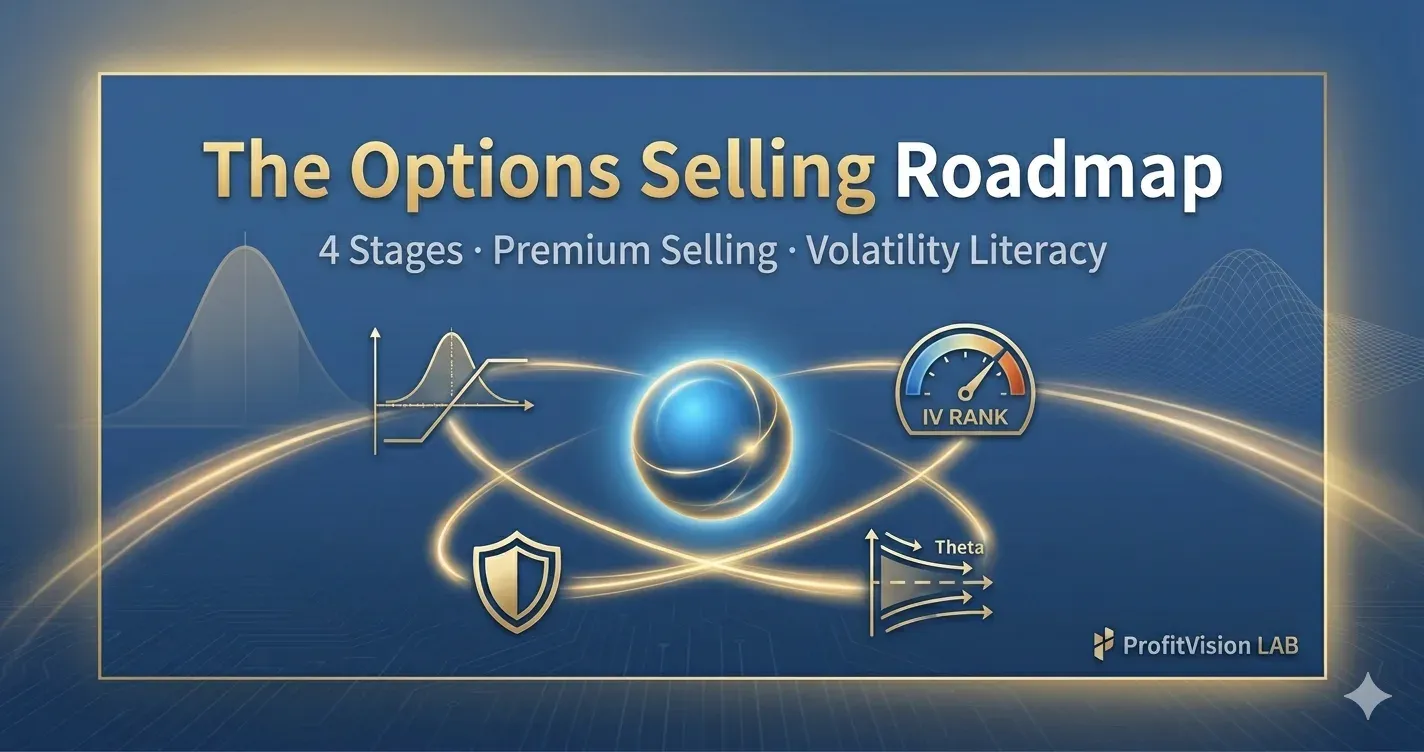
Most retail traders don't fail because of bad strategy — they fail because of the wrong mental model. Four stages, from premium-selling fundamentals to volatility literacy, to build a framework that lets you survive long enough for compounding to work.
This roadmap is written for investors who already know how to buy stocks or ETFs, but are new to U.S. options. If you can buy AAPL, MSFT, QQQ, or SPY, but calls, puts, strikes, premium, expiration, Delta, and IV Rank still feel fragmented, do not rush into placing trades. Options are not simply a faster version of stocks. They are contracts that package time, volatility, probability, and obligations into a tradable structure.
That is why PVL separates the learning path into two layers. This roadmap is the first layer: it teaches the language, the four roles, the options chain, the basic Greeks, and the first defined-risk spread structure. The second layer is the Complete Options Selling Learning Map, where underlying selection, IV Rank, Bull Put Spread SOP, Roll vs Exit, and risk controls are connected into a repeatable trading system.
In other words, this page is not a push to trade today. It is a guardrail against learning options in the wrong order: understand what the market is actually pricing first, then decide whether you want to become a seller of risk premium.
You're Losing the Framework War, Not the Strategy War
Many traders spend years in options markets and keep losing. Not because of bad strategy selection. Not because of bad luck. Because they built the wrong mental model on day one.
They treat options as a leverage tool for directional bets — buy Calls when bullish, buy Puts when bearish, size up when conviction is high. When they lose, they blame the market. When they win, they think they've found a system. Then they lose again.
The mental model that keeps professional options traders alive is not "can I predict the direction?" It is: "can I consistently extract risk premium from the market's structural tendency to overprice volatility?"
The distance between those two questions is the distance between amateur and professional. If your current orientation already includes premium selling, cash flow, volatility risk premium, and disciplined position sizing — you are closer to the right path than most. The question now is how to make that path complete.
- Options are not just directional bets; they are instruments for pricing future movement.
- Buyers pay for the chance that something large happens. Sellers collect premium for underwriting the probability that most of the time it will not.
- If your options framework is still "buy Calls when bullish, buy Puts when bearish," you are still thinking at the directional-trading layer.
Buyer vs. Seller: The Most Important First Decision
Before you learn any specific strategy, you need to make a foundational choice. This is not a matter of style preference — it is determined by your understanding of what options fundamentally are.
The Buyer's World
The buyer pays premium for leveraged exposure. Maximum loss is the premium paid, but to profit you need the underlying to move in the right direction, fast enough, with sufficient volatility expansion. Three conditions must align simultaneously.
The majority of out-of-the-money options expire worthless. The premium you pay embeds both time decay (Theta) and a volatility risk premium (Vega). Every passing day, Theta erodes your position. Every IV compression event reduces your mark-to-market value — even if the underlying hasn't moved against you.
The Seller's World
The seller collects premium, accepts an obligation, and makes time an ally. Each day, Theta works in your favor. IV mean-reversion adds to your P&L. You don't need the stock to rally — you just need it not to collapse.
✅ Recommendation: start on the sell side. Begin with the most conservative premium-selling strategies, build the right framework first, then expand your toolkit progressively. Sellers face their own existential risk — tail risk — which is precisely why risk management is not optional; it is the core infrastructure of any selling-based approach.
"Starting on the sell side" does not mean immediately selling naked Puts. It means using the seller's lens to understand the market: who is buying protection, who is selling insurance, why time decay works against buyers, and why extremely high IV can be a warning sign rather than an automatic opportunity. Once those questions make sense, strategy selection becomes much cleaner.
Stage 1 — Learn Two Strategies, Learn Them Cold
The most common entry-level mistake is trying to learn many strategies while understanding none of them deeply. Iron Condor, Calendar Spread, Diagonal, Ratio Spread — a quick survey of each, none truly internalized.
The correct approach is the opposite: pick the two simplest strategies and understand every dimension of their P&L structure until you can explain them without notes.
Strategy 1: Covered Call
Turn the stock you already own into an asset that generates rental income.
You own shares. You sell an out-of-the-money Call and collect premium. If the stock stays below the strike at expiration, you keep the full premium. If it rallies through the strike, you deliver your shares at the agreed price.
This is the best entry point into the seller's mindset because it forces you to genuinely understand Delta, Theta, strike selection logic, expiration management, and how IV levels directly translate into the premium you collect.
Suitable underlyings: liquid large-caps or ETFs you already hold — SPY, QQQ, NVDA, AAPL. High liquidity means tight spreads, which matters more than most beginners realize.
Strategy 2: Cash-Secured Put
Get paid to wait for the stock you already want to buy.
You already want to own a stock at a certain price. Instead of placing a limit order and waiting, you sell a Put at that strike and collect premium. If the stock falls to your target, you acquire shares at your intended price — net of premium collected, your cost basis is lower than if you had simply placed the limit order. If the stock doesn't fall, you keep the premium and run the trade again.
The deeper insight: during periods of elevated market fear, the market systematically overprices protective Puts. As the seller, you are monetizing the premium that fear creates — and that is a structurally repeatable edge.
- Explain the rights and obligations behind Covered Calls and Cash-Secured Puts in your own words.
- Understand that collecting premium is not free income; it is compensation for accepting a specific obligation.
- See why stock investors often understand the sell side most naturally through Covered Calls and Cash-Secured Puts.
Stage 2 — Learn Volatility: The Real Edge
Many traders spend years in options markets without ever truly understanding implied volatility. This is the most pervasive knowledge gap in retail options trading, and the single largest dividing line between amateur and professional thinking.
Options are not leveraged stock positions. Options are instruments for trading volatility.
IV Rank: Is the Premium Worth Selling Right Now?
Implied volatility (IV) reflects the market's current expectation of future price movement. Higher IV means more expensive options; lower IV means cheaper options. But IV in absolute terms is hard to interpret — a biotech stock with IV at 50% might be cheap; a utility stock with IV at 30% might be historically elevated.
This is why IV Rank (IVR) matters:
IV Rank = (Current IV − 52-week Low IV) ÷ (52-week High IV − 52-week Low IV) × 100%
IV Rank tells you where today's IV sits relative to the past year. As a seller, IV Rank above 35% is the minimum threshold for meaningful premium capture — that quantitative filter ensures the premium you collect is sufficient to compensate for the risk you are underwriting.
Vega: Understanding the "Unexplained" P&L Swings
Have you ever had a short-options position where the underlying didn't move against you, but your P&L showed a loss? That's almost certainly a Vega-driven move. Vega measures your position's sensitivity to changes in IV — every one-percentage-point move in IV translates into a dollar P&L impact equal to your Vega exposure.
As a seller, you are short Vega: you want IV to fall. Understanding Vega is what allows you to explain — and anticipate — the P&L behavior that otherwise seems irrational.
The beginner mistake is assuming that high premium automatically means a good trade. Options markets do not hand out free yield. Elevated IV may reflect earnings, product events, regulatory risk, litigation, merger speculation, macro shocks, or a broad market repricing. The seller's question is not "how much can I collect?" but "do I understand the risk, and is the compensation sufficient?"
- Distinguish IV, IV Rank, and realized stock movement as three different concepts.
- Understand why sellers like elevated IV that later compresses, but should not blindly sell into extreme IV spikes.
- Evaluate whether the premium fairly compensates the risk, instead of looking only at the dollar amount collected.
Stage 3 — Defined-Risk Spreads
Once you have meaningful reps on Covered Calls and Cash-Secured Puts, and a genuine feel for IV dynamics, it's time to move to the next layer: the Bull Put Spread.
The problem with naked short Puts is capital efficiency — you must post significant margin as collateral, and a sharp drawdown can produce outsized losses relative to the premium collected. The Bull Put Spread addresses this directly:
- Sell a higher-strike Put (collect premium)
- Buy a lower-strike Put (define your maximum loss)
✅ Defined risk does not mean weaker strategy. It means you can operate within a systematic framework without a single tail-risk event forcing you off the table permanently. Institutional traders use spread structures precisely because defined-risk positions allow for consistent, rules-based management across market cycles.
For beginners, the true value of a Bull Put Spread is not the headline return. It is that the worst-case scenario is defined before entry. You know the maximum profit, the maximum loss, the width of the spread, the premium received, and the expiration window. That forces you to move from guessing direction to designing risk and reward.
In practice, do not begin with large position sizes. Use $5-wide spreads on liquid mega-cap stocks or index ETFs such as SPY and QQQ, then complete 5 to 10 simulated trades before using real capital. Watch how IV rises into earnings, how IV crush behaves afterward, and how your exit rules change the final outcome. That experience is worth more than rushing to collect your first real premium.
- Calculate the maximum profit and maximum loss of a Bull Put Spread.
- Explain why defined-risk spreads are a better beginner practice structure than naked selling.
- Translate "sell the higher-strike Put and buy the lower-strike Put" into a clear risk diagram in your head.
Stage 4 — Learn Not to Trade
The gap between professional and amateur options traders is often not what they do — it's what they choose not to do.
Markets generate signals every day. The amateur treats every signal as an action trigger. The professional seller waits for all conditions to align, holds cash when they don't, and deploys capital only when the setup is structurally sound.
What Does "Conditions Aligned" Look Like?
IV Rank Elevated
Start with IV Rank, not the dollar amount of premium. As a rough threshold, IV Rank should generally be above 30% to 35% before the sell side is being paid meaningfully. If IV Rank is too low, the premium is thin; if IV Rank is extremely high, check whether you are being paid to catch a falling knife.
Market Sentiment Fearful
Options sellers are effectively selling insurance. When short-term fear increases, demand for protective Puts rises and pricing often becomes more favorable to sellers. But fear has levels: a normal pullback is one thing; a systemic selloff, binary event, or earnings gap risk is something else.
Liquidity Concentrated
Having a quoted option does not mean there is a real market. Beginners should focus on liquid mega-cap stocks and index ETFs such as AAPL, MSFT, GOOGL, NVDA, SPY, and QQQ, favor round-number strikes, and avoid contracts with wide bid/ask spreads, thin volume, or low open interest.
Technical Support + Intact Fundamentals
Do not choose a short strike by Delta alone. Ideally, the strike sits below a meaningful support zone, near or below an important moving-average structure, or underneath a clear consolidation range, while the underlying business remains intact. Technical structure gives you a tactical buffer; business quality gives you a reason to underwrite the name.
Real trading discipline is not about managing positions when you're in the market. It's about managing your psychology when you're not.
This stage is difficult because it goes against human nature. Once you have spent time learning options, the natural impulse is to do something. But the sell-side edge is not available every day. It becomes meaningful only when the underlying is high quality, liquidity is deep, volatility compensation is reasonable, the broader market is not a strong headwind, and the strike gives you enough buffer. When one of those pieces is missing, slowing down is part of the system.
- Treat "no good setup" as a normal market state, not a personal failure.
- Skip trades when spreads are too wide, IV is too low, earnings risk is too close, or the market trend is deteriorating.
- Understand that cash is a position and waiting is part of the strategy.
Three Traps to Avoid Early On
Zero-days-to-expiration trades are essentially directional bets on intraday sentiment under conditions of extreme Gamma amplification. To navigate them responsibly requires understanding Gamma Exposure, order flow dynamics, and intraday liquidity structure — concepts that belong in the advanced toolkit, not the beginner's. Without that foundation, the risk you're taking is far larger than what you can measure.
FDA binary events — trial readouts, approval decisions — are among the least predictable events in the market. Pre-event IV will often swell to levels that appear extremely attractive for sellers. That elevated IV exists precisely because the market is pricing an unknowable binary outcome. If the result is negative, you may face a -50% to -70% gap-down with no liquidity to exit at a reasonable price. Avoid until you have a specific framework for binary event risk.
Pre-earnings IV spikes are among the most seductive traps in options trading. The logic seems sound: IV is elevated, IV will crush after the print, sell premium. The problem is that you are not selling time premium — you are selling gap risk insurance. If the stock gaps -15% on the announcement, the IV crush gain will not come close to offsetting the Delta loss. Without a comprehensive earnings-trading framework, naked pre-earnings selling should be completely avoided in the early stages.
Recommended Reading
The problem in options education is not scarcity of material — it's knowing which material is worth your time. The three titles below have Traditional Chinese editions available at Taiwan's major bookstores.
The Complete Guide to Option Selling (3rd Edition)
Currently the most direct premium-selling framework available in Traditional Chinese. If you have decided to build a selling-based system, this is the book that maps most directly to that orientation. Read it cover to cover.
Options as a Strategic Investment (5th Edition)
The closest thing to a complete encyclopedia of options strategy — over 1,000 pages covering virtually every structure and scenario in options markets. Don't read it linearly. Use the first two sections to build your conceptual framework, then treat the rest as a reference to consult when specific questions arise. Almost any options question you encounter, this book has the answer.
Option Volatility and Pricing: Advanced Trading Strategies and Techniques
This is the book that changes how you see options markets permanently. It doesn't teach you how to trade — it teaches you how options are priced, and what that means for the structural dynamics of every position you take. After reading it, you stop asking "how much premium can I collect?" and start asking "is this IV level rational, and do I have a structural edge here?" Difficult reading, but the difficulty is exactly where the value lives.
The Unlucky Investor's Guide to Options Trading
The most statistically rigorous retail-accessible treatment of why premium selling carries a structural edge. Spina approaches the question not from trading lore but from historical data and probability theory — why does implied volatility persistently overstate realized volatility, and how does that translate into a repeatable seller's advantage? No Traditional Chinese edition exists. For readers with sufficient English proficiency, it belongs on the list.
One book at a time. Don't open the next until you've finished the current one.
Platform Selection
Platform choice is not merely about commissions — it's about whether the tool ecosystem supports the trading system you're trying to build.
Interactive Brokers (IBKR)
- Industry-leading margin structure
- Transparent, competitive commissions
- Broadest product coverage
- Risk Navigator for portfolio-level Greeks
- Steep interface learning curve — worth it
tastytrade
- Platform culture built around selling premium
- IVR, Probability of Profit displayed natively
- Free educational content, high quality
- Optimized for the learning phase
- Accessible to international retail traders
What Actually Matters: Capital Efficiency × Survival Rate
Most people enter options trading motivated by the prospect of outsized returns. This is a dangerous starting point. What professional options traders actually optimize for is something different:
At a sustainable risk level, how do I maximize capital efficiency — and stay in the game long enough for compounding to produce meaningful results?
Once you internalize that framework, several things become obvious:
- A consistent 5% monthly return compounds into something extraordinary. A single 50% windfall followed by a wipeout is a net negative.
- Strict position sizing is not conservative — it is the prerequisite for operating continuously across market cycles.
- "No trade" is often the highest-quality trade available.
The framework you are building — CANSLIM-based stock selection, SEPA technical confirmation, volatility risk premium capture, premium-selling cash flow structure — is not a collection of unrelated tools. It is a coherent investment system with sound internal logic at every layer.
The real danger is never a single losing trade.
It's the wrong leverage, in the wrong volatility environment, on a strategy you thought you understood but didn't.
If you only know how to buy stocks or ETFs, do not skip around. This seven-part series is designed in sequence: concept → roles → terminology → options chain → Greeks → seller-side logic → first defined-risk spread. The first four articles teach the language of the market, the fifth teaches the risk dashboard, the sixth explains why PVL starts from the sell side, and the seventh walks you through your first Bull Put Spread practice structure.
- What Is an Options Contract? A Stock Investor's Guide to the Insurance Analogy
- The Four Options Roles, Fully Decoded: Buy Call, Sell Call, Buy Put, Sell Put
- 5 Core Options Terms Every Investor Must Know
- How to Read an Options Chain: Every Column Explained
- Delta, Theta, IV & Gamma: The Options Greeks Every Seller Needs to Know
- Why I Sell Options Instead of Buying Them: Probability, Theta & IV Premium
- Your First Bull Put Spread on IBKR: From Level 3 Permissions to Position Exit