
The Complete Options Seller Roadmap: 4-Stage Evolution × Bull Put Spread SOP × 10 Blowup Mistakes
A systematic evolution map for US options sellers — from Covered Call basics to portfolio-level risk management. Includes a 6-step Bull Put Spread execution SOP, IV Rank filters, and the 10 most common account-blowup mistakes.
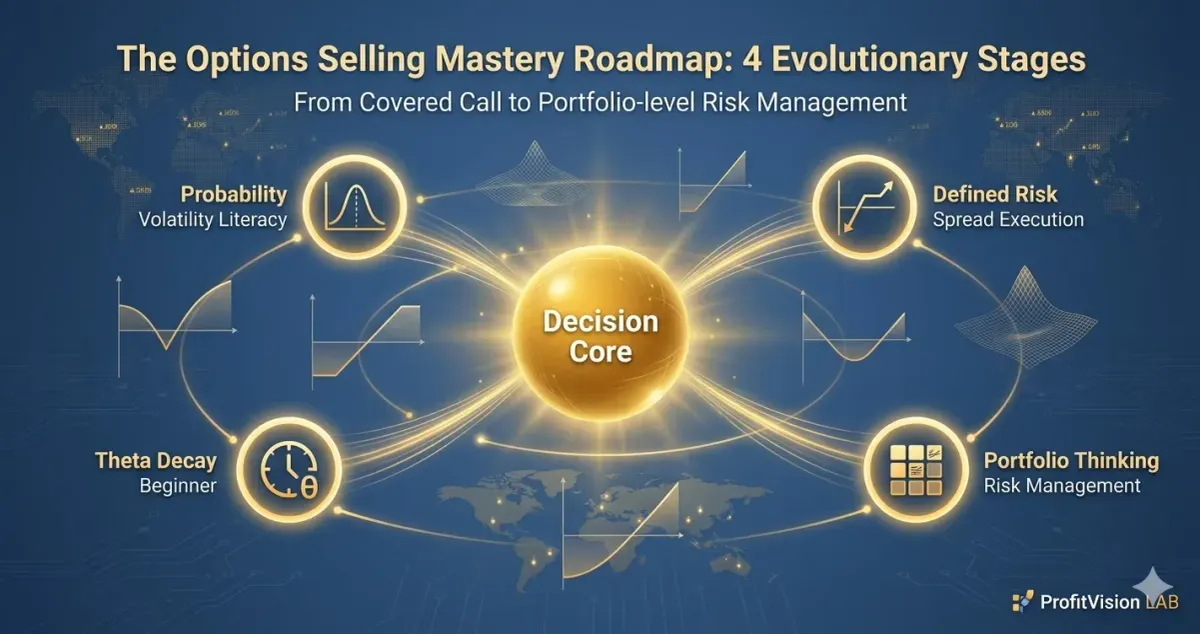
A complete evolution map for options sellers — from your first Covered Call to portfolio-level thinking. Includes a 6-step Bull Put Spread execution SOP and the 10 mistakes most likely to blow up your account.
📋 Key Takeaways
- Options selling evolves through four distinct stages: Survival, Volatility Literacy, Defined Risk, and Portfolio Thinking
- The Bull Put Spread SOP: strong stock selection → IV Rank confirmation → strike below support → 30–45 DTE → 50% profit target → 1–3% max risk per trade
- The most common blowup causes: over-leveraged margin, misunderstanding IV Crush, and absent stop-loss rules
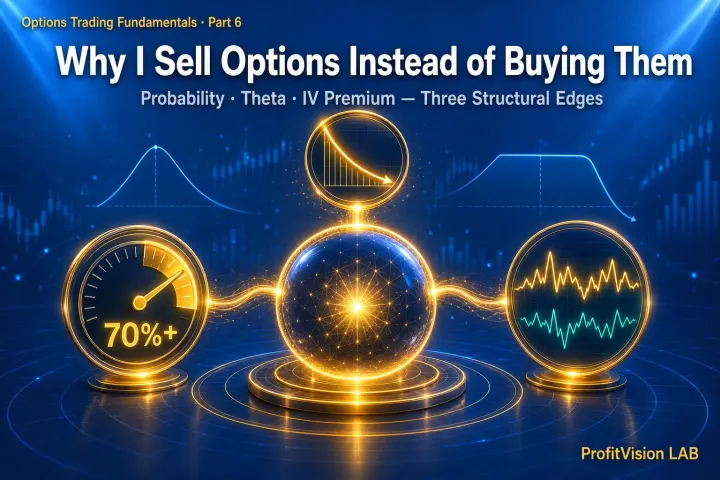
- The real edge of options selling is not win rate — it's the systematic collection of volatility risk premium over time
After working with hundreds of retail traders entering the options market, I've noticed a consistent pattern: most people start by buying calls and puts — betting on direction, betting on timing. Occasionally they double their position on a lucky trade, but more often they lose everything. Then they lose confidence in options entirely.
Selling options operates on an entirely different logic. Options sellers price risk — they don't predict direction. The role you play is closer to an insurance company than a casino gambler. But this mindset shift doesn't happen overnight — it requires a staged cognitive upgrade, and the right tools at each stage.
This article lays out what I believe to be the complete growth path for US options sellers: four learning stages, a six-step Bull Put Spread execution framework, and the ten mistakes most likely to destroy your account.
Four Core Concepts Before You Trade
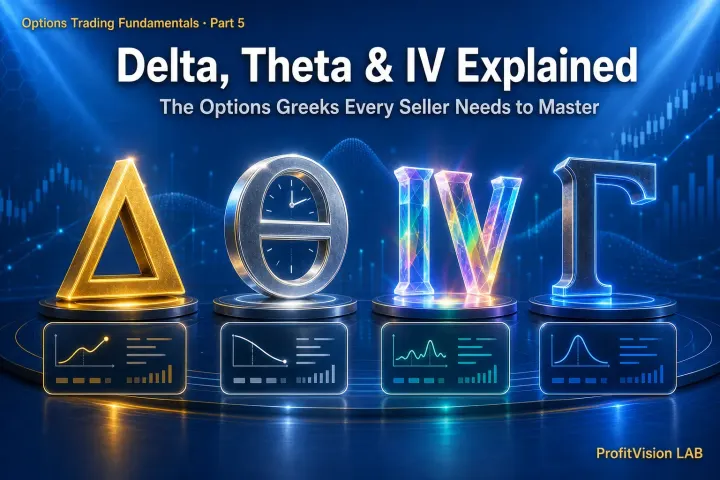
Before learning any selling strategy, you must be able to explain these four concepts in your own words. They are the fundamental language of every decision you'll make as an options seller.
Measures how much an option's price changes when the stock moves $1. Selling a Put carries negative Delta — the position loses value as the stock falls. Managing Delta is how sellers control directional risk.
The daily erosion of an option's time value. One of the seller's primary profit sources: every day that passes, the option you sold loses a little value. Theta decay accelerates dramatically in the final 30–45 days before expiration.
The market's expectation of future price movement — and the direct driver of option premiums. Higher IV means more expensive options, which favors sellers. But high IV also signals elevated risk and potential gap moves.
Where current IV sits relative to the past year's range, expressed as a percentile. IV Rank of 70 means current IV is higher than 70% of readings over the past year — a signal of elevated fear premium and a potential seller's opportunity.
The Options Seller Roadmap: Four Stages
The evolution of an options seller is never linear. Each stage has a specific mission — skip any one of them and you'll pay the tuition eventually. I've seen too many traders jump straight from Stage 1 to Stage 3 strategies and get wiped out in the first significant market move.
| Stage | Timeline | Core Mission | Primary Tools |
|---|---|---|---|
| Stage 1 — Survival | 0–6 months | Don't blow up | Covered Call, CSP |
| Stage 2 — Volatility Literacy | 6–18 months | Understand IV dynamics | IV Rank, Vega |
| Stage 3 — Defined Risk | 1–2 years | Cap maximum loss structurally | Bull Put Spread, Iron Condor |
| Stage 4 — Portfolio Thinking | 2+ years | Manage total portfolio risk | Correlation, Net Delta |
This stage has exactly one objective: stay alive. Don't let a single loss be large enough to take you out of the game permanently.
Learn only two strategies: Covered Calls (sell calls against stock you own to collect premium) and Cash Secured Puts (sell puts with full cash collateral, willing to take assignment). Both carry built-in risk guardrails.
Simultaneously, you must genuinely internalize four concepts: Delta, Theta, IV, and Assignment risk. These aren't optional vocabulary — they're the operating language for every decision ahead. Without them, every later strategy is built on sand.
In this stage, you encounter a critical realization: the stock can move in your favor and your options position still loses money. This is possible — and common.
The culprit is volatility. Post-earnings IV Crush (IV collapsing 40–60% after results), fear-driven Volatility Expansion — these forces move your positions independently of stock price. Your job now is to evaluate the volatility environment before entering any trade.
The core skill: learning to distinguish between "high premium from justified fear" versus "high premium from genuine uncertainty you shouldn't be selling into." IV Rank is your primary tool.
This is the critical pivot. You begin using defined risk structures — buying a further out-of-the-money option to cap your maximum loss.
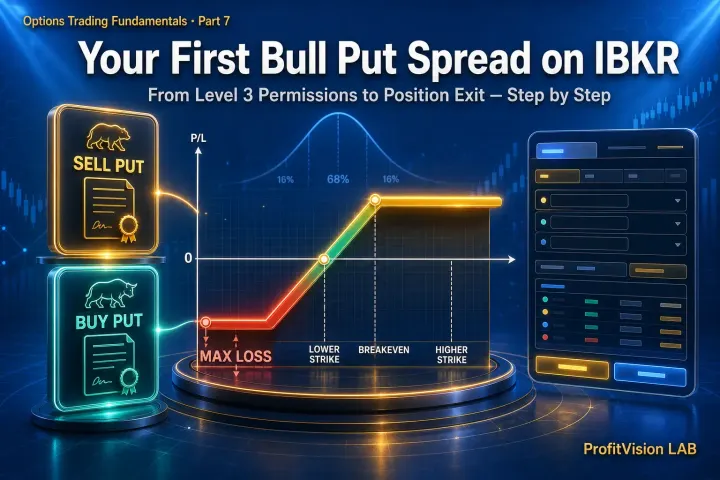
The Bull Put Spread (sell a higher-strike Put, buy a lower-strike Put) and the Iron Condor (dual spreads) become your core instruments. Maximum loss transforms from "theoretically unlimited" to a fixed, calculable number. This structural change means you can survive a black swan event — not because you predicted it, but because the structure already limits the damage.
Capital efficiency also improves substantially: the same account can be spread across more positions rather than concentrated in a single naked exposure.
At this level, you've stopped thinking about whether any single position will be profitable. You think about the risk structure of your entire portfolio.
Your focus shifts to: Correlation between positions, Sector Exposure concentration, Net Delta (your aggregate directional bet), Liquidity Risk (can you exit if needed?), and the current Macro Volatility Regime (low-vol trend vs. high-vol spike environment).
What you manage is no longer a trade — it's a book. Your job is to diversify underwriting, control maximum claims, and keep long-run expected value positive. You're no longer a retail trader. You're running a small insurance company.
Bull Put Spread Execution SOP: 6 Steps
The Bull Put Spread is the strategy I recommend most strongly for options sellers building their core framework: defined risk, Theta-friendly, and structurally advantaged on strong stocks. But execution discipline is non-negotiable — every one of these six steps is mandatory.
-
1
Only Trade Strong Stocks — Never Distressed Tickers
The Bull Put Spread is a bullish-leaning strategy: you're betting the stock won't drop significantly. Underlying selection is therefore your first and most important filter. Required conditions: strong Relative Strength, institutional accumulation visible in price action, earnings growth momentum, price above the 50-day moving average, participation in leading market themes.
Never sell Puts on weak or troubled stocks just because the IV is high. High IV on a weak stock is the market pricing in genuine downside risk — not an opportunity, a warning. The premium looks rich precisely because the danger is real.
✅ Strong RS · Institutional Flow · Earnings Growth · Above 50MA -
2
IV Rank Above 35 — Confirm the Volatility Premium Exists
The structural edge of options selling derives from the Volatility Risk Premium (VRP) — markets persistently overestimate future volatility, and sellers systematically collect that overpayment. IV Rank tells you how expensive the current premium is relative to the past year. The higher the rank, the fatter the edge.
Below IV Rank 35, premiums are thin, the statistical edge narrows, and the risk-reward of selling deteriorates. It's better to wait than to force a trade into an environment with no premium to collect. No premium, no seller's advantage.
🎯 IV Rank > 35 = Volatility Premium Present -
3
Strike Selection: Place Risk Below Key Support
Support levels are the market's psychological lines in the sand. Positioning your Short Put strike below a key support zone means your maximum-loss scenario requires the stock to first break support and then continue falling through your Long Put strike — requiring a sustained, significant move against you.
Example: stock at $120, support at $105 — sell the $100 Put, buy the $95 Put. Maximum loss only occurs below $95, requiring a break of support plus an additional 10% decline. This structure provides a meaningful buffer even when your directional read is slightly off. Avoid striking at round numbers and prior swing lows — these are frequently tested.
📌 Short Put = Below support, not at it -
4
Target 30–45 DTE — The Theta Acceleration Sweet Spot
Theta decay is not linear. In the 30–45 days before expiration, the rate of decay accelerates meaningfully — this window maximizes Theta revenue while Gamma risk (the extreme position sensitivity that builds in the final days) remains manageable.
Too long (60+ days): slow Theta, low capital efficiency, too much time tied up per unit of premium. Too short (under 14 days): Gamma dominates, any small price move can create outsized position swings that are difficult to manage within a disciplined framework. The 30–45 DTE window is where the math consistently works best.
⏰ 30–45 DTE = Optimal Theta Window -
5
Close at 50% Profit — No Exceptions
This is the discipline most new sellers resist most strongly — and the one most supported by data and the practice of experienced sellers. When a Bull Put Spread reaches 50% of its maximum premium collected, the remaining risk-reward becomes unfavorable: the last 50% of profit requires bearing nearly the same Gamma and event risk as the first 50%.
Close at 50%, free the margin, and deploy into the next opportunity. Over a full year of trading, capital efficiency from consistent 50% closes far exceeds the yield from "holding to the last dollar." Discipline here compounds into a structural advantage.
🏆 50% Profit Target = Close and redeploy -
6
Never Risk More Than 1–3% of Capital on a Single Trade
This is the floor of the entire system — and the only guarantee of long-term survival. Black swan events are not hypothetical tail risks. They are statistical certainties that repeat every few years in different forms. The question is never if one will occur, only when.
With maximum loss per trade capped at 1–3% of capital, even five consecutive maximum-loss events leave you with over 85% of your capital intact, fully operational, and positioned to benefit when conditions normalize. Blowup is the only true game-over — not a losing streak, but losing the ability to keep trading. This single rule prevents that outcome. (This is the foundation of the 5% Risk Unit framework.)
🛡️ Max Risk Per Trade: 1–3% of Total Capital (5% Risk Unit Framework)
10 Mistakes That Blow Up Options Sellers
Every mistake below corresponds to a real account I've seen damaged or destroyed. These aren't theoretical warnings — they're documented patterns from observing hundreds of retail traders navigate the options market.
The premium looks attractive. The gap risk is equally extreme. A bad earnings print or surprise news can produce an overnight -20% move on high-vol names. Naked positions have zero structural protection. High IV always requires a defined-risk structure.
You think you're collecting Theta. You're actually selling gap insurance. After earnings, IV collapses 40–60% regardless of direction. IV Crush losses frequently exceed any gain from the directional call. Do not sell the week before earnings. Full stop.
Win rates above 80–90% are common for options sellers. This does not mean low risk. A single unmanaged maximum-loss event can erase ten winning trades. A 99% win-rate strategy with a 20x loss on the 1% is a negative-expected-value strategy. Win rate and risk are unrelated.
When the market moves fast and hard, a margin call forces you to close at the worst price at the worst time. Always maintain 30–40% buying power reserve. This is not conservatism — it's the structural condition that lets you survive a spike and stay in the game.
An option with a wide bid-ask spread costs you 1–3% the moment you enter. Only trade strikes with sufficient open interest and volume. In a fast-moving market, illiquid options become impossible to exit at reasonable prices — at precisely the moment you need to most.
The stock didn't fall — but your put spread still lost 40%. That's IV Crush in action. When IV drops sharply post-earnings, Vega losses can completely overwhelm Theta gains. Selling options before earnings without understanding this mechanism is selling blind.
After a drawdown, the instinct to "make it back" with an oversized position is the most dangerous psychological pattern in options trading. Losses don't cause blowups — "recovery trades" with multiplied risk do. Any thought of "just one big trade to get even" is a stop signal, not a go signal.
Professional sellers lose small frequently — losing is part of the job description. The question isn't whether you'll have losing trades; it's whether your losses are capped by a pre-defined rule. A standard framework: close any position when the loss reaches 2x the maximum premium collected. No deliberation required.
Holding positions across multiple tech-related names looks diversified on the surface. In a systematic risk-off selloff, highly correlated names move together. Genuine diversification requires cross-sector, cross-Beta spread — not just multiple ticker symbols within the same industry cluster.
A strategy that printed consistently in a low-VIX trending market may fail completely in a high-VIX, mean-reverting environment. Volatility regimes shift every few years. Your strategy must evolve with market conditions — static systems applied to dynamic markets eventually fail.
Frequently Asked Questions
"The real edge of options selling is not a high win rate."
It's —
the sustained, systematic collection of market fear premium over time.
Markets perpetually overprice panic. Your job is to price it — not be carried away by it.
Four stages, one execution SOP, ten failure patterns — this roadmap has no shortcuts. But every options seller who has survived long-term in US markets has passed through these checkpoints, and paid tuition somewhere along the way.
Options selling is not a wealth-acceleration machine. It is a systematically buildable skill set. Its core principle never changes: define your maximum loss, put time on your side, and let fear premium flow consistently toward your account.
If you're currently in Stage 1, don't rush to Stage 3 strategies. Staying alive is the prerequisite for everything that follows.
Shiba the Disciplined · Founder, ProfitVision LAB
Focused on systematic US options selling with a risk-first framework. Founder of ProfitVision LAB, dedicated to teaching traders how to think structurally — not just follow signals. Core methodologies: The Four-Layer Defensive Screen and the 5% Risk Unit framework. The Discipline of Options: Think with me, not just trade with me.
I teach you how to think, not just what to do
Comments ()