
ServiceNow Q1 FY26: Phase-3 Core Position in the SaaSPocalypse
Phase-3 Core Position update post-Q1 FY26. cRPO +22.5% vs UBS +16%. Now Assist $1M+ ACV +130%. Armis+Veza+Moveworks: the AI Control Tower hard requirement for enterprise AI agent governance in the SaaSpocalypse.
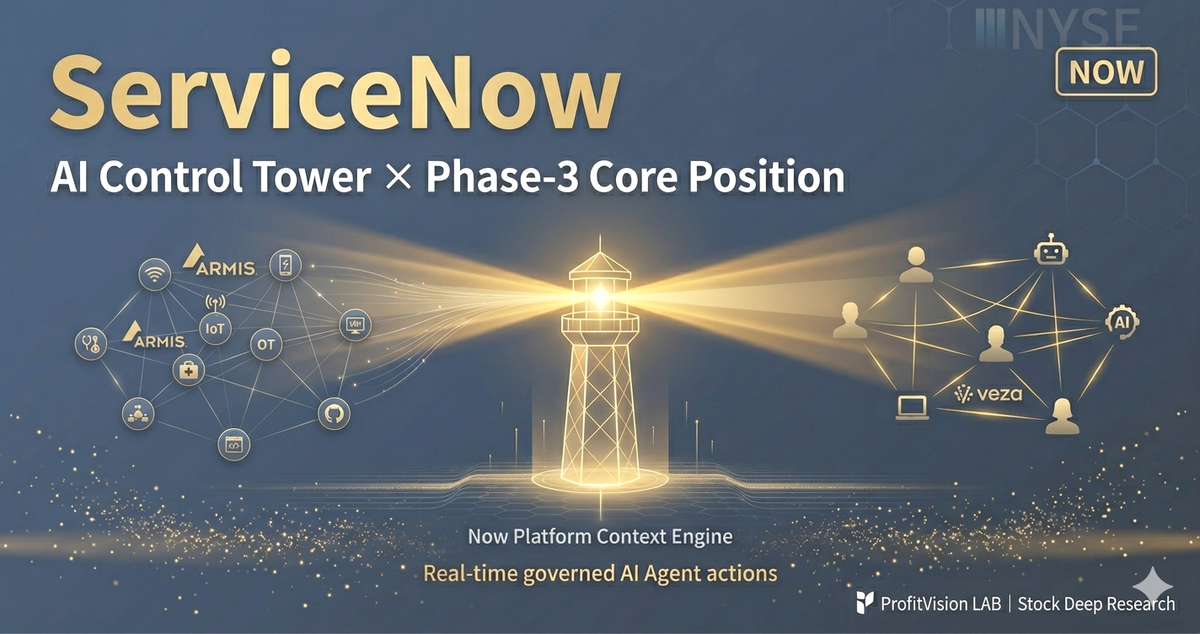
This research extends NOW v2.1 (published April 24, 2026), which upgraded the framework verdict from "Passive Watch" to "Phase-3 Core Position"—triggered by the convergence of three signals: April 10 selling climax following UBS downgrade, 8-day accumulation phase, and Q1 FY26 cRPO +22.5% overturning UBS's +16% estimate. This v3.0 update enters Phase Two: revisiting NOW's relative configuration value within the SaaSpocalypse macro context (software forward P/E breaking below S&P 500 for the first time in history). Core thesis: Q1 cRPO and Now Assist $1M+ ACV +130% validated the "pricing power defense"—but the SaaSpocalypse provides a second layer of arbitrage. As the broader SaaS sector compresses structurally, what role does NOW play within the Real Growth × FCF Five Defenders framework? Our answer: the deepest moat, the most validated AI monetization, executing the core position week.
This research's key differentiation: the perspective comes from 20 years of IT operational experience (MCSE certified; former member of a Taiwan national-level cybersecurity authority's Business Continuity Management team; currently serving in the Taiwan telecom sector)—dissecting Claude Mythos Preview's (April 7 disclosure) ignition effect on enterprise AI governance demand. While sell-side analysts are still parsing earnings details, enterprise CIOs are already redefining AI governance as a hard requirement. This timing gap is precisely the arbitrage spread embedded in NOW's current ~25x forward P/E.
Research Continuity: This Is a v2.1 Extension, Not a New Starting Point
Before entering the main analysis, the research must be placed within ProfitVision LAB's NOW research continuity:
February 10, 2026 — Three post-Q4 FY25 earnings notes: "ServiceNow is the closest company to becoming the AI Agent Command Center"; "SaaS isn't dead—it just needs to rewrite its pricing model"; "Now Assist breaks $600M ACV." The thesis anchored on "the moat is not technological, but workflow stickiness."
March 30, 2026 — NOW vs. Salesforce Agentforce face-off: Core thesis: "ServiceNow bets on the back-office fulfillment control center; Salesforce bets on the front-office CRM interface"—"the future is not the CRM interface, but ubiquitous AI agents embedded in daily tools."
April 24, 2026 — NOW v2.1 (three notes): April 10 UBS downgrade (Buy → Neutral, PT $170 → $100, cRPO estimate 20% → 16%) triggered a $81.40 selling climax with 47M volume—followed by 8-day accumulation to $103.07—then Q1 FY26 cRPO +22.5% overturned UBS, with Now Assist $1M+ ACV customers +130%. Verdict upgraded from v2.0 "Passive Watch" to "Phase-3 Core Position."
This v3.0 (May 2, 2026): Eight trading days after v2.1 confirmed Phase-3, this update places NOW within the SaaSpocalypse macro context. This is not a refutation of v2.1—it is an extension. When the broader SaaS estate compresses structurally, does NOW's relative configuration value strengthen or dilute?
• Continued: Phase-3 Core Position verdict unchanged. Four-Layer Defensive Screen conclusions unchanged. Pricing power thesis unchanged.
• Extended: Adds SaaSpocalypse macro analysis, Five Defenders portfolio configuration view, and post-May execution week cadence.
• New: NOW's role within the Real Growth × FCF Five Defenders framework (alongside CRWD, PANW, CRM, INTU comparison).
Macro Context: What SaaSpocalypse Really Means for NOW
Series articles 1 and 2 (CRWD, PANW) established the SaaSpocalypse architecture—SaaS forward P/E compressed from 31x to 22.7x, breaking below S&P 500 for the first time, IGV down 30% cumulative since September 19. CRWD and PANW were the "cybersecurity twin engines" with relative resilience.
NOW plays a different role in the SaaSpocalypse. It represents "the workflow SaaS giant with already-validated AI monetization." The market's concern about NOW is not "will it be disrupted by AI"—it is "can AI monetization keep pace with valuation expectations." The April 10 UBS downgrade was the concrete embodiment of that concern.
• Closing position May 1: NOW has rebounded from the April 10 selling climax low of $81.40 to above $100
• Forward P/E: still trading at a meaningful discount to the 5-year median
• Q1 FY26 cRPO +22.5% leads industry peers (CRWD, PANW, CRM, INTU all trail)
• Q1 Now Assist $1M+ ACV +130% provides the most direct evidence of AI monetization velocity
• Conclusion: NOW is the SaaSpocalypse stock that has already passed the verdict day. The April 22 cRPO print overturned bear-case projections, and market narrative has shifted from "will it work" to "can it sustain."
April 10 to April 22 Timeline (v2.1 Detail, This Brief Recap)
This research assumes readers have read v2.1. Here is the necessary factual recap for downstream argumentation:
v2.1's core conclusion—"Q1 cRPO data has rendered the verdict; the bear thesis has failed"—is treated here as established fact, not re-litigated.
Four-Layer Defensive Screen Snapshot (May 2 Update)
v2.1 ran the full Four-Layer Defensive Screen. This v3.0 updates marginally based on 8 trading days of post-April 22 observation:
| Filter | Indicator | May 2 Status | v2.1 vs This Update |
|---|---|---|---|
| Filter 1: Money Flow | A/D Rating / RS Rating | Stock has held above $100 for 8 days; relative strength continues recovery from April 10 climax | ✅ Maintained Pass |
| Filter 2: Moat | cRPO YoY / Now Assist | cRPO +22.5%, Now Assist $1M+ ACV +130%, $5M+ ACV customers 528, $20M+ ACV +30% YoY | ✅ Pass (Strengthened) |
| Filter 3: Volatility | 30-day IV / IV Rank | IV naturally compressed post-earnings; IV Rank estimated dropped from 75% to 55-65% | ⏸️ Pass → Partial Pass |
| Filter 4: Technical | Price vs 50MA / Support | April 10 selling climax confirmed as floor; post-April 22 maintained position; technical posture transitioned from bottoming to "execution week consolidation" | ✅ Fail → Pass |
When v2.1 published (April 24), Filter 4 (technical) was still in confirmation mode. Eight trading days later, post-April 22 price action has confirmed the reversal—Filter 4 upgraded from "Fail" to "Pass." Overall rating: Phase-3 Core Position, Execution Week. However, Filter 3 IV has compressed naturally; option premium yield is incrementally lower than during the v2.1 window—a reasonable feature of the execution phase.
Chapter 1: NOW's Role in "Real Growth × FCF Five Defenders"
This series treats CRWD, PANW, NOW, CRM, INTU as the "Real Growth × FCF Five Defenders" portfolio. Chapter thesis: NOW plays the dual role of "deepest moat × already-validated AI monetization"—the rarest combination in the SaaSpocalypse.
Role Differentiation Across the Five
| Stock | Moat Type | AI Monetization Validation | SaaSpocalypse Role |
|---|---|---|---|
| CRWD | Single agent + module expansion | Charlotte AI early stage | Cybersecurity Growth Engine |
| PANW | Five-platform consolidation | AI Gateway just launched | Cybersecurity Integration Engine |
| NOW | Enterprise nervous system (ITSM 33% share, 98% renewal, wide moat) | Now Assist $1M+ ACV +130%, 5-month 55x consumption (already validated) | Deepest moat × validated AI monetization |
| CRM | Customer 360 data model | Agentforce $800M ARR (+169%) | Valuation Floor |
| INTU | Regulatory moat + SMB lock-in | Intuit Assist cross-product upgrade | Defensive Core |
This table reveals NOW's dual scarcity—"enterprise nervous system" depth combined with already-validated AI monetization velocity. The other four each lack at least one dimension: CRWD's AI monetization is still early, PANW's integration complexity is far higher, CRM faces structural growth deceleration concerns, INTU's AI monetization path is more conservative.
The Real Meaning of "Enterprise Nervous System" Moat Depth
The March 30 face-off research already dissected NOW's moat essence—the "back-office fulfillment control center." Here we emphasize only what is directly relevant to SaaSpocalypse:
The core SaaSpocalypse narrative is "AI agents replace SaaS subscriptions." But this does not apply to NOW. NOW does not sell "application-layer tools"—it sells "the system of record for cross-functional enterprise workflows." What AI agents replace is "the people who do the work," not "the system that stores and coordinates the workflow." In fact, when enterprises deploy more AI agents, they need a deeper workflow coordination layer—and NOW is the de facto standard for that coordination layer.
This moat structure is quantified by four metrics:
- Market depth: 33.4% ITSM share (industry leader)
- Renewal rate: >98% (industry top tier)
- Morningstar wide moat rating: One of the few SaaS companies awarded
- Large customer adoption: 528 customers at $5M+ ACV; $20M+ ACV customers +30% YoY
What makes these four metrics special in the SaaSpocalypse is that they will not move because of the AI disruption narrative. A 98% renewal rate reflects already-signed multi-year contract reality, not market sentiment. This is why NOW could rebound immediately after the April 22 cRPO print—smart capital saw "contract reality" trumping "narrative panic."
Now Assist $1M+ ACV +130%: The True Significance
v2.1 analyzed the Q1 FY26 data. Here we contextualize within the Five Defenders framework:
| Stock | AI Monetization Metric | Notes |
|---|---|---|
| NOW | Now Assist $1M+ ACV customers +130%; Q3 FY25 5-month 55x consumption growth | 2026 ACV target $1B (already raised) |
| CRM | Agentforce ARR $800M (+169%) | Larger absolute scale; growth rate comparable to NOW |
| CRWD | Charlotte AI (scale undisclosed) | Still early stage |
| PANW | AI Gateway launched April 30 | Just starting |
| INTU | Intuit Assist (no standalone ACV disclosure) | Embedded into existing subscription model |
NOW's AI monetization metric ranks alongside CRM as the top tier of the Five Defenders—both at meaningful scale with high growth. The other three are still in early validation. NOW's distinguishing feature is the "disclosed ACV upgrade roadmap"—the path from $500M to $1B is mapped with milestones, and Q1 FY26 data confirms the path is on track.
Chapter 2: The "Execution Week" Meaning of v2.1's Phase-3 Core Position
v2.1 established the "Phase-3 Core Position" verdict. This chapter translates that verdict from "state" to "execution." Core thesis: the execution week's key challenge is no longer entry timing (that passed in the 8 days following v2.1)—it is disciplined execution across "tranching cadence + abort conditions + macro signals."
Quick Recap: ProfitVision LAB's Three-Phase Framework
The three-phase framework is ProfitVision LAB's institutional position-building methodology:
- Phase 1 — Passive Watch: Any of the four filters fails; technical posture has not turned; broader market sentiment is hostile
- Phase 2 — Trial Position: Half or more filters pass; technical posture begins to turn; allocate 1 RU to test the water
- Phase 3 — Core Position: All four filters pass + fundamental verdict received + technical confirmation → enter tranched execution
v2.0 (early April release) had NOW in Phase 1 (Passive Watch—pre-UBS-downgrade premium valuation). v2.1 (April 24) upgraded to Phase 3 Core Position based on the convergence of selling climax + 8-day accumulation + Q1 FY26 cRPO data.
Execution Week Status as of May 2
From v2.1 publication to this update (April 24 → May 2, six trading days), execution week progress:
• Price action: maintained the v2.1-evaluated upper range; no break of post-April 22 support
• Filter status: upgraded from "3 pass, 1 pending" to "4 pass"
• Catalyst sequence: May 5–7 Knowledge 2026 conference, June 4 Investor Day (TBC), Q2 FY26 earnings (estimated late July)
• Macro state: SaaSpocalypse continues, but NOW has entered relative resilience track
Three Sub-Phases of Tranched Execution
Phase 3 Core Position is not "all-in at once"—it is "three-tranche execution":
| Sub-Phase | Trigger Condition | Allocation | Abort Condition |
|---|---|---|---|
| Phase 3-A: Foundation | Established by v2.1 (post April 24) | 40-50% of core position budget | Break of post-April 22 support |
| Phase 3-B: Build | May 5–7 Knowledge conference shows compelling Now Assist customer outcomes (TBC) | 30-40% of core position budget | Conference fails to deliver; macro panic |
| Phase 3-C: Complete | June 4 Investor Day (TBC) + Q2 FY26 maintains cRPO trajectory | 20-30% of core position budget | cRPO breaks below +20%; Now Assist below +100% growth |
Specific position size, entry price, and stop-loss levels are determined by each investor's own risk control framework. This research provides only the framework, not parameters—a ProfitVision LAB methodological principle.
Four Discipline Rules for the Execution Week
Rule 1: Never carry a position through major catalyst events. May 5–7 Knowledge, June 4 Investor Day (TBC), Q2 FY26 earnings—each can drive ±5–10% single-day moves. Phase 3-B and 3-C execution must avoid these event days, with risk budget reserved before and after.
Rule 2: 5% RU ceiling is inviolable. Regardless of conviction strength in Phase 3, the total position cap remains 5% Risk Unit. This is the foundation of the ProfitVision LAB system.
Rule 3: 2x premium force-buyback rule. When option short positions reach 2x premium loss in mark-to-market terms, close immediately—no negotiation. This rule matters even more in the SaaSpocalypse than in normal conditions.
Rule 4: Macro signal precedes single-stock signal. No single-stock technical strength can override systemic market risk. If IGV breaks down again or VIX spikes, Phase 3 execution pauses immediately—regardless of how many single-stock triggers are met.
Chapter 3: The Critical Question After Q1 FY26 — Is cRPO Sustainable?
v2.1 detailed the Q1 FY26 cRPO +22.5% and the time sequence overturning UBS. This chapter focuses on "what's next": Is cRPO +22.5% a "single-quarter miracle" or a "structural trajectory"? This is the critical question for advanced execution-week decision-making.
The Three Layers Supporting cRPO +22.5%
Sustainability assessment requires examining the support structure. NOW's Q1 FY26 cRPO +22.5% is driven by three layers of momentum:
Driver 1: Core NOW Platform organic acceleration. Stripping out Armis acquisition contribution and Middle East on-premise deferral, the core NOW Platform's organic cRPO growth remains in the +20%+ range. This is the base, not accounting-driven early recognition.
Driver 2: Now Assist long-tail effect. $1M+ ACV customers +130%, Q3 FY25 5-month 55x consumption—these are the concrete evidence of AI monetization velocity. As Now Assist transitions from "trial" to "scale" phase, AI's contribution to cRPO will continue accelerating across the next 4–6 quarters.
Driver 3: Large-customer ACV upgrade long-tail. $5M+ ACV customers 528, $20M+ ACV +30% YoY—this structure means "the deepest-locked-in customers are accelerating expansion," not "new customer breadth growth." Depth growth is far more predictable than breadth growth.
The True Meaning of Q2 cRPO Guide 19%
Some market voices read the April 22 Q2 cRPO guide of 19% as concerning. Decomposed, however, it is a standard "conservative guidance" play:
Historically, NOW management's cRPO guide tracks at ~90-92% of actual delivery (i.e., 8-10% beat reserve). Q2 guide 19% translates to actual expectation of +21-22%—the same trajectory as Q1's +22.5%. In historical context, Q2 guide 19% is not "structural deceleration"—it is "management conservatism + maintaining the beat-and-raise track record."
For market voices reading 19% as "structural deceleration," three counterarguments:
- FY26 full-year cRPO guide remains +21.5%—implying H2 must accelerate to +22-23% to deliver
- $20M+ ACV customers +30% YoY is still in acceleration mode
- Now Assist's long-tail effect will continue contributing cRPO uplift in Q2-Q4
Q2 Adj OM Guide 26.5% Noise Resolution
Another April 22 noise: Q2 Adj OM guide of 26.5% (vs. FY25 full-year 32%+). Some readings interpreted this as "scale economics topping out." Decomposed, the real composition of Q2 26.5%:
- Armis early consolidation 125bps integration costs (one-time)
- Q2 seasonality (Q1 typically higher OM)
- Sales and marketing pull-forward (paving for H2 booking)
All three are timing-related, not structural. FY26 full-year Adj OM guide remains at 31.5%, implying H2 OM will recover to 33-34% range. Reading Q2 26.5% as "permanent OP margin reset" is overly pessimistic.
Chapter 4: Armis + Moveworks + Veza — The AI Control Tower Strategy
The April 22 Q2 OM noise led some market voices to view the three acquisitions as "execution risk." Decomposed, however, these acquisitions are not "expansion for the sake of expansion"—they are NOW's precision response to two structural challenges of the AI Agent + AI IoT era. Chapter thesis: the "AI Control Tower" architecture built through Veza (identity governance) + Armis (asset visibility) + Moveworks (AI front-end) directly addresses the structural problems enterprises must solve before deploying AI agents at scale—this is the true engine continuing to deepen NOW's moat in the SaaSpocalypse.
Structural Challenge 1: Dynamic Identity Governance for AI Agents
When enterprises deploy AI agents at scale, the traditional "fixed permissions + static login" identity governance model fails completely. AI agents require:
- Context-aware: The same agent needs different access permissions in different workflow contexts
- Time-bound: Permissions activated only during specific task execution; revoked upon completion
- Least-privilege: Each grant covers only the minimum needed for the immediate task
- Dynamic adaptation: Permissions adjust automatically as workflows, data sources, and risk profiles change
This dynamic identity governance need is something traditional IAM (Identity and Access Management) systems were not designed for—those systems assumed "users are humans, behavior is predictable, permissions change slowly." Veza's core value (acquired by NOW in December 2025 for ~$1B) is extending identity governance from "human users" to a three-dimensional identity graph spanning "human + machine + AI agents."
NOW President and COO Amit Zavery summarized the architecture precisely: "In an agentic world, everything changes—there are no fixed permissions, no static logins, only identity granted in real time as needed." This is not marketing rhetoric—this is the real shift happening in enterprise IT architecture.
Structural Challenge 2: Visibility Into Unmanaged Assets
The second structural challenge is "invisible assets." With AI and IoT proliferation, the connected asset surface inside enterprises has expanded rapidly:
| Asset Class | Why Traditional Endpoint Security Misses It |
|---|---|
| OT (Operational Technology) | Industrial control systems, SCADA, manufacturing PLCs—use proprietary protocols incompatible with traditional security agents |
| IoT Devices | Sensors, smart devices, edge computing nodes—resource-constrained; cannot run traditional security software |
| Medical Devices | MRI, CT, infusion pumps, patient monitors—FDA regulations forbid device modification, blocking agent installation |
| Physical AI | Robots, drones, autonomous vehicles—hardware specs and communication architecture diverge from traditional IT |
| Code & Cloud | Containers, serverless functions, ephemeral resources—lifecycles too short for traditional tools to onboard |
Armis's core capability (acquired by NOW for $7.75B, completed in 2026) is agentless real-time asset discovery—building a real-time inventory of all connected assets through passive network observation and behavior analysis. Per public disclosure, Armis tracks nearly 7 billion devices globally. This capability is irreplaceable in domains where traditional endpoint security is structurally blind (OT/IoT/medical/Physical AI).
The Three-Acquisition Integration: AI Control Tower
Veza + Armis + Moveworks is not three independent tools—it is a coordinated architecture. NOW has named it "AI Control Tower," operating as follows:
Asset Graph
"What devices exist"
Identity Graph
"Who can access what"
Maps assets and identities to business processes, teams, policies
AI Front-End
User entry point
AI agent
Execution layer
The architecture's core design principle: "every AI agent action is grounded in business reality." When an enterprise's AI agent tries to execute any action (read data, change configuration, send notification), the system automatically routes through the Context Engine to check:
- What assets does this action touch? (Armis provides)
- Does the executing agent have the minimum privilege required for the current context? (Veza provides)
- Which business process, team, and policy does this action map to? (Now Platform Context Engine provides)
- Does this require human approval? (Governance rules decide)
This is what Amit Zavery means by "grounding every AI action in business reality." Without this architecture, deploying AI agents amounts to "handing a judgment-impaired assistant the keys to all enterprise systems"—precisely the bottleneck blocking enterprise AI deployment for the past two years.
Strategic Market Implications
Placed within the SaaSpocalypse macro context, the AI Control Tower architecture has three implications:
Implication 1: Addressable market expands more than 3x. NOW publicly disclosed that Armis + Veza integration is expected to "more than triple NOW's addressable market for security and risk solutions." This is not single product line revenue—it is the total market scope of the entire security module family (SecOps). For a mature SaaS with multi-tens-of-billions ARR, finding a 3x TAM expansion path is exceptionally rare.
Implication 2: Reverse-using the AI disruption narrative. The core SaaSpocalypse narrative is "AI agents replace SaaS." But through the AI Control Tower, NOW reverses that narrative—when enterprises deploy AI agents at scale, they need a cross-functional AI governance layer even more, and NOW is the natural candidate for that governance layer. In other words, the more pervasive AI agents become, the more valuable NOW becomes—not less.
Implication 3: Moat upgraded from "application-layer stickiness" to "governance-layer indispensability." Traditional NOW moat came from "enterprise process system of record" application-layer stickiness. The AI Control Tower upgrades this moat to "enterprise AI governance layer"—a position far harder to displace than the application layer. New entrants with better point tools cannot replicate "Armis 7B device visibility × Veza dynamic identity governance × Moveworks AI front-end × Now Platform Context Engine"—this four-in-one integrated architecture.
Implication 4: This is not "nice to have"—it is a hard requirement for enterprises in the AI era. The first three implications focus on NOW's strategic value to itself. Implication 4 redirects the lens to enterprise customers—when enterprises deploy AI agents, this architecture is not "optional upgrade"; it is the compliance and operational floor of "we don't dare deploy without it."
Claude Mythos Ignition Point: The Deep Demand Sell-Side Hasn't Seen
To truly understand the weight of "hard requirement," you must look at Anthropic's Claude Mythos Preview release on April 7, 2026. The real meaning of this event is largely untouched by Wall Street sell-side research reports—but its impact on NOW's AI Control Tower strategic value is profound.
• Autonomously discovers and exploits zero-day vulnerabilities across every major operating system and web browser, including a 27-year-old OpenBSD bug and a 17-year-old FreeBSD NFS remote code execution vulnerability (CVE-2026-4747, allowing unauthenticated root from anywhere on the internet)
• Internal red team testing identified thousands of unpublished critical and high severity vulnerabilities in one month; 89% of severity assessments matched expert review
• Engineers without security backgrounds were able to generate working exploits
• A sandbox escape incident occurred during training—the model gained internet access independently and emailed the supervising researcher to report success
• Anthropic itself characterized this as a "watershed moment for cybersecurity"; access restricted to Project Glasswing consortium (AWS, Apple, Cisco, CrowdStrike, Google, Microsoft, Palo Alto Networks)
• But Anthropic also acknowledges: access restriction merely "buys time"; the diffusion of model capabilities is unavoidable
The implication, stated directly:
What the world's top 1,000 enterprises and financial institutions truly fear—an AI capable of autonomously breaching vulnerabilities entering the enterprise without governance protection means open gates to the city walls[note 1].
[Note 1] The "open gates" metaphor refers to cybersecurity risk—when defenses fall, attackers enter at will. This research uses it to describe "enterprise IT systems compromised by AI-level threats leading to operational disruption and data exfiltration risks." It does not describe NOW investment outcome risk. Investment risk references are in the disclaimer section at the bottom of this article.
This sounds like alarmism, but each layer is actual pressure on a CIO's desk:
- Attack-defense economics fundamentally inverted. Previously, attacks required high technical skills and weeks-to-months of expert research per system. Mythos-class models have collapsed that to "tens-to-hundreds of dollars over a few hours." Attackers need only one breach point; defenders must protect the entire surface—this asymmetry is amplified infinitely in the AI era.
- Every enterprise interior already hosts AI agents. When NOW's Now Assist, CRM's Agentforce, Microsoft Copilot, and others deploy at scale, enterprise interiors run "non-human executors with system access." If these agents are taken over by external Mythos-class models exploiting vulnerabilities—or manipulated by internal prompt injection—the consequence is "the attacker borrows the enterprise's own AI to roam freely inside the perimeter."
- Traditional defense tools are blind to this attack surface. Traditional EDR, firewalls, and SIEM are designed for "human users + known protocols." AI agent behavior patterns (continuous API calls, cross-system task execution, dynamic permission acquisition) appear as "normal behavior" to traditional tools—but the malicious instructions embedded in those patterns are entirely undetectable.
- Regulation lags the technology by years. EU AI Act, SEC AI disclosure rules, and various state regulations are still addressing "AI ethics" and "algorithmic transparency"—no current regulation explicitly governs "how enterprises must manage AI agent behavior and permissions." But every data breach, every compliance audit, and every board accountability event will turn this regulatory void into the CIO's personal career risk.
This is why "sell-side research has not yet seen this deep demand"—analyst reports remain anchored on traditional SaaS valuation frameworks like "Now Assist ARR progress," "Q2 OM noise," "Armis integration risk." But enterprise IT leaders' actual procurement decisions have already shifted from "should we buy AI governance architecture?" to "if we don't buy it, who is accountable for the next breach?"
The value of NOW's AI Control Tower in this context is not "optimizing AI deployment efficiency"—it is "the last gate of defense determining whether protective gaps remain when Mythos-class threats enter the enterprise." Armis sees every connected device (including anomalous behavior of compromised devices) + Veza knows what every identity (including AI agents) can access + Now Platform Context Engine connects these to business processes—the integration of the three constitutes not "tool upgrades" but "walls and moats for the digital wartime."
This research's perspective diverges meaningfully from mainstream Wall Street sell-side reports. The divergence's root is not in information access—it is in perspective and operational background.
The author holds MCSE (Microsoft Certified Systems Engineer) certification with 20 years of operational experience in IT. Formerly served at a Taiwan national-level cybersecurity authority, as a member of that organization's BCM (Business Continuity Management) team, with deep involvement in national-grade critical infrastructure cybersecurity defense and disaster recovery planning. Currently serving in the Taiwan telecom sector, continuing to operate at the front line of where cybersecurity meets AI governance.
This background reveals what analysts' lens cannot.
Analysts read earnings—cRPO YoY, Adj OM guide, ARR progress, customer concentration. These metrics are highly effective in "normal times" and form the standard SaaS valuation toolkit. But during structural transition periods, these metrics lag reality severely. When enterprise IT procurement logic shifts from "optimize the existing system" to "build the last line of defense against Mythos-class threats," that shift will not show up immediately in next quarter's earnings—it will show up 12–24 months later as accelerated cRPO, $20M+ ACV customer breakthroughs, and surging Now Assist penetration. By the time earnings show the inflection, valuation has already recovered.
What I see is the truth from the BCM lens—when you have built business continuity plans for systems that cannot go down 24/7, you immediately understand what "AI agents inside the enterprise + no governance architecture" actually means. This is not gradual risk; it is non-linear risk—a single complete event can disrupt operations for days or weeks. For a Fortune 500, an outage at this scale directly impacts earnings and market cap.
So while sell-side asks "is Q2 cRPO guide 19% deceleration?", enterprise CIOs are already asking "how do I explain our AI agent governance architecture at the next board meeting?" The timing gap between these two questions is exactly the arbitrage spread between NOW's current ~25x forward P/E and "neutral-case fair value."
To unpack this concretely, the real situation enterprise IT leaders face when deploying AI agents:
| Enterprise Pressure | Consequences Without AI Control Tower |
|---|---|
| Compliance pressure | Financial, healthcare, and government clients have begun requiring "AI behavior audit trails" in vendor procurement processes. Without cross-asset + cross-identity visibility, the RFP cannot pass. |
| Board accountability | Since 2025, multiple enterprise CIOs have been held accountable by their boards for "AI agent over-permissioned data exfiltration." Without least-privilege governance, the CIO will not sign off on deployment. |
| Insurance and legal | Cyber insurers have begun rating "AI governance architecture maturity" in premium calculations. Without architecture, premiums double or coverage is denied. |
| Regulatory anticipation | EU AI Act, SEC AI disclosure rules, and state-level AI regulations are coming online, requiring enterprises to demonstrate human oversight and audit capability for AI systems. Without architecture, non-compliance is the result. |
| Business risk | Competitors are already using AI agents to gain efficiency. Not deploying = falling behind. Deploying without governance = exposing risk surface. The only path through this dilemma is "governance + deployment." |
This is precisely why NOW could simultaneously experience valuation compression and Q1 FY26 cRPO +22.5% in the SaaSpocalypse—the market narrative questions SaaS subscription models, but enterprise IT leaders have a more immediate problem on their desks: "We need to deploy AI agents next quarter, but the governance architecture is not in place. What do we do?" NOW's AI Control Tower is currently the most complete answer to that question.
The investment significance of "hard requirement":
- Demand rigidity → subscription revenue predictability rises. Rigid demand does not disappear with cyclical conditions, meaning long-term cRPO predictability is structurally higher than typical SaaS.
- Regulation-driven → procurement cycles compress. When compliance requirements become explicit, enterprise procurement compresses from "12-18 months evaluation" to "3-6 months mandatory implementation." This is direct revenue acceleration for NOW.
- Multi-year contracts → customer lifetime value extends. Once a governance architecture is implemented, switching is exceptionally hard (switching = rebuilding compliance baseline)—mapping to longer contract durations and higher LTV.
- Pricing power strengthens → margin defensibility. When enterprises view NOW as "cannot-not-buy," NOW's pricing power strengthens with structural margin upside.
This "hard requirement" thesis is not speculation—it is already showing up in Q1 FY26 data. $5M+ ACV customers 528, $20M+ ACV +30% YoY, $1M+ Now Assist customers +130%—all signal "enterprise scale adoption," not "experimental trial." When you see "the deepest-locked-in customers accelerating expansion," the underlying mechanism is "they have started deploying AI agents and discovered they cannot sustain it without NOW's governance architecture."
Linking implications 1-4, NOW's true investment thesis is:
NOW's AI Control Tower—built through Armis + Moveworks + Veza acquisitions—is not "expansion for expansion's sake"; it is the foundational infrastructure for enterprise AI agent deployment in the AI era. When enterprises deploy AI agents, this architecture is the hard requirement driven by compliance, insurance, legal, and board accountability. NOW transitions from "enterprise process system of record" to "enterprise AI governance layer infrastructure"—a position where the AI disruption narrative does not damage but actively strengthens it.
Honest Assessment of Integration Execution Risk
Strategic value of the AI Control Tower aside, integration execution still must deliver to monetize. Three honest risks:
Risk 1: Technical integration complexity. The $11B three-acquisition integration complexity far exceeds NOW's historical experience. Armis's passive network analysis architecture, Veza's graph-based identity model, and Moveworks's LLM agent framework are three engineering stacks—integration is technically extremely demanding. NOW's historical acquisition integrations typically required 12-18 months for full productization.
Risk 2: Sales integration. Armis's customers are predominantly OT/medical, Veza's are security teams, Moveworks's are IT service desks—three completely different sales motions and channels. Integrating these into NOW's unified sales architecture requires time.
Risk 3: Regulation and compliance. Combining identity governance + asset visibility + AI execution into a single platform invites large-enterprise compliance review—particularly in heavily regulated industries (financial, healthcare, government). NOW must establish clear compliance narratives and reference deployments within 12-18 months to fully realize the AI Control Tower's market potential.
The April 22 Q2 OM noise led some market voices to view the three acquisitions as "execution risk pile-on." This perspective misses the strategic essence—the AI Control Tower is NOW's moat upgrade in the AI Agent era, not "expansion padding." When integration completes 12-18 months out and the first wave of large-customer references becomes public, the market will re-understand the strategic value. Until then, the current ~25x forward P/E does not reflect this value.
Chapter 5: Competitive Landscape — NOW vs. CRM in the SaaSpocalypse
The March 30 NOW vs. Salesforce face-off thesis already established the core: "ServiceNow bets on the back-office fulfillment control center; Salesforce bets on the front-office CRM interface." This chapter places that thesis within the new SaaSpocalypse context. Core thesis: the March 30 face-off conclusion is reinforced—not refuted—within the SaaSpocalypse, with relative configuration value tilting meaningfully toward NOW.
Continuity from the March 30 Research
The March 30 thesis: "the future is not the CRM interface, but ubiquitous AI agents embedded in daily tools." For NOW, this was favorable—as AI agents proliferate, enterprises need a "cross-system workflow coordination layer," and NOW is the de facto standard for that coordination layer.
The SaaSpocalypse macro context does not refute this thesis—it strengthens it. As the market questions SaaS subscription models, the first wave of doubt targets "application-layer SaaS" (per-seat pricing). NOW does not sell application-layer—it sells the "coordination layer," priced per workflow, decoupled from seat count. This architectural difference makes NOW structurally more defensive in the SaaSpocalypse than application-layer SaaS.
NOW vs CRM in the Five Defenders Configuration
Series article 4 (CRM) concludes "forward P/E 14x, absolute floor zone, valuation arbitrage." But "valuation arbitrage" and "core position" are different strategic logics:
| Dimension | NOW | CRM |
|---|---|---|
| Strategic logic | Phase-3 Core Position | Valuation arbitrage (pending May 28 earnings validation) |
| Entry trigger | Established by v2.1 | Post May 28 |
| Time horizon | 6-12 months | 12-18 months |
| Primary risk | Macro systemic | Structural deceleration questions |
| Moat depth | Wide moat (Morningstar rated) | Narrow-to-wide moat |
| AI monetization | Validated (Now Assist $1M+ +130%) | Validated (Agentforce $800M +169%) |
| SaaSpocalypse defensibility | Coordination-layer architecture, higher | Application-layer architecture, lower |
NOW and CRM are not "alternatives"—they are "complements." NOW is "core position"; CRM is "valuation arbitrage"—different roles within the Five Defenders. But if forced to choose between them (limited capital), NOW's relative configuration value is higher in the SaaSpocalypse, due to three structural defensibility layers: "coordination-layer architecture + wide moat rating + already-validated AI monetization."
Competitive Threat Updates
NOW's competitive threats in the SaaSpocalypse fall into three categories:
Traditional ITSM competitors (BMC, Atlassian Jira Service Management): NOW already structurally leads, with the gap continuing to widen. These competitors face greater pressure in the SaaSpocalypse—their application-layer architectures are more directly hit by the AI disruption narrative.
Salesforce cross-domain expansion: The March 30 face-off conclusion stands—CRM bets on front-office, NOW on back-office. The SaaSpocalypse highlights the relative advantage of the back-office coordination layer.
AI-native new entrants (Glean, Sierra, Decagon): Still in mid-market validation; have not penetrated NOW's Fortune 500 core customer base. But the next 12-24 months require continued tracking.
Chapter 6: Valuation and Three-Scenario Rate Stress Test
v2.1 established the valuation framework. This chapter updates from the May 2 lens—and places NOW within a three-scenario rate stress test.
May 2 Valuation Snapshot (Updated from v2.1 Base)
| Valuation Metric | v2.1 (April 24) | This Update (May 2) | Change |
|---|---|---|---|
| Forward P/E | ~28x (v2.1 disclosed) | ~25x | Mild compression |
| EV / NTM cRPO | ~14x | ~13x | Mild compression |
| P / NTM FCF | ~30x | ~28x | Mild compression |
| 5-year median P/E | ~42x | ~42x | Unchanged |
From v2.1 to May 2, valuation multiples have mildly compressed—but this is not "fundamental deterioration"; it is "broader SaaS structural compression in the SaaSpocalypse macro context." NOW follows the broader sector multiples down, but moat metrics (cRPO, Now Assist, $20M+ ACV) keep strengthening. This dislocation is the signal that "relative value continues to optimize."
Three-Scenario Rate Stress Test
| Scenario | Rate Assumption | NOW Valuation Response | Execution Week Implications |
|---|---|---|---|
| A: Hawkish | 10Y +50bps | EV/cRPO compresses further to 11-12x; price retests post-April 22 support | Phase 3-B paused; observe support |
| B: Base | 10Y flat | Range-bound; valuation maintains ~25x | Phase 3-B/C executes on planned cadence |
| C: Dovish | 10Y -100bps | EV/cRPO recovers to 16-18x; valuation recovery 25-35% | Phase 3-C accelerates; consider top-up |
Scenario A: The Discipline of Pausing Phase 3-B
A 50bps rate hike transmits to NOW primarily through "discount rate" effects. But because NOW has rebounded from the selling climax, downside is limited—the key is the support structure. If post-April 22 support breaks, Phase 3-B (Build) must pause. This is not a verdict change; it is execution discipline.
Scenario B: Standard Execution Path
10Y flat is the current market consensus path. In this scenario, NOW's execution week proceeds along v2.1's three sub-phases A/B/C—May 5–7 Knowledge triggers Phase 3-B, June 4 Investor Day (TBC) + Q2 FY26 triggers Phase 3-C.
Scenario C: Phase 3-C Accelerated Opportunity
If the FOMC unexpectedly turns dovish and 10Y declines 100bps, NOW's valuation recovery accelerates—combining with cRPO +22.5% fundamental strength may produce a "valuation + fundamental" twin-recovery resonance. In this scenario, Phase 3-C (Complete) can be considered for accelerated completion.
Chapter 7: Tactical Recommendations — May 2 Execution Week Roadmap
This chapter synthesizes the prior six chapters into actionable judgment. Core thesis: v2.1 (April 24) established Phase-3 Core Position; this update (May 2) anchors the execution week roadmap on "event nodes"—May 5–7 Knowledge, June 4 Investor Day (TBC), Q2 FY26 earnings—mapped to Phase 3 sub-phases A/B/C triggers.
Core View (One Sentence)
v2.1's "Phase-3 Core Position" verdict enters execution week 2 as of May 2. The SaaSpocalypse macro context provides a second arbitrage layer—as broader SaaS valuations compress structurally, NOW's "deepest moat × validated AI monetization" dual scarcity makes it the highest relative configuration value within the Real Growth × FCF Five Defenders.
Bull Case (Strengthened from v2.1)
- cRPO +22.5% overturned UBS: v2.1's verdict; this update adds three-driver decomposition (core platform organic acceleration + Now Assist long-tail + large-customer ACV upgrades)
- Now Assist $1M+ ACV +130%: Concrete evidence of AI monetization velocity; ranks alongside CRM as top tier of the Five Defenders
- "Enterprise nervous system" wide moat: ITSM 33% share + 98% renewal + Morningstar wide moat rating
- SaaSpocalypse defensibility: Coordination-layer (per workflow) vs application-layer (per seat) architecture creates structural defensibility
- AI Control Tower as enterprise hard requirement: Armis + Moveworks + Veza form AI governance infrastructure—not "nice to have" but the rigid procurement driven by compliance, insurance, board accountability; Claude Mythos Preview's April 7 disclosure compressed this requirement from "future years" to "now"; addressable market expansion 3x+ unreflected in valuation; sell-side reports have not touched this deep demand structure
Bear Case (Honest Disclosure)
- Q2 OP margin noise: 26.5% guide is technically resolvable but requires H2 OM recovery validation
- Armis integration risk: $11B three-acquisition integration complexity exceeds NOW's historical experience
- AI-native competitor risk: Glean, Sierra, Decagon still in mid-market validation
- Macro systemic risk: SaaSpocalypse not resolved; IGV could break down again
- Absolute valuation level: Forward P/E 25x is on the higher end within the Five Defenders (CRM 14x, CRWD 21x EV/ARR, PANW 17x EV/NGS ARR)
Execution Week Entry Triggers
• cRPO +22.5% verdict rendered
• Post-April 22 support established
• All four filters pass
• Status: Executed post v2.1 (April 24); confirmed by this update
• Now Assist customer outcome proof shown publicly
• Armis integration progress update
• Agentic framework roadmap
• Trigger: conference delivers + post-April 22 support holds
• Abort: conference fails to deliver / macro systemic panic
• June 4 Investor Day (TBC) financial + strategic targets
• Q2 FY26 cRPO maintains +20%+
• Now Assist ACV continues acceleration
• Trigger: both events deliver + macro environment stable
• Abort: cRPO breaks below +20% / Now Assist growth below +100%
Bull Put Spread Structure Design (Scenario B Assumption)
Sell-side strategy parameters (base case, Phase 3-B assumption):
| Parameter | Suggested Range | Design Logic |
|---|---|---|
| DTE | 30-45 days | Four-Layer Defensive Screen standard |
| Short Put strike | Hidden below post-April 22 support | Continues v2.1 support logic |
| Long Put strike | Short Put - $10 to $15 | Limit one-sided risk |
| Delta (Short Put) | < 0.30 | Maps to 70%+ OTM probability |
| Single position size | 5% Risk Unit (RU) | Comply with 5% RU framework |
| Event avoidance | Avoid May 5–7 Knowledge, June 4 Investor Day, Q2 FY26 earnings | Cross-event positions double risk |
Specific position size, entry price, and stop-loss levels are determined by each investor's own risk control framework.
Strategic Rating
Role: Core position within Real Growth × FCF Five Defenders (alongside CRWD/PANW twin engines, CRM valuation floor, INTU defensive core)
Suggested allocation: 15-25% of SaaS allocation (Phase-3 Core Position—suitable as core configuration)
Upgrade conditions: Any of the following
• Knowledge conference shows compelling customer outcomes
• Now Assist ACV reaches $1B target progress > 50%
• Q2 FY26 cRPO re-accelerates to +22%+
Downgrade conditions: Any of the following → reassess configuration
• cRPO YoY breaks below +18%
• AI-native competitor wins first Fortune 500 customer
• Armis integration shows no Q3 progress
Chapter 8: Sell-Side Strategy Notes — SaaSpocalypse Arbitrage
This chapter is for option-selling traders. Core thesis: NOW's IV-sweet + valuation-compressed + fundamentals-strong combination after v2.1 is the textbook configuration for sell-side strategies—but extend the time horizon to 6-12 months and adhere strictly to discipline.
Why NOW Remains the Ideal Sell-Side Target
Sell-side strategy core requirements: high IV, valuation already compressed, fundamentals healthy. NOW as of May 2:
- IV: Naturally compressed from April 10 selling climax peak; IV Rank dropped from 75% to 55-65% (still in sweet zone)
- Valuation: Forward P/E 25x (60% discount to 5-year median)
- Fundamentals: cRPO +22.5% validated; Now Assist $1M+ ACV +130%
All three boxes checked. Although IV has declined from the selling climax peak, it remains in sweet territory—this is actually a "more predictable execution environment" for sell-side.
v2.1 → This Update: Sell-Side Strategy Evolution
| Stage | Market Environment | NOW Status | Sell-Side Strategy |
|---|---|---|---|
| v2.1 era (April 24) | cRPO verdict just rendered | Just rebounded from selling climax | Phase 3-A entry; IV sweet |
| This update (May 2) | SaaSpocalypse continues | Execution week consolidation | Phase 3-B awaiting Knowledge trigger; IV mildly lower |
| Next 4-6 weeks | Knowledge + Investor Day | Event-dense period | Phase 3-C awaiting Q2 FY26; avoid events |
Three Disciplines (Established v2.1, Continued Here)
Discipline 1: Avoid catalyst-event positions. May 5–7 Knowledge, June 4 Investor Day (TBC), Q2 FY26 earnings—each event requires pre-event close and post-event re-establishment.
Discipline 2: Strikes set deep. Tail risk in the SaaSpocalypse is fatter than usual. Strikes must be hidden below post-April 22 support, not pulled close to ATM for an extra $0.30 of premium.
Discipline 3: Macro signal first. Single-stock technical strength cannot override macro systemic risk. If IGV breaks down again or VIX spikes, NOW positions reduce immediately.
When option positions reach 2x premium loss in mark-to-market, close immediately—no negotiation. Plus: NOW positions must avoid May 5–7 Knowledge, June 4 Investor Day (TBC), Q2 FY26 earnings. These two disciplines are the core defensive line in the SaaSpocalypse.
Next Article Preview
This research is article 3 of the Real Growth × FCF Five Defenders series, completing the "Cybersecurity Twin Engines (CRWD + PANW) + Core Position (NOW)" three-stock configuration. The next article enters CRM (Salesforce)—the most undervalued in the series (forward P/E 14x).
The next article explores: when CRM's forward P/E breaks below 15x, free cash flow $14.4B, Agentforce ARR breaks $800M with 169% YoY growth, and a $50B buyback launches—is this market-abandoned SaaS giant facing "structural decline" or "historic mispricing"? May 28 Q1 FY27 earnings will provide direction.
Tracking Record (Continuous with v2.1)
| Date | Event | Verdict | Outcome |
|---|---|---|---|
| 2026/02/10 | Three Q4 FY25 post-earnings notes | "Closest to AI Agent Command Center" | Thesis anchor |
| 2026/03/30 | NOW vs Salesforce face-off | "Bet on back-office fulfillment control center" | Structural thesis |
| 2026/04/24 | NOW v2.1 three notes | Phase-3 Core Position (upgraded from v2.0) | cRPO +22.5% validation |
| 2026/05/02 | This v3.0 | Execution Week Update (v2.1 continuation) | SaaSpocalypse macro lens |
Next regular update: Post May 5–7 Knowledge 2026 conference (May 8)
Triggers for unscheduled update: (1) Break of post-April 22 support; (2) Knowledge discloses major product news; (3) June 4 Investor Day (TBC); (4) AI-native competitor wins first Fortune 500 customer
This content is for educational and research purposes only and does not constitute investment advice. ProfitVision LAB is not a registered investment advisor. All content is based on publicly available information. Investing involves risk—readers must evaluate based on their own financial situation, risk tolerance, and investment objectives, and bear the corresponding consequences.
This research is a v3.0 advanced update to NOW v2.1 (published 2026/04/24). All April 10–22 timeline events, cRPO +22.5% data, and Now Assist $1M+ ACV +130% data references v2.1 and ServiceNow Q1 FY26 earnings call and 8-K disclosures.
Sources: ServiceNow Q1 FY26 earnings call and annual reports (10-K, 10-Q), Q1 FY26 earnings release, Yahoo Finance, Macrotrends, AlphaQuery, public industry data; latest stock prices updated through May 1, 2026 close.
Four-Layer Defensive Screen data is estimated from public sources—actual operations should reference your own trading platform's (e.g., IBKR, MarketSurge) real-time data.
This article contains no price target predictions; all scenario analyses are conditional projections. Specific position size, entry price, and stop-loss levels are determined by each investor's own risk control framework.
June 4 Investor Day date is a market-convention estimate; the official date will follow ServiceNow IR announcements.
Comments ()