
MaxLinear (MXL) Deep Research: DSP Dark Horse — Can It Hold Ground in the 1.6T Era?
MaxLinear pivots from broadband to AI optical interconnect. Keystone PAM4 DSP secured hyperscale design wins, lifting Infrastructure revenue 136% YoY in Q1 2026. The 1.6T era test: Can Rushmore outpace Marvell and Broadcom? Valuation ~8x NTM EV/Revenue; execution risk is high.
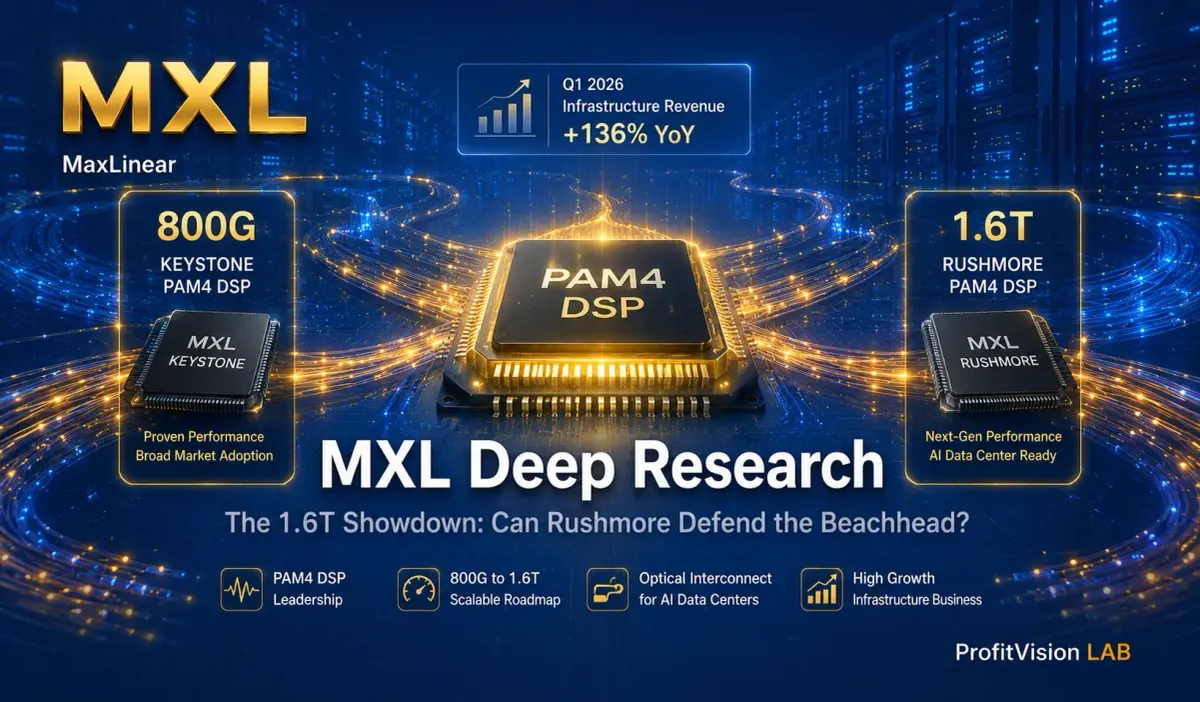
From broadband chip maker to AI Infrastructure optical interconnect player — Keystone's success is just the prologue; Rushmore is the decisive battle
2026.05.16 | Shiba the Disciplined | ProfitVision LAB | Last Updated: 2026.05.16
🔍 Four-Filter Quick Reference
| Filter | Metric | Data | Result |
|---|---|---|---|
| Filter 1: Institutional Flow | RS Rating / Price Momentum | Stock jumped +76% in a single day post Q1 2026; institutional positioning still in flux | ⏸️ Watch |
| Filter 2: Economic Moat | Gross Margin / EPS / Switching Costs | Gross margin 56.8% (FY2025), still loss-making (net loss -$136.7M); moat under construction | ⏸️ Borderline |
| Filter 3: Volatility | IV / Price Volatility | Transformation-stage stock with extreme volatility; +76% single-day post Q1 earnings | ⏸️ Caution |
| Filter 4: Technical | Trend / Key Moving Averages | Surged sharply after earnings; needs consolidation to confirm support | ⏸️ Wait for Base |
Chapter 1: Industry Map
This chapter answers one question: exactly which battlefield is MaxLinear fighting on, and how large is it?
Behind the AI compute explosion lies a connectivity revolution. GPU clusters have expanded from hundreds of cards to tens of thousands, and every signal transmission node between them requires high-performance interconnect chips. One of the core technologies in this market is the PAM4 DSP (Pulse Amplitude Modulation 4 Digital Signal Processor) — responsible for converting electrical signals into optical signals for high-speed fiber transmission, and restoring them at the receiving end, ensuring complete data transfer at 800G and even 1.6T speeds.
MaxLinear's position in this market is as the third-largest merchant PAM4 DSP supplier, behind Marvell (first) and Broadcom (second). That ranking by itself illustrates both the opportunity and the risk.
PAM4 (Pulse Amplitude Modulation 4) is a signal modulation technique that allows each electrical signal cycle to carry 2 bits of data (versus just 1 bit with traditional NRZ), effectively doubling bandwidth capacity. It is one of the key technologies enabling 800G and 1.6T high-speed transmission.
DSP (Digital Signal Processor) compensates for signal distortion and eliminates noise during transmission, ensuring data can be fully recovered after long-distance fiber travel. A PAM4 DSP chip handles both "modulation" and "recovery" — it is the core component inside every high-speed optical module.
Simple analogy: if optical fiber is a highway and optical signals are vehicles, the PAM4 DSP is the "signal translation station" at the exit ramp — converting optical signals back into data the computer can read, completing this translation in picoseconds with zero errors.
Compute demand
Keystone / Rushmore
Rack-to-rack interconnect
End procurement decision
Optical module market size: The global optical module market surpassed $23 billion in 2025 and is expected to maintain 25%+ annual growth through 2026. The share of 800G-and-above modules is projected to exceed 60% in 2026. This implies a total addressable market (TAM) for PAM4 DSP potentially reaching $3–5 billion in scale during 2026–2027.
MaxLinear also operates three legacy business segments: Broadband (home Wi-Fi 7 / fiber PON), Connectivity (industrial networking), and Industrial & Multimarket. These segments were hit hard by the market cycle downturn in 2024–2025, the primary driver of the company's large losses. Starting in 2026, however, large US telecom operators' Wi-Fi 7 mass deployments are beginning to drive a recovery.
Chapter 2: Business Model & Economic Moat
This chapter answers: how does MXL make money? Is its Economic Moat real or manufactured?
2.1 Revenue Breakdown (Q1 2026)
| Segment | Q1 2026 Revenue | YoY Growth | Share (est.) |
|---|---|---|---|
| Infrastructure | ~$63M | +136% | ~46% |
| Broadband | ~$35M | Moderate growth | ~25% |
| Connectivity | ~$25M | Flat | ~18% |
| Industrial & Multimarket | ~$14M | Declining | ~10% |
| Total | $137.2M | +43% YoY | 100% |
The Infrastructure segment became the company's largest business for the first time in Q1 2026 — a key milestone in MXL's transformation story. The full-year optical interconnect target was raised to $150M–$170M, indicating Infrastructure's share of total revenue will continue to expand through 2026.
2.2 Economic Moat Classification
MXL's Economic Moat is of the technology barrier type, but with limited depth:
A design win means a chip maker's product has been selected by a customer and incorporated into their hardware design. In the semiconductor industry, winning a design win does not immediately translate into revenue — but it signals extremely high order visibility over the next 12–24 months.
For AI data center optical modules, hyperscale customers (e.g., Google, Meta, AWS) typically have design cycles lasting 6–18 months. Once a DSP supplier is selected, the entire rack design is optimized around that chip. Swapping it out requires re-certifying the entire module — a process that is both costly and time-consuming. This is exactly why design wins create a "switching cost moat."
✅ Switching Costs (Moderate): Once an optical module OEM completes DSP integration, switching suppliers requires full re-certification. Hyperscale data center procurement cycles are long, and once a design win is secured, there is meaningful customer stickiness.
✅ Technology Iteration Speed: Keystone 5nm PAM4 DSP has passed 800G certification at multiple hyperscale data centers. Rushmore 1.6T uses Samsung's process node — the industry's first DSP built on Samsung technology — offering a differentiated advantage in supply chain diversification.
⚠️ Moat Weakness: Every speed-generation transition (400G → 800G → 1.6T) triggers a re-certification process at the customer level. Marvell and Broadcom are ahead of MXL on the 1.6T timeline, meaning the critical early design wins may not land with MXL. The moat must be re-defended at each technology transition point.
⚠️ Morningstar Moat Rating: MXL has not yet received a formal Morningstar moat rating, or has been rated Narrow Moat, reflecting the intensity of competition and technological dependency.
Chapter 3: Competitive Landscape
The PAM4 DSP market structure is relatively clear — and brutal.
| Company | Technical Positioning | 800G Status | 1.6T Progress | Scale |
|---|---|---|---|---|
| Marvell (MRVL) | PAM4 DSP + Coherent DSP full stack | Market leader | ✅ In mass production | $7.7B annual revenue |
| Broadcom (AVGO) | PAM4 DSP + switch bundling | Market leader | ✅ In mass production | $51B annual revenue |
| MaxLinear (MXL) | PAM4 DSP (merchant market) | #3, design wins at multiple hyperscalers | ⏳ Rushmore ramping | ~$0.55B annual revenue |
| Credo (CRDO) | AEC (primary) + Optical DSP (emerging) | AEC dominant, DSP nascent | ⏳ Cardinal 3nm in development | ~$0.6B annual revenue |
| Astera Labs (ALAB) | PCIe Retimer / CXL / Scale-up Switch | Different race track | Not directly competing | ~$1.2B annual revenue (2026E) |
3.1 Who Are the Real Threats?
Primary Threat: Marvell. MRVL's 1.6T Ara series DSP is already in mass production and deeply integrated with its full optical module solution. Hyperscale procurement decisions tend to favor suppliers with certain delivery timelines. MRVL overwhelms MXL on both capital and engineering scale.
Secondary Threat: Technology Cycle Re-Opens. Each speed-rate transition gives customers a fresh opportunity to re-evaluate suppliers. The design wins MXL secured in 800G do not automatically carry over to 1.6T. Rushmore's mass production timeline and yield performance will determine whether MXL can retain its seats at hyperscale customers.
Credo is Not a Direct Competitor (for now): CRDO's primary market is Active Electrical Cables (AEC), while MXL focuses on fiber DSP — different technology stacks. However, CRDO is advancing Cardinal DSP, which could create overlap in the optical market going forward.
Chapter 4: Financial Resilience
Financial numbers tell the truth, and MXL's truth is this: transformation-phase growth potential is clear, but the current financial position remains fragile.
4.1 Revenue Trend
| Period | Revenue | YoY | Notes |
|---|---|---|---|
| FY 2023 | ~$882M | — | Peak following failed Silicon Motion acquisition |
| FY 2024 | $360.5M | -59% | Broadband cycle trough; inventory correction |
| FY 2025 | $467.6M | +30% | Infrastructure beginning to contribute |
| Q1 2026 | $137.2M | +43% | Infrastructure becomes largest segment |
| Q2 2026E | $160–170M | ~+50%E | Management guidance |
| FY 2026E | ~$620–660M | ~+35%E | Optical interconnect $150–$170M accelerating |
4.2 Profitability
| Metric | FY 2024 | FY 2025 | Q1 2026 |
|---|---|---|---|
| Gross Margin (GAAP) | 54.0% | 56.8% | ~58–59% (guided) |
| Operating Margin | Deep loss | -27.1% | Improving |
| Net Margin | — | -29.2% | Improving |
| R&D Expense | — | $208.6M (45% of revenue) | Elevated R&D maintained |
| Free Cash Flow (FCF) | — | $7.0M | Turned positive, but thin |
MXL's gross margin is improving, but the R&D expense ratio of ~45% of revenue keeps the company in the red. This is a normal cost of the transformation phase, but it also means the company needs continued revenue scale expansion to reach breakeven. Analysts estimate that if the optical interconnect business grows as planned, FY 2027 could deliver Non-GAAP operating breakeven.
GAAP (Generally Accepted Accounting Principles) requires all expenses to be recorded in the income statement, including non-cash items such as Stock-Based Compensation (SBC) and amortization.
Non-GAAP is an adjusted profit figure that companies compute by excluding certain one-time or non-cash items. Semiconductor companies typically carry large SBC charges and intangible amortization, so Non-GAAP profit tends to better reflect a business's underlying cash generation capability.
⚠️ Note: Non-GAAP figures are self-defined by each company, and the adjustment items vary — exercise caution when making cross-company comparisons. Unless otherwise noted, gross margin figures cited in this article are typically Non-GAAP.
4.3 Balance Sheet
| Item | FY 2025 |
|---|---|
| Cash & Equivalents | $72.8M |
| Long-Term Debt | $123.6M |
| Net Debt | -$50.8M (net debt position) |
| D/E Ratio | 0.27 |
| Shares Outstanding | ~86M shares |
Debt levels are manageable, but cash reserves are thin. If Rushmore's mass production ramp encounters technical delays, additional financing may be required. This is a tail risk that warrants monitoring on the financial side.
Chapter 5: Valuation & Scenario Analysis
Valuation analysis here does not predict price targets — it maps scenario ranges to understand what script the market is pricing in.
The market currently prices MXL at an NTM EV/Revenue of approximately 8x, which is meaningfully cheaper than CRDO (~17x) and ALAB (~20x+). This discount reflects the market's pricing of MXL's transformation uncertainty.
| Scenario | Core Assumptions | FY 2027E Revenue | Fair EV/Rev | Market Implication |
|---|---|---|---|---|
| 🟢 Bull Case | Rushmore wins multiple hyperscale design wins in the 1.6T era; optical interconnect reaches $200M+ in 2026; broadband recovery in sync | $1.2B+ | 12–15x | MXL establishes third-pole status; valuation discount narrows |
| 🟡 Base Case | Rushmore ramps on schedule, but 1.6T market share dominated by MRVL/AVGO; optical interconnect reaches $150–$170M in 2026 | $800–900M | 8–10x | Current stock price broadly fair; look for entry opportunities during volatility |
| 🔴 Bear Case | Rushmore delayed or poor yield; hyperscale customers pivot to MRVL; AI capex slowdown | $500–600M | 5–6x | Current price significantly overvalued; transformation narrative breakdown risk |
Current market pricing is closest to the Base Case with a bullish lean — particularly after the Q1 earnings surge absorbed a significant amount of good news. The issue: this valuation reflects 2027 expectations, and any noise around Rushmore's progress in the interim could trigger a meaningful stock price correction.
Chapter 6: Conclusion & Tactical Recommendations
Core View
MaxLinear is the most compelling transformation story in the PAM4 DSP optical interconnect market — but its success depends on capturing a technology transition window that is rapidly closing.
✅ Bull Case (Three Supporting Points)
- Scarcity value of a third-pole merchant DSP: Hyperscale data centers deliberately avoid single-supplier dependency. MXL, as the alternative to Marvell/Broadcom, carries structural demand.
- Samsung process differentiation: Rushmore is the industry's first 1.6T DSP built on Samsung CMOS, which is uniquely attractive in the context of supply chain diversification trends.
- Valuation margin of safety: At 8x NTM EV/Revenue, MXL is 50–60% cheaper than peers CRDO and ALAB. Base case pricing risk is relatively contained.
🚨 Bear Case (Three Risk Points)
- 1.6T timeline risk: MRVL and AVGO are already in mass production at 1.6T while MXL's Rushmore is still catching up. Every quarter of delay is a lost window for hyperscale design wins.
- Thin financial buffer: Cash of $72.8M against $123.6M in debt — if business growth falls short of expectations, the capital structure will face pressure.
- Transformation-phase concentration risk: Current optical interconnect hyperscale customers are concentrated. If a key customer shifts to a competitor, quarterly results will show significant volatility.
Options Trading Framework (Bull Put Spread Logic)
If Rushmore's mass production progress is confirmed on track and Q2 2026 results meet guidance ($160–$170M), consider:
- Bullish directional Bull Put Spread: Sell ATM-10% Put, Buy ATM-20% Put
- Entry trigger: Q2 earnings confirm continued sequential Infrastructure growth and no major Rushmore production delays
- Exit trigger: Any negative supply chain news or customer concentration developments — close first, ask questions later
Trigger Conditions
| Situation | Conditions | Action |
|---|---|---|
| Upgrade to Greenlight | Rushmore mass production confirmed + Q2 optical interconnect beats expectations + second hyperscale design win added | Increase position; NTM EV/Rev up to 12x acceptable |
| Downgrade to Reject | Rushmore delayed more than two quarters / hyperscale design win lost / cash below $50M | Full exit; wait for clear reversal signal |
📋 Tracking Log
| Date | Event | Judgment | Outcome |
|---|---|---|---|
| 2026/05/16 | Initial publication, based on Q1 2026 earnings | ⏸️ Active Watch | — |
Next scheduled update: After Q2 2026 earnings (July 2026)
Early update triggers: Rushmore mass production announcement / hyperscale design win news / major competitive event
Frequently Asked Questions
Over fifteen years of experience in US equity options strategy and industry research, applying the Four-Filter Defense Screen to systematically evaluate individual stock actionability, with ongoing coverage of the high-speed interconnect chip market's technology cycles and investment opportunities. This research is based on public filings, SEC disclosures, and first-hand industry data. It does not constitute investment advice.
Investing involves risk. Please evaluate carefully based on your personal financial situation.
Data sources: MaxLinear SEC Filings, Q1 2026 earnings call transcript, StockAnalysis, Investing.com, TIKR, MacroTrends (as of May 2026)


Comments ()