LVMH: Arnault's Luxury Empire — Combining Brands Into a Castle
Over forty years, Bernard Arnault combined heritage houses — Dior, Louis Vuitton, Tiffany (~US$15.8bn) — into LVMH (MC.PA), the world's largest luxury empire. We unpack his takeover of LVMH, the best-owner model that scales a brand without diluting its scarcity, and the vision of 'Asia's Arnault.'
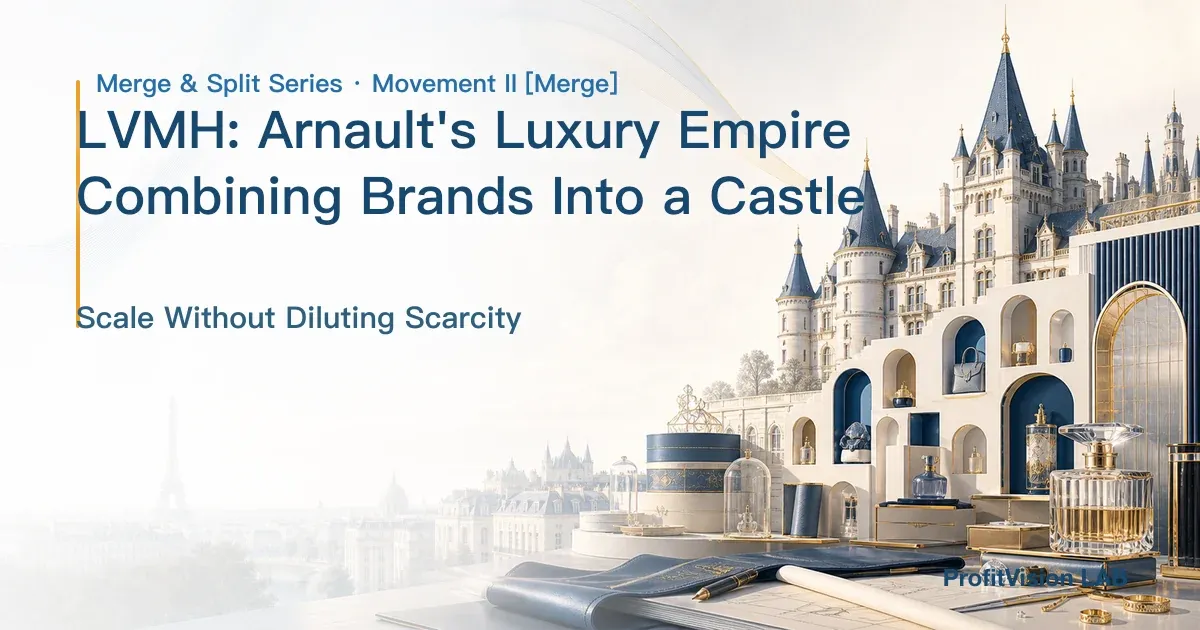
- Movement II, stop two — from chips to Paris. The last piece, Broadcom (AVGO), proved that "merging cash" can be a compounding machine; this one, LVMH (MC.PA), demonstrates a completely different yet equally peerless kind of "merge" — what's being combined is not cost and efficiency, but "brand" and "desire." Both are serial acquirers, yet they practice two utterly different crafts.
- Bernard Arnault's model is unusual: he buys storied ateliers and brands with history and soul, grants creativity enormous autonomy (decentralized maisons + star designers), but provides concentrated firepower behind the scenes — shared retail channels (Sephora / DFS), prime real-estate storefronts, media and marketing muscle, supply chains, and the scarcest thing of all: patient long-term capital.
- The acquisition list spans four decades: 1984 took over Boussac (landing Dior), 1987 LV and Moët Hennessy merged to form LVMH, 1997 Sephora, 2011 Bulgari (~€5.2bn), 2017 folding Dior couture back into the group, all the way to swallowing Tiffany for ~US$15.8bn in 2021 — the largest luxury acquisition in history. A man nicknamed "the wolf in cashmere" built his empire one acquisition at a time.
- The result: LVMH became one of Europe's largest companies by market value (roughly the €300–400bn range, swinging widely with the cycle), and Arnault repeatedly ranked as the world's richest man. This is the most elegant proof of the best owner test — it can amplify a brand's scale while still guarding craft and scarcity, so the brand not only survives but becomes more prestigious and more profitable.
It Started With a Single Cheque: That Cool-Headed Young Man in 1984
In 1984 Paris, an old textile group called Boussac was on the brink of bankruptcy. Among its holdings sat a crown-jewel asset — Christian Dior, the name that once defined the post-war "New Look" and rewrote the history of women's fashion. But to most investors, Boussac was just a pile of toxic mess: loss-making textile mills, outdated department stores, tangled labor problems.
That was when a 35-year-old, recently back from the US and trained as an engineer, made his move. His name was Bernard Arnault. He saw what others had missed: in that whole pile of mess, the only thing truly valuable was the single name Dior — and that name's value lay buried under a heap of assets that shouldn't have existed.
So he did something cold and precise: once he had Boussac, he sold off nearly everything else and clung tightly only to Dior. The move was later criticized by many as ruthless (mass layoffs, selling off the family silver), and it earned him a famous nickname — "the wolf in cashmere." But to Arnault it was a simple judgment: a pile of mediocre assets lumped together will never beat one undervalued great brand. His life's work began with that one cheque that saw through to a brand's true value.
The Four Letters "LVMH" Are Themselves a Merger
Many assume LVMH has always been one consistent company. It hasn't — its very name is the product of a merger.
L V M H, split apart, is two companies: Louis Vuitton (leather goods and travel trunks) and Moët Hennessy (champagne and cognac). In 1987, to fend off being swallowed by outsiders, the two chose to merge and form the LVMH group. But after the merger the two founding families feuded constantly, each with their own agenda — and that gave Arnault his opening.
His method of "taking control" remains a classic business-school case study to this day, and it is what saddled him forever with the "wolf" reputation.
How did he "take control"? A textbook-grade power grab
The fuse was the family infighting inside LVMH. After the merger, Henry Racamier, head of the Louis Vuitton camp, was bitterly at odds with Alain Chevalier of the Moët Hennessy side. In 1987, to counter his rival, Racamier himself invited Arnault — who held Dior and had deep pockets — in as a "white knight." He thought he had found an ally.
The result was letting the wolf in the door. Arnault picked no side; instead he turned around and took on both at once: orchestrated by his mentor, the Lazard banker Antoine Bernheim, he allied with the brewing giant Guinness, secured large bank financing, and quietly but ferociously hoovered up LVMH shares on the open market, deploying billions of francs to stack his stake up to a controlling level of roughly 40%-plus. By the time Racamier woke up, the game was over — the man he had invited in to help had become the new master riding above him. This drama of "the ally you invited turning on you" is the very origin of the nickname "the wolf in cashmere."
Wouldn't the exchange or the regulator object? They questioned it — but couldn't stop it. Racamier's camp filed a string of lawsuits, and France's then market regulator (COB, the predecessor of today's AMF) stepped in to scrutinize the takeover tactics and minority-shareholder rights. But after rounds of legal battles, by 1989–1990, the equity Arnault had absorbed on the market was ultimately validated — and he won control. The key: France's oversight of "accumulating shares bit by bit on the market and thereby gaining control" was far looser back then than it is today — there was not yet today's strict rule that "once a stake crosses a threshold, you must launch a mandatory tender offer for all shareholders." Arnault effectively slipped through a gap in the era's framework, completing a power grab via open-market accumulation that would be far harder to pull off today. (Which also reminds us: how M&A is played is forever shaped by the regulatory environment of the moment.)
By 1989, this "outsider" had turned the tables and formally become the master of the group built from LV and Moët Hennessy. From then on, the luxury empire LVMH the world remembers — its true soul and playbook — all belonged to Arnault.
An Acquisition List Spanning Four Decades
If Broadcom's Hock Tan built an M&A machine over a decade, Arnault spent four decades laying a castle brick by brick. Lay out his key acquisitions over the years and you see a map stretching across fashion, leather goods, jewelry, watches, champagne, beauty and retail:
| Year | Target | Amount (approx.) | What it bought |
|---|---|---|---|
| 1984 | Boussac (containing Dior) | — | Christian Dior, a crown-jewel brand |
| 1989 | Gained control of LVMH | — | LV + Moët Hennessy (leather + spirits) |
| 1996 | Loewe, Celine, etc. | — | Expanded the fashion / leather maison roster |
| 1997 | Sephora | — | Beauty retail channel (own retail firepower) |
| Around 2000 | DFS, TAG Heuer, Hublot, etc. | — | Duty-free retail + watchmaking footprint |
| 2001 | Fendi (gained control) | — | Italian fur and leather house |
| 2011 | Bulgari | ~€5.2bn | Italian jewelry house, reinforcing hard luxury |
| 2013 | Loro Piana | — | Top-tier cashmere and wool craftsmanship |
| 2017 | Christian Dior Couture (folded back into group) | — | Consolidated Dior fashion into LVMH |
| 2021 | Tiffany & Co. | ~US$15.8bn | American jewelry icon, the largest luxury acquisition ever |
From a single Dior to today's roughly 75 maisons (brand ateliers), spanning five business groups — fashion and leather goods, wines and spirits, perfumes and cosmetics, watches and jewelry, and selective retail — Arnault's map is a history of luxury written through acquisitions. But note one thing carefully: almost everything he bought was an old brand "with history, with a story, with a heritage of craft," not a label conjured from scratch. Because he understood deeply that the most expensive thing in luxury is not the material but time and legend — and that is something money can buy but cannot manufacture.
The Model, Unpacked: Buy the Soul, Free the Creativity, Concentrate Firepower Behind the Scenes
Why does LVMH's M&A leave brands un-destroyed and instead grow ever more prestigious? This is precisely the most fascinating contrast with Broadcom. After Broadcom buys, it "cuts, focuses, harvests"; after Arnault buys, he does almost the opposite — he carefully protects the brand's soul and only provides, behind the scenes, the firepower it could never get fighting alone. Roughly four moves:
(1) Buy only brands "with a soul." Arnault doesn't buy new labels without history; he specifically targets old maisons with decades or even centuries of heritage, with craft, with a story, where customers are buying a "dream." Because a luxury brand's moat is not patents, not cost, but scarcity and the sense of legend — things that cannot be mass-produced or rushed, only accumulated over time. To buy it is to buy a stretch of time others cannot replicate.
(2) Grant creativity enormous autonomy. This is LVMH's most counterintuitive — and most crucial — move. The group does not use one standard process to "integrate" every brand; on the contrary, it lets each maison keep its own creative director, its own style, its own ateliers and lineage. Arnault personally directed one of the most important things in luxury history — turning the "star designer" into a brand's engine (from bringing John Galliano into Dior and Marc Jacobs into LV early on, to generations of creative directors since). Creativity must be free; standardization kills luxury.
(3) Provide "concentrated firepower" behind the scenes. So where is the group's value? In the heavy weaponry a single brand can't deliver on its own but the group can centralize: its own retail channels (Sephora, DFS), bargaining power for prime locations worldwide, vast media and marketing muscle, shared supply chains and management talent. A standalone small leather brand can't snag a golden storefront on the Champs-Élysées, but LVMH can; a small perfume label can't fund a global ad war, but LVMH can. Scale is used to amplify each brand, not to flatten them.
(4) Provide "patient long-term capital." This is the most underrated yet most decisive move. Luxury needs time to nurture — reinventing a brand can take a decade to bear fruit. Most public companies' shareholders lack that patience. But thanks to the pyramid control structure, Arnault can think about a brand in units of "decades," investing counter-cyclically and doubling down on locations and craft when others pull back. What he provides is the scarcest thing in the market: money that doesn't demand results next quarter.
The Best Owner Test: He's Not Just a Buyer, He's a Brand's Best Long-Term Owner
This series' iron rule is: "Am I the best owner of this business?" — only if you can bring it value no one else can should you buy it and keep it. Most failed acquisitions fail this test outright: buying the brand merely adds a bureaucratic overlord and grinds down its uniqueness instead.
For luxury brands, Arnault is almost a textbook-grade best owner. Standing alone, these brands are often hamstrung by a lack of capital, a lack of global channels, a lack of resilience against the cyclical winter — many glorious old maisons withered precisely because they couldn't survive one downturn or one botched succession. In LVMH's hands they gained three things they could never assemble on their own: scale-amplifying retail and marketing firepower, the discipline to guard scarcity, and a patient shareholder who can invest in units of decades.
Most crucially, Arnault solved luxury's hardest puzzle: how to "amplify scale" without "diluting scarcity"? — selling more should, by rights, make a brand less prestigious. But LVMH proved that, done the right way (guarding price, guarding craft, guarding creative freedom, controlling distribution), scale can instead make a brand stronger. His skill is not "buying cheap" but "making the brand, once bought, live longer, sell dearer, and grow more prestigious." This is the most elegant form of the best owner.
"Amplify scale without diluting scarcity" — how exactly did he do it?
That line sounds like a slogan, but behind it sits a whole set of counterintuitive operations. The growth formula for ordinary businesses is "sell more, sell cheaper, distribute wider"; luxury is the opposite — sell too much, make it too easy to buy, and the brand dies. Arnault's solution is to split "scale" and "scarcity," two seemingly contradictory things, onto different layers and manage them separately:
(1) Grow through "raising prices," not "pushing volume." Luxury's growth comes mainly from raising prices year after year and steadily climbing toward the top of the pyramid, not from desperately increasing units. Selling dearer rather than selling more — this way revenue (scale) grows while the sense of scarcity goes undiluted. Its pricing power can, over the long run, even outrun inflation, which is its most captivating financial trait.
(2) Control distribution and channels. Insist on directly operated stores, manage store counts and inventory, even deliberately make certain styles "limited, waitlisted, hard to get" — making "hard to come by" itself part of the brand's value. Scale is placed on "per-store output and unit price," not on "everywhere you look."
(3) Pour resources back into craft and creativity. The cash that scale brings is funneled back into ateliers, artisans, top-tier materials and designers' creative freedom, so the product "deserves" its ever-higher price — rather than using scale to cut corners. Here, scale is fuel that strengthens scarcity, not a flood that dilutes it.
(4) Harvest in layers through the "pyramid." Use entry-level perfume and cosmetics (via the Sephora channel) and small leather goods to reach the masses, earning breadth and cash flow; use haute couture and rare pieces to guard the apex's prestige and dream. The same brand can both scale downward and guard scarcity upward.
Stack these four together and you get the puzzle Arnault solved: scale grows on "price, store productivity, breadth cash flow," while scarcity is guarded on "limited editions, craft, the apex" — each runs on its own layer, so scale, far from diluting scarcity, actually gives the brand more ammunition to strengthen scarcity. This is why the best owner in his hands is "the most elegant form": he doesn't squeeze cash out of the brand (that's Broadcom's approach to mature tech) but lets the asset keep appreciating in his hands — living longer, selling dearer, growing more prestigious.
Let the Numbers Speak: A Luxury Castle's Scorecard
(across five business groups)
(2021)
largest companies
| Aspect | Arnault in 1984 | LVMH today (MC.PA) |
|---|---|---|
| Starting point | Took over the near-bankrupt Boussac, just to save Dior | The world's largest luxury group |
| Number of brands | Effectively one — Dior | ~75 maisons, five business groups |
| Footprint | Fashion | Fashion & leather + spirits + perfumes & cosmetics + watches & jewelry + retail |
| For shareholders | — | Among Europe's largest by market value, stunning long-term TSR; Arnault repeatedly the world's richest man |
Note: amounts and brand counts are approximate, in US dollars or euros, as of 2026; luxury-sector valuations and market caps swing enormously with the cycle and exchange rates, and past returns do not indicate future performance.
But the most exquisite part of LVMH's scorecard is not "how many bags it sold" but its structural resilience. Its map deliberately covers both "soft luxury" (fashion and leather, rising and falling with trends) and "hard luxury" (jewelry and watches, value-preserving and recession-resistant), plus the cash-cow champagne and cognac, and the retail earner Sephora. On one side, a growth engine that ignites desire; on the other, ballast that weathers the winter. When one category goes cold, another usually holds up — this "brand portfolio" style of diversification is exactly why an empire is more durable than a single brand.
The Honest Side: This Empire Has Its Cracks, Too
To paint LVMH as flawless would be dishonest. Even the most elegant empire has its fragilities and controversies.
(1) Highly exposed to the cycle and the Chinese market. Luxury is, by nature, something you "can choose not to buy," and demand is extremely sensitive to the cycle. In particular, over the past decade-plus Chinese consumers propped up a large slice of luxury's growth; around 2024, as China's economy slowed and consumer confidence weakened, the entire luxury sector (LVMH included) saw revenue growth cool markedly. However large the empire, it cannot escape the invisible hand of the cycle.
(2) Acquisitions come at a steep price. Tiffany ~US$15.8bn, Bulgari ~€5.2bn — Arnault buys top-tier assets, and the prices are often not cheap. Although he has bidding discipline (he fought to cut the price in the Tiffany episode), "overpaying" is always a built-in risk of this "buy only the best" model, and the payoff hinges on long-term execution.
(3) Succession uncertainty. This is the empire's biggest crack. LVMH's whole soul is highly tied to Arnault alone; he is now past seventy, with his five children placed in different key roles across the group to gain experience and position themselves. Can the founder's eye and taste pass to the next generation? The shift from "one genius" to "a family team" is one of the most-watched — and least answerable — questions in luxury history.
(4) Some acquired brands perform indifferently + the "is the empire too big?" question. Not every brand bought was turned to gold; some have languished for years. When a group grows to roughly 75 brands, outsiders also ask: has it grown too large to be the "best owner" of every brand? Is the limit of scale also the limit of the best-owner advantage?
In other words, LVMH is an exceedingly elegant but not impregnable castle: it has created stunning value for both shareholders and brands, but it depends heavily on cyclical tailwinds, on Arnault's personal eye, and on a succession exam not yet sat. Acknowledging this is what lets you truly understand the real cost and boundaries of the "merge brands" model.
Merging Cash vs. Merging Brands: LVMH Against Broadcom
Place LVMH side by side with the last piece, Broadcom, and you see how different two crafts of "merging" can be — yet how they share the same core.
| Dimension | Broadcom's (Hock Tan) merge | LVMH's (Arnault) merge |
|---|---|---|
| Core of the merge | Cash and efficiency | Brand and desire |
| What it buys | Mature tech franchises customers can't switch off | Old maisons with history and soul |
| After buying | Cut costs hard, focus, harvest cash | Grant creative autonomy, provide concentrated firepower behind the scenes |
| Integration philosophy | Standardize, centralize, squeeze out efficiency | Decentralize, protect the soul, amplify scale |
| Time horizon | Results within a few years (deleveraging) | Decades of nurturing a brand (patient capital) |
| Shared core | Both rely on iron discipline + being the best owner — once bought, they make it more profitable | |
One coldly harvests cash, the other elegantly cultivates brands; one seeks speed, the other seeks longevity; one integrates through standardization, the other through protecting uniqueness. On the surface, these are two almost opposite kinds of "merge." But peel back the shell and their cores are entirely aligned — both rely on strict capital-allocation discipline, and both pass the best owner test: they don't simply buy assets and let them sit, they genuinely run what they buy better than the previous owner did. This is the core Movement II keeps proving: "merging" is neither right nor wrong in itself; whether you can merge, and whether the right owner is doing the merging, is the watershed.
M&A Discipline Scorecard: LVMH
Continuing Movement II's "M&A Discipline Scorecard," we use the same table to examine Arnault's luxury empire:
| Checkpoint | Verdict | Notes |
|---|---|---|
| (1) Capital-allocation discipline | ✅ | Buys only old brands with soul and a moat; pays high but with discipline (fought to cut the Tiffany price) |
| (2) Best owner | ✅✅ | Amplifies scale yet guards scarcity — a textbook-grade best long-term owner of luxury brands |
| (3) Synergy realization | ✅✅ | Retail (Sephora / DFS), locations, media, supply-chain synergies are real and sustainable, not paper promises |
| (4) Financial discipline | ✅ | Strong free cash flow; brands deliver high margins and pricing power; leverage relatively healthy |
| (5) Integration ability | ✅ | Decentralized integration, protects creative souls, amplifies with group firepower — distinctive and masterful |
| (6) Shareholder returns | ✅✅ | Among Europe's largest by market value, stunning long-term TSR; Arnault repeatedly the world's richest man |
Verdict: the ultimate template for "merging" brands into an empire — top marks on several of the six checkpoints, with best owner, synergy and shareholder returns especially shining, and financial discipline also strong. It and Broadcom are the two extremes of "merge": one merges cash, the other merges desire, both creating value by different roads. But don't forget its two worries: it must keep a close eye on the cycle (China above all), and on that succession exam not yet submitted. This is a castle of awesome power that still depends on tailwinds and on a clean hand-off.
From "Buying Luxury" to "Owning Luxury": See Desire as an Asset
Having analyzed the empire's inner workings, the view should pull out a layer. People in Taiwan love buying luxury — but here we ask a higher-order question: we love buying luxury at the shop window, but have we ever thought about "buying luxury itself" in the capital markets? That is, treating companies like LVMH (MC.PA) and Ferrari (RACE) as assets to hold for the long term.
This is no coincidence: this series has already featured two "luxury" cases, and they reached the same destination from opposite directions. Ferrari (RACE) was Movement I's "split" — spun off from Fiat and re-classified by the market from "carmaker" to "luxury," with its P/E leaping a world apart; LVMH (MC.PA) is Movement II's "merge" — Arnault used four decades of M&A to combine brands into an empire. One by splitting, one by merging, both ended up standing on the high ground of "luxury valuation." This tells us: luxury's value lies not in the act of "splitting" or "merging" but in that shared core — pricing power and scarcity.
(1) Pricing power that outruns inflation. They can raise prices year after year and customers still buy — meaning revenue and profit have a kind of "built-in inflation resistance."
(2) Scarcity = the moat. The moat is not patents or cost but time, legend and deliberately maintained rarity — things rivals can't buy faster or copy with money.
(3) High-ROIC, asset-light cash machines. They sell brand and dream, with very high gross margins and relatively low reinvestment needs, throwing off abundant free cash flow over the long run.
(4) A patient large shareholder. Whether Arnault's pyramid control or the Exor behind Ferrari (to be discussed next movement), both let the company think in units of decades, unbound by the quarter.
But be honest about the risks too: luxury is heavily swayed by the cycle and a single market (China above all), valuations often already price in high expectations (the overpaying risk), and each carries the unsubmitted exam of "founder-family succession." They are excellent assets, not guaranteed wins — whether you can hold them long-term depends on the price you pay and whether you can stomach their cyclical swings.
So for investors, understanding luxury is really a way of training the eye to see "what a true moat is." Rather than chasing hot themes, learn to recognize the good businesses with pricing power, scarcity, a patient large shareholder, and the ability to compound over a decade — exactly the yardstick this series trains from start to finish. See luxury not as "desire in a shop window" but as "compounding on a balance sheet," and your investment perspective levels up.
Taiwan's Homework: Add "Pricing Power" and "Patient Capital to Nurture Brands"
That same "luxury = pricing power and scarcity" eye, moved into the operator's seat, becomes an even sharper piece of homework. Taiwan's greatest strength is the efficiency and scale of "making things well, cheaply, and in volume" (contract manufacturing, production); but LVMH and Ferrari prove another ultimate competitiveness — pricing power and scarcity. Their moat lies not at the low point of the cost curve but in "customers willing to pay, for your name, a price far above cost." This is the lesson Taiwanese industry most needs to learn yet finds hardest to learn: don't compete only on the "cheaper" dimension — find a way to climb to the "more prestigious, more irreplaceable" dimension.
Taiwan does not lack potential "merge" cases: Johnson Health Tech (1736) has climbed by acquiring Western fitness-equipment brands, Hon Chuan (9939) has integrated the beverage-packaging supply chain, and even homegrown cultural-creative and food-and-beverage groups are all trying to "merge" scattered brands or links together. But most still stop at "scale integration" or "channel integration"; few truly achieve what Arnault did — guarding the brand's soul and using patient capital to grow it into a legend with pricing power.
The crucial self-question: for this brand in my hands (or this acquisition), am I its "best long-term owner"? Do I have firepower others don't, and am I willing to nurture it with a decade's worth of patience? The operator who answers this honestly is the one who has truly read LVMH — merging brands has never been about merging names, but about merging time and patience.
Who Will Be "Asia's Arnault"?
Scale that homework up one more notch and you run into an exciting opportunity. Arnault proved one thing: good brands are not in short supply; what's missing is a "best owner" with the eye, the firepower and the patience to combine them. So — could that, too, be exactly what Asia is missing?
Here is a proposal worth Taiwanese entrepreneurs thinking about with enlarged ambition: turn your eye toward Japan, Thailand, the Philippines, Indonesia — and Taiwan itself. Why these countries in particular? Because they share something striking — they all possess deep century-old craft and culture, yet have long been undervalued and under-capitalized by the West, with most brands stuck in the "local treasure" frame, unable to break out. They commonly face family succession and capital gaps (which is precisely the "integrable" opportunity), and they have natural supply-chain, cultural and geographic ties to Taiwan — neatly echoing Taiwan's "New Southbound Policy" direction. Better still, they complement one another: Japan = precision craft and artisan heritage; Thailand = the sensory / wellness / hospitality culture; the Philippines = handicraft + a huge overseas diaspora forming a natural distribution channel; Indonesia = the homeland of spices + herbal wellness and textile craft + a huge domestic market. Combine them and you get a luxury map more complete, and richer in layers, than any single country's.
🇯🇵 Japan — the land of artisans and "shinise" (old establishments). Japan has the most century-old companies in the world (shinise, old establishments), yet commonly suffers a "successor problem" (a succession gap): from sake (Dassai is already a successful example of internationalization, but more local breweries remain trapped as local treasures), to soy sauce and fermentation craft, wagashi (such as Toraya), knife and metal artisanship, traditional textiles and the tea ceremony. The soul and heritage are all there; what's missing is the hand to push them onto the world stage.
🇹🇭 Thailand — the senses, hospitality and heritage. Such as Jim Thompson (Thai silk, Thailand's most iconic heritage brand), spa and wellness, spices and Thai food, gems and jewelry, and tropical top-tier hospitality. Thailand understands the business of "sensory experience" best — exactly the part of a high-end brand that is hardest to quantify and most valuable.
🇵🇭 The Philippines — handicraft + a natural diaspora channel. Such as Don Papa rum (acquired by Diageo — which itself shows that Western groups have long had their eye on such Asian assets), South Sea pearls, piña / abaca pineapple-and-Manila-hemp weaving (the fabric of the barong national dress), cigars (such as the Tabacalera tradition); plus the Filipino diaspora spread across the globe, which is in itself a ready-made natural distribution channel.
🇮🇩 Indonesia — the homeland of spices and herbal wellness. This is the original "Spice Islands" of the Age of Exploration that European powers fought madly to control (nutmeg, clove, pepper) — that history alone is a legend the West cannot tell. Such as the top-tier craft of batik (UNESCO intangible cultural heritage), jamu (a century-old herbal wellness drink, echoing the global wellness wave, already with brands like Sido Muncul and Mustika Ratu), top-tier single-origin coffee (Sumatra, Toraja), ikat / songket weaving and teak craft. Add the world's fourth-largest population and a huge domestic market, and it is both a cradle of brands and a ready-made proving ground.
And Taiwan's greatest strengths — its global supply chain, capital deployment and marketing-integration capabilities — are exactly what could play Arnault's role: using a group's firepower to "merge" these century-old Asian brands together — guarding their craft and scarcity while supplying them with global channels, long-term capital and brand marketing, so that Asia's legends, like Dior and Tiffany, can stand atop the international pyramid too.
This is not fantasy. In cultural depth and craft depth, Asia is in no way inferior to Europe; even Diageo's acquisition of Don Papa has already confirmed that Western capital is already treasure-hunting in Asia. What we lack has never been good brands, but a "Asian luxury group" with Arnault's eye and patience, willing to spend a decade nurturing brands. This will be the most worthwhile — and most scalable — chess game for Taiwan's next generation of entrepreneurs: not contract-manufacturing yet another product, but combining Asia's century-old luxury into a castle of our own.
Up Next: From Desire to the Cold Arithmetic of a Glass of Beer
LVMH demonstrated the most elegant art of "merging brands" — using patience and firepower to grow desire into an empire. Next time we switch to a completely opposite atmosphere, looking at a "merge" cold to the bone — AB InBev and the 3G Capital behind it, and how, with near-militarized "zero-based budgeting (ZBB)" discipline, they merged the world's beer brands one by one and squeezed costs to the extreme, building the global beer hegemon.
Both are serial M&A, but LVMH is about "nurturing" while 3G is about "cutting." See you next time, with AB InBev.
- Introduction: Merge & Split — The Art of Capital Allocation
- Movement I [Split]: GE, Abbott, eBay, Siemens, Daimler, Ferrari, Haleon, GE×Wabtec, Novartis, Philips, Universal Music, Hitachi, Sony (13 pieces)
- Movement II [Merge] · Broadcom: The Man Who Merges Best, and His M&A Compounding Machine
- Movement II [Merge] · LVMH (this piece): Arnault's Luxury Empire — Combining Brands Into a Castle
- Movement II [Merge]: AB InBev, Schneider, Exor, Fujifilm
- Conclusion: The Wisdom of Merge & Split