Merge & Split: The Art of Capital Allocation
Mergers and spin-offs are two sides of the same capital allocation question. This introduction uses conglomerate discount, focus premium and the best owner test to judge when to merge and when to split.
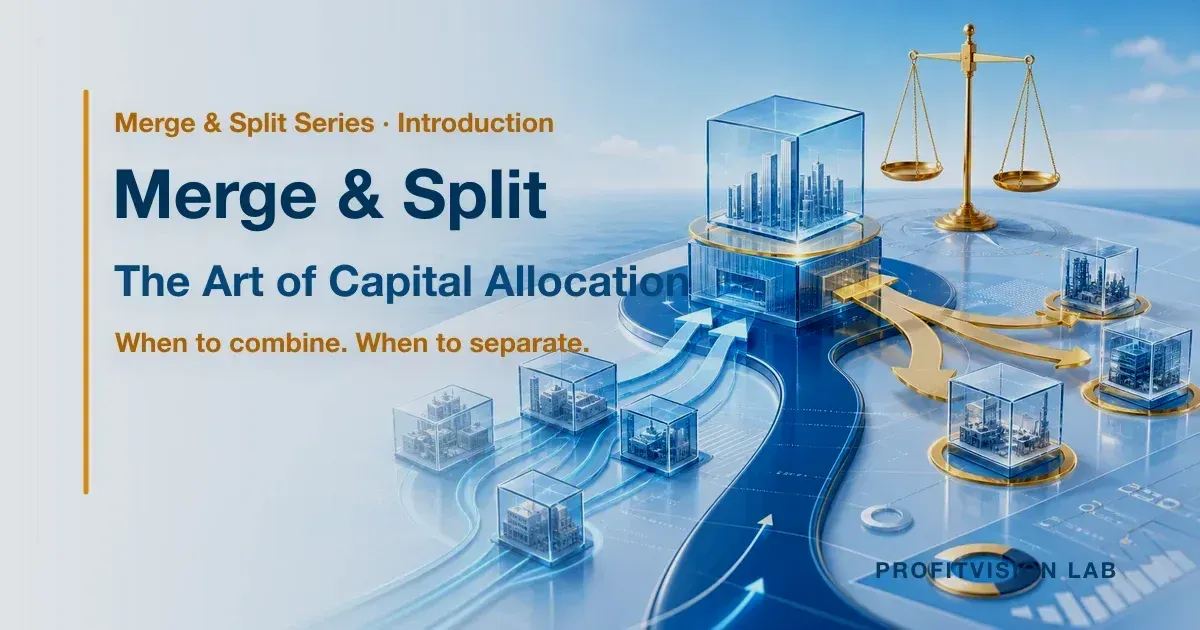
- "Merge" and "split" are not opposites. They are two sides of the same discipline: capital allocation. A company's most important decision is often not how to operate, but where capital and assets should sit.
- Mergers often destroy value because of conglomerate discount and empire building. Diversification without real synergy can make the whole worth less than the sum of the parts. Peter Lynch called this diworsification.
- Spin-offs often release value because of focus premium: each business gets the right management incentives, the right shareholder base and the right valuation frame. Market history and academic work both suggest spin-offs can generate excess returns.
- The iron rule is the best owner test: is this business worth more in your hands, or under another owner? If the former, merge or keep it. If the latter, split it. GE's story shows both the collapse of empire and the rebirth through separation.
- A split releases more than valuation. It can release organizational metabolism: a business that has grown sleepy and constrained inside a large group can regain start-up-like urgency, faster decision-making and aligned incentives once independent.
The Question Few People Like to Ask: Should This Company Be Split?
Open almost any business publication and you will see merger news everywhere: who bought whom, at what price, and with what promised synergy. "Merge" always makes headlines because it sounds like growth, ambition and empire expansion.
But few people ask the opposite question: should this company be split? Splitting sounds like retreat, defeat, or an admission that a past merger was a mistake. No CEO enjoys admitting that the empire in his hands may simply be a collection of businesses that drag one another down.
That is the blind spot this series challenges. A split can often create more value than a merger, and it usually requires more wisdom and courage. To understand both, we first need to return to one badly underappreciated capability: capital allocation.
Merge and Split Are the Same Question: Capital Allocation
Warren Buffett has observed that many CEOs rise to the top through marketing, production or engineering skill. Once they reach the top, however, they suddenly need to do something they were never trained to do: decide where every dollar the company earns should go. That is capital allocation, and it is often the key driver of long-term shareholder returns.
The capital-allocation toolkit is not complicated: reinvest in the core business, pay dividends, repurchase shares, acquire businesses, or spin off and sell businesses. Merge and split are simply two tools in the same box, pointing in opposite directions. Great allocators know how to use both. Mediocre allocators often only know how to keep merging.
Why Do Mergers So Often Destroy Value?
If acquisitions are so attractive, why do so many studies show that most acquirers fail to create value for their own shareholders? The answer sits inside three ideas.
Conglomerate discount: when unrelated businesses are tied together, the market often values the company below the sum of the parts. Investors cannot see clearly, cannot buy only the business they want, and analysts struggle to value the whole. So the whole gets discounted.
Empire building: this is an agency problem. CEO compensation, status and power are often linked to company size rather than shareholder returns. Some executives therefore acquire to enlarge the empire even when the deal is unattractive for shareholders.
Diworsification: Peter Lynch coined the term for the moment when a good company uses cash to buy businesses it does not understand and where no real synergy exists. The result is not diversification. It is making the company worse.
Why Do Spin-offs So Often Release Value?
If merging can create a discount, splitting can unlock that discount. The logic is clear.
Focus premium: an independent company can finally tell its own story, answer to its own shareholders, and be valued using the right industry multiple. Management incentives become cleaner: executives' wealth is tied directly to the business they run, instead of being buried inside a larger empire's consolidated statements.
Spin-off excess returns: Joel Greenblatt devoted a chapter of You Can Be a Stock Market Genius to spin-offs. His point was that spin-offs are often ignored by the market because institutions mechanically sell the small companies they receive. That forced selling can create opportunities for investors willing to do the work. Academic studies have reached similar conclusions: spun-off companies often outperform over longer horizons.
After Larry Culp took over, he did the opposite of Welch. He did not build an empire; he dismantled one. In 2024, GE completed its split into GE Aerospace, GE HealthCare and GE Vernova. Each company now has its own listing, shareholder base and valuation frame. The market response said everything: the value of the separated pieces exceeded the old "everything company." The same company used Welch's merge to write the rise and collapse of empire, and Culp's split to write the rebirth. That is why GE is the natural opening case for this series.
A Split Releases More Than Valuation. It Releases Organizational Metabolism
So far, we have discussed valuation. But a split can release something harder to quantify and often more important: organizational vitality.
A promising business placed inside a large group can slowly become lethargic. People are not less capable; the system grinds them down. Layers of approval slow decisions. Budget politics dilute good ideas. Group-level compromise overrides business-level urgency. Promotion can depend more on tenure and factions than battlefield results. The distance between employee effort and visible reward becomes enormous. Over time, even a motivated team can become passive.
A spin-off can work like a shock to the heart. Once independent, the business suddenly behaves like a start-up: it has its own P&L, its own stock, its own board and its own CEO. Decisions become faster, responsibility becomes clearer, incentives become aligned. Cross-subsidies, internal resource fights and headquarters bureaucracy loosen almost overnight.
This is an extension of the best owner test: sometimes the parent company is not bad; its size and stability are themselves the weight that suppresses vitality. For such a business, the best gift is not more resources. It is freedom.
So When Should a Company Merge, and When Should It Split?
At this point, it may sound as if the conclusion is "splits are better than mergers." It is not. History also contains failed splits and missed opportunities where companies should have combined but did not. Merge and split are not answers. Timing and standards are the answer.
The standard is brutally simple: the best owner test.
in your hands?
with another owner?
The question is not whether the business is good. The question is: am I the best owner of this business? If you can bring something others cannot bring, such as technology, distribution, capital discipline or scale, then you should keep it or even buy more. If the business is buried, constrained or discounted in your hands, letting it become independent or move to a better owner may be the most responsible decision for shareholders.
| Dimension | Merge / Acquire | Split / Spin off |
|---|---|---|
| Value-creation condition | Real synergy; you are the best owner | No real synergy; independence creates more value |
| Main trap | Empire building; diworsification | Splitting for show; losing real scale synergy |
| Market signal | Synergy realized → premium | Conglomerate discount unlocked → focus premium |
| Shareholder test | Discipline: do not grow just to be bigger | Courage: do not keep businesses for face |
After a Split, How Do We Judge Whether It Worked? Six Checkup Questions
The best owner test tells us whether a business should be separated. But after the separation, how do we judge whether the spin-off was real value creation or only noise? We need six checkup questions. These are the shared standards used at the end of every case study in this series.
| Checkup Question | What It Asks |
|---|---|
| (1) Capital-allocation benefit | After independence, did ROIC, allocation autonomy and focus premium actually improve? Be careful not to mistake industry tailwinds for spin-off success. Look at operating metrics, not just stock price. |
| (2) Original shareholders' interests | Did shareholders of the original parent gain in combined parent-plus-child value? A stock-distribution spin-off is usually the most shareholder-friendly structure. |
| (3) Clean separation or half split? | Are there residual cross-holdings? Does the parent still control the child? Retained control usually means only half the valuation is released and governance gray zones remain. |
| (4) Synergy trade-off | Is the lost shared synergy smaller than the focus value released? In most good spin-offs, the old synergy was weak or even negative. |
| (5) Exit mechanism | Does the parent have a clear timetable to reduce or monetize retained stakes? Without an exit timetable, conglomerate discount often survives in a new form. |
| (6) Structure type | Is it a pure spin-off, serial spin-off, one-into-two split, or a spin-merge / Reverse Morris Trust? Each structure releases value and creates risk differently. |
These six questions form a post-spin-off scorecard. They remind us that splitting is not automatically good. Clean separation, fairness to original shareholders and a credible exit path determine whether the deal creates real value or only excitement.
Two Movements, Nineteen Cases: A Map Across the US, Europe and Japan
The journey has two movements. Movement I studies "split": how separation releases value. Movement II studies "merge": how disciplined combination creates value.
(13 split / 6 merge)
cross-cultural map
merge or split
Why This Matters for Taiwan: Two Ways to Read the Series
This is a series built around US, European and Japanese companies, but it has two direct meanings for readers in Taiwan.
Reading 1: As Investors
Understanding merge and split is a way to see through valuation. When a company announces a spin-off, can you tell whether it is genuine value release from removing conglomerate discount, or merely financial theater? When a company keeps acquiring, can you tell whether it is best-owner compounding or empire-building diworsification? This framework helps investors look for mispriced spin-offs and avoid seductive but value-destroying deals.
Reading 2: As a Mirror for Taiwanese Companies
Taiwan has many family groups, cross-shareholding structures and diversified businesses that "do a little bit of everything." Taiwanese companies are good at merging: growing through acquisitions, satellite factories and expansion. They are far less familiar with splitting. When you are no longer the best owner of a business, do you have the courage to let it go? That may be one of the most important capital-allocation lessons for the next generation of Taiwanese management teams.
If holding structures and cross-shareholdings have tied everything together, the solution is not to cut blindly. The order should be: (1) make the structure transparent, mapping ownership, debt, related-party transactions and internal subsidies; (2) isolate the businesses, stopping new cross-holdings and returning each business to its own P&L and board responsibility; (3) run the best owner test one business at a time; (4) set an exit mechanism when the parent retains stakes. A spin-off without an exit timetable simply leaves conglomerate discount in another form.
Next: We Begin with GE
This introduction is not an article with a single answer. It is a map of judgment standards.
The first stop is GE. Over more than a century, GE played the full drama of merge at its peak and collapse, then staged a rebirth through one of the defining corporate breakups of the century. Once you understand GE, you hold the key to the next eighteen stories.
To merge is ambition. To split is wisdom. To know when to merge and when to split is the real art of capital allocation. See you in the next piece: GE.
- Introduction: Merge & Split—the Art of Capital Allocation
- Movement I [Split]: GE, Abbott, PayPal, Siemens, Daimler, Ferrari, Haleon, GE × Wabtec, Novartis, Philips, Universal Music, Hitachi, Sony
- Movement II [Merge]: Broadcom, LVMH, AB InBev, Schneider, Exor, Fujifilm
- Conclusion: The Wisdom of Merge & Split—best owner and the craft of capital allocation