
HUBS | Taiwan Is Asia's Time Machine: Reading HubSpot's Long-Term Asia Opportunity Through a B2B Mid-Market Lens
When the market votes -19% saying 'AI monetization doesn't work,' remember the advertising industry cast the same vote five years ago — and was wrong. A management-research lens on HubSpot's plunge, plus an observation Western analysts have missed: Taiwan is Asia's time machine.
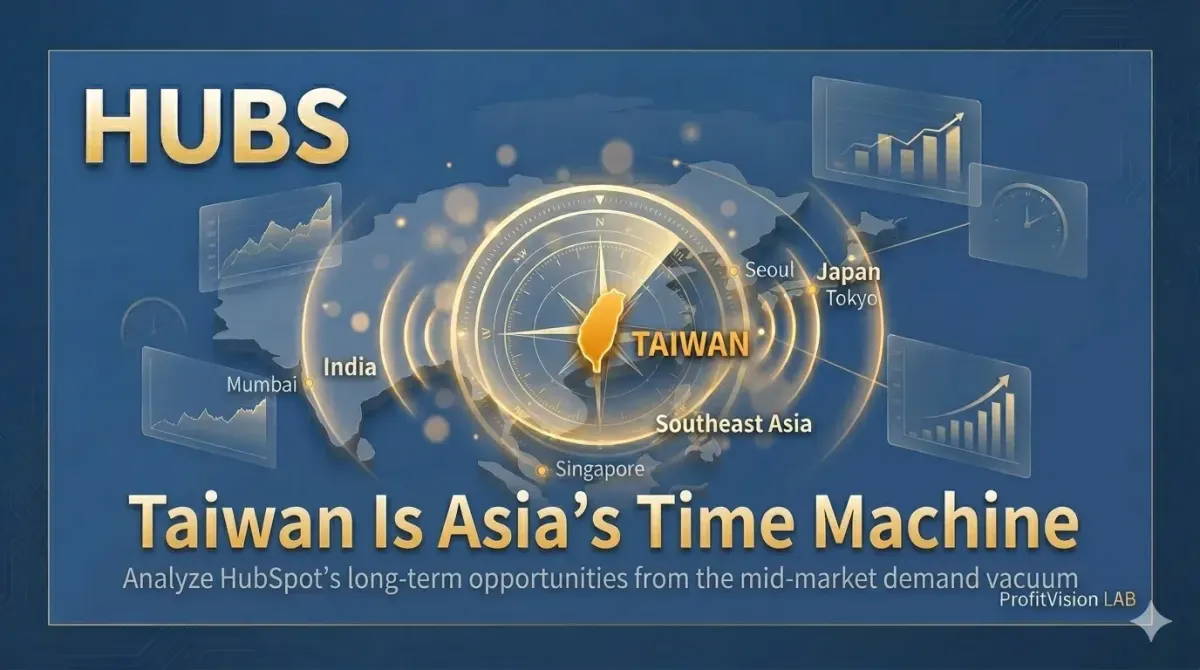
When the market votes -19% saying "we don't believe AI monetization works," remember this: the advertising industry cast the same vote five years ago — and was wrong. A management-research lens on HubSpot's plunge, plus an observation Western analysts have completely missed: Taiwan isn't a microcosm of Asia. Taiwan is Asia's time machine.
On the evening of May 7, 2026, HubSpot reported Q1 2026 results. Revenue grew 23% year-over-year. Non-GAAP EPS beat estimates by 10%. GAAP operating income flipped from a loss to a gain. Free cash flow rose 26%. By the numbers alone, this was a champagne-worthy quarter.
And then the stock fell 12% after-hours, kept falling the next day, and collapsed from $243 to $187 — down nearly 22% intraday, closing -19%, breaking through 52-week lows and hitting a six-year bottom. Sell-side capitulated en masse: BofA cut from Buy straight to Underperform with a $180 target; Citi went from Buy to Neutral, slashing PT from $321 to $230; Raymond James downgraded from Outperform to Market Perform.
What exactly is the market punishing here?
The surface explanation: management openly disclosed three things on the earnings call — Customer Agent price cuts, a shift to outcome-based pricing, and a week of sales team retraining in April that left Q2 starting weak. "Our ARR will be self-suppressed for several quarters. Please be patient." Growth stocks aren't allowed to say "be patient." So the market killed it.
But that explanation isn't deep enough. From a management-research perspective, this article gives you three layers of analysis: first, whether this business-model bet is well-placed; second, the on-the-ground reality of Taiwan's mid-market and upper-mid-market enterprises — and why Taiwan is the time machine that lets you forecast the broader Asian opportunity; and third, how this stock should enter your research map when researchers and traders aren't operating on the same time horizon.
What you'll take away isn't "should I buy HUBS." It's how to read SaaS × AI industry shifts through a business-model lens — a thinking framework that will apply to every SaaS × AI name you research over the next several years. And you'll see a slice of opportunity Western sell-side has badly underestimated. The size of this slice is far larger than HubSpot's current price implies.
First, the Key Analogy: HubSpot Isn't Inventing — It's Porting
In April 2026, HubSpot shifted Customer Agent and Prospecting Agent to outcome-based pricing:
- Customer Agent: $0.50 per resolved conversation
- Prospecting Agent: $1 per qualified lead
The market's first reaction: "This is reckless. The 'outcome' concept is unproven. HubSpot just blew up its own revenue visibility."
That reaction has a blind spot — outcome-based pricing isn't a HubSpot invention. It's a mature model that Google Performance Max (PMax) has been running for five years and has become the industry standard.
PMax has been commercially live since 2021. It is, in essence, an outcome-based ad product: the advertiser sets a goal (conversion, signup, purchase), Google's AI auto-allocates spend across YouTube, Search, Display, Gmail, Discover, and Maps, and the advertiser only pays when the outcome is achieved.
Translated into management-textbook language: PMax is Christensen's disruptive innovation made manifest in advertising. It didn't improve existing solutions — it redefined what advertisers were buying. Once they bought "impressions and clicks" (input). Now they buy "conversions and outcomes" (output). Geoffrey Moore's "Crossing the Chasm" has played out on PMax too — it took roughly three years to move from early adopters to mainstream.
Once you look at HubSpot's two outcome-based products through the PMax lens, the entire story flips.
A Three-Dimensional Framework for Evaluating SaaS × AI Business Model Innovation
This framework has three dimensions. All three must pass for the bet to be well-placed. Let's run HubSpot through it.
Is this bet porting an already-validated model, or running a from-scratch experiment? Porting validated models has a vastly higher success rate. Hamilton Helmer's "Process Power" from 7 Powers captures this — validated processes are real competitive advantages.
Has the market education needed to accept this pricing logic already been paid for by someone else, or does this company have to fund it from scratch? Zero-education-cost market entry is a rare gift in SaaS.
Is the introductory price set below 5% of the industry standard, leaving multi-fold expansion headroom? Outcome-based pricing's historical trajectory is "low entry price to capture share, then raise to monetize" — entry pricing is the key indicator of future ARPU expansion.
Dimension One: HubSpot's Model Alignment
The three structural conditions that made PMax work: the goal must be machine-definable, the cost of failure must be controllable and distributed for the buyer, and the system must not damage existing customer relationships (it's about acquiring new ones).
| Condition | Google PMax | HubSpot Prospecting Agent |
|---|---|---|
| Machine-definable goal | ✅ Click / conversion | ✅ Qualified lead (lead score threshold) |
| Controllable failure cost | ✅ Ad budget cap | ✅ Customer-set credit cap |
| Doesn't harm existing customers | ✅ New-customer acquisition focus | ✅ New-customer acquisition focus |
All three conditions align. HubSpot Prospecting Agent isn't a business model experiment. It's a port of PMax's mature playbook into B2B CRM. Dimension One: passed.
Dimension Two: Market Infrastructure Readiness
This is what sell-side research consistently misses — the market education needed to accept outcome-based pricing has already been paid for by Google.
The industry has accepted "black box plus outcome-based pricing." When HubSpot Prospecting Agent charges $1 per qualified lead, customers won't argue about how "qualified" is defined — because they've already lost that fight with Google for five years on PMax. They've learned the rule: black boxes are acceptable as long as outcomes are measurable and budgets are capped.
The data backs this up: HubSpot disclosed that Prospecting Agent customer activations grew 57% quarter-over-quarter, Customer Agent has been deployed across 8,000+ customers, and resolution rates hit 65%. Customers aren't deliberating whether to try it. They're applying the same decision logic they used on PMax — they saw it work for Google, and now HubSpot is bringing the same model to B2B CRM, so they accept it directly. Dimension Two: passed.
Dimension Three: Pricing Anchor vs. Industry Standard
This dimension matters most — and is most often overlooked. HubSpot Prospecting Agent charges $1 per qualified lead. What does that number actually represent?
| Channel / Scenario | B2B CPL (Cost Per Qualified Lead) |
|---|---|
| Google Ads (B2B keywords) | $50 – $200 |
| LinkedIn Ads | $100 – $500 |
| B2B SaaS industry average | $200 – $400 |
| Enterprise software | $300 – $1,000+ |
| High-intent leads (purchase-ready) | $500 – $2,000 |
| HubSpot Prospecting Agent | $1 |
HubSpot's $1 per qualified lead is 0.33%–0.5% of the industry B2B CPL standard. This isn't pricing — this is giving money away. And it's strategic.
Strategic Intent #1: Use a low entry price to capture adoption and build a data flywheel. HubSpot is using the $1 price tag to buy data — every outcome deepens the model's competitive moat. This is the exact same playbook Google ran with early PMax: cheap CPC harvested cross-channel conversion data, and three years later PMax became the industry standard while Google charged full price.
Strategic Intent #2: Differentiate from internal seat-based pricing to avoid cannibalization. If Prospecting Agent charged $50 per lead, enterprise customers would think, "Why do I still need Marketing Hub?" By charging $1, HubSpot makes the Agent an extension of Marketing Hub, not a replacement — additive ARR, not substitutive ARR.
Strategic Intent #3: Bet on future pricing expansion. Today $1 is the land. Tomorrow $30 is the expand. Intercom Fin started at $0.99 per resolution and has negotiated enterprise contracts up to $1.50–2.00. HubSpot starts at $1; tomorrow it could be $5, $10, even $30 — and customers won't push back, because compared to industry B2B CPL of $300, HubSpot remains 90%+ cheaper. Dimension Three passes — and most beautifully.
Taiwan Isn't a Microcosm of Asia. Taiwan Is Asia's Time Machine.
This is the most important chapter of this piece — and the dimension Western sell-side analysts cannot see.
HubSpot's Q1 international revenue grew 29% year-over-year (18% in constant currency), with international now approaching 50% of total revenue. Sell-side typically frames this as "expansion" or "penetration improvement" — that framing is wrong. HubSpot's real story in Asia (especially in Taiwan's mid-market and upper-mid-market enterprises) isn't penetration improvement. It's filling a structural demand vacuum. And that vacuum can be back-projected from Taiwan to the rest of Asia.
The On-the-Ground Reality of Taiwan's Mid-Market and Upper-Mid-Market Enterprises
How do listed Taiwanese companies actually do front-end customer acquisition today? Let's break it down.
Mid-market (100–500 employees, NT$1–5 billion annual revenue) runs a "two-leg structure":
- Leg one: outsourced agencies running digital ads (Google Ads, Facebook Ads, occasionally LinkedIn). Agencies charge 15–20% service fees. Internal headcount is 1–2 marketing planners who interface, monitor, and review reports.
- Leg two: in-house sales doing cold calls and EDM. Lead lists come from rep experience, trade shows, customer referrals, and industry directories. No systematic lead scoring — sales rely on intuition.
Upper-mid-market (500–3,000 employees, NT$5–30 billion annual revenue) runs an even more fragmented "three-leg structure":
- Leg one: multiple agencies operating across channels (one for Google, one for FB, one for LinkedIn, one for SEO).
- Leg two: in-house digital marketing teams of 5–15 people — but the role is still primarily interfacing and oversight, not execution.
- Leg three: sales teams plus channel and distributor networks. B2B upper-mid-market complexity multiplies here.
The internal team's actual role: not executors, but interfacers, monitors, and reviewers. They depend heavily on trusting agency judgment, because they lack the hands-on capability to challenge it. This structure has not meaningfully changed in Taiwan's mid-market and upper-mid-market enterprises for the past 10 years.
Four Structural Problems
Problem 1: Disconnected legs, no data continuity. The lead data agencies generate from ads and the customer data sales generate from cold calls live in separate worlds. Agencies hand leads to internal marketing planners as Excel files, who hand them to sales. Each handoff loses data, loses time, loses attribution. By the time sales gets the lead, it's 3–7 days old — and the B2B response window is the first 48 hours. Upper-mid-market companies face it worse, with cross-departmental data silos and multi-brand / multi-product-line fragmentation.
Problem 2: Agency KPIs are "spend the budget." Agency commissions are 15–20% of spend — meaning their internal incentive is to spend more, not to find better leads. When CPL looks good, they brag about CPL. When CPL looks bad, they pivot to "brand exposure." Internal marketing planners can't push back, because their judgment was raised by the same agencies.
Problem 3: Lead qualification is fuzzy. An agency's "lead" might mean "filled out a form," "downloaded a white paper," or "clicked an ad" — none of which equals "actually buying." B2B sales gets 100 leads and finds maybe 5 with real purchase intent.
Problem 4: Cost accounting is opaque. Add up ad spend, agency fees, internal marketing salaries, and sales follow-up time, and Taiwan's true mid-market and upper-mid-market CPL ranges from NT$5,000 to NT$15,000 (about USD $150–500). But nobody calculates this number — because calculating it requires a system.
Upper-mid-market companies face a fifth problem: legacy CRM sunk costs. Many implemented Salesforce or built custom CRMs 8–10 years ago, now caught in the political tug-of-war of "upgrade or replace" — while the existing system sits largely unused, a multi-million-dollar implementation reduced to decoration.
HubSpot's Entry Isn't Disruption. It's Upgrade.
Now you see HubSpot's role:
| Structural Problem | HubSpot Solution | Value to Taiwan Mid-Market |
|---|---|---|
| Disconnected legs | Integrated CRM + Marketing Hub + Prospecting Agent | Ads → Lead → Sales follow-up: same system |
| Agency KPI distortion | Outcome-based ($1/qualified lead) | Pricing logic directly tied to "qualified" |
| Fuzzy lead qualification | Lead scoring + AI auto-grading | The system defines what "qualified" means |
| Opaque cost accounting | Single platform pricing + transparent dashboards | Total Cost of Ownership becomes legible |
| Legacy CRM sunk costs (upper-mid-market) | Lightweight implementation + progressive migration | No need for one-shot replacement |
Key insight: From the perspective of Taiwan's mid-market and upper-mid-market enterprises, HubSpot isn't competing with agencies, and it isn't going head-to-head with Salesforce — it's upgrading the way agencies and sales teams already collaborate. HubSpot isn't asking customers to fire agencies or replace sales — it's saying "let agency ad effectiveness become verifiable, let sales time gain leverage."
The internal marketing planner shifts from "agency interfacer" to "HubSpot platform operator." Same headcount of 1–2 (or upper-mid-market's 5–15), but the job content, internal leverage, and organizational influence are entirely different. When the decision-maker (CMO or VP Marketing) sees this value proposition, they're not just buying a tool — they're redefining what the marketing function will look like for the next five years.
The Logic of Taiwan as Asia's Time Machine
By now you might be asking: can the Taiwan observation be back-projected to the rest of Asia?
Yes, with conditions. Taiwan is a signal beacon, not a microcosm. It satisfies three preconditions, which is why it has back-projection power for most Asian markets:
Precondition 1: Market structure homogeneity. Taiwan mid-market and upper-mid-market's "agency + cold-call + marketing-planner-as-interfacer" structure isn't Taiwan-specific — it's the shared shape of B2B mid-market enterprises across East Asia and Southeast Asia. Japan, Korea, Singapore, Malaysia, Thailand, Vietnam, Indonesia: B2B mid-market digital marketing operations look almost identical. Why? Because this structure isn't culturally determined — it's determined by economic development stage × MarTech penetration. When a region's digital ad share of GDP crosses a certain threshold, but integrated MarTech solutions haven't yet entered, the market always evolves into "agency-dominated" architecture. It's a game-theoretic equilibrium, not a national characteristic.
Precondition 2: Enterprise psychology homology. Asian mid-market enterprises don't choose SaaS purely on functional comparison — they choose on "what does this brand make our company look like?" This psychology runs especially strong in Japan, Korea, Taiwan, Singapore, and Hong Kong. Even in price-sensitive Southeast Asia, "American SaaS" remains the priority choice for B2B mid-market — because the real concern isn't brand vanity, it's "when employees turnover, can the next employer use the same tool?" HubSpot is a recognizable LinkedIn resume credential globally. Zoho is not. This labor-market network effect is shared across Asia.
Precondition 3: Maturity timeline staggered by 2–3 years. Asian digital marketing maturity follows roughly this order:
Singapore ≥ Japan ≥ Korea ≥ Taiwan ≥ Malaysia ≥ Thailand ≥ Vietnam ≥ Indonesia ≥ Philippines
What this means: the "disconnected legs, distorted agency KPIs" pain points Taiwan's mid-market faces today, Malaysia will face two years later, Vietnam three years later, Indonesia four years later. The seeds HubSpot plants in Taiwan now (the zero-to-one demand creation) will mature market-by-market over the next five years.
This is what "leading indicator" really means — Taiwan isn't Asia's miniature, it's Asia's time machine.
How Big Is This Slice? An Order-of-Magnitude TAM Estimate
Sell-side won't do this calculation, because they lack on-the-ground Asia visibility. Here's a rough estimate of the size.
| Market | B2B Mid- + Upper-Mid-Market Companies (rough) | HubSpot-Applicable ACV (annual) |
|---|---|---|
| Japan | ~150,000 | $30,000–80,000 |
| Korea | ~80,000 | $25,000–60,000 |
| Taiwan | ~30,000 | $20,000–50,000 |
| India | ~250,000 | $10,000–30,000 (post-subsidy) |
| SEA-6 combined | ~200,000 | $10,000–30,000 |
| Asia total (ex-China) | ~710,000 mid- / upper-mid companies | Weighted average ~$25,000 |
Estimated TAM: 710,000 × $25,000 = $17.75 billion / year
Compare against HubSpot's full-year 2026 revenue guidance of $3.7B — Asia alone represents a TAM 4.8× HubSpot's current global revenue. Even with conservative assumptions of 5–10% Asian penetration over 5–10 years, HubSpot's Asia revenue would reach $0.9B–1.8B per year — equivalent to 24–49% of 2026 total revenue. And almost none of this is currently baked into HubSpot's guidance.
Note: Above figures are order-of-magnitude estimates, not precise TAM calculations. Actual numbers depend on each country's commercial registry, enterprise size definitions, and SaaS penetration assumptions.
Why This Slice Tastes Especially Good: Three Structural Advantages
Size alone doesn't make a slice good. Structural advantages do. Asian revenue carries three structural traits that North American revenue does not.
Advantage 1: Higher-margin structure. Zero-to-one revenue (creating the market) versus one-to-two revenue (taking share) carries fundamentally different margin structures. HubSpot doesn't need to discount in Asia, because there's no integrated solution competitor — first-time customers pay list price. In North America, HubSpot must discount against Salesforce, run promotions, and offer concessions, with actual prices realized at 70–80% of list. Asian gross margins should be structurally higher than North American gross margins — a dimension HubSpot hasn't disclosed and analysts haven't asked about.
Advantage 2: Higher Net Revenue Retention. Asian mid-market SaaS churn is structurally lower than North America's — implementation friction, cross-departmental political resistance, and IT department switching costs all run higher. Once a customer is on HubSpot, the probability of switching out within 3–5 years is far lower than for North American customers. On the expansion side, Asian customers' multi-hub adoption ramps slower but sticks better once started — Asian enterprises tend toward "one-vendor-for-everything." Result: Asian customer LTV could be 1.5–2× North American LTV. HubSpot's current 103% NRR drag will be progressively offset by Asia's higher retention as Asian revenue grows.
Advantage 3: Larger pricing expansion runway. In North America, HubSpot's outcome-based pricing expansion will be capped by competition from Salesforce and Microsoft Copilot. In Asia, HubSpot is alone — Salesforce has minimal mid-market penetration in Asia (too expensive, too complex), Microsoft Dynamics is largely absent from Asian B2B mid-market, and local SaaS players (NetSuite, Sage) have no outcome-based offering. HubSpot has essentially no outcome-based pricing competitor in Asia. This means Asian pricing expansion runway is 2× larger than North American runway.
Three Risks: Honest Hedges
This slice tastes good, but it isn't free. Three risks must be honestly hedged:
Risk 1: Localization capability is a real bottleneck. HubSpot's traditional Chinese, simplified Chinese, Japanese, Korean, and Indonesian language support still has gaps. Language, customer service, contracts, invoicing, payment methods (many Asian enterprises still wire-transfer rather than credit-card) — these "last mile" issues will determine whether Asian penetration lands at 5% or 10%.
Risk 2: Solution Partner ecosystem is undeveloped. North America has 6,000+ HubSpot Solution Partners providing implementation. Asia (ex-China) likely has fewer than 500 combined. Without partners, there's no scaled implementation capacity — this constrains Asian revenue growth velocity.
Risk 3: Geopolitics and data sovereignty. Southeast Asia and India are progressively imposing data localization requirements. HubSpot must build local data centers and meet local regulations (e.g., India's DPDPA) — this is a timing problem, not a capability problem, but it affects short-term growth curves.
These three risks won't kill the Asia story, but they will discount the most-optimistic scenario by 30–40%. Even after that haircut, Asia remains HubSpot's most important growth engine for years to come.
Putting This Logic Back Into HubSpot's +29% International Number
Sell-side currently looks at HubSpot's international business and sees, at most, "expansion" and "FX tailwinds." Back-projected from Taiwan, you see a different story.
HubSpot's international revenue +29% (constant currency +18%) isn't FX tailwinds. It isn't a low-base effect. It's a structural acceleration in Asian mid-market SaaS adoption — and that acceleration is just beginning. The demand vacuum HubSpot is filling in Taiwan today will surface in Malaysia, Thailand, Vietnam, and Indonesia in successive 2-to-4-year waves.
$1 per qualified lead, viewed through the eyes of Taiwan's mid-market and upper-mid-market enterprises, isn't "cheap" — it's "America's top digital marketing team finding leads for me at 1/300th the price." This isn't a price war. This is dimensional reduction. And that dimensional reduction will sweep across Asian markets along the time machine's clock hand.
Three Dimensions Pass — So Why Did the Stock Still Get Killed?
This is where business-model research gets interesting. Three dimensions pass plus a structural Asian demand vacuum — that's a lot of positive signals, and yet the stock still fell 22%. Why?
Because market pricing is a tug-of-war across three layers:
Layer 1: Business model verification (long-term) — HubSpot passes all three dimensions plus Asia advantage. No problem here.
Layer 2: Revenue mix ceiling (medium-term) — outcome-based business is currently estimated at only 25% of HubSpot revenue. The other 70% is traditional seat-based. AI Agents penetrate slowly into "existing customer relationship maintenance, large enterprise account management, compliance-sensitive communications" — these areas require human final decisions. So HubSpot's overall growth is dragged down by the mixed structure, with FY2026 guidance at 18% rather than 25%+.
Layer 3: Industry paradigm panic (short-term) — the market is currently re-pricing the entire SaaS sector around "will AI break SaaS business models?" Apollo's PE partner told CNBC "software's AI troubles will persist, with large unknowns ahead;" Salesforce said on its earnings call "AI hasn't shown up in our results yet." HubSpot isn't being killed for its own problems — it's being killed because the SaaS sector is being re-priced for AI uncertainty, and HubSpot is the poster child of the collateral damage.
Layer 1 is right long-term. Layer 2 is reasonable medium-term. Layer 3 is short-term noise. But stock prices are short-term noise-dominated — which is why all three dimensions pass, the Asian time machine is running, and HUBS still fell 22%.
Research Watchlist vs. Trade Candidate — A Business-Model Researcher's Discipline
This chapter sets the final frame for this article.
Most investing content assumes "research equals preparing to trade" — you research a stock to find an entry timing. ProfitVision LAB wants to demonstrate another path: research is the goal itself. Understanding industry structure is the reward.
Within this framework, HUBS's role is clear — it enters the research watchlist, not the trade candidate list.
The role of the research watchlist:
- It's the representative slice of the "mid-market SaaS × AI monetization" industry segment
- Researching it lets you see the shared industry questions across Adobe, Salesforce, ServiceNow, Shopify, and Intuit
- Its outcome will shape how you read every other SaaS × AI company's business model over the next 2–3 years
- It's the litmus test for whether outcome-based pricing works in enterprise software — a paradigm-defining industry question
Trade candidacy is a separate matter — that requires evaluating institutional flow, technicals, volatility, and entry timing as an integrated whole. These two systems operate on different time horizons:
Business model research looks at 5-year industry trends.
Trade candidacy looks at 4–8-week entry timing windows.
HUBS is a strong business-model research target — three dimensions pass, Asia has a structural demand vacuum, and the industry paradigm shift created collateral selling. But today's institutional flow (RS Rating 5, A/D Rating C+, all moving averages declining) keeps it some distance from "trade candidate."
These two facts don't conflict. The researcher's discipline is being able to distinguish "what am I researching this for?" from "is the timing right to trade this?" When the answers diverge, research goes first, trading follows — research builds the cognition, and trading waits for the right window.
The Disciplined Researcher Distinguishes Three Kinds of Drops
The lesson from HUBS's plunge isn't just "should I buy HUBS" — it's a reusable classification tool:
Customer churn, margin collapse, lost competitive position. Two or more of the three dimensions fail. Disposition: remove from research watchlist.
Business model holds, but growth permanently de-rates and prior valuation multiples won't return. Passes 1–2 of the three dimensions. Disposition: keep in research watchlist, lower attention frequency.
Business model remains strong, pricing strategy aligned to validated models, customer adoption accelerating, regional structural demand vacuum, and time-projection leading indicators across markets. All three dimensions pass. Disposition: keep in research watchlist, track the evolution of the underlying industry question.
HUBS belongs to category C.
It's a research-map coordinate ProfitVision LAB will track over the next 12 months — not because we plan to trade it, but because tracking it lets you read the script of how SaaS × AI industry evolution unfolds.
The discipline of research isn't seeing cheap and pulling the trigger. It's seeing cheap and still being willing to spend the time to understand why it's cheap. Once you understand, you may choose to wait in some cases and to enter in others — but whichever you choose, the choice comes from having seen the full industry picture, not from a reflex.
That's the research discipline ProfitVision LAB seeks to demonstrate.
All views expressed in this article are the author's personal research observations and do not constitute investment advice. Investing involves risk. This report should not be construed as a recommendation to buy or sell any specific security. Readers should make independent judgments based on their own financial situation and risk tolerance. The author bears no responsibility for any investment outcomes resulting from reference to this article.


Comments ()