
- Published #1 BDC Overview: Complete Guide for Taiwan Investors
- Published #2 ARCC: America's Largest BDC Deep Research
- This Article #3 HTGC: Tech BDC Leader Deep Research
- Coming #4 BDC ETF Landscape: BIZD vs. Direct Holdings
- Advanced #5 BDC Covered Call: ARCC × HTGC Complete Strategy
Hercules Capital (NYSE: HTGC), founded in 2005, is the first and longest-standing BDC exclusively focused on technology and life sciences venture debt. It is not a generalist lender — it is a specialist with no close parallel in the publicly traded BDC universe.
HTGC's borrowers are growth-stage tech and biotech companies — typically VC-backed, scaling rapidly, but not yet consistently profitable. These companies need bridge capital without diluting equity further. Venture debt is the optimal instrument, and HTGC built the category.
HTGC's Position: Not a Competitor — a Complement
Traditional banks require cash flow and collateral — the wrong criteria for a fast-burning SaaS or biotech company. Venture capital provides equity but dilutes founders. HTGC fills the gap: loan-based capital where underwriting decisions are based on growth trajectory and VC backing, not current profitability.
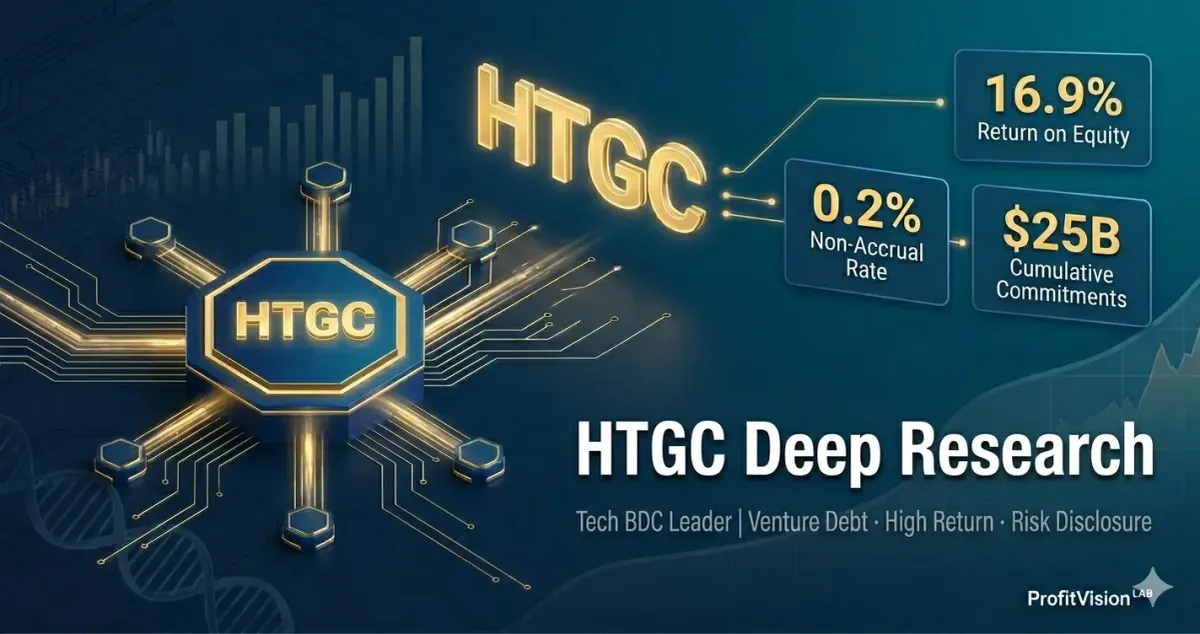
This makes HTGC an indispensable capital relay station in the Silicon Valley ecosystem — a role that generalist BDCs like ARCC structurally cannot fill. As of end-2025, HTGC has crossed the $25 billion milestone in cumulative debt commitments.
ARCC: Mid-market companies with $10M–$250M EBITDA, typically PE-sponsored, financially mature, already profitable.
HTGC: Growth-stage tech/biotech companies, VC-backed, often pre-profitability, scaling fast. Historical borrowers include pre-IPO Airbnb, Palantir, and hundreds of similar names.
| Income Source | % of Revenue | Notes |
|---|---|---|
| Floating-rate interest income | ~80% | SOFR + spread, typically 12–14% — higher than ARCC's ~10–11% |
| Origination & structuring fees | ~10% | Collected at loan closing |
| Warrant income | ~5% | Equity warrants attached to loans; monetized at IPO or acquisition |
| RIA subsidiary dividend | ~5% | Hercules Adviser LLC manages external funds; ~$2–2.5M/qtr flows back to HTGC |
The 12.8% effective yield is one of HTGC's most striking financial metrics — well above ARCC's ~10.3%. This reflects the natural risk premium of tech venture debt: borrowers carry lower credit ratings, so HTGC demands a higher rate as compensation.
The RIA subsidiary structure is HTGC-unique: Hercules Adviser LLC manages multiple external private funds and remits a portion of management fee income to HTGC as dividends each quarter. This makes HTGC's income more diversified than a pure BDC — a structural advantage.
HTGC's most distinctive feature is its two-tier dividend structure: base quarterly dividend plus a supplemental distribution. This mechanism directly affects your actual income calculations and requires careful understanding.
① It is not guaranteed. The $0.07 is a discretionary distribution based on excess earnings. HTGC can reduce or eliminate it in any given quarter. If NII compresses, the supplemental is the first line item cut.
② The 22-quarter record signals management confidence. Paying supplemental dividends for 22 consecutive quarters (~5.5 years) is a strong statement about earnings conviction. But 2026's legal cloud introduces a caveat to reading this signal at face value.
③ Use $0.40 for conservative analysis. When modeling HTGC's dividend safety, treat the $0.40 base as the reliable floor and the $0.07 supplemental as upside optionality — never count it as guaranteed income.
| Metric | Q1 2026 | Q4 2025 | Q1 2025 | Assessment |
|---|---|---|---|---|
| Total Investment Income | $141.5M | $137.3M | $119.6M | Record; +18.4% YoY |
| Core Investment Income | $134.9M | $133.3M | $115.5M | Also record; +16.8% YoY |
| NII / Share | $0.48 | $0.48 | $0.43 | +13.8% YoY; 120% coverage |
| Quarterly Dividend | $0.47 | $0.47 | $0.47 | Consistently maintained |
| NAV / Share | $11.90 | $12.13 | $11.66 | Market valuation loss; YoY still positive |
| ROAE | 16.9% | 16.4% | 14.8% | Best-in-class |
| New Commitments | $1.81B | $1.06B | $1.02B | Record; +77.8% YoY |
| Non-Accrual (FV) | 0.2% | 0.2% | 0.4% | Among sector's lowest |
| Available Liquidity | $454.5M | Ample | — | Adequate for volatility |
HTGC's NAV is more volatile than ARCC's — from a 2022 peak of $13.34 it fell to $11.66 in 2024 before recovering. This reflects the tech market cycle's direct impact on HTGC's portfolio valuations. It's the price of specialization: higher rewards in up-cycles, more compression in down-cycles.
For a BDC lending to pre-profitability tech startups, maintaining a 0.2% non-accrual rate (fair value basis) is genuinely remarkable. It means HTGC's credit assessment and portfolio management capabilities substantially outperform what the borrower risk profile would suggest. Compare this to ARCC's 1.2% — HTGC's credit quality is actually tighter, despite lending to riskier companies on paper. This is HTGC's deepest moat.
| Metric | Current | Historical Range | Interpretation |
|---|---|---|---|
| Share Price (May 2026) | ~$16.15 | — | Significantly off 2025 highs post-lawsuit |
| NAV / Share | $11.90 | $10–13 | Q1 2026 reported |
| Price / NAV | 1.36x | 0.7x–1.9x | Significant premium, but mid-range historically |
| Annual Yield ($0.47×4) | 11.6% | — | On base $0.40 only: 9.9% |
| ROAE | 16.9% | 12–18% | Best-in-class; justifies premium |
| Premium Justification | ROAE 16.9% + Non-accrual 0.2% + venture ecosystem moat = premium defensible, but lawsuit is an unpriced new variable | ||
Current Status: Multiple securities class action lawsuits were filed against HTGC in March–May 2026. The lead plaintiff deadline is May 19, 2026.
Allegations: The lawsuits follow Hunterbrook Media's investigative report "The Myth of Hercules Capital," which alleges:
① HTGC's deal sourcing process copies materials published on Google Ventures' public website — not a proprietary capability as claimed
② Certain investment marks were misstated
③ Incomplete disclosure of PIK loan exposure
Class Period: Investors who purchased HTGC between May 1, 2025 and February 27, 2026 are within the class definition.
Market Impact: HTGC's share price fell from ~$22 (2025 high) to ~$16 currently — more than 20% market cap erosion since the report surfaced.
Securities class actions are a common tool in U.S. markets and do not automatically imply management wrongdoing. However, several dimensions require sustained attention:
Short term: Legal proceedings formally begin after the lead plaintiff deadline (May 19). These cases typically take 2–4 years to resolve. Management has not publicly responded to the substantive allegations.
Medium term: If the court finds merit, HTGC may face settlement costs (historically 3–10% of alleged investor losses) or stricter disclosure requirements. The more serious scenario: if the allegations are proven true, HTGC's differentiation moat may be thinner than the market assumed.
Positioning guidance: Keep HTGC at no more than 5% of portfolio until the lawsuit reaches a clearer outcome. Do not build a large position while the core differentiation claim remains under legal challenge.
| Topic | Management Statement | Shiba's Read |
|---|---|---|
| Record originations | $1.81B in new commitments, +77.8% YoY — highest in company history | ✓ Business momentum strong; moat still functioning |
| NAV decline explanation | Primarily broad-based market yield increases causing valuation adjustments — not credit | ✓ Mark-to-market, not fundamental impairment |
| 12.8% effective yield | Maintained at best-in-class levels, reflecting tech venture debt's natural rate premium | ✓ Income quality sustained |
| RIA expansion | ~$2–2.5M quarterly dividend from adviser subsidiary expected to continue | ✓ Income diversification on track |
| Leadership transition | CFO Seth Meyer becoming President May 18 — internal promotion, management continuity | Neutral; positive for succession planning |
| Lawsuit | Management declined to comment on the substantive merits of the litigation | ⚠️ Silence is itself a data point — monitor closely |
CEO Scott Bluestein concluded: "We have started 2026 with record-setting momentum, delivering all-time highs in originations and total investment income while navigating meaningful market volatility."
The subtext: the fundamentals are strong — but management deliberately avoided addressing the lawsuit. A confident management team with nothing to hide would answer the allegations directly. This silence is not neutral information.
| Year | HTGC Total Return (DRIP) | Year-End NAV/Share | Annual Dividend/Share |
|---|---|---|---|
| 2016 | +13.8% | $10.38 | $1.24 |
| 2017 | +18.2% | $11.02 | $1.24 |
| 2018 | −5.1% | $11.14 | $1.24 |
| 2019 | +36.4% | $12.61 | $1.24 |
| 2020 | +5.2% | $10.83 | $1.20 |
| 2021 | +24.8% | $12.43 | $1.32 |
| 2022 | −5.8% | $13.34 | $1.44 |
| 2023 | +46.1% | $13.20 | $1.68 |
| 2024 | −3.2% | $11.66 | $1.88 |
| 2025 | +8.4% | $12.13 | $1.88 |
| 10-Year CAGR | ~15.6% | $10.38 → $12.13 | $1.24 → $1.88 |
Financial history contains a brutal recurring pattern: the most exceptional institutions are sometimes destroyed by the most exceptional people. Michael Milken's junk bond empire, Bill Gross's PIMCO legend, Bernie Madoff's perfect lie — every story began with "this person is the best in the business," and ended differently.
Scott Bluestein is genuinely among the best in tech venture lending. That is precisely why he is both HTGC's deepest moat and the variable that demands the most scrutiny.
Century-spanning institutions: Vanguard (John Bogle's philosophy fully institutionalized), Berkshire Hathaway (Buffett deliberately built a culture that transcends the individual). Common thread: founders actively codified their values into the institution rather than letting it depend on personal charisma.
Founder-dependent failures: PIMCO (performance diverged sharply after Bill Gross's departure), Drexel Burnham Lambert (disappeared after Milken's downfall). Common thread: core knowledge and relationships concentrated in a single individual; not transferable to the institution.
Integrity collapses: Lehman Brothers, Enron, Madoff. Initially outstanding performance. But management's moral boundaries were invisible — and when they broke, the collapse was non-linear and instantaneous.
| Dimension | Positive Assessment | Watch Area |
|---|---|---|
| Scott Bluestein tenure | 15+ years; one of sector's longest-serving CEOs. Deep, stable tech lending expertise. | Over-reliance on a single CEO's knowledge and relationships. Succession plan not clearly articulated. |
| Institutionalization depth | RIA subsidiary, multiple external funds — suggests platform breadth beyond one person. | Core credit decisions still made by CEO/CIO. Knowledge transfer pathway opaque. |
| Integrity track record | 15 years of 0.2% non-accrual. No surprise dividend cuts. Consistent performance delivery. | Lawsuit alleges management misled investors. Management has not publicly refuted the substance. |
| Management ownership | Bluestein holds HTGC shares — some alignment with shareholders. | Stake is small relative to HTGC's total market cap. Personal wealth not primarily HTGC-dependent. |
| Near-term fatal risk | Low. HTGC's financial health is strong. Bluestein's near-term departure or the lawsuit's initial phase alone is insufficient to destabilize dividends or operations. | |
① Is the institution better while this person is there?
For HTGC: yes. Bluestein's 15 years of tech lending knowledge and VC relationships are the core of HTGC's current competitive position.
② Can the institution operate after this person leaves?
Currently uncertain. Meyer's promotion to President is a positive signal, but no public succession plan or knowledge transfer roadmap exists.
③ Does this person treat the institution as a lifelong mission or as a vehicle?
This is the most important moral question. People with integrity build century-long institutions; people without principle hollow out companies from the inside. Fifteen years of a clean record gives Bluestein an initial presumption of integrity — but the lawsuit has introduced a crack in that presumption that requires validation.
Financial history tells us: integrity is the foundation of the moat; financial metrics are just the building above it. You can renovate or rebuild a building; but if the foundation is compromised, the fate of the entire structure is already written. HTGC's foundation currently remains the basis for my initial trust in Bluestein — 15 years without a major credit event, 0.2% non-accrual, dividends never silently cut. These are not meaningless numbers.
But the lawsuit is a mirror — it gives us the opportunity to re-examine this institution at higher magnification. Sustained observation, not excessive trust, and not premature condemnation, is the correct posture toward a personalized institution.
The $0.07 supplemental is discretionary — theoretically reducible or eliminated in any quarter without notice. The 22-consecutive-quarter record is a strong signal of management confidence, but it is not a legal commitment. If NII compresses, the supplemental is the first item at risk.
The $0.40 base dividend is considerably safer. Q1 2026 NII of $0.48 covers the $0.47 total payout at 120%. For the base to be cut, NII would need to fall sustainably below $0.40 — a high threshold requiring a significant deterioration in the portfolio or interest rate environment. Conservative modeling: use $0.40 as your safety floor, treat $0.07 as upside optionality.
Not directly, at present. Securities class actions target management's disclosure conduct toward investors — they do not restrict HTGC's lending operations. Q1's record $1.81B in new commitments confirms the lawsuit has not yet impaired deal flow.
Potential indirect effects: legal costs eroding profitability, management attention diverted, and reputational risk if certain VCs or founders become reluctant to work with HTGC. Monitor subsequent quarters' origination figures as the clearest leading indicator of business impact.
The premium has rational support: HTGC's ROAE of 16.9% consistently leads the sector, its non-accrual of 0.2% is exceptional, and its tech venture ecosystem moat is genuinely hard to replicate. Historically, the market has priced these qualities at a premium (0.7x–1.9x range, most frequently 1.2–1.6x).
The 2026 lawsuit introduces a new pricing variable: if the market begins to question whether HTGC's differentiation is real or overstated, the premium compresses rapidly. From 1.36x to 1.0x NAV implies a stock price of ~$11.90 — roughly a 26% downside from current levels. This risk cannot be ignored while the lawsuit remains unresolved.
This is the most consistently surprising aspect of HTGC. Three structural factors explain it:
① VC-backing as implicit guarantee. HTGC primarily lends to VC-backed companies. If a borrower hits trouble, the VC has strong incentives to inject capital and prevent a default — because a default damages the VC's reputation and portfolio valuations.
② Loan structures include warrant protection. Borrowers hold equity warrants in HTGC's loans, creating incentives to maintain the lender relationship and avoid default.
③ 20 years of proprietary credit knowledge. HTGC's tech and biotech credit assessment capability is the accumulated product of thousands of loans over two decades. This institutional knowledge is not replicable by a generalist lender — which is why the Hunterbrook allegation (that the sourcing process merely copies Google Ventures' website) is so damaging to HTGC's narrative, if true.
Before the lawsuit resolves, the recommended structure is ARCC as primary anchor, HTGC as a smaller satellite position.
Reference allocation logic: if total BDC exposure is 10% of portfolio, consider ARCC 7% + HTGC 3%. ARCC provides the stable cash flow foundation; HTGC delivers outperformance when tech venture cycles are favorable. Their price correlation is approximately 0.51 — meaningful diversification.
If you have zero tolerance for lawsuit-related uncertainty, hold ARCC only and revisit HTGC once legal proceedings reach a clearer outcome. This is not a permanent exclusion — it's disciplined waiting.
HTGC: The Highest-Return BDC — and the One Requiring the Most Discipline Right Now
HTGC's 10-year CAGR of 15.6%, ROAE of 16.9%, and non-accrual of 0.2% are sector-leading numbers. Scott Bluestein's 15 years of specialized tech lending expertise are the most authentic source of HTGC's moat. But a person is both the moat and the tail risk — financial history's most exceptional institutions have sometimes been brought down by their most exceptional individuals. The lawsuit is a mirror: it asks us to re-examine whether what HTGC built is as described. Near-term, there is no fatal risk. Long-term, integrity is the foundation of every lasting institution; principle is the only guarantee that a moat endures. Conditional approval: maintain a small position (3–5% of portfolio). Expand after the lawsuit clarifies and management integrity receives renewed confirmation. Not a permanent rejection — disciplined waiting.
- Published #1 BDC Overview: Complete Guide for Taiwan Investors
- Published #2 ARCC Deep Research: Moat, Resilience & 10-Year Track Record
- This Article #3 HTGC Deep Research: Tech BDC Leader — High Returns, Real Risks, and the Man Behind It All
- Coming #4 BDC ETF Landscape: BIZD vs. Direct Holdings Decision Framework
- Advanced #5 BDC Covered Call: ARCC × HTGC Complete Strategy (Margin & Cost-to-Zero)
ProfitVision LAB · Shiba the Disciplined · "I teach you how to think, not just what to trade."

Comments ()